

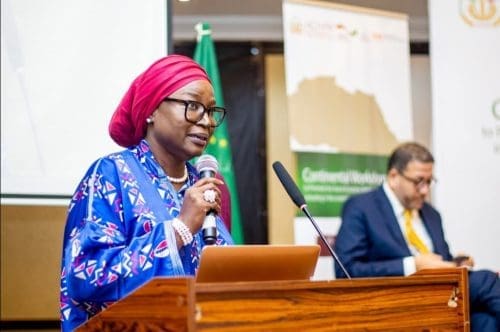
Economic systems that exclude or disempower women represent exploitation rather than genuine progress, according to a senior African Union official who challenged policymakers to confront structural inequalities affecting millions across the continent.
Hon. Janet Ramatoulie Sallah Njie, Vice-Chairperson of the African Commission on Human and Peoples’ Rights (ACHPR), delivered the stark assessment at a continental workshop in Accra examining women’s socio-economic rights, particularly in communities affected by extractive industries.
“Development that undermines the rights and dignity of women is not development—it is exploitation,” Sallah Njie stated at the opening of the two-day gathering held September 25-26, 2025. Her remarks set a confrontational tone for discussions about persistent gender inequalities across Africa’s mining, oil, and gas sectors.
Sallah Njie, who also serves as the African Union’s Special Rapporteur on the Rights of Women in Africa, criticized the continued lack of access to education, healthcare, employment, and protection for millions of African women and girls. She warned that the continent cannot build its economic future on systems that devalue women’s lives.
“We cannot continue to hide behind the principle of ‘progressive realization’ while women are denied their right to live and parent with dignity,” she emphasized, referencing language often used by governments to justify delayed implementation of social and economic rights.
The workshop, themed “Promoting the Socio-Economic Rights of Women, including in the Extractive Industries,” was organized by ACHPR in partnership with IPAS Africa Alliance and GIZ’s AWARE Project. It brought together AU organs, national governments, international development partners, and grassroots organizations.
Hon. Medford Zachariah Mwandenga, ACHPR Commissioner and Chairperson of its Working Group on Economic, Social, and Cultural Rights, noted that despite comprising over half of Africa’s population, women remain disproportionately affected by poverty, discrimination, and systemic exclusion.
“Women continue to face entrenched socio-economic inequalities driven by discriminatory gender norms, limited access to education, health, and social protection, and exclusion from decision-making spaces,” he said.
Mwandenga expressed concern over poor ratification and implementation of key AU legal instruments—particularly the Maputo Protocol and the Protocol on Social Protection. “This gap is especially stark in the extractive industries, where women face systemic exploitation, unsafe conditions, exclusion from compensation and governance mechanisms, and heightened vulnerability to environmental harms,” he observed.
Sallah Njie argued that while extractive industries are central to many African economies, they too often operate at the expense of women’s rights, environmental justice, and community well-being. “Large-scale projects disrupt communities and expose women to heightened risks of exploitation, while excluding them from benefit-sharing and decision-making,” she said.
She further contended that reproductive justice must be seen as a core component of economic justice, calling for full ratification and implementation of both the Maputo Protocol and the AU Convention on Ending Violence Against Women and Girls, which remains stalled due to insufficient signatures.
Representing Ghana’s Ministry of Gender, Children and Social Protection, Madam Faustina Acheampong reaffirmed the country’s commitment to removing barriers hindering women’s full participation in development. She highlighted passage of the Affirmative Action (Gender Equity) Act, 2024 and ongoing review of the National Gender Policy as significant advances.
Acheampong also spotlighted social protection interventions including the Livelihood Empowerment Against Poverty (LEAP) programme and planned establishment of a Women’s Development Bank to enhance credit access for women entrepreneurs.
Sophia Gallina, Head of the GIZ AWARE Project at the African Union, stressed that addressing gender disparities in extractive industries represents both a rights issue and a developmental priority. “Unless we act boldly, women will remain excluded from economic growth and the green transition,” she warned.
Mr. Erick Mundia, Programme Officer at IPAS Africa Alliance, called attention to environmental and health consequences of extractive activities. He noted that polluted air, contaminated water, and toxic soil in extraction zones have direct and long-term impacts on maternal health, child development, and reproductive outcomes.
“Women must not only be protected they must be recognized as rights holders and agents of change,” Mundia said, urging adoption of inclusive frameworks centering reproductive justice, environmental safety, and economic inclusion.
The workshop occurred within the context of continental frameworks including Agenda 2063, the African Social Policy Framework, and the Africa Health Strategy (2016–2030) all emphasizing inclusive, gender-responsive development. However, participants agreed that despite progressive policies, implementation at the national level remains weak and inconsistent.
Panel discussions explored interconnected dimensions of sexual and reproductive health rights, environmental governance, and corporate accountability. Women from mining, oil, and gas sectors shared experiences of exclusion, abuse, resilience, and activism that underscored the urgency of change.
In closing remarks, Sallah Njie called for bold political leadership, dedicated resources, and accountability mechanisms ensuring women’s rights are enforced in practice, not merely protected on paper. “The rights exist on paper but where are the budgets? Where are the enforcement mechanisms?” she asked. “We must stop treating women’s rights as optional. They are a legal and moral obligation.”

