

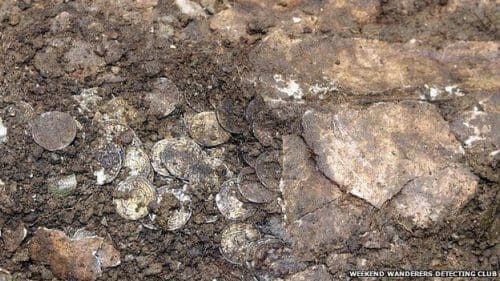
Paul Coleman from the Weekend Wanderers Detecting Club discovered more than 5,000 coins buried inside a lead bucket two feet under a field near Aylesbury.

The hoard contains specimens dating back to the 11th Century ? the late Anglo Saxon, early Norman period.
The coins will now be examined by the British Museum.
Mr Coleman, from Southampton, was taking part in a dig in the Padbury area on 21 December when he found the 5,251 coins depicting the heads of kings Ethelred the Unready and Canute.
A spokesman for the national club said those on the dig had ?agreed this was the most exciting day of their detecting lives?.
?Without a doubt this is the best find ever made in the Weekend Wanderers Detecting Club?s 25-year history,? he said.
?Dream? find
Peter Welch, who was at the dig, said Mr Coleman had seen some fragments of lead, picked off the top one and saw the ?layers of coins?.
?He didn?t touch them, he knew it was important,? he said.
Mr Welch, who was immediately notified, said he was ?shellshocked? when he realised ?it was real?.
?There was general silence and a sharp intake of breath of the people watching,? he said.
?This is something you dream of witnessing, let along digging up.
?They looked almost uncirculated, like they were straight from a mint.?
The old Buckingham mint would have been within a day?s walking distance so a possible link with that will be explored, he said.
The coins have been taken to the British Museum and a coroner must now rule if they are ?treasure? under the Treasure Act.
A museum could then buy them with the proceeds being split between the landowner and the finder.
The largest UK hoard of Anglo Saxon treasure was found in a field near Lichfield in Staffordshire in July 2009, by metal detector enthusiast Terry Herbert.
The 7th Century hoard of 1,600 items including sword pommels, helmet parts and processional crosses was valued at ?3.285m.
Source: BBC

