

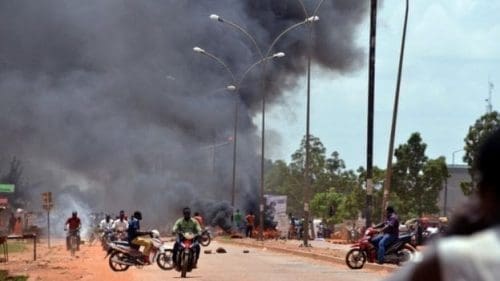
Gen. Gilbert Diendere, who led a coup aimed at derailing upcoming
elections in Burkina Faso, was arrested in the capital of Ouagadougou
on September 30.

Earlier reports suggested that he had gone to the Vatican
representative?s residence in the capital of the impoverished and
underdeveloped West African state. The coup was designed to derail the
national elections which were scheduled for October 11.
The 1,200 presidential security regiment (RSP) had refused to disarm
even after an agreement had been reached through negotiations mediated
by the regional Economic Community of West African States (ECOWAS).
Broader elements within the Burkinabe military had entered the capital
threatening to disarm the RSP by force if they did not return to the
barracks.
Diendere was quoted by the Associated Press as saying “I am willing to
turn myself over to face justice. I would like the people of Burkina
Faso to find a solution to this crisis through dialogue. All parties
must talk to find an inclusive solution for the future of the
country.”
Due to the political crisis the elections were postponed to a later date.
A national uprising against the dictatorial rule of ousted military
leader turned head-of-state, Blaise Compoare, during late October
2014, created the conditions for the formation of an interim
government. Michel Kafando and Isaac Zida were appointed as temporary
president and prime minister respectively after intensive
negotiations.
Hundreds of thousands of workers and youth took to the streets
demanding an end to the 27-year rule of Compaore. The leader soon fled
to neighboring Ivory Coast where he has close political and family
ties.
In order to calm the October 2014 revolt, military and political
forces agreed to hold internationally-supervised elections one year
later. A coalition of parties claiming the political legacy of
revolutionary socialist leader Capt. Thomas Sankara pledged to run as
a bloc during the elections.
Both Kafando, a career diplomat, and Zida, a former military official,
were placed under detention at the beginning of the coup on September
16. Kafando and Zida were eventually released and have returned to
their positions.
Diendere was a longtime intelligence director for the 1,200-member
elite presidential security regiment (RSP) which worked closely with
French and United States imperialism. The coup was probably
precipitated by the concern that the RSP would be disbanded leading to
possible prosecutions of members of the unit which have committed
crimes against the people of the country.
In addition, political parties allied with Compaore were barred from
participating in the national elections. The former rulers are seeking
to secure a future in the soon to be new political dispensation.
Mass demonstrations, international pressure and dissent within the
broader military forces converged to force Diendere to surrender on
October 1 after refusing to disarm for several days in the wake of a
brokered agreement by the Economic Community of West African States
(ECOWAS).
Interim Leaders Pledge to Continue Transition Process
After being the first of the two interim leaders to be released,
President Kafando traveled to New York City to participate in the 70th
United Nations General Assembly.
Kafondo addressed the international gathering saying ?The transition I
am leading is the result of a popular uprising in October 2014. It is
a response to the arbitrariness, nepotism and injustice of an
anti-democratic regime.? (UN News Center, October 2)
He expressed his greater appreciation of the notions of liberty noting
?As I was deprived of this for a time, I know how precious it is.?
Just two weeks prior to his address at the UN, he had been arrested by
members of the RSP whom he described as ?praetorians of another time
who were rowing against the current of history and trying to seize
democracy to serve their sordid ambitions.?
The interim president continued stressing that ?It is thanks to you,
defenders of [liberty and democracy], that I speak freely today.? His
speech denounced as ?heinous? the September 16 coup staged by military
officers who Kafando said were ?bought by vengeful politicians? to
influence political developments leading up to the previously
scheduled elections.
RSP Officially Disbanded Amid Calls for Retribution
Burkinabe Confederation of Labor leaders are demanding that Diendere
be put on trial for the coup as well as other crimes such as
involvement in the assassination and overthrow of Capt. Thomas
Sankara, the revolutionary leader who ruled the country during
1983-1987.
The labor federation, which represents 17 unions, had staged a general
strike in opposition to the coup. Their efforts were instrumental in
bringing the RSP to the negotiating table with the ECOWAS mediators.
Secretary General of the Confederation of Labor, Bazie Bassolma,
outlined what he thought was the proper course to take in bringing the
coup makers to justice. Bazie said ?There are many, many, many things.
The first thing is that we have found his name in many problems in our
country. We also know that at this moment there are many bodies in our
hospitals. So we need to try him to get justice for our people.? (VOA,
October 1)
News reports said that at least 10 people were killed in the recent
struggle against the RSP coup while many others were wounded and
injured.
Bassolma went on to say also that ?It is not only Thomas Sankara;
there are others like Dabo Bokari and Charles Taylor in Liberia and
Angola. His name is found on many, many problems his name was found.
We cannot accept that terrorists killed many people and now want to
get amnesty. We will not accept.?
The labor leader appealed to the Burkinabe people from across the
county saying ?You know the solution to our problem is not in
elections. If we are not organized, if we are not mobilize it would be
difficult to find solution to our problems.?
He also expressed his gratification to the people throughout the
continent stressing that ?The first thing is to thank our brothers and
sisters in other countries who helped us in this difficult situation.
We are fighting for democracy in Burkina Faso but also for Africa and
the world.?
Unrest Reflects Growing Economic Crisis
Despite the positive reports about the phenomenal growth of African
economies, countries like Burkina Faso have not been able to translate
the escalation of foreign direct investment (FDI) into better living
standards for workers, farmers and youth. Burkina Faso is the fourth
largest producer of gold in Africa but remains one of the poorest
countries in the world.
Even leading exponents of FDI such as Mo Ibrahim, a wealthy African
businessman, said recently that he is concerned about the immediate
prospects for growth and development on the continent considering the
precipitous decline in oil and other commodity prices.
In an interview published by the Wall Street Journal on October 5,
Ibrahim said ?Things are stalling. We can?t pat ourselves on the back
and pretend everything is hunky-dory. It?s not.?
This same Wall Street Journal article noted ?An annual index of
economic, political and developmental indicators compiled by Mr.
Ibrahim?s philanthropic foundation and released Monday (October 5)
showed that the security and business environment in many of Africa?s
54 nations isn?t improving as rapidly as a decade ago, when the
continent was hailed as the next great global economic frontier.
This year?s rating of 50.1 on a 100-point scale, while up from 46.5 when
the index was first issued in 2000, is down from a peak of 50.4 in
2010. Under the Ibrahim Index of African Governance 100 represents a
prosperous, democratic utopia.?
By Abayomi Azikiwe
Editor, Pan-African News Wire

