

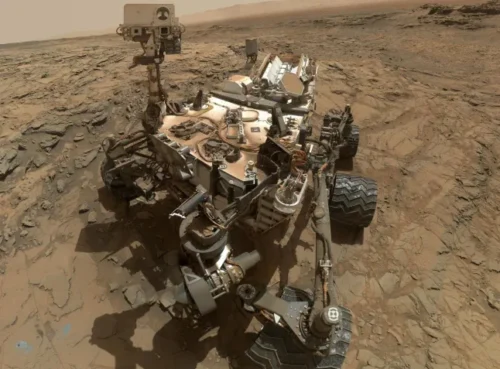
The newest “postcard” from Mars is not a single photograph. NASA built it from two black-and-white panoramas that its Curiosity rover shot three Martian days apart, and then tinted by hand.
The US space agency released the image on 16 September 2026 to mark Curiosity’s 5,000th sol, or Martian day, on the planet. For a car-sized robot that landed in Gale Crater in August 2012 and was originally expected to work for about two years, that is a long run of service.
Curiosity took both panoramas with its navigation cameras while it was parked at a sand ridge the mission team nicknamed “Chocolatal”. The first was shot at 9:56 a.m. local Mars time on 30 August, the rover’s 5,000th sol. The second followed at 5:39 p.m. on 2 September, sol 5,003. Engineers on Earth then merged the two frames and added colour as an artistic interpretation: blue for the morning scene and yellow for the afternoon.
What the picture shows
The rover’s own deck fills the foreground. Two pieces of hardware stand out. One is its can-shaped UHF antenna, which relays data to spacecraft orbiting Mars. The other is the finned Multi-Mission Radioisotope Thermoelectric Generator at the back, a nuclear power source that has kept Curiosity running through thousands of dust-laden Martian days. Behind it, the rover’s tracks trail off towards the floor of Gale Crater.
Curiosity is working its way up the foothills of Mount Sharp, a peak rising about 5 kilometres (3 miles) above the crater floor. The crater itself is roughly 154 kilometres (96 miles) wide.
Why a sol is not a day
A Martian sol lasts 24 hours, 39 minutes and 35 seconds. That makes it about 2.75 per cent longer than a day on Earth, so the rover’s calendar drifts steadily out of step with ours. Its 5,000 sols add up to a little more than 5,130 Earth days.
A familiar format
NASA has made similar two-tone postcards before, including one in November 2021 and another from panoramas taken on 8 April 2023. The 2023 version was shot in the Martian winter, when shadows are sharper and deeper because there is less dust in the air.
Curiosity launched in 2011 to test whether Mars ever had conditions that could support microbial life. NASA’s Jet Propulsion Laboratory, which is managed by the California Institute of Technology (Caltech) in Pasadena, California, built the rover and leads the mission.
This year, the rover also studied a field of honeycomb-shaped polygons at a site called “Valle Grande”, where carbon-based molecules were reported.

