

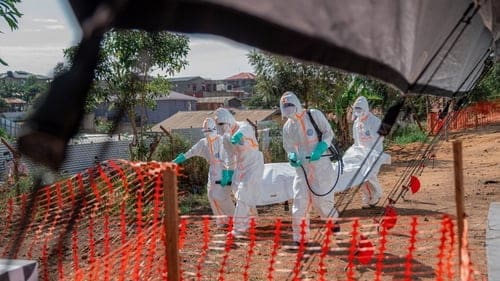
The Bundibugyo Ebola outbreak in the Democratic Republic of Congo has passed 8,000 confirmed cases, and two health researchers argue that Africa’s slow response has an economic cause: years of neglected research spending.
The US Centers for Disease Control and Prevention calls it the second-largest Ebola outbreak on record, spreading faster than any before it. By 26 September, Congo had confirmed 8,067 cases and 3,901 deaths, according to the European Centre for Disease Prevention and Control. Uganda recorded 20 cases and two deaths before declaring its outbreak over.
Writing on 28 September for Economist Enterprise’s Health Dividend platform, Andrew Tuttle, Chief Executive of Global Health Ecosystems, and Dr Mosoka Fallah, Deputy Director of Research, Clinical Trials and Innovation at Africa Centres for Disease Control and Prevention (Africa CDC), argue that governments should treat health research as an investment in growth rather than a health budget line. They estimate the returns in the hundreds of billions of dollars.
What the model claims
The authors draw on a study that Global Health Ecosystems carried out for Africa CDC. Suppose African governments met the African Union’s long-standing target of spending 1 per cent of gross domestic product (GDP) on research and development, with 15 per cent of that going to health. The model projects an extra US$668 billion in GDP over 20 years.
On their figures, every dollar invested returns US$137 in economic value, and each dollar of public money draws in about US$5 of private capital. The spending would pay for itself within four years and support more than 4.5 million skilled jobs. The authors stress that these returns cover economic output only, not lives saved or outbreaks prevented.
The gap to that target is wide. A 2018 policy brief from the UN Economic Commission for Africa put the continent’s research spending at about 0.5 per cent of GDP, against a world average of 2.2 per cent.
Where the money goes now
Africa carries about a quarter of the world’s disease burden but produces less than 1 per cent of the research behind new vaccines, diagnostics and treatments, the authors write. Citing Impact Global Health, they note that high-income governments spent US$71 billion on global health research between 2007 and 2023, and 90 per cent of it stayed in high-income countries.
The cost of being unprepared is well documented. The World Bank estimated that the 2014-16 West African Ebola epidemic wiped US$2.2 billion off the combined GDP of Guinea, Liberia and Sierra Leone in 2015 alone. A 2018 peer-reviewed study put the outbreak’s total economic and social burden at more than US$53 billion.
The authors point to cases where local capability has paid off. In 2025, Ugandan scientists confirmed an Ebola outbreak and produced preliminary whole-genome sequencing within 24 hours, working with South African researchers. Egypt combined a national treatment programme with regulatory capacity and locally made generic drugs. That brought the cost of a three-month hepatitis C course down to about US$58, and it has treated more than 4.1 million people with a reported cure rate of 98.5 per cent. South Africa’s Afrigen Biologics has built research capacity in mRNA vaccines.
Their conclusion is that countries rarely build competitive drug industries before they build scientific depth. “Manufacturing follows capability,” they write.
The caveats
The figures are projections from a model, not observed results. The modelling was carried out by Tuttle’s own organisation, and Enabel, the Belgian development agency, funded the study through the African Union and European Union health partnership.
The current outbreak shows what is at stake. The authors say laboratories, trained researchers, trial networks and regulators cannot be built once a virus is spreading. They are urging finance ministers and parliamentarians, not just health ministries, to put the 1 per cent commitment at the centre of national development plans.

