

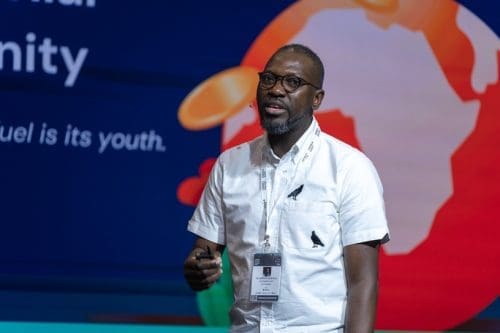
Speaking at back-to-back financial technology conferences in Saudi Arabia’s capital, Flutterwave founder and chief executive Olugbenga “GB” Agboola laid out an ambitious vision for making stablecoins central to how Africans send and receive money. His message at Money 20/20 Middle East and the Fluidity 2025 summit wasn’t about distant possibilities—it was about infrastructure already being built.
Agboola’s conviction stems from watching Africa’s youth reshape global finance. During a presentation exploring the continent’s fintech opportunities, he described young Africans as natural innovators who don’t wait for permission to adopt new technologies. That pattern, he argued, explains why mobile money transactions across Africa exceeded one trillion dollars in 2024, with much of that growth driven by people under 35.
Now those same demographics are turning to stablecoins, and Nigeria is leading the charge. South Africa, Ethiopia, and Kenya aren’t far behind. For Agboola, this isn’t surprising it’s the logical progression of how payments evolve when traditional banking infrastructure can’t keep pace with demand.
What makes Flutterwave’s approach noteworthy is how quickly the company is moving beyond theory. Earlier this year, Flutterwave joined Circle’s Payments Network, an alliance designed to make cross-border transactions faster and cheaper using USDC, the stablecoin issued by Circle Internet Group. The company has also partnered with Global Remit to handle stablecoin conversions, tackling one of the practical headaches that slows adoption getting digital currencies in and out of local banking systems.
During his Riyadh appearances, Agboola previewed new features coming to Flutterwave’s dashboard and its Send App, both designed to make stablecoin transactions feel as routine as traditional transfers. He’s describing what he calls “Africa’s largest infrastructure for tomorrow’s money,” though the real test will be whether businesses and consumers actually find it more useful than what they’re using now.
The timing matters. Remittances remain a massive part of many African economies, but they’re expensive and slow through conventional channels. If stablecoins can genuinely cut costs and speed things up without adding complexity that scares off non-technical users they could reshape how millions of people manage their money.
Agboola also participated in discussions about the Group of 20’s (G20) targets for improving cross-border payments, alongside a panel moderated by Nicole Valentine from the Milken Institute. His consistent theme was that financial innovation works best when it reaches everyone, not just those already comfortable with technology.
There’s still plenty that could go wrong. Regulatory uncertainty around cryptocurrencies and stablecoins remains high across many African countries. Questions about consumer protection, volatility risks (even with stablecoins pegged to traditional currencies), and technical literacy haven’t been fully answered. But Flutterwave’s bet is clear: the next generation of African payments will run on stablecoins, and they’re building the pipes to make that happen.
For a continent where vast distances, multiple currencies, and limited banking infrastructure have always complicated commerce, stablecoins offer something genuinely different. Whether Agboola’s vision becomes reality depends on execution and on whether Africa’s youth continue embracing new financial tools as enthusiastically as they have in the past.

