

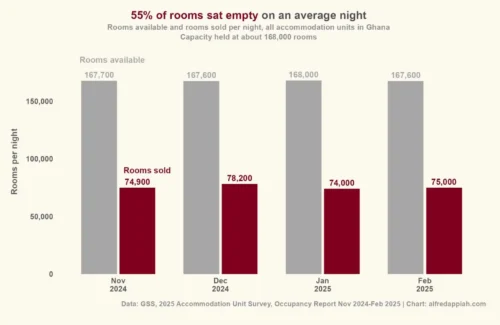
Close to 92,000 of Ghana’s roughly 168,000 accommodation rooms went unsold on an average night between November 2024 and February 2025, Ghana Statistical Service (GSS) data shows.
The figure follows from a national occupancy rate of about 45% across hotels, guest houses, hostels and unlicensed lodgings in the first four months of the GSS’s first Accommodation Unit Survey. It matters to anyone financing a new hotel, and to a sector that the Ministry of Tourism, Arts and Culture has projected could become the country’s third-largest foreign exchange earner by 2027, with accommodation making up 30% of tourist spending.
Where the rooms fill
Demand splits sharply by type of lodging. Standard hostels ran at about 98% occupancy, according to The High Street Journal, which first reported the analysis. Three- to five-star hotels filled about 43% of their rooms, while guest houses and one-star hotels managed roughly a third.
Hotels hold about 70% of the country’s room capacity, yet averaged around 40% occupancy. One-star hotels dropped to 28% in February 2025. Most of the empty stock, in other words, sits in the hotel segment.
The regional spread is uneven. Only the Central, Savannah, Ashanti and Western regions beat the national average. Greater Accra, the largest market and the main hub for business travel and events, recorded about 43%. In the Eastern, Bono East and Volta regions, roughly three in four rooms went unsold.
The affordability argument
Policy and data analyst Alfred Appiah reads the gap as a problem of price rather than supply. If more than half of existing rooms stand empty, he argued in comments reported by The High Street Journal, the first question for policymakers is why they go unused, not how to add more.
The near-full hostels sit at the cheap end of the market, and Appiah says that points to demand for beds that ordinary travellers, workers and students can pay for. He urges investors to look at budget hotels, hostels and serviced rooms, and wants policymakers to examine taxation, land costs, planning rules and financing, all of which feed into room rates.
What the data does not yet show
Other parts of the same survey complicate a simple price story.
Size, for one. Establishments with 100 rooms or more sold between 83% and 86% of their rooms over the four months, while those with 90 to 99 rooms recorded just 10.2% in February 2025. Large properties, as a group, were not the ones struggling.
The guest mix is lopsided too. Domestic guests numbered between about 1.87 million and 2.17 million a month, against fewer than 40,000 foreign guests. Hostels alone took in 934,157 domestic guests in January 2025. Hotels drew most foreign visitors, who stayed three to four nights on average, compared with about two nights for domestic hotel guests.
The occupancy figures do not measure price directly. The link between empty rooms and room rates is Appiah’s interpretation, not a finding the survey has published. Four months of data also cannot show whether hostel demand holds through a full year.
The survey fills a long-standing gap. It sampled 1,077 of the 9,602 accommodation units on record, and covers licensed and unlicensed operators in all 261 districts across the 16 regions. An earlier Ghana Tourism Authority exercise had recorded only 550 licensed units among those 9,602.
GSS said at the survey’s launch in October 2024 that it would gather revenue trends, capacity, occupancy, guest nights and room prices over 12 months to October 2025.

