Bono police arrest eight over alleged fraud initiation beating

0

Bono Regional Police have arrested eight men accused of beating a 21-year-old at Kotokrom, near Sunyani, in what police say the suspects called an initiation into internet fraud.

Officers from the Regional Operations Unit made the arrests on 4 October after a distress call at about 4.30pm reported that a group was attacking a man in the Sunyani West Municipality suburb, according to a police statement issued on 9 October.

The patrol team found the young man with several injuries from the assault and arrested the eight at the scene.

Police named them as Peter Mbam, 24; Godwin Moses, 26; Humble Oweifah, 18; Osas Ogbemudia, 30; Samuel Aisosa, 22; Ashile Godbess, 24; Alexander Uyuo, 30; and Patrick Romans, 25.

The suspects told investigators that the beating was part of an initiation they had themselves gone through before joining the fraud business, the police said.

The case points to a romance-style scam. Preliminary investigations suggest the group was brought to Ghana by a man they described as their “chairman”, according to the police. Members allegedly used photographs of foreign soldiers downloaded from the internet to pose as troops serving in Yemen, struck up online conversations with victims and then collected money from them. The money was paid into the account of the man described as their boss, the police said.

The police did not say how many people may have been defrauded, how much money was involved, or whether the alleged leader is in custody. They also did not say whether the eight have been charged or put before a court.

Online fraud, including romance scams, is the most common cybercrime reported in Ghana. The Cyber Security Authority has said online fraud caused GH¢12.87 million in losses between January and September 2025, accounting for 47 percent of the complaints it received. Total cybercrime losses in that period exceeded GH¢19 million, up about 17 percent on the same months of 2024.

The Bono Regional Police Command praised residents for acting quickly and said it would keep working with the public to fight crime in the region. The Cyber Security Authority takes fraud reports on its toll-free line, 292.

Pope Leo XIV to have surgery after lung nodule found

0

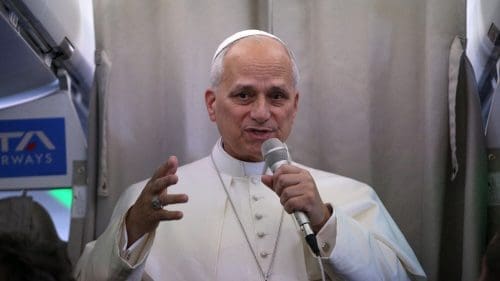
Pope Leo XIV will undergo surgery in Rome early next week after doctors found a nodule on his lung, he told pilgrims in St Peter’s Square on 11 October.

The announcement, made at the end of his Sunday Angelus prayer, is the first public health scare of a pontificate that began in May 2025. “The doctors found an early, well-localised nodule on my lung,” the 71-year-old said.

He said the growth had been picked up during a medical check-up, was contained and had been caught early. His doctors had advised that it was right to operate, and he had agreed. He thanked the faithful for their spiritual closeness and asked for their prayers.

The Pope did not say whether the nodule was cancerous, and the Vatican has not said so. A lung nodule is a small growth of tissue, usually found on a chest X-ray or CT scan, and most cause no symptoms.

Holy See Press Office spokesman Matteo Bruni said the operation was scheduled for the first days of next week and that recovery was expected to take about a week. Vatican News said it would take place at Rome’s Gemelli Hospital.

Gemelli has treated popes for decades. John Paul II had a benign intestinal tumour removed there in 1992, and Francis had colon surgery there in 2021 and hernia surgery in 2023. Francis, who had part of a lung removed at 21, also spent weeks at the hospital with double pneumonia in early 2025, shortly before his death that April.

Leo said his planned November visit to Uruguay, Argentina and Peru would go ahead. The Archbishop of Montevideo, Daniel Sturla, said preparations would continue with even greater enthusiasm and asked for prayers for the Pope’s recovery.

Messages of support came quickly. Italian Prime Minister Giorgia Meloni offered her personal solidarity, President Sergio Mattarella wished him a calm recovery and a full return to health, and Israeli President Isaac Herzog wished him a full and speedy recovery.

Born Robert Francis Prevost in Chicago, Leo is the 267th pope and the first from the United States. He was ordained in 1982 and spent years as a missionary in Peru, the country he is due to visit after his surgery.

Minority questions GH¢16.4m in South Africa evacuation records, seeks audit

0

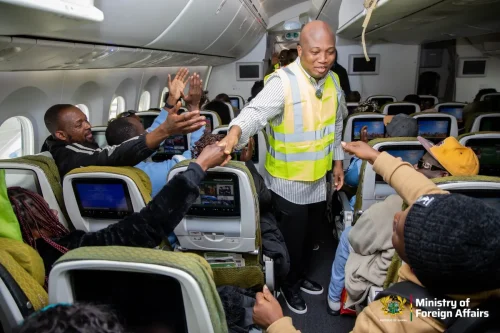
The Minority in Parliament says Foreign Affairs Ministry records do not support GH¢16.4 million of the GH¢49.7 million spent evacuating Ghanaians from South Africa, and wants an independent audit.

The figure comes from Nana Asafo-Adjei Ayeh, the Member of Parliament for Bosome-Freho and Deputy Ranking Member of Parliament’s Foreign Affairs Committee. He based it on a review of a report of more than 200 pages that the ministry supplied in response to his Right to Information request.

The Minority does not allege that money was stolen. Its case is that the ministry’s payment registers and flight records, as supplied, cannot be reconciled with the official count of 1,964 evacuees, and that the gap needs explaining.

The stakes go beyond one operation. The evacuation was unbudgeted, and the ministry has already asked the Auditor-General to examine every evacuation it has run since 2017. The Minority says an audit by a private firm would carry more weight.

How the money was spent

Foreign Affairs Minister Samuel Okudzeto Ablakwa announced the total of GH¢49,721,786 on 7 September, after an operation that ran from 27 May to 4 September and followed xenophobic attacks on foreign nationals in South Africa. The government paid GH¢33,721,786 and Engineers and Planners, a company owned by businessman Ibrahim Mahama, contributed GH¢16 million.

According to the ministry’s report, chartered flights cost GH¢27,183,700 and commercial tickets and layovers GH¢9,420,463.68. A further GH¢10.802 million covered a GH¢5,000 reintegration grant and a GH¢500 transport allowance for each of the 1,964 returnees.

What the Minority says it found

Ayeh said only 824 names appeared in the signed registers for both the reintegration grant and the transport allowance. Set against the official 1,964, that leaves 1,140 people whose combined GH¢5,500 payments, worth GH¢6.27 million, the Minority says the registers do not establish.

On flights, the Minority counted 926 passengers on chartered flights, which would leave 1,038 on commercial flights. It says the records it received evidence only 247 commercial passengers. Using an average ticket cost of about GH¢9,076, it values the travel of the remaining 791 people at about GH¢7.18 million.

Together, those two gaps come to GH¢13,449,116, about 27 percent of the total.

Duplicates and minors

The Minority also cited duplicate names in the reintegration register, the transport register and at least one flight manifest, along with blank and unsigned entries. Duplicate entries do not on their own show that anyone was paid twice, and the Minority is asking the ministry to establish whether they affected payments or the headcount.

It separately counted 442 minors among the 1,708 people listed in the reintegration register and asked how payments meant for children were made and recorded. If each child received the full package, that would come to GH¢2.431 million. Payments to minors are not in themselves improper, and the Minority has not said they were.

Adding its estimates for minors and duplicates, the Minority puts the total requiring explanation at GH¢16,423,470, about 33 percent of the bill.

The statement leaves some questions about its own method. It does not say whether any of the 442 minors are also among the 1,140 unmatched evacuees, which would mean some amounts are counted twice. Its closing demand also cites a different total, GH¢16,302,586, a difference of GH¢120,884 that it does not explain.

The ministry’s position

The ministry had not publicly responded to the latest findings by the time of publication. Ablakwa said when he announced the cost that the bill had been paid in full with no outstanding liabilities, and that the evacuation had not been budgeted for because it could not have been anticipated.

The Minority first demanded supporting records at a press conference on 10 September. “If the books are closed, then let’s open the books,” Ayeh said then. The caucus later boycotted a closed-door committee briefing by the minister. The committee’s chairman, Dr Alfred Okoe Vanderpuije, said at the time that Ablakwa was committed to giving the Minority whatever information it needed.

The Minority wants the audit carried out by Deloitte, KPMG, PricewaterhouseCoopers or Ernst & Young, or a firm of similar standing independent of the ministry and its contractors, with the results published. The ministry asked the Auditor-General on 17 September to conduct a special audit of all its evacuation exercises since 2017.

Stephanie Benson says only Majid Michel unsettled her husband

0

Singer Stephanie Benson says Majid Michel is the only man her husband, Jonathan, has been uneasy about, despite her sitting on the laps of other prominent men.

Benson made the remark on Okay FM’s drive-time show Ekwanso Dwoodwoo, where she appeared alongside the actor’s elder sister, Juliette Mills-Lutterodt.

It was Mills-Lutterodt who raised it, teasing Benson that Majid was the one man her husband did not want her sitting on.

Asked by host Nana Romeo to explain, Benson laughed and said only her husband could answer that. She said she had sat on the laps of other men, including billionaires, without any objection from him. “Majid was the only one that my husband said he felt some way about,” she said.

The exchange drew laughter in the studio and pointed to a long friendship between Benson and the Michel family.

Benson, a UK-based singer often described in Ghana as the queen of jazz, married Jonathan Benson, an Englishman, on 17 June 1989. The couple have five children, and she has said publicly that he is the only man she has ever been with.

Majid Michel, a winner of Best Actor at the 2012 Africa Movie Academy Awards, built his career on romantic leading roles in Ghanaian and Nigerian films before turning much of his attention to Christian ministry.

On the same programme, Mills-Lutterodt said her brother, the last of 11 children, had become the most successful of all the siblings.

Don Little says dwarves took him away as a child

0

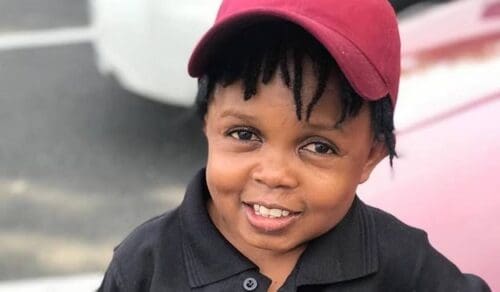
Kumawood actor Don Little says he was repeatedly taken away by dwarves as a small child in his father’s hometown, and believes the episodes affected his growth.

The actor, whose real name is Stephen Atanga, told the story on The Atuu Show, the celebrity chat programme hosted by Abeiku Santana on United Television (UTV).

He said his parents had been told to bring him to his father’s hometown for family customs. One day, he said, his mother put him to bed and stepped out briefly, only to return and find him gone. When she raised the alarm, people in the town told her dwarves had taken him and would bring him back, and they did, according to his account.

It did not stop there. “The dwarves would always come for me,” he said, adding that they took him to their land, played with him, fed him and returned him. The visits ended, he said, only after the family completed its customary rites and his mother moved him out of the town.

He said he was too young to understand what was happening. His parents later noticed he was not growing normally, and he said the time spent with the dwarves might explain it. As an older child, he added, he had episodes similar to sleepwalking in which he wandered unaware towards the edge of nearby forests.

Stories of forest dwarves carrying off children run deep in Ghanaian folklore. In Akan tradition they are known as mmoatia, short beings said to live in thick forest and to snatch people, especially children, using a whirlwind.

Short stature in people is generally linked by medicine to genetic or hormonal conditions. Don Little did not mention any medical diagnosis in the interview.

He has said he started acting in 2007, and his first television appearance was in comedian Funny Face’s series Cow and Chicken. He has since become one of the best-known faces in Kumawood films.

Majid Michel’s sister says youngest sibling became family’s biggest star

0

Actor-turned-evangelist Majid Michel was the youngest of 11 children and had the least of their father, yet outgrew all his siblings, his elder sister Juliette Mills-Lutterodt has said.

Speaking on Accra radio station Okay FM, Mills-Lutterodt said the small share Majid received as the last born had turned into the greatest return of any child in the family. “He became the biggest of all of us,” she said.

She said the public knew him mainly through his films, but that off screen he was grounded, spiritual, devoted to his family and an exceptional man.

Born on 22 September 1980 in Cantonments, Accra, to a Lebanese father and a Ghanaian mother, Majid did not have an easy start in acting either. He told Starr FM in 2017 that he failed his first audition because he spoke too fast, and enrolled in acting school before trying again.

His break came with the television series Things We Do for Love, where he played a young Lebanese hotel worker and earned the nickname “Shaker”. The lead role in the 2004 film Divine Love followed, and the 2009 Nigerian film Silent Scandals made him a star across the border.

He won Best Actor in a Leading Role at the 2012 Africa Movie Academy Awards, one of six nominations in that category between 2009 and 2017.

In recent years he has devoted much of his time to Christian ministry, preaching in churches across Ghana alongside his film work.

Ghana secure but not an island, says counter-terror chief Ba-Taa-Banah

0

Ghana’s counter-terrorism chief, Major General Timothy Ba-Taa-Banah, has warned that the country’s record of escaping jihadist attacks could be lost if citizens and security agencies grow complacent.

Ba-Taa-Banah, Director of the National Counter-Terrorism Fusion Centre, said the country was safe for now but exposed to the violence spreading south from the Sahel. “We are secure, but we are not an island,” he said.

The threat sits close to Ghana’s northern and eastern borders. Jama’at Nusrat al-Islam wal-Muslimin (JNIM), al-Qaeda’s Sahel affiliate, has staged attacks in Côte d’Ivoire, Benin and Togo since 2019. In March, its fighters killed 15 soldiers at a base in Kofouno in northern Benin, after an April 2025 attack in which 54 Beninese soldiers died. Nigerian think tank Nextier has put deaths linked to jihadist attacks in Benin at 58 in 2023 and at least 575 in 2025.

Ghana has so far avoided a major attack of that kind.

Ba-Taa-Banah said keeping it that way would take more than guarding the borders. He called for steady intelligence gathering, an alert public and close coordination among the state’s security agencies, so that threats are stopped before they take shape.

He said the agencies were watching for danger every day and working to give citizens the best protection possible within the resources allocated to them, an acknowledgement that funding limits what they can do.

He urged communities to report suspicious movements to the authorities, describing public cooperation as the country’s strongest defence.

His emphasis on intelligence over troops echoes advice from the International Crisis Group. In a February 2026 report on JNIM’s push towards the coast, the think tank urged coastal states to invest more in intelligence to understand local threats, and advised those not yet under attack to rely on police rather than soldiers at their borders.

Ba-Taa-Banah has previously said terrorist attacks across Africa rose by 14 percent in the first half of 2026.

Abdallah urges tighter borders, protection for Sahel refugees in Ghana

0

Dr Mustapha Abdallah of the Kofi Annan International Peacekeeping Training Centre has urged tighter border controls but warned against treating people fleeing Sahel violence as extremists.

Abdallah, a Senior Research Fellow at the centre, said Ghana’s first task was to staff its borders properly so that only people legally entitled to enter the country do so.

His call comes as the number of people seeking refuge in Ghana climbs sharply. The UN refugee agency, UNHCR, said Ghana hosted 32,500 refugees and asylum seekers in June 2026, about three-quarters of them from Burkina Faso. In December 2024 the figure was about 17,300, meaning the population has nearly doubled in 18 months.

Abdallah drew a firm line between those arrivals and security threats. “They are not extremists and terrorists,” he said of people escaping danger in Sahelian countries, adding that Ghanaian and international law require the state to protect them.

He said the country should give such people shelter and keep them safe. Most new arrivals from Burkina Faso are received in the north, where UNHCR supports government-run reception and settlement centres at Tarikom in the Upper East Region and Zini in the Upper West Region. World Vision Ghana said in June that it was supplying more than 500 cubic metres of safe water a day to over 5,000 people in those two camps.

Abdallah said protection should not mean lowering guard. Residents who suspect someone of criminal activity should report them to the security agencies, he said, and called for closer cooperation between communities, the police, the Ghana Immigration Service and other agencies.

The aim, he said, was to keep citizens safe from crime while ensuring that people living in Ghana legally are treated humanely.

Burkina Faso has faced a long armed insurgency, and World Vision Ghana has said conflict, extremist violence and climate shocks are driving families across Ghana’s northern border. Asylum seekers are also hosted in border communities including Fielmo, Bansi and Issakatinga, as well as in the two reception centres.

NPP orders parliamentary hopefuls to halt campaigns ahead of 2028

0

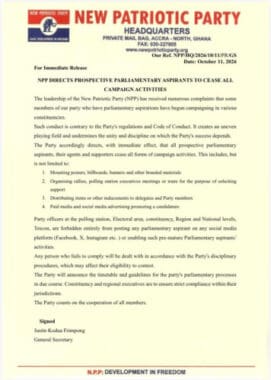
The New Patriotic Party (NPP) on 11 October ordered would-be parliamentary candidates to stop campaigning immediately, warning that breaches could cost them the right to contest its primaries.

General Secretary Justin Kodua Frimpong said in a statement that some aspirants had already started campaigning in constituencies, in breach of the party’s regulations and Code of Conduct. Early campaigns, the party said, tilt the contest in favour of those who start first and damage unity and discipline.

The order lands eight days after delegates in Kumasi elected a new national executive, and as the opposition party begins mapping out its route to the 2028 general election. It also cuts across a contest the new leadership wants to manage closely. Nana Akomea, newly elected Third Vice Chairman, has said the party plans to profile possible candidates early in constituencies where it has no sitting MP, partly to stop aspirants spending heavily on campaigns that fail. The NPP has more of these seats after losing power to the National Democratic Congress in 2024.

The directive bans posters, billboards, banners and other campaign materials, along with rallies, meetings with polling station executives and tours aimed at drumming up support. Aspirants and their backers must also stop handing out gifts or other inducements to delegates and members, and end paid adverts in traditional and social media.

Party officers at every level, from polling station to national office, are barred from promoting any aspirant online or helping early campaigns. The ban extends to the party’s tertiary students’ wing.

Anyone who ignores the order faces the party’s disciplinary process, which the statement said “may affect their eligibility to contest”. Constituency and regional executives are responsible for enforcing it in their areas.

The party has used such bans before, and has acted on them. In May 2025, Kodua ordered members to stop campaigning for internal party posts until nominations opened. Two months later, the Agona West constituency executive suspended Christopher Arthur, the NPP’s 2024 parliamentary candidate there, accusing him of holding an electoral area meeting in breach of that directive.

The NPP said the timetable and guidelines for its parliamentary primaries would be announced later. In the last cycle, it held primaries in seats without an NPP MP on 2 December 2023 and in seats it held on 27 January 2024.

IPMP-Ghana honours Elsie Effah Kaufmann with lifetime achievement award

0

The Institute of Project Management Professionals (IPMP-Ghana) has given Ing. Prof. Elsie Effah Kaufmann, the National Science and Maths Quiz host, its Lifetime Achievement Award at its 10th anniversary.

The institute also named her Outstanding Member of the Decade and Outstanding Member, making her one of the most decorated figures at the anniversary celebrations.

The honours come from a field most Ghanaians would not link to her. Effah Kaufmann is best known as the face of the quiz, but she holds a Project Management Professional certification and is a Fellow of IPMP-Ghana, which trains and certifies project managers. The institute has previously named her its Outstanding Member of the Year, and its website lists her as president of Women in Projects.

Her main career is in engineering. She joined the University of Ghana in 2001 as a physics lecturer and went on to found its Department of Biomedical Engineering. In August 2022 she became the first woman to lead the university’s School of Engineering Sciences as dean, a post she still holds.

International recognition followed. The Royal Academy of Engineering in the United Kingdom elected her a Fellow in September 2025, one of only two Africa-based academics chosen that year. She was formally admitted in London in November 2025, becoming the first Ghanaian to receive the honour.

Away from the university, she set up the Elsie Effah Kaufmann Foundation to support hands-on science and technology research by students across Ghana.

The quiz remains her public stage. She has hosted the televised contest for senior high schools since 2006, which makes 2026 her 20th year in the role.