John Boadu vows no pampering as NPP rebuilds for 2028

0

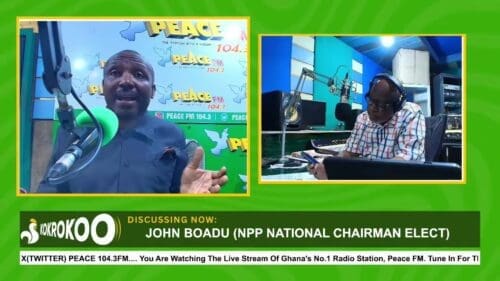
New Patriotic Party (NPP) National Chairman John Boadu has told Peace FM he will take decisions that anger party members if they help the opposition party win power in 2028.

“I’m not going to pamper anyone,” Boadu told host Kwami Sefa Kayi on the station’s Kokrokoo morning programme.

He said the NPP had to reorganise and rebrand, and that its leadership should act boldly and fairly even when choices proved unpopular, because winning power would benefit every member. He warned that another defeat would hand the party’s rivals room to widen their political reach.

The remarks set a hard tone for a chairman who took office without a majority of delegates behind him. Boadu won with 47.19 percent of the votes cast at the congress held at the Baba Yara Stadium in Kumasi, polling 2,888 votes to beat his closest contender, Boakye Kyerematen Agyarko, who got 2,408 (39.35 per cent). Paul Afoko, who was attempting a return to the chairmanship after his earlier term was cut short by a suspension in 2015, got 790 votes, and Sammy Crabbe had 41. Crabbe had announced a late withdrawal from the contest to back Boadu.

His radio message is sharper than the one he issued after the vote. In a statement on Monday, 5 October 2026, Boadu said the party now had no winners or losers and pledged to lead with humility, consultation and reconciliation. On Peace FM, he made clear that concern over upsetting members would not stop decisions he considered necessary to win.

The new leadership takes charge as the NPP seeks to reorganise its structures following its defeat in the 2024 general election. At the same Kumasi conference, the party altered its constitution to make the flagbearer the leader of the party. Former Vice-President Mahamudu Bawumia is the NPP’s flagbearer.

Boadu will work alongside General Secretary Justin Frimpong Kodua, who beat him for that post in 2022. Kodua was re-elected with 4,486 votes, the highest tally of any contestant in the 2026 national executive elections. Boadu served as General Secretary from 2018 to 2022.

Boadu has said the new executive team will work with Bawumia to strengthen the NPP’s organisational and financial structures, particularly at constituency level.

Developing nations’ debt crisis already here, says Jubilee USA’s Caliari

Developing countries are already in a debt crisis, even though few of them are defaulting, a senior official of the debt relief campaign Jubilee USA Network has told NewsGhana.

Aldo Caliari, Senior Director of Policy and Strategy at Jubilee USA, said governments were choosing to keep paying creditors at heavy cost to their own people rather than face a restructuring system he called inefficient and unpredictable. He gave his assessment in written answers to NewsGhana ahead of the International Monetary Fund (IMF) and World Bank Annual Meetings, which run in Bangkok from 12 to 18 October.

“We may not have a ‘debt crisis’ as scores of countries defaulting,” he said, “but we have something more serious: a social and development crisis.”

A crisis without defaults

Caliari said the average developing country now spends 45 percent of its revenue on debt payments, and that 75 countries spend more than a third. He said both figures were higher than in the 1990s, when the debt burden led to the Heavily Indebted Poor Countries initiative and the Multilateral Debt Relief Initiative.

For countries the IMF and World Bank judge to have a short-term cash squeeze rather than unpayable debt, the main tool is the “3-pillar approach” launched in 2024. It combines domestic reforms, more official lending and incentives for private creditors to keep lending, so that debtors can keep paying while their economies grow. Caliari said the approach works only if the institutions correctly identify which countries do not have a deeper problem, and only if the growth rates it assumes are achievable. “There is a big question mark on that,” he said.

He added that no public list exists of the countries eligible for the approach or using it, so its results cannot be judged. Jubilee expects progress in Bangkok on transparency and on clearer measures of success.

Senegal as the test case

For countries whose debt cannot be paid, Caliari said the G20 Common Framework had failed to provide timely or sufficient relief. He added that only a small share of the countries that arguably need a restructuring have applied for it. Chad, Ghana, Zambia and Ethiopia all went through the framework.

The G20 has since endorsed a Restructuring Playbook and a revised blueprint for agreements between debtors and creditors, both meant to make the framework faster and more transparent. Senegal will be the first country to go through the new process. On 1 September, Senegal reached a staff-level agreement with the IMF on a 36-month loan of about US$2.2 billion and said it would seek treatment under an enhanced version of the framework, keeping debt denominated in CFA francs outside the deal. Prime Minister Ahmadou Al Aminou Lo has told lawmakers the country will reprofile its debt rather than restructure it.

“The proof will be in the pudding,” Caliari said.

Vulture funds and New York

On private creditors, Caliari pointed to contract reforms that make it harder for a minority of creditors to block a deal, and to efforts to extend those rules from bonds to commercial bank loans.

He singled out New York’s champerty bill, which would stop investors who buy distressed sovereign debt cheaply and then sue for full repayment. New York law governs more than half of sovereign bonds. The state Senate passed the bill on 2 June, but its companion bill never reached the Assembly floor before the session ended. Caliari said the bill had enough votes to pass the Assembly had the Speaker allowed a vote. The Managed Funds Association and six other financial industry groups opposed it, arguing in a joint letter that it would raise borrowing costs for sovereign borrowers and drive debt issuance to rival financial centres.

More lending without new money

Caliari said the World Bank could lend significantly more. Its lending arm for middle-income countries, the International Bank for Reconstruction and Development, had lent more than US$800 billion since its founding on capital of less than US$20 billion, he said. He argued that its equity-to-loan ratio, above 21 percent last year, could safely fall to 18 percent or lower.

He said reforms to the International Development Association (IDA), the World Bank’s fund for the poorest countries, could expand its reach without new donor money. He named changes to the rules on when countries graduate out of IDA, transfers from the bank’s other lending arm and tools for mobilising private investment. He said higher donor contributions were still needed.

On Special Drawing Rights (SDRs), the IMF’s reserve asset, he said a new allocation was unlikely to win the necessary support. Because SDRs are shared out according to each country’s IMF quota, developing countries receive only about a third of any allocation. He saw more room in passing existing SDRs from rich countries to poorer ones through development banks, noting that the African Development Bank and the Inter-American Development Bank have led that effort.

Energy shock and El Niño

Caliari said developing countries face more than six months of high oil prices linked to the Middle East conflict. Even if conditions return to normal soon, he said, the recovery will trail by months. Scarce, expensive fertiliser is only beginning to feed through to food prices, and he warned it could combine with El Niño to push them up for at least the next three years.

He said the countries hit hardest would be those whose per capita income has barely moved in 15 years.

AI and what Africa should watch

On artificial intelligence, Caliari cited Pope Leo XIV’s encyclical Magnifica Humanitas, published in May. He said AI should remain a tool under human control, with the dignity of work put first. He said the IMF, World Bank and G20 could help through advice, training and financing, but nothing would replace country-owned development strategies.

He urged African governments to watch three things in Bangkok. The first is whether reforms to the IMF and World Bank debt sustainability framework for low-income countries give borrowers a bigger say in the assessments. The second is whether development banks increase concessional and emergency lending. The third is whether they steer private capital to the countries that need it most rather than to the easiest markets.

His longer-term priorities are a rapid solution to the current debt crisis, safeguards to prevent the next one, and a rules-based framework for resolving sovereign debt crises that works the way bankruptcy works within national economies.

The Governing Council of the Borrowers’ Platform, a United Nations-backed forum for debtor countries launched in April, will hold its first meeting in Bangkok.

COCOBOD Debut Cocoa Note Sale Falls 15 Percent Short

0

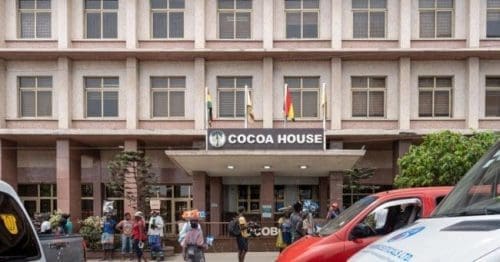
COCOBOD has raised GH¢3.39 billion from its debut local debt sale, 15 percent below target, an early test of whether domestic lenders can replace foreign banks in financing cocoa.

The money matters most at the farm gate. Ghana’s cocoa season opened on September 25, but licensed buying companies warned they would not buy beans with their own cash and then wait months for repayment. The new funds should let COCOBOD start disbursing money to those buyers so purchases can pick up.

The first sale

Cocoa Capital PLC, the special-purpose vehicle the cocoa regulator set up for the programme, issued the commercial paper on October 5 at a yield of 11 percent. The paper matures on June 28, 2027. The sale raised about GH¢604 million less than the GH¢4 billion presented to investors. That figure was indicative, however, and the amount COCOBOD accepted may not reflect everything investors offered.

The vehicle is new. Cocoa Capital was incorporated on August 7, 2026, with paid-up capital of GH¢5 million, and holds Securities and Exchange Commission (SEC) approval to borrow on the domestic market.

A long way still to go

The first sale is only a small part of what COCOBOD needs. The programme aims to raise GH¢14 billion in commercial paper to buy cocoa this season, issued in three tranches: GH¢4 billion, another GH¢4 billion and a final GH¢6 billion. A further GH¢2.3 billion in medium- to long-term bonds will refinance older COCOBOD debt.

By NewsGhana’s calculation, the first sale covers about 24 percent of the commercial paper target, leaving roughly GH¢10.6 billion to raise in the next two rounds.

Not all of the first tranche will reach farmers. About 14 percent of the funds raised will go towards COCOBOD’s legacy debts. Proceeds may also repay a bridge facility linked to that older debt.

How investors get paid

Repayment depends on cocoa sales. Receivables from selected forward sales contracts are assigned to Cocoa Capital and paid into ring-fenced accounts. Even so, the commercial paper is classed as senior unsecured debt, meaning holders do not have a direct claim on specific assets.

That puts weight on the size of the harvest. COCOBOD expects production to fall by at least 16 percent in the 2026/27 season.

The backdrop investors were weighing

The sale opened two weeks after a cross-border investigation put COCOBOD’s past finances under scrutiny. Ghana Business News, working on the China Capital project led by the International Consortium of Investigative Journalists (ICIJ), reported that the London branch of the Industrial and Commercial Bank of China (ICBC) placed COCOBOD on a watchlist on February 9, 2023. The outlet also said that loss figures in some of the Board’s annual reports did not match its audited accounts.

The regulator’s latest reported results look stronger, but they rested on conditions that have faded. The State Interests Governance Authority (SIGA) recorded a GH¢5.11 billion profit, driven largely by exchange-rate gains. In that year COCOBOD sold cocoa at an average of $5,174 a tonne. For the new season, it has announced a realised free-on-board (FOB) price of $2,650 a tonne.

Old bills still unpaid

The Chamber of Cocoa Marketers Ghana says COCOBOD owes licensed buying companies nearly GH¢4 billion. It warned that the arrears make it hard for them to secure fresh credit while they keep servicing loans taken out for earlier purchases. COCOBOD has acknowledged the outstanding payments but said such balances are not unusual at the end of a season and do not signal that it cannot meet its obligations.

To stop the problem spreading to farmers, COCOBOD has barred buying companies from taking cocoa on credit and warned that repeat violators risk losing their licences.

The new price

Farmers are being paid GH¢42,400 a tonne this season, or GH¢2,650 per bag, a rise of GH¢1,008 a tonne. That equals 71.18 percent of the realised FOB value, above the 70 percent minimum guaranteed by the Ghana Cocoa Board Act, 2026 (Act 1182). The same law bars COCOBOD from quasi-fiscal activities.

COCOBOD’s Public Affairs Department acknowledged questions sent by NewsGhana on the watchlist report, the discrepancies in its accounts, the arrears and the financing programme. On September 29 it said the questions had been forwarded to the relevant office for review, but it had not provided answers by October 10.

The second GH¢4 billion tranche of commercial paper is next in the programme.

Joseph Gordon-Levitt says AI firms, not machines, are the danger

0

Actor Joseph Gordon-Levitt says the real risk from artificial intelligence (AI) lies with the companies building it, warning that chatbots are being designed to win users’ affection.

Gordon-Levitt made the case in a video interview with The New York Times, recorded as he travelled to the United Nations. Since March 2026 he has served as the UN’s first Global Advocate for Human-centric Digital Governance. He said AI models were being “trained to hijack your intimacy”, built to befriend users and even get them to fall in love. People should worry less about AI itself, he argued, and more about the people building it.

His warning sharpens a theme he has pushed for more than a year. At Fortune’s Brainstorm AI conference in December 2025, drawing on conversations with New York University psychologist Jonathan Haidt, he warned of “synthetic intimacy”. He argued that chatbots offer children a fake form of connection built to serve advertising rather than to help them develop.

In the new interview, he rejected the idea that the main fear should be AI wiping out humanity. He said the risk was real but reduced a dense set of problems to a single frightening soundbite. What worried him more, he said, was the decline of democracy and of human empathy, and the ambition of AI companies to take over the entire economy, which he said would amount to totalitarianism.

Gordon-Levitt began by telling viewers not to take an actor’s word for it. He pointed them instead to Stuart Russell’s book “Human Compatible”, the work of the computer scientist Yoshua Bengio, and researchers in AI safety and policy. He said fast-moving businesses should not be left to design the future in the interests of their own profits while the public stays confused or apathetic.

He argued that the term “artificial intelligence” was itself misleading. AI, he said, is human-produced data recombined by algorithms, and calling it artificial pushes people out of the picture and conjures up the machines of science fiction.

His campaigning has reached lawmakers. He spoke out about Meta’s AI chatbots and child safety in September 2025, backed a Utah bill on AI and child safety in January 2026, and called for the repeal of Section 230, the US law that shields online platforms from liability for user content, in February 2026.

Not everyone in the industry accepts his case. At the Fortune event, Stephen Messer of the analytics firm Collective[i] argued that his position fell apart in a room full of AI specialists. Gordon-Levitt countered that opponents of regulation often cherry-pick bad laws to argue against all laws, and has said he is not pessimistic about technology itself.

He is also set to direct a thriller about AI for Rian Johnson and Ram Bergman’s production company, T-Street.

Portugal federation opens disciplinary case against Ronaldo over walkout

0

The Portuguese Football Federation (FPF) has opened disciplinary proceedings against Cristiano Ronaldo and suspended him from national team duty after the captain walked out of camp in Copenhagen.

The federation confirmed the decision on 10 October. Its disciplinary council has classified the case as urgent and will keep the investigation confidential until it concludes. The FPF also imposed a preventive suspension, separate from the automatic suspension that already applied to Ronaldo under its rules. It has not announced a final sanction.

The case will decide whether the 41-year-old, Portugal’s record goalscorer, plays for his country again before next year’s matches. Article 160 of the FPF’s disciplinary regulations covers players who leave or skip national team activities without justification, and provides that walking out triggers an automatic preventive suspension. A Portuguese sports lawyer told A Bola the minimum penalty is one month’s suspension and a €510 fine, which the council could halve to 15 days and €255. The lawyer said the time already served under the automatic suspension would count against any sanction, so Ronaldo could be free for Portugal’s next international window.

The dispute began in Oslo, where coach Jorge Jesus left Ronaldo on the bench for the whole of Portugal’s 2-1 Nations League win over Norway. Gonçalo Ramos, who started in his place, scored the winner. Jesus said keeping Ronaldo out was a tactical decision.

On 30 September, the eve of the Denmark match, Jesus told reporters that Ramos would start again and that Ronaldo’s role would depend on how the game went. Ronaldo left the camp shortly afterwards. He said on Instagram that he made the decision after the coach’s news conference and a conversation with FPF President Pedro Proença.

In a long letter published on 6 October, Ronaldo accused Jesus of breaking promises about his playing time. He said they had agreed that the coach would explain his omission against Norway publicly before the Denmark match, and that Jesus did not do so. “A broken word has, for me, a defining impact,” he wrote. He said he had not demanded to play.

Ronaldo apologised to his teammates for leaving and to supporters for not joining the squad in thanking the fans after the Norway match. He said the federation should assess and punish his conduct, and that he remained available to play for Portugal once he had served any sanction.

Jesus coached Ronaldo at the Saudi club Al-Nassr and took charge of Portugal in July 2026, after the team’s exit in the World Cup round of 16. Portugal have won all three Nations League matches played under him that have been reported, including a second 2-1 win over Norway in Lisbon on 4 October without Ronaldo.

Trump says Ukraine needs new president after diesel deal row

0

US President Donald Trump said on 10 October it was time for Ukraine to get a new president, after Volodymyr Zelensky condemned a US deal easing sanctions on Russian diesel.

Speaking to reporters outside the White House, Trump accused Zelensky of making problems for the world by continuing to authorise drone strikes on Russian oil refineries. “He’d better damn well stop,” Trump said, adding that Ukraine should find a leader who could make a deal.

The attack came a day after Trump confirmed an agreement with Moscow to suspend sanctions on Russian diesel exports until 7 April. The deal meets a condition Russian President Vladimir Putin set at the Valdai forum on 1 October. Putin said then that Russia had enough diesel but would not supply global markets while sanctions on its oil and oil products stayed in place. He also said Ukraine’s refinery strikes had cost Russia about one percent of its economic output.

Zelensky said the deal would give Moscow fresh money to buy weapons and keep fighting, and called it a gift to Putin. He accused Russia of reading the deal as permission to keep bombing cities, after new deadly strikes on Zaporizhzhia, and spent 10 October calling allies. Downing Street said UK Prime Minister Andy Burnham offered his full solidarity, and that the two leaders agreed Russia should accept an immediate energy ceasefire and stop attacking shipping in the Black Sea.

Under the deal, Trump said, Russia would first release 300,000 tonnes of diesel onto American and global markets, with more to follow depending on the condition of its refineries. Kirill Dmitriev, Putin’s investment envoy, welcomed Trump’s remarks and said Ukraine needed leadership focused on peace.

Diesel has become a political liability for Trump ahead of November’s midterm elections. The war with Iran has effectively closed the Strait of Hormuz, and Russia, the world’s second-largest diesel exporter, has banned exports after Ukrainian drones damaged its refineries. US diesel prices rose to a record of more than $6.50 a gallon earlier this month.

Trump has pressed Kyiv for weeks to stop hitting Russian refineries. On 14 September, he announced that the two sides had agreed to halt strikes on each other’s energy sites. Zelensky said no deal had been reached and that Ukraine would stop only if its partners guaranteed Russia would do the same.

Europe is moving the other way. EU foreign policy chief Kaja Kallas criticised the suspension, saying it would give Moscow more revenue to wage war. She has also said EU foreign ministers will approve the bloc’s largest sanctions package since Russia’s full-scale invasion when they meet on Monday. In March, she called an earlier US easing of Russian oil sanctions a dangerous precedent.

Trump called for elections in Ukraine last December. Ukraine has been under martial law since February 2022, which suspends national elections.

State asks court to make Adu-Boahene open his defence

0

The Attorney-General has asked the High Court to reject former National Signals Bureau chief Kwabena Adu-Boahene’s submission of no case and order him to open his defence.

The prosecution filed its response on 9 October, as directed by the court, in the trial of Adu-Boahene, his wife Angela Adjei-Boateng and their co-accused over a US$7 million cyber-defence contract. The state argues it has produced enough evidence to establish a prima facie case, the legal threshold for requiring the accused to answer the charges.

A submission of no case asks the judge to end a trial before the defence calls any witnesses, on the ground that the prosecution’s evidence is too weak to justify one. If Justice Francis Apangabuno Achibonga upholds it, the accused will be acquitted at this stage. If he dismisses it, they must give evidence in their own defence.

In its written submission, the prosecution set out the evidence it says it presented during the trial. It argued that the defence’s cross-examination of its witnesses was largely off the point and failed to shake the documents at the heart of its case.

The accused have pleaded not guilty to 11 counts, including stealing, defrauding by false pretences, wilfully causing financial loss to the state, using public office for profit and money laundering. The state alleges that GH¢49.1 million meant for a cyber-defence system ordered in 2020 from the Israeli firm ISC Holdings was diverted through private companies. It says the system was never delivered.

The prosecution’s evidence has included testimony that Adu-Boahene opened a bank account in his private company’s name on the day the first cheque was issued, and that only GH¢9.54 million, about US$1.75 million, reached ISC Holdings.

The defence disputes the state’s figures. Lead counsel Samuel Atta Akyea has argued that the amount in question is GH¢38.15 million, not GH¢49.1 million. He has also accused the state of trying the case in the media and has called the allegations against his client sordid. He had earlier objected that the 14 days the court allowed the defence to file its submission were too short, given the volume of documents.

With both sides’ papers now filed, the court will rule on the submission on 5 November 2026.

Ampofo Ankrah took no World Cup visa money, lawyer says

0

The lawyer for suspended National Sports Authority (NSA) Director-General Yaw Ampofo Ankrah says his client received no money from anyone over the alleged 2026 World Cup visa scheme.

Jerry Avenorgbor said Ampofo Ankrah had been attending interviews at the Criminal Investigations Department (CID) headquarters over the past week and had neither collected money from visa applicants nor taken part in any visa transactions. “My client has not received a penny from any individual,” he said.

The denial comes as pressure on the case widens beyond one official. The NPP Minority in Parliament alleges that about US$623,000 was collected from people seeking help to travel to the tournament in the United States and Canada, and is now demanding the dismissal and prosecution of Sports Minister Kofi Adams and the Chief Executive of the Ghana Tourism Authority (GTA). Neither the amount nor the Minority’s account of the arrangement has been established.

Avenorgbor said the police were handling the investigation well and should be allowed to establish the facts. If his client were found culpable, he said, the law would take its course.

President John Dramani Mahama suspended Ampofo Ankrah on 1 October pending the outcome of the CID investigation, and appointed Professor Emmanuel Osei Sarpong as Acting Director-General. The letter from the Presidency described the suspension as an administrative measure and said it was not a finding of wrongdoing. The Bureau of National Investigations is also looking into the matter.

The case began with a petition to the CID on 8 September, alleging that people connected to the NSA took money from prospective travellers on the promise of arranging visas and travel. The NSA has said its partnership with TRIBE Culture Fest, a FIFA-licensed fan-experience company, never authorised anyone to collect money for visas. The Minority says the arrangement grew out of a Memorandum of Understanding between the NSA and TRIBE signed on 2 June 2025, and that visa processing was costed at US$3,000 per person for the United States and US$2,000 for Canada.

Ampofo Ankrah told JoySports after his suspension that he was disappointed he had not been given a chance to explain his side.

On 8 October, his lawyers said he would not appear before Parliament on the allegations until the CID investigation was complete, arguing that testifying earlier could prejudice the inquiry. They said he would respond to the substance of the allegations once the police findings were made public.

NCCE turns violent extremism campaign to Ghana’s southern borders

0

The National Commission for Civic Education (NCCE) is extending its violent extremism awareness work to Ghana’s southern border communities, saying years of northern-focused programmes have left a gap.

Samuel Asare Akuamoah, the NCCE’s Deputy Chairman in charge of Operations, made the case at a national dialogue in Accra on 7 October on sustaining post-election peace and building resilience against emerging security threats in southern border communities. The dialogue opens a series of community engagements in those areas.

Akuamoah said most efforts to prevent violent extremism had concentrated on the north, partly because that was where development partners chose to fund work. The record bears this out. The European Union-funded Preventing and Containing Violent Extremism project, run by the NCCE, covered 75 districts in the Northern, North East, Savannah, Upper East, Upper West, Oti, Bono and Bono East regions. It followed an earlier project aimed specifically at the northern border regions.

NCCE Chairperson Kathleen Addy, in a speech read on her behalf, said security concerns were often associated with the north, but the southern and coastal borders were increasingly becoming hotspots for cross-border crime, including violent extremism, narcotics and disinformation.

Akuamoah said the campaign belonged to the commission’s post-election programme, and warned that the period after a vote carries its own risk. “This is the time when people’s complacency can set in,” he said. He noted that some neighbouring countries had suffered attacks by extremist groups, and that in some of them democratic government had collapsed.

The threat he described has moved steadily towards the coast. Al Qaeda’s Sahel affiliate, Jama’at Nusrat al-Islam wal-Muslimin (JNIM), has expanded from Burkina Faso and Niger into northern Benin and Togo. Togo suffered its first deadly militant attack in May 2022, when eight soldiers were killed. Benin recorded 155 attacks in 2024, up from five in 2021. Ghana has not suffered a confirmed attack.

Dr Mustapha Abdallah, a Senior Researcher at the Kofi Annan International Peacekeeping Training Centre (KAIPTC), told the dialogue that tighter border control would not be enough on its own. He urged the authorities to tackle the economic hardship that makes vulnerable communities along the southern borders open to recruitment.

The NCCE plans to follow the dialogue with sensitisation sessions in southern border communities to help residents recognise and report warning signs.

NPP supporters greet Baffour Awuah in Kumasi after GH¢10m bail

0

Hundreds of New Patriotic Party (NPP) supporters greeted MP Nana Agyei Baffour Awuah at Kumasi’s airport on his first return since his arrest and GH¢10 million bail.

Video of the arrival at Prempeh I International Airport, published by GhanaWeb, shows party supporters waving NPP flags, wearing campaign shirts and chanting as the Manhyia South MP arrived. It was his first visit to Kumasi since the Economic and Organised Crime Office (EOCO) detained him.

The reception shows how the case has become a political rallying point for the opposition. Baffour Awuah, a lawyer, has called the prosecution a witch-hunt, while EOCO and the Attorney-General’s office say they are pursuing an ordinary criminal investigation.

On 3 October, an Accra High Court sitting on a Saturday granted him GH¢10 million bail with two sureties, the MPs for Bosome Freho and Effia. He pleaded not guilty to conspiracy to commit a crime, intentionally causing a financial loss of GH¢9.85 million to the state, and money laundering. The money laundering charge relates to an alleged GH¢1 million transfer to the then Managing Director of SIC Life in 2024. The court, presided over by Justice Charity Akosua Asem, ordered him to surrender his passport and to make himself available to EOCO whenever required.

The charges arise from work his former law firm, Sarkodie Baffour Awuah & Partners, did for SIC Life Savings and Loans in trying to recover money from Equity Savings and Loans. His lawyer, Samuel Atta Akyea, says his client’s role came from legitimate legal work for SIC Life. The allegations have not been tested in court.

Speaking after his release, Baffour Awuah challenged the prosecution to prove its case before the court. “No dirt can stick on me,” he said.

His arrest followed a confrontation on 23 September at the Accra High Court, where EOCO officers tried to detain him after he appeared in an unrelated bail hearing. EOCO said he had not honoured two invitations in February 2026. His lawyers replied that the letters were addressed to him as a senior partner of the firm and that he had referred them to the Clerk to Parliament because he had since become an MP. He took refuge in Parliament, and the NPP Minority accused EOCO of abusing its power. A High Court then issued a warrant for his arrest, and he surrendered to EOCO on 1 October.

The case returns to court on 26 October and 2 November 2026.