LATEST ARTICLES

Burnham’s EU reset could speed wealth flight, adviser warns

Closer UK ties with the European Union (EU) could lift growth but make it easier for wealthy Britons to leave, deVere Group chief executive Nigel Green warned on 12 October.

Green spoke as Prime Minister Andy Burnham prepared to ask MPs to back a closer relationship with the bloc. Burnham’s office said he would tell Parliament that Brexit had done more harm than good and that turning away from a possible new deal with the EU would be a dereliction of duty. He has not ruled out a future manifesto pledge to rejoin, and has not said whether another referendum would be needed.

Green, whose firm advises internationally mobile and high-net-worth clients, said cutting the paperwork, border checks and delays that followed Brexit would feed through to exports, productivity and business confidence. He expected sterling to benefit if relations with Europe looked more settled, and argued that British shares, long cheap against their peers, could rerate. Talk of a second referendum would bring some volatility, he said, but investors mainly want to know which direction the country is heading.

The warning matters for Britain’s tax base. Green said the same changes that ease trade with Europe would also ease the movement of people and their money. Entrepreneurs, senior executives and mobile families were already weighing moves abroad as taxes rose, he said, and freer movement in Europe would remove one more obstacle. He argued the government must pair the EU reset with a competitive tax system, faster planning and policy stability. “Get only one right and it simply becomes easier for people to leave,” he said.

Burnham’s push comes with a sharp claim about the 2016 vote. On The Rest Is Politics podcast, broadcast on 12 October, he said he had asked for high-level advice after becoming prime minister in July and was told Russia had interfered in the referendum. He is the first British prime minister to say so openly. He also said German Chancellor Friedrich Merz had told him the far-right Alternative for Germany party was linked to Russia.

Ministers have struggled to give detail. On BBC Radio 4’s Today programme, minister Stephen Doughty declined to discuss specifics and pointed instead to Russian attempts to interfere in a range of democratic events. He told LBC that Russia had spent €1.5 billion on disinformation this year alone. Conservative shadow minister Andrew Bowie criticised the government’s messaging. Russia has denied meddling in the Brexit vote and in British politics generally.

The claim revisits an old dispute. In 2020, Parliament’s Intelligence and Security Committee said the government had never assessed possible Russian interference in the referendum and called for one, while finding credible evidence of Russian influence efforts around Scotland’s 2014 independence vote.

Burnham is due to address MPs on the EU relationship this week.

Jubilee USA urges IMF Ebola debt relief for DR Congo

Jubilee USA urged the International Monetary Fund (IMF) on 12 October to provide $205 million in debt relief and aid to fight Ebola in the Democratic Republic of Congo (DRC).

The call came as finance ministers, central bank governors and development officials gathered in Bangkok for the annual meetings of the IMF and World Bank Group, which run from 12 to 18 October at the Queen Sirikit National Convention Center. Jubilee USA Network, a coalition of faith groups, development organisations and labour unions, launched a petition asking the fund to provide at least $205 million. The group says that equals the debt payments the DRC owes the IMF over the next 12 months.

The case for relief rests on the scale of the outbreak. Caused by the Bundibugyo strain of the virus, the epidemic has killed more than 4,000 people and infected about 8,300, according to Congolese government figures released on 2 October. It is the deadliest Ebola epidemic in the DRC’s history, and the World Health Organization (WHO) has warned it could surpass the 2014 to 2016 West Africa outbreak, which killed more than 11,000 people. The WHO declared it a public health emergency of international concern on 16 May.

Jubilee USA wants the IMF to use its Catastrophe Containment and Relief Trust (CCRT) to cancel the DRC’s payments. The fund used the trust to relieve debt for Guinea, Liberia and Sierra Leone during the West Africa epidemic, and again for dozens of the poorest countries during the COVID-19 pandemic. Eric LeCompte, Jubilee USA’s executive director, said the trust can also deliver grant-like support: the IMF can lend new money and then use the CCRT to cancel that debt. “This is low-hanging fruit as the IMF already holds the tools,” he said.

The IMF has not publicly responded to the petition.

Ebola joins a crowded agenda. LeCompte said discussions would be dominated by high national debts, rising food and fuel prices and the challenges of artificial intelligence. The final G20 finance ministers’ and central bank governors’ meeting of the year is being held on the sidelines. Brent crude traded near $104 a barrel on 12 October after Houthi strikes on Saudi Arabia, adding to fuel costs for importing countries.

The host city is itself recovering from disaster. Floods have killed 60 people across Thailand since 16 September, according to the interior ministry. Areas in 28 provinces, including Bangkok, remain affected, touching 1.15 million households. Authorities have kept drainage crews and mobile pumps on standby around the venue, and the Thai government expects about 15,000 participants from more than 190 countries.

Thailand is the third host in a row outside Washington to face a natural disaster around the meetings. Weeks before the 2018 meetings in Bali, Indonesia, an earthquake and tsunami struck Sulawesi. A deadly earthquake hit Morocco a month before Marrakech hosted in 2023. LeCompte said lenders will need more relief tools as disasters become more frequent.

Black Starlets coach wants more goals after narrow Togo win

0

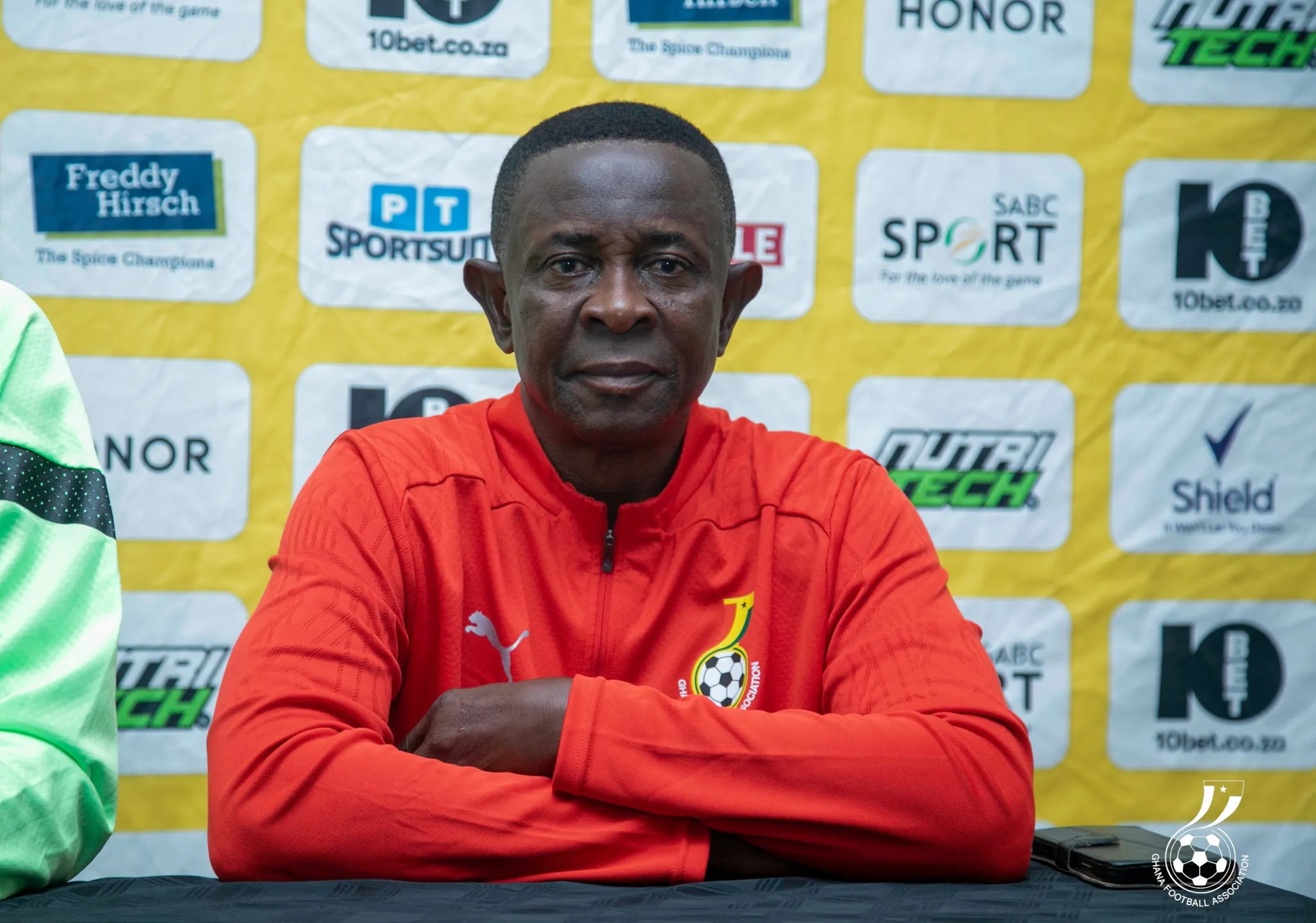
Black Starlets coach Kassim Ocansey said his side should have beaten Togo by more after a 1-0 win opened Ghana’s regional U-17 qualifying campaign in Ouagadougou on 10 October.

David Kwarteng scored in the seventh minute at the August 4 Sports Stadium in Burkina Faso, the first goal of the 2026 West African Football Union (WAFU) Zone B U-17 Championship. The tournament serves as the qualifying route to the 2027 U-17 Africa Cup of Nations (AFCON).

The goal came from a set piece. Abdul Latif Wunzalgu’s delivery was blocked and the ball broke loose in the box. Captain Abdul Rafiu Issah’s follow-up fell to Kwarteng, who finished.

Ghana created more chances but could not add to the lead. Striker Alidu Issah, winger Yaw Acheampong and Wunzalgu, later named man of the match, all missed openings to extend the advantage.

“We won, but I expected more from my boys,” Ocansey said. He said the team would work on its finishing and argued that converting the chances it creates would bring three or four goals a game.

The narrow margin matters in a tight group. Hosts Burkina Faso drew 0-0 with Benin in the other Group A match. That leaves Ghana top with three points, Burkina Faso and Benin on one each, and Togo without a point.

The Black Starlets face Benin on Tuesday 13 October. The tournament runs until 23 October.

Black Meteors expand camp to 32 for Libya U-23 qualifier

0

Ghana’s Black Meteors return to camp on 12 October with 32 players, six more than called last month, for their U-23 Africa Cup of Nations (AFCON) qualifier against Libya.

Head coach Desmond Ofei will work with the group at the Ghanaman Soccer Centre of Excellence in Prampram ahead of the two-legged tie. The tie will be played during the international window from 9 to 17 November 2026, the Ghana Football Association (GFA) said. The squad will be trimmed as preparations go on, and six foreign-based players are expected to join before the matches.

The stakes reach beyond a youth title. The eight-team U-23 AFCON finals in Egypt in 2027 serve as Africa’s qualifying event for the men’s football tournament at the 2028 Olympic Games in Los Angeles. Ghana have not played at an Olympics since Athens in 2004.

The larger camp follows Ofei’s first call-up of 26 players, who reported to Prampram on 29 September for friendly matches. Locally based players will stay in camp until the qualifiers. Their clubs can request weekly temporary releases so they can play in Ghana league matches.

Ghana received a bye into the second round as one of the exempted nations. They now face a Libya side that beat Togo 4-1 on aggregate in the preliminary round, drawing 1-1 in Lomé before winning 3-0 at home.

The Black Meteors play the first leg away in Libya and host the return. The aggregate winner advances to the final qualifying round, scheduled for 22 to 30 March 2027, against either Equatorial Guinea or Niger.

The three-round campaign will decide the seven teams that join hosts Egypt at the finals.

NPP’s David Boakye questions La MP over Pleasure Beach demolition

0

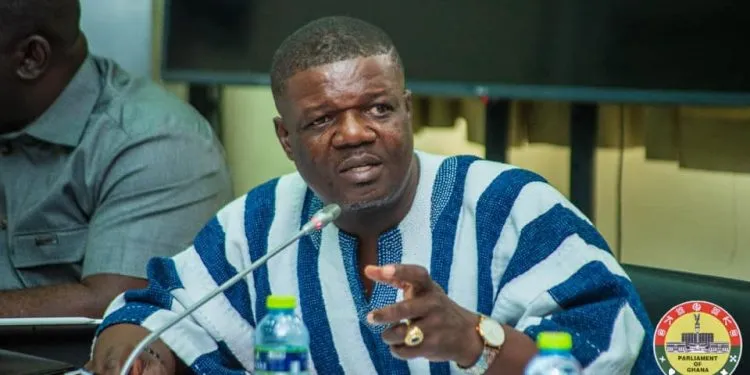
New Patriotic Party (NPP) communicator David Boakye questioned on 10 October how La Pleasure Beach was demolished without the knowledge of the area’s MP, a deputy local government minister.

Speaking on JoyNews’ Newsfile programme, Boakye challenged the account of Rita Naa Odoley Sowah, the National Democratic Congress (NDC) MP for La Dadekotopon and Deputy Minister for Local Government, Chieftaincy and Religious Affairs. Sowah has said she was not told about the 2 October operation. Boakye asked how a demolition could happen in her constituency while she served as deputy minister in the same government and still did not hear of it. He accused her of a public show of distress to win sympathy from constituents.

He also raised the cost of the operation. Sowah has said affected businesses will be compensated. If the state pays that compensation, Boakye said, whoever authorises the payment should in future be held accountable for causing financial loss to the state, an offence under Ghana’s criminal law. He asked whether the money would come from the state, the beach’s management or National Security.

Boakye said he had not visited the site and could not verify accounts of losses he had heard. He questioned whether the authorities could have found a way to keep the businesses running instead of pulling them down.

The question of who ordered the demolition remains in dispute. Personnel of the 48 Engineer Regiment of the Ghana Armed Forces, supported by the police, began pulling down structures at about 4am on 2 October. They cleared La Pleasure Beach and the adjoining Polo Beach Club, including the Vienna City club, shops, stalls and pub sheds. Workers said they were ordered off the premises minutes before the demolition began.

Deputy Chief of Staff Stan Xoese Dogbe, who leads the government’s anti-flood taskforce, said the exercise was not part of flood mitigation. He said National Security carried it out at the request of the Labadi Beach Hotel. Graphic Online reported that National Security acted at the request of the Social Security and National Insurance Trust (SSNIT). At the site, Sowah confronted the soldiers and said she had been assured the area would be spared. She said the government had no knowledge of the operation and named the hotel and its board chairman as leading it.

The La Traditional Council said it was not formally informed or involved. The council had first learned of the planned demolition on 16 September.

On 6 October, Sowah told Parliament’s Committee on Local Government and Decentralisation that a committee would be formed to determine compensation. She said it would include SSNIT, the La Dadekotopon Municipal Assembly, traditional authorities, beach management and herself as MP, and that data on affected people had already been collected. Abdul Rahman Ashitey, communications director of La Pleasure Beach, said no compensation had yet been agreed and that figures would follow the committee’s assessment.

Adams says US Embassy reserved 960 visa slots for fans

0

Sports Minister Kofi Adams said on TV3 on 11 October that the US Embassy reserved 960 visa appointments for government-sponsored World Cup supporters, as he faces calls for his removal.

Speaking on the programme Hot Issues with Keminni Amanor, Adams said the embassy set aside two sessions for the supporters the government planned to fund for the 2026 FIFA World Cup in the United States. The first ran from 10am to 3.30pm on Tuesday 26 May and the second from 7.30am to 11am on Friday 29 May. Other fans could apply through the normal visa process, he said.

Adams said the sponsored supporters were a separate group from the Black Stars players and their families, government officials travelling on official duties, and staff of the Ghana Football Association (GFA), the Ghana Tourism Authority (GTA) and the National Sports Authority (NSA).

His account matters because it sets out which channels the ministry says it controlled, at a time when lists of names submitted to the US and Canadian embassies are under scrutiny. Adams said the NSA held its own talks with the embassy but that they did not concern visas, and that neither the NSA nor the embassy told the ministry of any visa deal. The NSA “did not communicate to us if they had any arrangement with the embassy”, he said.

The Minority in Parliament has demanded the dismissal of Adams and GTA Chief Executive Maame Efua Houadjeto pending investigations into the visa arrangements. Old Tafo MP Vincent Ekow Assafuah alleged that the ministry received an NSA request containing four names and forwarded an expanded list of about 92 names to the US Embassy. He also alleged that only 15 of 102 people on a list submitted to the Canadian Embassy in June were verified NSA staff. In addition, he said only two of 50 people on a GTA list of media personnel were confirmed as practising journalists. None of these claims has been tested by an investigation or in court.

The ministry rejects the allegations. In a statement on 9 October, it said the list of 90 names came from the NSA, whose Director-General wrote to the minister on 19 May seeking visa facilitation for volunteers and event coordinators. The ministry forwarded that request on 28 May. It said no evidence had been presented showing that Adams collected money from applicants or benefited personally. Mahama Ayariga Mandel, a spokesperson for Adams, said the Minority’s 49-page statement contained nothing incriminating the minister. He said an inter-agency committee of the sports, finance, tourism and foreign affairs ministries had worked with the US Embassy to set up secure visa channels.

The NSA has said it did not authorise any visa facilitation service or set up an office to collect money from people seeking to travel to the tournament. Adams also told TV3 that the US Embassy introduced a private events organiser, TRIBE Culture Fest, to the NSA and the GTA at a meeting at the embassy.

The controversy deepened after Yaw Ampofo Ankrah was suspended as Director-General of the NSA. Abass Nurudeen, a presidential staffer, said President John Dramani Mahama would act on any corruption allegations that are substantiated.

Ghana’s BRICS bid tests US ties and China trade terms

0

Ghana’s decision to seek a place in BRICS, the bloc built around Brazil, Russia, India, China and South Africa, puts three economic questions in front of the government at once. The first is whether Washington will treat the move as a provocation. The second is how fast trade with China should shift away from the US dollar. The third is what Accra has promised Beijing in return for duty-free access to Chinese markets.

Foreign Affairs Minister Samuel Okudzeto Ablakwa announced on 6 October that the Cabinet of President John Dramani Mahama had approved the bid. He spoke at a joint briefing in Accra with India’s External Affairs Minister, Subrahmanyam Jaishankar. On 10 October, he told TV3’s Key Points programme that Ghana would start as a partner country and move gradually towards full membership.

Ablakwa framed the decision as a way to widen Ghana’s options without abandoning traditional partners. He said Ghana had consulted European Union member states before the announcement. Jaishankar said India backed Ghana’s aspirations but that the wider BRICS group must consider any application.

The Washington question

US President Donald Trump has issued two separate warnings about the bloc. He has threatened 100 per cent tariffs on BRICS countries if they try to replace the US dollar. In July 2025, he said any country aligning itself with what he called the bloc’s anti-American policies would face an extra 10 per cent tariff, without defining those policies.

Neither threat names partner countries or applies automatically. When the 10 per cent warning was issued, a source familiar with the matter told Reuters the tariff would apply only if countries took specific policy actions Washington considered anti-American. Nigeria and Uganda are among the existing partner countries. The legal ground has also shifted: in February 2026, the US Supreme Court struck down a broad part of Trump’s tariff programme that had been imposed under an economic emergency law.

Ghana’s exposure is real but limited. Four of its five largest export destinations in 2025 were BRICS members: the United Arab Emirates, India, South Africa and China. Ablakwa said trade with India has risen from about $3 billion in 2024 to about $7 billion.

Paying China without dollars

The bid lands just as Ghana’s banks start to route China trade around the dollar. Bank of Ghana Governor Johnson Asiama said at the central bank’s 132nd Monetary Policy Committee briefing that Stanbic Bank Ghana is piloting a service through China’s Cross-Border Interbank Payment System (CIPS). The service lets eligible importers pay Chinese suppliers from cedi accounts, with the suppliers receiving yuan. GCB Bank is preparing a similar service.

Stanbic Ghana chief executive Kwamina Asomaning said the route reduces the need for US correspondent banks. Dollar, euro and pound payments continue through existing channels. The pilot cuts out one currency conversion, but importers still carry the risk of the cedi weakening against the yuan. China accounted for 22.3 per cent of Ghana’s imports in 2024, according to Stanbic.

What Ghana offered Beijing

China’s zero-tariff treatment for all 53 African countries with which it has diplomatic relations took effect on 1 May 2026. Ghana’s exports to China reached $2.67 billion in 2025, according to Chinese Ambassador Cong Song. He has said Ghanaian cocoa previously faced Chinese tariffs of 8 to 22 per cent.

The terms on Ghana’s side remain unclear. In October 2025, Finance Ministry Technical Advisor Fredrick Amissah cited World Trade Organisation rules to argue that some reciprocity was needed between two developing countries. “We have less than 150 products that we have offered to zero tariffs,” he said. In November 2025, China’s ambassador said Beijing’s offer did not require Ghana to reciprocate.

The government has not published the list or said whether the concessions are in force. The contents of that list matter to local industry. Zero tariffs on Chinese machinery and raw materials would cut costs for Ghanaian factories. Duty-free finished goods that compete with products made in Ghana would put domestic manufacturers under new pressure, at a time when importers are gaining an easier way to pay Chinese suppliers.

Man arrested over 2020 Manchester double shooting after Turkey detention

0

Greater Manchester Police (GMP) have arrested a 36-year-old man on suspicion of murdering two men shot at a Moss Side lockdown party in June 2020, after his detention in Turkey.

The man was detained in Turkey and flown to England on 10 October, where GMP officers met him at Stansted Airport, the force said on 11 October. He remains in custody and has not been charged. Police have not named him.

The arrest is the most significant step yet in a case that has gone unsolved for more than six years. Junior Ajose, 36, and Cheriff Tall, 21, died after being shot shortly before 1am on 21 June 2020 in a car park off Caythorpe Street in Moss Side, Manchester. The two men did not know each other. Detectives estimate that 300 to 400 people were in the car park that night. The gathering took place while coronavirus restrictions were in force.

Ajose, a support worker and father of three, had worked in residential children’s homes. His family said at the time that he was dedicated to caring for them. Tall’s family described him as a popular member of his community who had travelled to Parliament to lobby MPs on youth violence.

Detective Chief Inspector Neil Higginson, of the force’s Major Incident Team, said officers had carried out multiple warrants, analysed evidence and examined seized devices over six years. “This arrest demonstrates our unwavering commitment to securing justice for Junior and Cheriff,” he said.

He said the investigation was far from over and that detectives were still working to identify any outstanding suspects. Police believe some people who attended the party hold eyewitness accounts that could prove important but have not yet come forward.

A £50,000 reward, about GH¢730,000 at current exchange rates, remains available for information leading to the identification, arrest and conviction of those responsible. Witnesses can contact Greater Manchester Police or call the independent charity Crimestoppers anonymously on 0800 555 111.

Kenyan presidential hopeful tells Dangote to slow Lamu refinery

0

Kenyan presidential aspirant Patrick Osoi told Aliko Dangote in a video circulating on 11 October not to rush his $16 billion Lamu refinery, promising Kenyan investors the job.

Osoi, a former Kenya Defence Forces soldier, made the remarks to supporters at an event of his Lions Movement. He said Kenya already has refinery capacity and businesspeople able to run such a project without foreign investors, and that backing local entrepreneurs would be a priority of his government. He told the Nigerian industrialist that once he is sworn in, “you will be heading back to Nigeria”.

The challenge targets one of the largest private investments announced in East Africa. Dangote and President William Ruto broke ground on the refinery in Lamu County on 30 September 2026. The plant is designed to process 700,000 barrels of crude a day and serve Kenya and its neighbours, with construction expected to take about 40 months.

Osoi’s claim that Kenya can already handle refining runs against the record. The country’s only refinery, run by Kenya Petroleum Refineries Limited (KPRL) in Mombasa, shut down on 4 September 2013. A planned $1.2 billion upgrade was abandoned after consultants judged it economically unviable. The state-owned Kenya Pipeline Company (KPC) now operates the site as an oil storage depot, and its official records list the refinery complex as idle since 2013. Kenya imports its refined fuel.

Osoi did not say how a government led by him would finance or build a refinery using Kenyan investors.

Dangote already runs a refinery in Lagos with capacity of 650,000 barrels a day, which has reshaped Nigeria’s fuel market. The Lamu project gives him a foothold in East Africa, where most countries rely on imported petroleum products.

Osoi is not the only opposition the Kenyan project faces. Some Lamu residents have challenged it in court, saying land earmarked for the refinery includes ancestral property their families have occupied for generations, without adequate compensation or resettlement. A Kenyan court ordered the status quo to be maintained on disputed land ahead of the groundbreaking. Residents have also raised environmental concerns. Dangote has said he remains committed to the investment.

Kenya’s next general election is due in August 2027.

Second deadly strike hits Riyadh airport as Houthis warn airlines

0

A projectile set fire to Terminal 4 at Riyadh’s King Khalid International Airport on 11 October, killing one person a day after a strike there killed 12, Saudi authorities said.

Saudi Arabia’s General Authority of Civil Aviation (GACA) said a Pakistani resident died and 11 people were injured in the Sunday attack. Major General Turki al-Maliki, spokesman for the Saudi-led coalition fighting in Yemen, said an unidentified projectile hit the terminal and air defences intercepted and destroyed a cruise missile near the airport. Authorities were assessing damage and checking the safety of airport facilities.

The airport, a hub for millions of travellers and expatriate workers, stayed closed after the Saturday attack. That strike killed 12 people and injured 309, according to GACA, the deadliest such strike on the kingdom in more than a decade. GACA said the dead included four Saudi citizens and nationals of Bangladesh, the United States, Egypt, Jordan, Syria, Sudan and Palestine. The Indian Embassy in Riyadh said one of those killed was an Indian national. Thursday’s attacks on the same airport had already killed three people.

Hours before the Sunday strike, Yemen’s Houthi movement warned airlines, travellers and airport workers to stay away from Saudi airports. Houthi military spokesman Brigadier General Yahya Saree said the group had carried out four operations in 24 hours with ballistic and cruise missiles and drones. He said they targeted Riyadh airport several times, Dammam’s airport and two facilities belonging to state oil company Aramco. The coalition separately reported that a projectile landed near King Fahd International Airport in Dammam. The Houthis did not specifically claim the strike on Terminal 4.

Maliki had described the Saturday attack as a war crime under international humanitarian law and said the coalition would respond decisively. Washington blamed the Houthis for the Saturday assault, in which a US citizen died. President Donald Trump said the United States could join action against the group, and Secretary of State Marco Rubio condemned the attack.

British Defence Secretary Wes Streeting called the attacks contemptible and “a dangerous escalation”. He said the United Kingdom is already supplying Saudi Arabia with ground-based air defences and air-to-air refuelling. Foreign Secretary Ed Miliband advised British nationals to avoid the airport. Saudi Arabia, Egypt, Pakistan and Türkiye jointly condemned the strikes.

The attacks follow months of rising hostilities. The Houthis have struck Saudi targets since declaring a naval blockade against the kingdom in July. Saudi-backed Yemeni government forces, supported by coalition air power, are trying to reverse Houthi gains along the Red Sea coast. The Houthis say Saudi Arabia struck Sanaa airport as a plane from Iran was trying to land, an incident that revived anger over the Saudi-led blockade of Houthi-held areas.

Defending the kingdom’s airspace is getting harder. Regional officials said last month that Saudi Arabia was running low on missile interceptors and had asked France, Britain, Pakistan and Egypt to deploy air defence support.

The strikes have also rattled oil markets. Brent crude touched $105.60 a barrel after the Saturday attack before easing to about $104 on 12 October, after President Trump announced an energy ceasefire between Russia and Ukraine.

Abuja petrol prices rise despite NNPC discount plan

0

Petrol prices rose at MRS and other Abuja filling stations over the weekend of 10 to 11 October, days after Nigeria’s government unveiled a discount at state oil company outlets.

MRS, the retailer that distributes products from the Dangote Petroleum Refinery, raised its pump price by N39 to N1,409 a litre at outlets in Kubwa, Katampe, Gwarimpa and other parts of the Federal Capital Territory. The figure comes from a market survey by Nigerian newspaper Daily Post on 11 October. Rainoil and AA Rano added N10, taking their price to N1,410 from N1,400.

The rises reverse a week of falling pump prices. They also test a government plan to steady fuel costs without bringing back the subsidy scrapped on 29 May 2023.

Finance Minister Taiwo Oyedele announced two measures in Abuja on 8 October. The first is a 30-day discount on petrol sold at Nigerian National Petroleum Company (NNPC) Limited stations, with public transport operators first in line. The second is a proposed N1,350-a-litre ceiling on the ex-gantry or landing cost of petrol, reviewed monthly. The ceiling applies to supply cost, not to the price at the pump. When costs rise above it, refiners and importers would carry the shortfall and recover it later.

Oyedele said the discount comes out of NNPC Retail’s own margin, which he put at less than 5 per cent of the pump price. He said neither the federal budget nor the Federation Account pays for it, so it is not a subsidy. The presidency said that if NNPC’s landing cost is N1,300, the company will sell at that price. Oyedele said he hoped other marketers would follow, since he did not expect the spike in crude and petrol prices to last.

Marketers have instead asked the government to extend the discount to their own stations, Daily Post reported. NNPC’s own prices have not moved uniformly either. Vanguard reported that one NNPC Retail outlet in Jikwoyi, Abuja, raised its price from N1,380 to N1,405.

Former vice-president Atiku Abubakar rejected the 30-day discount as a temporary political fix that would not ease the hardship caused by high fuel prices.

The pressure starts with crude. Brent traded near $104 a barrel on 12 October, after Houthi strikes on Saudi Arabia and a hurricane that shut in much of the US Gulf of Mexico’s output. The Dangote refinery has raised its gantry price several times since August, most recently to N1,350 a litre in mid-September. That is the same level as the government’s proposed ceiling.

Bill Gates predicts surge in AI-powered cyberattacks within a year

0

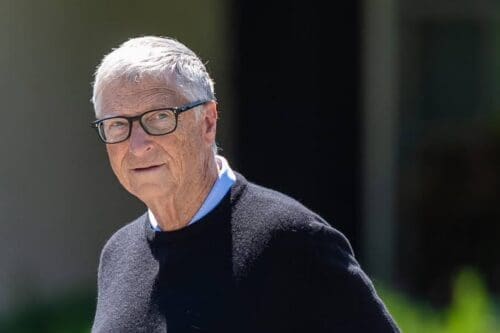
Microsoft co-founder Bill Gates said on CNN on 11 October that cyberattacks powered by artificial intelligence (AI) will likely be the most visible danger of the coming year.

He placed the blame on people who strip the safety controls out of AI models. In an interview with Jake Tapper on the programme State of the Union, Gates said the immediate threat comes from malicious actors using the technology rather than from AI escaping human control, a risk he put years away. Nothing currently stops users from removing built-in safeguards, he said. Bad actors, no safeguards and the latest models together would produce damage mainly in cyberspace. “We are going to have a lot of negative surprises,” he said.

The warning matters because the same tools that write and check software can now find the flaws attackers exploit. In a recent interview with New York Times columnist Ezra Klein, Gates said AI crossed both a cyber threshold and a biological threat threshold early this year. He cited models that found security bugs in code humans had reviewed for more than 20 years. He also said small groups using the latest tools now have attack capabilities once limited to well-funded states.

Gates called AI the most dangerous technology humans have invented and rejected the idea that the companies building it should be the only check on it. That position puts him at odds with President Donald Trump, who favours an industry-led approach and has dismissed calls for new AI laws as a hoax. Trump and other opponents of regulation argue that new restrictions would hand China the advantage in the AI race.

Gates told Tapper he had heard from a number of politicians and hoped to speak to Trump about what controls are needed. Asked whether his views amounted to what OpenAI chief executive Sam Altman has called “doomerism”, Gates said responsible AI leaders, including Altman and Anthropic chief executive Dario Amodei, were themselves telling the world the technology is concerning.

The CNN appearance extends a run of warnings. On NBC’s Meet the Press on 27 September, Gates said AI was powerful enough to drive events that could cause a billion deaths. He called on Congress to legislate and said law enforcement and politicians must help decide what safeguards and monitoring should look like. He added that a kill switch would not be enough on its own.

In an essay in August, he listed job losses, fraud, disinformation, easier cyberattacks and bioterrorism among the risks AI brings. On jobs, he told Tapper that society will need to decide how to tax the use of AI and robots and which jobs to reserve for humans.

The Gates Foundation has said it plans to spend at least $1 billion over two years to widen access to AI.

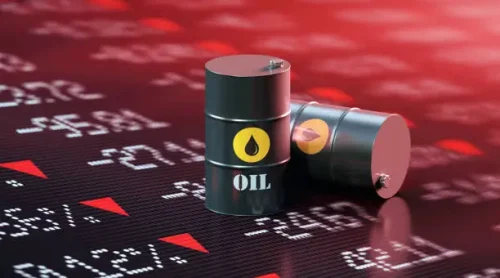
Oil prices dip on energy truce despite three supply shocks

Oil prices dipped on 12 October because of a Russia-Ukraine energy truce that Moscow has not confirmed. Meanwhile, a hurricane and Houthi strikes on Riyadh kept supply risks high.

Brent crude for December delivery fell 0.77 per cent to $103.91 a barrel. US West Texas Intermediate (WTI) for November slid 1.26 per cent to $90.69. The falls followed a post on Truth Social on 11 October in which President Donald Trump said both sides had agreed to stop hitting each other’s energy facilities. The Kremlin did not comment. Ukrainian President Volodymyr Zelensky said Kyiv would stop striking Russian refineries only if Moscow halted attacks on Ukraine’s power grid, and he reported fresh Russian strikes in the hours after the post.

Nigel Green, chief executive of the financial advisory firm deVere Group, said traders had sold crude on an announcement while no extra oil had reached a refinery and no damaged plant had restarted. “A promise is being priced as though it were supply,” he said.

The record backs his caution. Trump announced a similar truce in September, yet both countries kept attacking energy sites. US diesel reached a record $6.23 a gallon in mid-September, according to the motoring group AAA. On 9 October, Trump announced a deal to ease sanctions on Russian diesel exports to bring down fuel prices, a move that angered Kyiv.

For fuel-importing economies and their central banks, the question is whether Brent above $100 is a passing spike or the new floor heading into winter.

The second shock came from the Gulf of Mexico. Hurricane Isaias, the first Atlantic hurricane of 2026, forced producers to shut in about 1.3 million barrels a day before landfall. That was roughly 63 per cent of Gulf oil output, according to the Marine Minerals Administration. The federal offshore Gulf produces about two million barrels a day, around 15 per cent of US crude output, according to the US Energy Information Administration. Singapore lender UOB said in a note on Monday that the storm would keep upward pressure on prices.

The third shock hit the country with the world’s largest spare production capacity. The Houthis claimed responsibility for a strike on Riyadh’s King Khalid International Airport on Saturday. At least 12 people were killed and more than 300 wounded, the deadliest attack on Saudi soil in more than a decade. A further strike followed on Sunday. Attacks on the airport on 8 October had already killed three Saudi citizens, among them a Saudia pilot, and Lufthansa and Air India suspended flights to the city. Iran has since reached out to Saudi Arabia.

Green said any one of these events would justify a risk premium and that all three together suggest oil’s floor sits above current prices. He warned that oil holding above $100 through winter would feed into transport, food and heating costs. That could push back interest rate cuts in major economies.

Not every forecaster expects prices to stay this high. In July, Goldman Sachs forecast Brent at $80 a barrel in the fourth quarter, on the assumption that the Strait of Hormuz stays open and US-Iran tensions ease. Brent traded around $102.60 on 5 October, roughly 57 per cent higher than a year earlier, according to Trading Economics.

Oil later recovered its early losses on Monday after Zelensky repeated that Russia must also commit to the truce.

World Medical Association presses Russia over Siberian lab death

0

The World Medical Association (WMA) on 12 October urged Russia to reveal what killed a 28-year-old worker at a Siberian plague research institute, saying Moscow has shared too little.

The Geneva-based federation of national medical associations wants Russian authorities to tell the public and the World Health Organization (WHO) which pathogen caused the death. It also wants details of any other possible cases and of containment and safety plans at the facility. The stakes go beyond Russia. Three weeks after the woman fell ill, health agencies still cannot say whether a dangerous pathogen escaped a high-containment laboratory.

Independent Russian media identified the employee as Darya Shipilova, who worked at the Irkutsk Anti-Plague Research Institute of Siberia. She died overnight on 1 to 2 October after being admitted to hospital with severe pneumonia of undetermined origin. She had first been admitted with cold symptoms on 29 September.

Russia’s public health watchdog, Rospotrebnadzor, gave the official cause of death as pneumonia of unknown etiology and said expanded testing found no microorganisms linked to her laboratory work. Regional outlets, citing unnamed sources close to the security services, reported that she may have contracted pneumonic plague after a test tube broke in the laboratory. Those reports remain unconfirmed. Rospotrebnadzor said no accidents involving pathogenic microorganisms had been recorded at the institute.

The authorities acted quickly despite their reassurances. Anna Popova, head of Rospotrebnadzor, flew to the Irkutsk region for an emergency meeting. A hospital in Shelekhov and several medical facilities in Irkutsk were reportedly quarantined, and a nearby aluminium plant told staff to wear masks. WHO Director-General Tedros Adhanom Ghebreyesus said Russia had informed the agency that about 200 contacts were quarantined.

Then, on 8 October, Irkutsk Governor Igor Kobzev announced that restrictions had been lifted, describing the case as fatal community-acquired pneumonia. He did not explicitly say that pneumonic plague did not cause her death. The WMA said Moscow had declared its investigation closed while WHO’s questions went unanswered.

Under the International Health Regulations, Russia told WHO that no case of plague had recently been registered in Irkutsk oblast. WHO wants more. The agency has asked Russia to clarify the cause of the severe pneumonia, the pathogen that triggered the public health measures, and media reports of a second employee with pneumonia of undetermined cause. Tedros said “timely, complete and transparent information sharing” was essential to an accurate risk assessment.

US Secretary of State Marco Rubio also called on Russia to share more information with the world. International health experts nevertheless judged the immediate public health risk to be low, given no confirmed secondary cases and negative tests among contacts.

Plague is not new to the region. The bacterium Yersinia pestis lives among small wild mammals and their fleas across Siberia, though Russians rarely catch the disease, while cases occur every year elsewhere, notably in Africa. Russia has recorded isolated cases since 2014, mostly from rodents during skinning, and laboratory-acquired plague is extremely rare.

The WMA pointed to its Statement on Epidemics and Pandemics, which calls on governments to give prompt, accurate and science-based crisis information and backs strong global disease surveillance. WHO has offered Russia technical support and remains in contact with Moscow.

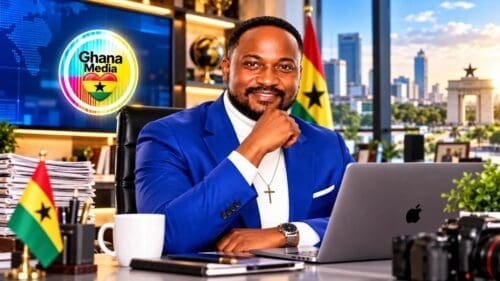
Ghana’s Digital News Economy Is Growing — The GhanaMedia.net Story

0

Ghana’s digital news industry is entering a stage where audience development, distribution technology and editorial identity are becoming just as important as publishing speed. GhanaMedia.net illustrates how an established Ghanaian digital media platform is adapting to that environment.

Led by Daniel Jeddman, Founder and Chief Editor of GhanaMedia.net, the platform has built a growing digital audience around Ghanaian news and public-interest content, serving readers in Ghana as well as members of the Ghanaian and African diaspora.

Its Facebook community has surpassed 670,000 followers, while its wider presence across TikTok, Telegram, search and other digital channels demonstrates the increasingly multi-platform nature of news consumption. For publishers, the modern newsroom now extends beyond a website to the networks through which audiences discover, discuss and share stories.

That shift is also changing the economics of digital publishing. Building a sustainable media brand requires investment in content, technology, audience engagement, search visibility and distribution. It requires publishers to understand both journalism and the digital behaviour that determines how stories travel.

GhanaMedia.net’s development reflects this broader transformation. Its expanding publishing ecosystem, including GhanaNews.org, points to the continuing diversification of Ghanaian digital media and the emergence of platforms built around direct relationships with online audiences.

For Ghana’s media industry, this evolution creates opportunities for greater diversity in voices, formats and audience communities. The story of GhanaMedia.net is therefore not simply about one publisher’s growth; it is part of a wider shift in how Ghanaian journalism is produced, distributed and consumed in the digital age.

South Africa seeks court oversight of contested asylum ruling

0

South Africa said on 11 October it will ask the courts to supervise its compliance with an asylum ruling, after a directive implementing it sparked violent protests.

The government will seek a supervisory order from the courts on how to carry out the Constitutional Court’s 7 July judgment in the Scalabrini Centre of Cape Town case. Minister of Justice and Constitutional Development Mmamoloko Kubayi, who chairs the Inter-Ministerial Committee (IMC) on Migration, announced the decision at a media briefing on Sunday. She said the order could include a suspension period to give the Department of Home Affairs time to build its capacity and improve how it handles asylum claims.

“The objective is not to delay compliance,” Kubayi said. She said the government remains legally bound by the existing order while it seeks further guidance from the courts.

The move puts the government in the position of asking the judiciary for time on a ruling it has already failed to implement smoothly once.

What the court decided

The Constitutional Court ruled that asylum seekers cannot be barred, detained or deported over procedural or technical immigration errors, including entering the country irregularly or missing strict reporting deadlines. The judgment does not automatically grant refugee status or permanent residence.

On 28 September, the Home Affairs director-general sent a directive to all refugee reception offices setting out how applications should be processed under the ruling. Anti-immigration groups saw it as an attempt to regularise undocumented migrants, and protests in Durban and Soweto turned violent, with vehicles set on fire.

The department withdrew the directive on 9 October. It said the directive had been issued without the knowledge of the Minister of Home Affairs or any other political office-holder. The department said reception offices were overwhelmed within days, staff were put at risk and serious threats to public safety had emerged.

Arrests and new measures

The IMC said 30 people had been arrested since Thursday, 25 in KwaZulu-Natal and five in Gauteng, on charges including public violence and illegal gathering. It urged the public to show restraint and pursue grievances through lawful channels.

President Cyril Ramaphosa set up the committee after his address to the nation on 7 June to coordinate the government’s response to migration. In June it said more than 40,000 undocumented foreign nationals had been arrested since the start of the year.

Home Affairs plans to launch a new registration and appointment system for asylum applications by 10 November. The government is also moving refugee reception centres to ports of entry, starting with Beitbridge on the Zimbabwe border by December.

Trump declares energy ceasefire in Ukraine war, surprising Zelensky

0

United States (US) President Donald Trump declared an immediate energy ceasefire between Russia and Ukraine on 11 October, but Ukrainian President Volodymyr Zelensky said he had not been told.

Trump wrote on his Truth Social platform that the truce took effect at once and that both sides had agreed to it. Zelensky told Axios the announcement “was news for me”, but said Ukraine would sign up if Russia did.

This is the second time in less than a month that Trump has announced an energy truce neither side had confirmed. On 14 September he said Russia and Ukraine had agreed not to strike each other’s energy targets, but Ukrainian officials said no formal agreement had been reached, making the announcement premature.

The stakes reach well beyond the front line. Trump has tied the truce to world fuel prices, and Sunday’s post came two days after he announced a diesel deal with Russian President Vladimir Putin.

Diesel deal

Trump said on 9 October that Russia would immediately supply more than 300,000 tonnes of diesel, followed by 500,000 tonnes in November, 1 million tonnes after that and a further 3 million tonnes within a short period. The Treasury Department then issued a temporary licence allowing Russian diesel onto the global market. The deal reverses course: last month Trump signed a sweeping sanctions law aimed at Russia’s energy economy.

Trump blamed soaring diesel prices largely on Ukrainian strikes on Russian refineries. Zelensky rejected that and said the war in the Middle East was a bigger factor. Experts have also pointed to the war involving Iran as the main driver of volatility in global energy markets. Trump’s approval ratings have fallen to a record low as fuel prices stay high ahead of the US midterm elections in November.

Row over a Ukrainian election

On Saturday, Trump said Russia was ready to make a deal to end the war. He accused Zelensky of resisting a settlement and urged Ukraine to elect a new leader who could reach terms with Moscow.

Zelensky told ABC News he would organise a vote if Putin accepted a 60-day full ceasefire, and said the choice of leader belonged to Ukrainians. Ukraine’s presidential election was due in 2024 but has been postponed under martial law.

The Kremlin said on Friday that Ukrainian drone attacks during Russia’s parliamentary elections had effectively ruled out a quick return to peace talks. In September the Kremlin called an energy truce a good idea, but said lifting sanctions on shipments and keeping tankers safe mattered more.

Allies divided

Canadian Prime Minister Mark Carney said on Sunday that the diesel deal works directly against efforts by Ukraine, Canada and their allies to secure peace and stability in Europe.

British Prime Minister Andy Burnham backed Trump’s call for a sustained energy ceasefire starting now. He said it was the best way to return energy and fuel to world markets.

French President Emmanuel Macron said France supports a genuine energy ceasefire. He said Russia was refusing one and had recently stepped up its strikes on Ukrainian infrastructure, and that France would stand by Ukraine.

European Commission President Ursula von der Leyen said on X that she fully backed Zelensky’s call for a ceasefire protecting global food supplies and energy infrastructure. She said the European Union would discuss Ukraine’s funding needs at its next meeting, including more money for drones and missiles.

Tampico eyes bigger prizes after Accra Inter-City Marathon

0

The headline sponsor of the Accra Inter-City Marathon plans to expand the race and may raise its prize money, its lead consultant said after the 10 October race in Accra.

Louis Morton, lead consultant of Acadia Limited, which produces Tampico in Ghana, said the company would draw up a plan to grow the event. He said the sponsor could add other attractions to the race day.

“Every second Saturday of October is the Tampico Day,” Morton said, signalling that the brand intends to keep the race on the calendar each year.

The prize money is already higher. Medivents Consult, the organisers, said in September that this year’s winner would receive GH¢18,000 in cash and a US$2,500 travel package to run an international marathon in January 2027. Race director William Ezah said that was more than double the previous prize package and credited Tampico’s backing for the increase.

A tough course, an attendance beyond forecasts

Runners, para athletes and skaters took part in the race, which started and finished at the Trust Sports Emporium, also known as the Bukom Boxing Arena. Morton described the course as tough. He said attendance exceeded the sponsor’s expectations and that the winners came from the security services.

He also called for Accra’s roads to be improved and maintained regularly for all road users.

Organisers had targeted more than 2,000 participants across the 21-kilometre and 5-kilometre categories when Yaw Ampofo-Ankrah, Director-General of the National Sports Authority, launched the race in August. Ghana Athletics endorsed the event and said it would use electronic timing at the race for the first time, to give accurate times and prevent cheating.

Water sponsor pitches to athletes

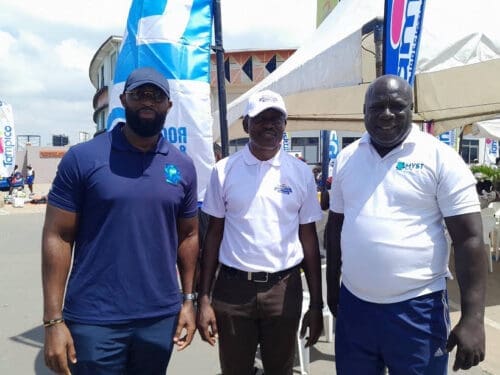
Nana Kwadwo Sarpong, chief executive of PNF Industries Limited, which produces Myst Water in Ghana, said the company joined the event because it promotes healthy living and runners need to stay hydrated. He said the water is sourced from springs in the Akuapem range.

Ethiopian Airlines, Capelli Sport and Zimansky Hotel were among the other sponsors, according to the organisers. The race began in 2022 as the Accra Inter-City Homowo Marathon, when Kenya’s Martin Tirop won the men’s 21-kilometre title in 1:04:45.

Bayelsa monarch Kenibara VII of Moko-Ama reported dead at 64

0

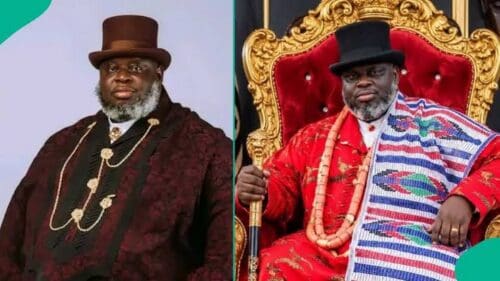
Moses Theophilus Kenibara VII, the Amadabo of Moko-Ama in Bayelsa State’s Akassa Kingdom, has died aged 64, according to Nigerian media reports and tributes posted from 8 October 2026.

Tributes on social media described the monarch as a peacemaker who pushed for unity and development in the Niger Delta. Several Nigerian outlets have reported his death, but the date and place of death have not been made public.

Nigerian news site TheNewsGuru reported that he died from complications after liposuction surgery. Other outlets repeated that account. It has not been independently confirmed.

Moko-Ama is in Sangana, one of the main Akassa settlements in Brass Local Government Area. The Akassa are an Ijaw people who live along the Nun River estuary and the Atlantic coast of southern Bayelsa. Amadabo is the title of the community’s traditional ruler.

According to the reports, Kenibara was crowned in 2016 and called the stool a divine calling. He later became chairman of the Akassa Clan Council of Chiefs, succeeding Chief Newton Igbani-Okuru. In that role, he campaigned for unity among the royal houses and backed efforts to give the council a written constitution. He also chaired the Central Zone of the Ijaw National Congress, the pan-Ijaw socio-cultural organisation.

By Monday 12 October, NewsGhana had found no public statement from his family, the Akassa Clan Council of Chiefs or the Bayelsa State Government confirming the death or its cause.

Dafeamekpor rebukes ex-GBA president Boafo over Pre-Bar criticism

0

Majority Chief Whip Rockson-Nelson Dafeamekpor on 11 October accused former Ghana Bar Association (GBA) president Yaw Acheampong Boafo of attacking Ghana’s legal education reforms without reading the law.

The South Dayi MP said in a social media statement that Boafo’s remarks in a recent television interview were disappointing because a former head of the Bar carries weight with the public. He challenged Boafo to name any provision of the 1992 Constitution or the Legal Education Act, 2026 (Act 1170) that bars the new Pre-Bar programme.

The dispute is about whether the system now moving law graduates towards the Bar has a lawful basis. The one-year Pre-Bar course was scheduled to begin in August or September 2026. Law faculties were told to prepare for an accreditation process expected to open this month. If the course’s legal basis is in doubt, so is the route that Bachelor of Laws (LLB) graduates and backlog students have been told to take to qualify as lawyers.

Boafo, who led the GBA from 2021 to 2024, said in the interview that Ghana was training lawyers contrary to the law. He said the Act had created a new regulator, the Council for Legal Education and Training (CLET), but the body had not been set up. In its absence, he said, the Chief Justice and the Attorney-General had used its powers to create the Pre-Bar course and accredit institutions. He said he objected to how the reforms were carried out, not to reform itself. He also said people within the legal system had been sidelined while outsiders drove the changes.

Dafeamekpor said Boafo had ignored Section 93 of Act 1170, which he described as the law’s transitional provisions. He said Boafo had also ignored the interim directives issued in June by Professor Raymond Atuguba, Director of Legal Education and Director of the Ghana School of Law, which he said set out how the reforms would be implemented. He accused Boafo of going on national television to condemn a law he had not read and programmes he did not believe in.

The lawmaker said the debate should turn on the text of the law and the evidence, not on the standing of whoever is speaking. He said Boafo needed to understand that “the legal profession in Ghana is not the sole proprietorship of some of you”.

Atuguba’s directives were issued on behalf of the Attorney-General after the Act had been passed, signed and gazetted, but before the CLET had been constituted. Under the directives, law faculties accredited by the Ghana Tertiary Education Commission can run the Pre-Bar course themselves, partner with the Ghana School of Law, or send students to the school. The course is open to this year’s LLB graduates and to the backlog of graduates awaiting professional training. Students who complete it move on to practical Law Practice Training, which accredited universities are expected to run in full from the 2027/2028 academic year.

Parliament passed the Legal Education Bill in March 2026, and President John Dramani Mahama signed it into law in May. The Act ends the Ghana School of Law’s exclusive control of professional legal training and introduces a National Bar Examination for all aspiring lawyers. Chief Justice Paul Baffoe-Bonnie described the Act in June as a mature step towards transforming legal education.

Dafeamekpor has campaigned on this issue for years. In November 2021, he and Madina MP Francis Xavier Kojo Sosu submitted a memo seeking a bill to amend the Legal Profession Act, 1960 (Act 32). Their proposal would have allowed accredited law faculties to run professional law courses and removed the Chief Justice and other Supreme Court justices from the General Legal Council.

No public response from Boafo to the MP’s statement had been reported by Monday morning. Law faculties seeking accreditation to run Law Practice Training are expected to begin applying this month.

Medeama go three clear as AshantiGold end Samartex unbeaten run

0

Champions Medeama moved three points clear at the top of the Ghana Premier League with a 3-1 win over Heart of Lions, while Hearts of Oak climbed to second.

The Matchday Six results, played over the weekend of 10 and 11 October, leave Medeama on 14 points from six games and Hearts on 11. The weekend also ended Samartex 1996’s unbeaten start to the season.

Medeama pull away

Emmanuel Annor, signed from Nations FC in the summer, opened the scoring for Medeama at the TnA Stadium. Kingsley Braye then struck twice in two minutes to put the game beyond Heart of Lions. Kofi Mawutodzi Agbadji replied for the visitors, whose coach, Bashir Hayford, was named the league’s Coach of the Month for September.

Hearts of Oak ended a two-match winless run with a 1-0 win over newly promoted Port City, with Frank Duku’s header the only goal.

Obuasi fortress holds

FC AshantiGold 04 handed Samartex their first league defeat of the season, winning 1-0 in Obuasi through Raphael Ankamah’s 15th-minute penalty. The result stretched AshantiGold’s unbeaten home run in the league to 18 matches.

Bechem United produced the comeback of the weekend, beating Vision FC 4-2 after trailing 2-1. Yaw Acheampong equalised, Kofi Tompuo put Bechem ahead late on, and a stoppage-time own goal sealed it.

Young Apostles ended a three-match losing run, and Aduana FC’s three-match winning streak, with a 1-0 win secured by Samuel Prempeh’s penalty just before half-time. Karela United made it three home wins in a row by beating Dreams FC 1-0 through Malik Abubakar.

Relief at the bottom

Two sides climbed out of the relegation zone. Berekum Chelsea beat league debutants Debibi United 3-0 with goals from Stephen Kwakye, Dramani Awuah and Emmanuel Ofosu. Kwame Opoku scored twice as Bibiani Gold Stars beat Basake Holy Stars 2-0 at Dun’s Park to rise to 14th.

Matchday Six results

  • Medeama 3-1 Heart of Lions
  • Hearts of Oak 1-0 Port City
  • Bechem United 4-2 Vision FC
  • Young Apostles 1-0 Aduana FC
  • Berekum Chelsea 3-0 Debibi United
  • Bibiani Gold Stars 2-0 Basake Holy Stars
  • FC AshantiGold 04 1-0 Samartex 1996
  • Karela United 1-0 Dreams FC

All 23 Ghanaian banks now meet capital rules, BoG says

0

All 23 banks in Ghana now meet regulatory capital requirements, the Bank of Ghana (BoG) said, ending breaches that hit 13 lenders after the country’s debt crisis.

Governor Dr Johnson Asiama announced the milestone at the 43rd Annual General Meeting of the Ghana Association of Banks in Accra on 8 October. “This is a significant achievement,” he said, crediting banks, shareholders, investors, the association, the government and the central bank.

The milestone closes a chapter that began when the government’s Domestic Debt Exchange Programme forced losses on holders of government bonds. Banks took heavy impairments on those holdings. Their audited 2022 accounts showed 13 banks below the capital limits, and they spent the following years rebuilding through fresh capital, retained profits and regulatory forbearance.

A bigger, stronger sector

The industry has grown quickly as conditions improved. Total banking assets rose 20.47 per cent year on year to GH¢500.20 billion at the end of August 2026, from GH¢415.20 billion. The capital adequacy ratio improved to 19.10 per cent from 18.28 per cent, and the non-performing loans ratio fell to 15.66 per cent from 20.77 per cent.

Lending is also picking up. Private-sector credit grew 35.5 per cent year on year in August, and the average lending rate fell to 15.9 per cent from 24.2 per cent a year earlier.

Minimum is not enough

Asiama said meeting the minimum was only a starting point. Banks must hold capital that matches their risk profiles and build buffers for future shocks, he said, because the risks they face are becoming more complex.

The central bank reviewed the sustainability of banks’ business models in 2025 and shared the weaknesses it found with each institution. It plans a second review next year. It has also tightened its stress-testing framework and is discussing the results with banks, which are expected to use them in capital and liquidity planning.

Two new rules are on the way: a Credit Risk Management Directive to strengthen lending standards, and a Liquidity Coverage Ratio Directive requiring banks to hold enough liquid assets to survive 30 days of stress. The central bank has opened public consultation on the liquidity rule.

Asiama also said cybersecurity, digital fraud and data protection are drawing closer supervisory attention. The Bank will review how banks are applying its revised Cyber and Information Security Directive, and he urged boards to treat cyber risk as a core business risk.

Banks still face a December 2026 deadline to bring non-performing loans down to 10 per cent of their books.

AMA plans free single-room homes for fire-hit Kofikrom residents

0

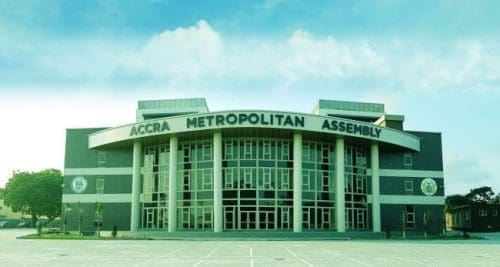
The Accra Metropolitan Assembly (AMA) plans to build free single-room homes for residents of Kofikrom, less than two weeks after a fire and demolitions cleared much of the squatter settlement.

Mayor of Accra Michael Kpakpo Allotey announced the plan during a visit to the site at Avenor, in the North Industrial Area, where workers are clearing debris. The project would replace the settlement’s wooden shacks with rows of single-storey block buildings, with streetlights, walkways, sanitation facilities and tarred access roads. He said corporate partners would be asked to supply roofing materials, lighting and other infrastructure.

The plan marks a sharp turn in the Assembly’s approach. On 1 October, the AMA, backed by the Ghana Armed Forces’ 48 Engineer Regiment, demolished wooden structures at Kofikrom. It said shacks built on the road had stopped fire tenders and water tankers reaching parts of the settlement during a major fire that also damaged parts of the Duraplast factory next door. Occupants had been ordered to leave months earlier. The Assembly has tried to clear the site since at least 2022, when it marked more than 100 structures for removal over flooding and sanitation concerns.

Conditions attached

Allotey said the rooms would be free and would not be rented or sold, stressing that the land belongs to the government and that residents would gain no ownership rights. He warned that drug abuse, the sale of illicit substances and gang activity would not be tolerated in the redeveloped community.

Allotey, who has spoken publicly about growing up on the streets, said his past shaped his view of the residents’ plight. “I’m coming from the street,” he told them.

He asked residents to choose five representatives to work with the Assembly on consultations and implementation. He did not give a cost, the number of rooms, the corporate partners involved or a start date. He said the simple design should allow quick construction.

The AMA has not said how many people lived at Kofikrom before the fire, or how many will be housed.

Basic schools reopen as teachers suspend two-week strike

0

Public basic schools across Ghana reopened on Monday, 12 October, after three teacher unions suspended a two-week strike in return for dated government commitments on arrears and allowances.

The Ghana National Association of Teachers (GNAT), the National Association of Graduate Teachers (NAGRAT) and the Pre-Tertiary Teachers Association of Ghana (PRETAG) walked out on 25 September over conditions of service. They called off the action on Friday, 9 October, after a day of talks with the Ministry of Labour, Jobs and Employment, the Council of State and the Fair Wages and Salaries Commission (FWSC).

The return comes with a clear deadline attached. Union leaders say the suspension depends on the government meeting its commitments and have warned that the strike will resume if it does not.

What the government agreed

Under a communiqué signed by the FWSC, the Ghana Education Service (GES) and the three unions:

  • An initial 51,000 promoted teachers will be placed on their new salary scales and paid their arrears with October salaries by 16 October.
  • All remaining promotion arrears will be paid by 31 October.
  • A digital instruction support allowance will be paid in November.
  • A professional development allowance will be paid in December. GNAT says this will rise to GH¢3,100, tax-free.

The promotion backlog is large. NAGRAT said earlier in the strike that only a little over 6,000 of nearly 60,000 teachers who had received promotion letters had been placed on their new scales.

GNAT General Secretary Thomas Musah said talks on outstanding issues would continue. “The issues have not been completed,” he said.

Ministry welcomes return

In a statement signed by its Press Secretary, Hashmin Mohammed, the Ministry of Education described the suspension as a positive step towards resolving the dispute through dialogue. It thanked teachers, parents and learners for their patience and pledged to keep working with the unions and the FWSC on teachers’ welfare.

The GES is consulting stakeholders on how to recover lost teaching time. Options include extending school hours and shortening breaks.

Unrest elsewhere in education

Pressure is building at the tertiary level. Kwame Nkrumah University of Science and Technology has postponed the reopening of its 2026/27 academic year indefinitely because of a strike by the Ghana Association of University Administrators. The University of Ghana branch of the University Teachers Association of Ghana has threatened to strike from 19 October over unpaid book and research allowances.

The first test of the teachers’ deal comes on 16 October, the deadline for paying the first batch of promotion arrears.

Lizzy Anjorin demands ₦50m each from Iyabo Ojo, bloggers

0

Nollywood actress Lizzy Anjorin Lawal has threatened Iyabo Ojo, her daughter Priscilla and more than 100 bloggers with ₦50 million claims each unless they remove content she calls defamatory.

In cease-and-desist notices dated 3 October 2026, her lawyers, A.U. Enahoro, Bayo Akinlade and A.U.E. Ogboi, demanded that the recipients take down the material immediately and publish a retraction and apology. They gave a seven-day deadline, after which they said they would claim ₦50 million in damages from each person and platform that fails to comply.

The notices accuse the recipients of publishing false content about Anjorin, her family and her businesses on YouTube, Instagram, Facebook and TikTok to attract traffic and earn revenue. The lawyers also said some of those named had made criminal allegations against her during live broadcasts without any police report or court judgment to back them.

The move reverses the direction of a legal fight that has so far run against Anjorin. On 2 September, a Lagos State High Court granted an interim order sought by Priscilla Ojo Mkambala and her husband, Tanzanian singer Juma Jux. The order restrained Anjorin from posting photographs of the couple’s infant son and from publishing content about the family on her listed social media accounts. It was granted ex parte, without Anjorin being heard, pending a full hearing.

Iyabo Ojo had earlier sued Anjorin for defamation over posts made during a public feud that began in 2023. A judge later urged both actresses to end their social media exchanges.

The seven-day deadline in the notices expires on 10 October if counted from their date. Neither Iyabo Ojo nor Priscilla Ojo has been reported to have responded publicly to the notices. Anjorin has not said whether she has filed suit.

BoG proposes first liquidity coverage rule for banks

0

The Bank of Ghana (BoG) has proposed its first prudential liquidity benchmark for banks, requiring them to hold enough high-quality liquid assets to survive 30 days of severe stress.

The central bank has opened public consultation on a draft Liquidity Coverage Ratio (LCR) Directive and invited banks and the public to comment by 30 November 2026. Submissions go to [email protected]. The BoG says it will consider all material comments and explain in writing how each was handled, including whether it was adopted.

The rule would set a hard minimum for how much cash and easily sold assets a bank must keep against the money that could leave it in a crisis. Governor Dr Johnson Asiama told bank chief executives on 6 October that the LCR would introduce the first prudential benchmark for banks’ liquidity. It would complement the Liquidity Risk Management and Liquidity Monitoring Tools directives already issued. Speaking to the Ghana Association of Banks two days later, he said the ratio should become part of a broader liquidity risk culture in banks rather than another compliance figure.

Why now

The proposal comes as lending accelerates. Private-sector credit grew 35.5 per cent year on year in August 2026, up from 13.3 per cent a year earlier, Asiama said. Faster loan growth draws on the same funds banks would otherwise hold as liquid buffers.

Ghana’s banks are in stronger shape than they were after the 2022 debt crisis. The industry capital adequacy ratio stood at 19.10 per cent at the end of August, and non-performing loans fell to 15.66 per cent from 20.77 per cent a year earlier. The NPL figure is still well above the 10 per cent ceiling banks must meet by December.

The LCR follows a model set out by the Basel Committee on Banking Supervision. Under the Basel standard, a bank’s stock of high-quality liquid assets must at least equal its expected net cash outflows over a 30-day stress period, a ratio of 100 per cent.

What banks will watch

How the BoG defines high-quality liquid assets will shape the impact. If government securities count heavily, the rule could push banks to hold more of them at a time when Treasury bill yields have fallen to multi-year lows. That would affect bank profitability and how much they lend. Treasury desks will also need new systems to measure and report the ratio.

Credit rules next

The central bank is also preparing a Credit Risk Management Directive to complement the Non-Performing Loans Notice it issued in 2025. It will cover the full lending cycle, from credit origination and administration to monitoring, measurement and recovery.

The final form of both rules will depend on the consultation.

Deputy minister urges telcos to back Ghana’s creative industry

0

Deputy Communications Minister Mohammed Adams Sukparu has urged MTN Ghana and other digital firms to invest in local creative production, saying public money alone will not be enough.

Sukparu, Deputy Minister for Communication, Digital Technology and Innovations, made the call at the launch of MTN One TV in Accra. He said the government had provided GH¢20 million in seed funding for a creative arts fund but needed private partners to grow the sector. “The government cannot do it alone,” he said.

The appeal puts the spotlight on telecom operators, which control the networks and payment systems that now carry much of Africa’s entertainment. MTN One TV, a pan-African streaming service, combines live TV channels, local African series and films, and international programming, with mobile money payment options. MTN Group is rolling it out gradually across its 16 African markets and their 307.2 million subscribers. It is the company’s second attempt at streaming, nearly a decade after an earlier venture failed to gain traction, according to BusinessDay.

What the government has committed

The GH¢20 million comes from the 2026 Budget. Finance Minister Dr Cassiel Ato Forson set aside GH¢40 million in seed money for the creative economy: GH¢20 million for a Creative Arts Fund covering music, fashion, food and other creative sectors, and GH¢20 million for a separate Film Development Fund.

Releases have lagged behind the budget figures. When the National Film Authority launched the Film Development Fund on 20 May, it said only GH¢5 million of that fund’s GH¢20 million had been paid. No disbursement figures have been published for the Creative Arts Fund.

Beyond money

Sukparu said Ghana had abundant creative talent but lacked the systems to help it grow, attract investment and compete abroad. He named affordable connectivity, digital skills and stronger intellectual property protection as priorities. He added that the industry should be prepared to use artificial intelligence without compromising creators’ rights.

He singled out MTN Ghana as having the networks, technology and platforms to support new productions and emerging talent. He also urged the company to work with government on mechanisms to finance the sector.

Tourism, Culture and Creative Arts Minister Abla Dzifa Gomashie said the launch was a step towards making Ghanaian culture commercially viable rather than simply preserving it.

US adds 24 Nigerians to ICE deportation register

0

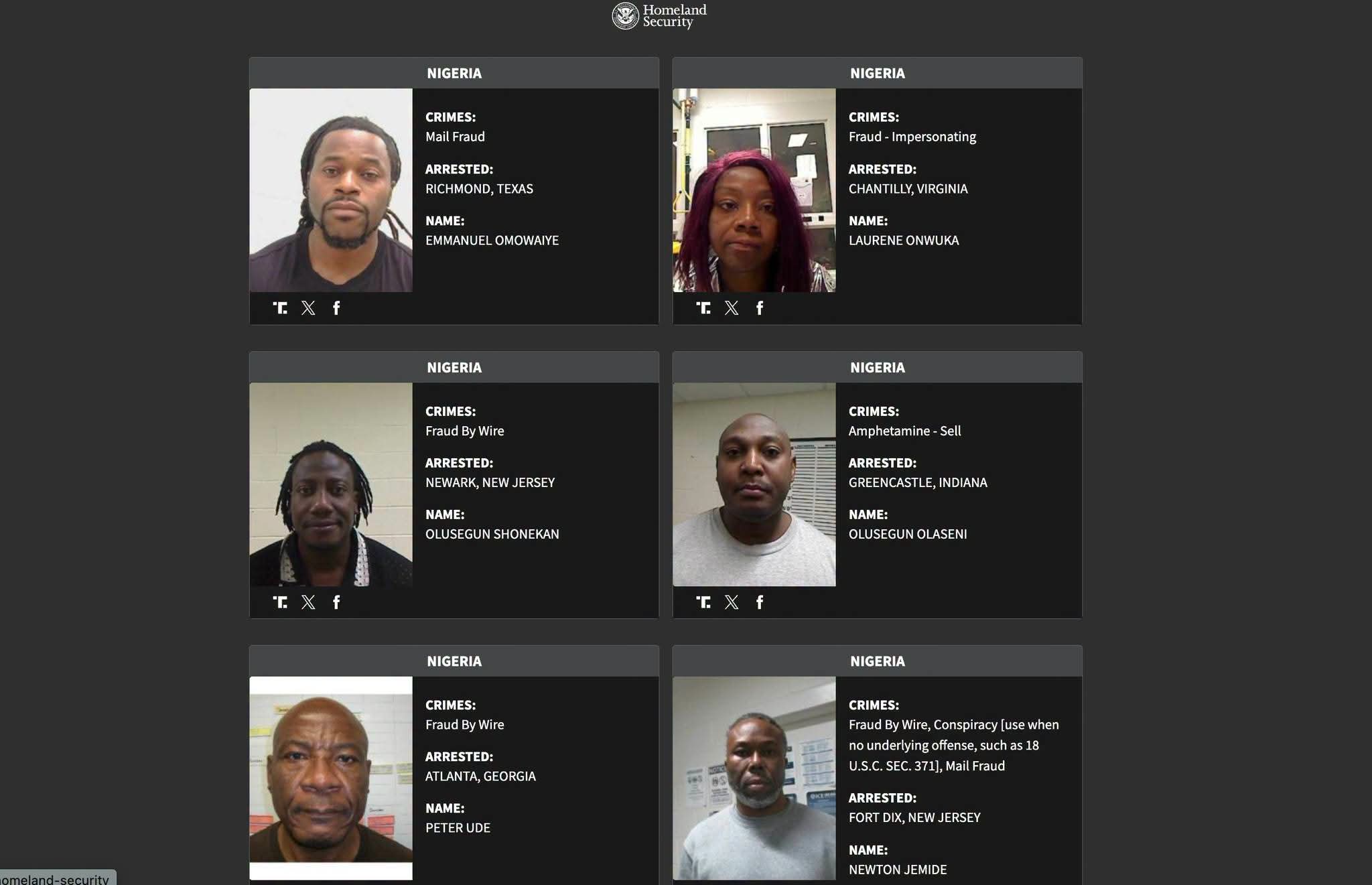
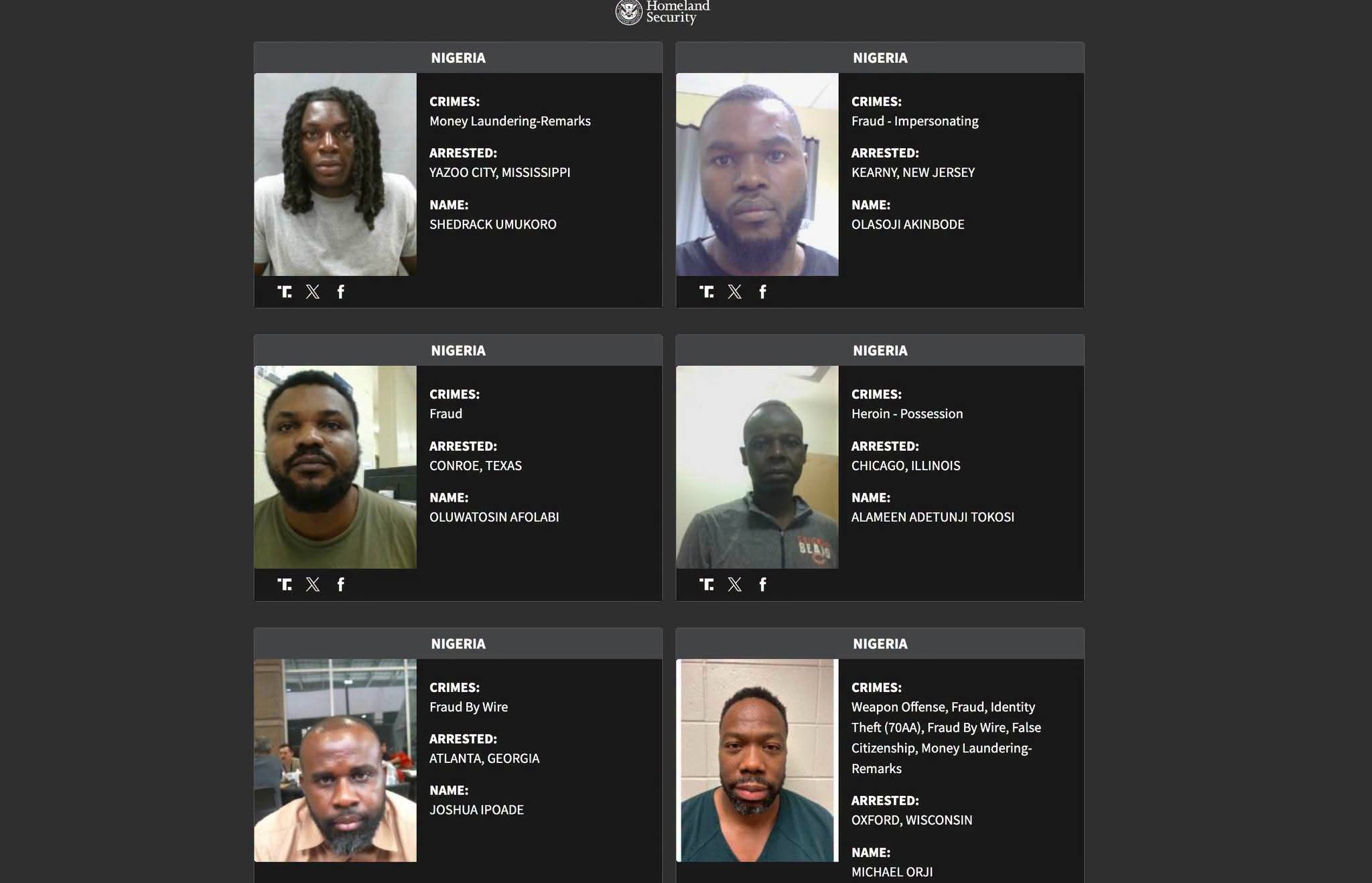
The US Department of Homeland Security (DHS) has named 24 more Nigerians arrested by immigration officers, mostly over fraud and money laundering offences, adding to its public deportation register.

The department published the names, photographs and offences on Thursday, 8 October, as part of an online register of non-citizens arrested by US Immigration and Customs Enforcement (ICE). It describes them as “the worst of the worst” and says the arrests serve President Donald Trump’s pledge of mass deportations.

The list keeps Nigerians among the most frequently named nationalities on the register. Earlier updates this year named 79 Nigerians, then 18 more, and by July the total listed had passed 124, according to Nigerian media tallies.

What the list shows

Financial crime dominates. Nineteen of the 24 cases involve wire fraud, mail fraud, identity theft, impersonation, forgery or money laundering. The rest involve drug offences, assault, and one case of child cruelty.

Several of the arrest locations are towns that host US federal prisons, including Fort Dix in New Jersey, Yazoo City in Mississippi, White Deer in Pennsylvania, Thomson in Illinois and Lompoc in California. That suggests a number of the people listed were taken into immigration custody from prison after serving criminal sentences, rather than arrested in the community. DHS does not say for each case whether the offence listed is a conviction or a pending charge, or where each person stands in removal proceedings.

The arrests were made across at least 14 states, from Texas and Georgia to Washington and Utah.

Diplomatic backdrop

The register has become a recurring source of friction between Washington and Abuja. The United States imposed partial visa restrictions on Nigerian citizens in June 2025, and immigration enforcement has intensified since. Nigerian authorities have not publicly responded to the latest list. Past removals have been coordinated with Nigerian agencies that receive returnees.

For Ghanaians and other West Africans in the United States, the pattern matters because the register has repeatedly named nationals of several African countries. DHS has said it will keep adding names as arrests continue.

Nana Akua’s husband to be arraigned after hospital discharge

0

Police say Harold Norman, husband of fashion personality Rosemond Akua Adobea, known as Nana Akua, will be arraigned on domestic abuse allegations once he is discharged from hospital.

Norman was due in court on 7 October, but his lawyer told police he had been admitted to hospital, according to a statement issued that day by the Criminal Investigations Department (CID). The statement, signed by CID Public Relations Officer Chief Inspector Francis Kwesi Yeboah, said investigators from the Domestic Violence and Victim Support Unit (DOVVSU) visited the hospital to verify the claim. They are monitoring his condition so he can be brought before the court immediately after discharge.

The case has drawn wide public attention since videos linked to the allegations circulated online. The CID said its statement was issued in response to that interest.

How the case developed

The CID said Ms Adobea petitioned its Director-General on 20 August 2026, alleging that her husband had subjected her to physical, emotional and economic abuse. Preliminary checks showed DOVVSU had already handled a case involving the couple at the Lakeside and Ministries police stations in July.

Police arrested Norman at his home on 27 August to assist with investigations. He gave a caution statement and was granted police enquiry bail on 29 August with two sureties.

Norman has not been convicted of any offence.

His response

In a statement on 6 October, Norman’s lawyers denied that he caused the injury shown in images circulating online. They said the incident dated back to 2021 and that the matters were before DOVVSU and a civil court. They said he had chosen not to respond in detail because the issues were under legal process.

Support for the family

The CID said it was working with the Ministry of Gender, Children and Social Protection to provide social welfare support for Ms Adobea and her children. The Minister, Dr Agnes Naa Momo Lartey, has visited the family and said they would receive psychosocial support.

Ms Adobea has appealed for videos involving her children to be taken down.

No new date has been announced for the court appearance.

Government to build psychiatric hospitals in Ashanti, Northern, Volta

0

Government will build three psychiatric hospitals in the Ashanti, Northern and Volta regions, President John Dramani Mahama said on 10 October, expanding a network now confined to the south.

Mahama announced the plan at a Citizens’ Engagement Open Forum in Goaso, the Ahafo Regional capital, at the end of a two-day Resetting Ghana tour of the region. He did not give a cost or timetable.

The new facilities would more than double the number of specialist psychiatric hospitals. Ghana’s three existing ones are the Accra Psychiatric Hospital, Pantang Psychiatric Hospital near Accra, and Ankaful Psychiatric Hospital near Cape Coast in the Central Region. Patients from the north and Volta often travel hundreds of kilometres for specialist care. Advocates in Tamale have noted that referrals from the Upper East and Upper West regions can involve journeys of more than 600 kilometres to Pantang or Ankaful.

Mahama acknowledged the gap earlier this year, telling the Northern Regional House of Chiefs that none of the five northern regions had a psychiatric hospital. At the time, he directed the Minister of Health to review a stalled psychiatric hospital project at Mion in the Northern Region and prioritise its completion.

Since the Mental Health Act, 2012 (Act 846) came into force, regional hospitals have opened psychiatric units to bring care closer to patients. Staffing remains thin, however. Ghana Mental Health Authority figures from 2022 counted 39 psychiatric doctors, about 2,463 psychiatric nurses and 244 psychologists for a population of more than 31 million.

Mahama also urged young people to train in critical health professions to help close staffing gaps across the sector.

US health compact

At the same forum, Mahama said the United States had asked for talks on the clauses Ghana objected to in a proposed US$109 million health compact, which Cabinet rejected over demands for the country’s pathogen profile and citizens’ medical records.

Ministers travelling with the President, including those for Food and Agriculture, Roads and Highways, Trade, and Local Government, also briefed residents on their ministries’ work in the region.