B2B trade could drive Africa’s stablecoin boom, says GSN chief

0

Business payments, not remittances, could become the main use of stablecoins in Africa, according to Ryan Kirkley, Chief Executive of the digital settlement firm Global Settlement Network (GSN). He warned, however, that faster transfers will not cut costs unless banks and liquidity providers can reliably convert the money at either end.

Stablecoins are digital tokens pegged to a currency, usually the United States (US) dollar. Their use by businesses is growing fast. Consultancy McKinsey estimated in February that business-to-business stablecoin payments reached about US$226 billion a year, based on December 2025 activity. That is roughly 60 per cent of genuine stablecoin payment volume, though still a tiny share of global business payments.

“I think B2B trade has the potential to become one of the largest sources of stablecoin payment volume in Africa,” Kirkley said in written responses to NewsGhana.

A dollar problem, not a technology problem

For African firms, Kirkley said, demand comes down to access to foreign currency. He gave the example of a Nigerian electronics importer buying stock from Shenzhen. The importer may have customers waiting and enough naira in the bank, but still face weeks of delay obtaining the dollars to pay the supplier.

He expects the biggest disruption in the chain of correspondent banks that sits between a bank in Accra and a supplier’s bank in Guangzhou. Each extra account in that chain, he said, adds liquidity costs, reconciliation work and another possible delay. The Bank for International Settlements (BIS) has documented a long decline in correspondent banking relationships, which has left some smaller economies with limited access to international payments.

Other parts of the system will stay. “What remains essential is trade credit, FX liquidity, sanctions screening and local-currency access,” Kirkley said. A letter of credit still protects a supplier against non-payment, and a bank still has to check the customer and the underlying trade.

Savings depend on the exchange rate

Kirkley said the real cost of cross-border payments often lies in currency conversion, not in the transfer itself. He used a Ghanaian importer paying US$300,000 to a supplier in Dubai as an example. A 1 per cent spread on that payment costs US$3,000, however cheaply the stablecoin transfer settles.

“A provider with limited liquidity can easily absorb the savings through its conversion spread,” he said. For businesses, he said, three things matter: the final amount the supplier receives, a guaranteed exchange rate, and the time the payment takes to complete.

Scale also matters. A provider quoting a good rate on US$1,000 may not have the depth to move US$500,000 without the price slipping, he said. That is why he argues banks and liquidity providers must commit funds in advance against defined settlement obligations.

Risks for small firms

Kirkley cautioned smaller businesses against assuming a stablecoin payment is safe simply because the token holds its dollar value. He listed several risks: the receiving provider may lack the liquidity to convert the funds; the issuer may have weak reserves or limited redemption rights; and a payment sent to a compromised wallet usually cannot be reversed. Different countries also regulate payment providers in different ways.

He added that a firm earning in cedis but holding dollar stablecoins remains exposed to movements in the cedi-dollar exchange rate. Before moving large sums, he said, he would want verified counterparties, clear redemption rights, institutional custody and a compliant banking route in place.

A role for banks and regulators

Kirkley said African banks could become infrastructure providers in their own right, not just intermediaries. They could supply local-currency liquidity, issue tokenised deposits backed by their balance sheets and settle directly with banks in markets such as the United Arab Emirates. He pointed to the BIS’s Project Agorá, which is testing how tokenised bank deposits and central bank money can support cross-border payments.

He said central banks must be involved from the start. If importers move a large share of their working capital into dollar stablecoins, he warned, it could reduce demand for local-currency deposits and limit central banks’ view of capital flows.

Ghana has started to set rules. Its Virtual Asset Service Providers Act, 2025 (Act 1154) requires firms promoting virtual assets to register with both the Bank of Ghana and the Securities and Exchange Commission. In February 2026, the central bank barred providers from mass advertising of virtual asset and stablecoin products without express permission, and ordered billboards in Accra taken down.

Kirkley expects adoption to concentrate first in established trade corridors with China, India, the UAE and Europe, where importers struggle to obtain dollars. By 2031, he said, a meaningful share of business payments in Africa’s main trade corridors could settle through stablecoins and tokenised bank money.

GSN, which builds settlement infrastructure for digital assets, raised US$11 million in pre-seed funding in May 2026 and says it has secured more than US$125 million in committed settlement liquidity.

Infantino urges more chances for African players at CAF summit

0

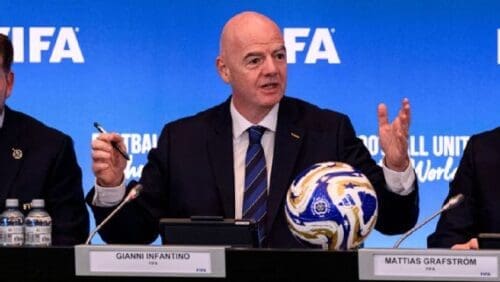
FIFA President Gianni Infantino said on Thursday, 8 October 2026, that young African footballers should not have their careers limited by where they were born. He was speaking at the opening of the Confederation of African Football’s (CAF) strategy conference on Cabo Verde’s Sal Island.

“African talent has shaped and is increasingly shaping the world,” Infantino told delegates in Santa Maria, the Cabo Verdean news agency Inforpress reported. He said FIFA had invested about US$1 billion in African football through its Forward development programme over the past decade.

His appeal came on the same day CAF President Patrice Motsepe pledged the backing of Africa’s 54 football associations for Infantino’s bid for a fourth term. The vote takes place in Rabat, Morocco, in March 2027. Africa is the largest voting bloc in FIFA’s 211-member Congress, and its support matters more now that UEFA, the Asian Football Confederation and CONCACAF have withdrawn theirs. Those three confederations turned against Infantino after his abandoned plan to sell up to 20 per cent of FIFA tournament rights to private investors.

The three-day conference, which ends on Friday, brings together CAF member association presidents, national team coaches and experts. They are reviewing African teams’ performances at the 2026 World Cup and planning for 2030.

Motsepe said the meeting gave each association more time to raise concerns than CAF’s general assemblies allow, and to identify where African football must improve. He called for closer cooperation between football associations, governments and sports ministries.

Infantino praised the hosts’ national team. On their World Cup debut, Cabo Verde’s Blue Sharks went unbeaten in a group that included Spain and Uruguay and reached the knockout stage.

Cabo Verde Football Federation President Mario Semedo said hosting the conference reflected international recognition of the islands’ football development and would promote Cabo Verde as a destination for tourism and international events.

Ghana declares yellow fever outbreak after three deaths in Upper West

0

Ghana’s Ministry of Health has declared a yellow fever outbreak in the Upper West Region after three laboratory-confirmed cases, all of which ended in death.

Health Minister Kwabena Mintah Akandoh announced the outbreak in a statement on Thursday, 8 October 2026. The confirmed cases are in the Wa West and Sissala West districts. Health facilities in the two districts began reporting suspected cases, with fever, jaundice and bleeding, from 9 September. Samples were first tested in Ghana and then confirmed by a World Health Organization (WHO)-accredited laboratory in Dakar, Senegal.

The patients died “despite aggressive management by our health staff,” the ministry said.

Vaccination campaign next week

The ministry has activated the national and regional public health emergency operations centres. It has sent rapid response teams into affected communities to find cases, step up surveillance and inform residents.

An emergency vaccination campaign is planned for this month in Wa West, Sissala West and Sissala East. Dr Franklin Asiedu-Bekoe, Director of Public Health at the Ghana Health Service, told JoyNews on Friday that the vaccine had been approved and the campaign would begin next week. He said suspected cases had been reported from seven districts in the region.

The official count may rise. JoyNews reported on 6 October that at least seven people had died in Sissala East Municipality during the outbreak. The ministry has so far confirmed three deaths.

What residents should do

The ministry urged anyone with sudden fever, headache, muscle pain, yellowing of the eyes or skin, or unusual bleeding to go to the nearest health facility immediately and not to self-medicate. It also advised residents to clear stagnant water around their homes and to use insecticide-treated nets and repellents, including during the day.

Yellow fever is a viral disease spread by mosquitoes that bite mainly in daytime. A single dose of vaccine gives lifelong protection, according to the WHO. Ghana includes the vaccine in its routine childhood immunisation programme and requires proof of vaccination from travellers arriving in the country.

The Upper West has faced the disease before. In November 2021, yellow fever killed at least six people in the region.

Ivorian cocoa seized en route to Ghana as prices slip

0

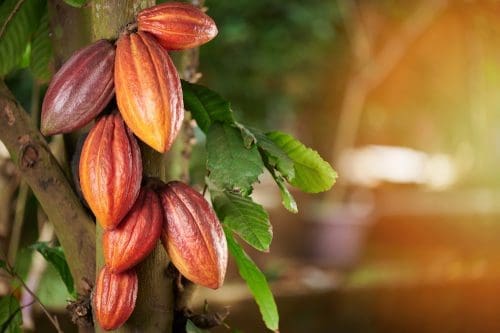
Ivorian authorities seized 42 tonnes of cocoa bound for Ghana on 4 October 2026, a sign that smuggling across the border is rising as unofficial buyers outbid Côte d’Ivoire’s state-set farm price.

The seizure, of 492 bags valued at about CFA50 million, took place at Ebilassokro in the Abengourou area, according to the Ivorian state news agency AIP. The trucks were heading for the Kati border crossing. One vehicle crossed into Ghana before it could be stopped, and AIP said talks are under way for its return.

Cooperatives around Abengourou have reported unofficial buyers offering CFA1,500 to CFA1,600 a kilogram, against an official Ivorian farmgate price of CFA1,200, according to a market briefing from CocoaRadar, a cocoa intelligence service. Ghana opened its 2026/27 season on 25 September with a producer price of GH¢42,400 a tonne, up 2.4 per cent on last season. The Ghana Cocoa Board (COCOBOD) said the price is 71.18 per cent of the realised gross export value.

Harder to read the world’s top crop

The cross-border flow muddies the figures from Côte d’Ivoire, the world’s largest producer. Exporters’ estimates put arrivals at the ports of Abidjan and San Pedro at about 54,500 tonnes from the start of the season on 1 September to 4 October, CocoaRadar said. That includes 18,000 tonnes in the latest week.

The briefing noted that beans leaving through unofficial routes would make Ivorian arrivals understate the harvest, but would not remove that cocoa from world supply.

Prices have eased as rain returned to western Côte d’Ivoire. ICE New York December cocoa settled at US$5,582 a tonne on 7 October, down 1.6 per cent from 2 October, after briefly rallying to US$5,867 on 5 October. London December fell 1.5 per cent to £4,174 a tonne.

Inventories are also weighing on the market. Cocoa held in ICE-monitored US warehouses reached about 3.55 million bags, the highest in more than two years, although only about 424,000 bags were certified for delivery against futures.

Processors under pressure

Cargill, one of the world’s biggest cocoa processors, booked mark-to-market losses on cocoa in its fiscal first quarter to 31 August, Bloomberg reported from the company’s accounts. The losses came after New York futures rose more than 70 per cent between early June and the end of August. Cargill’s net income fell 52 per cent to US$927 million, although the previous year’s figure was boosted by a one-off US$455 million tax gain.

Demand signals remain mixed. European grindings, a measure of how much cocoa is processed, fell 4.6 per cent year on year in the second quarter, while North American and Asian processing rose. Swiss chocolate maker Lindt & Sprüngli has cut its 2026 organic sales growth forecast to 0 to 2 per cent, from 4 to 6 per cent. Third-quarter grinding figures are due around 15 October.

CAF pledges Africa’s 54 votes to Infantino’s FIFA re-election

0

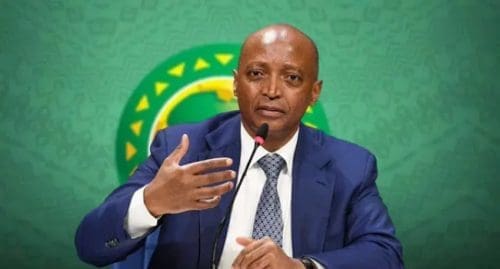
Confederation of African Football (CAF) President Patrice Motsepe has said Africa’s 54 football associations will back Gianni Infantino’s bid for a fourth term as FIFA President. Three other confederations have withdrawn their support.

Motsepe gave the pledge at CAF’s two-day strategy conference in Cape Verde, which ended on Thursday, 8 October 2026, according to reports from the meeting. He credited Infantino with funding the development of football across the continent.

Africa holds the largest bloc in FIFA’s Congress. Its 54 votes make up just over a quarter of the 211 member associations, and a candidate needs a simple majority of 106 to win. The election is scheduled for March 2027 in Rabat, Morocco. Candidates must declare by 18 November.

Support elsewhere has fallen away

The endorsement comes as Infantino faces the strongest opposition of his decade in charge. Europe’s governing body UEFA led resistance to the FIFA Forward Enterprise, a proposed US$20 billion scheme to sell up to 20 per cent of the commercial rights to FIFA tournaments, including the World Cup, to private investors. UEFA threatened to boycott FIFA competitions, and the plan was scrapped in August.

The Asian Football Confederation and CONCACAF, which governs the game in North and Central America and the Caribbean, have since withdrawn their backing for Infantino, as have some national associations, including the Netherlands. Prince Ali bin Al Hussein, president of the Jordan Football Association, has accused FIFA of holding back Arab Cup prize money owed to Jordan while asking for its endorsement. Jordan has said it will not back Infantino.

CAF stood by Infantino after the investment plan collapsed. Its Executive Committee reaffirmed its support on 6 August. In July, Motsepe called Infantino “a faithful friend, loyal to Africa”.

Infantino has kept close ties with African football since he was first elected in 2016. FIFA’s development programmes have funded stadiums, training centres and other projects on the continent.

New World Medical Association president calls burnout a system failure

0

Dr Jung Yul Park took office as President of the World Medical Association (WMA) on 9 October 2026. He pledged to protect doctors from burnout and violence and to set ethical rules for the use of artificial intelligence (AI) in medicine.

The South Korean neurosurgeon was installed at the association’s 77th General Assembly in Rotterdam, the Netherlands. He had been elected President-Elect at last year’s assembly in Porto, Portugal. He succeeds Dr Jacqueline Kitulu of Kenya.

In his inaugural address, Park named four pressures on the profession: widening health inequities and failing health systems, the effects of climate change on health, physician burnout and workplace safety, and the ethical questions raised by AI and digital healthcare.

He was blunt about doctors’ wellbeing. “Burnout is not a personal weakness, but a system failure,” he said. He added that poor working conditions and heavy legal risks are pushing physicians out of medicine. He also condemned continuing attacks on hospitals and health workers in conflict zones as violations of international law.

Six commitments

Park set out six priorities for his year in office. He promised to strengthen primary healthcare and to encourage national medical associations to work together to close gaps in health infrastructure. He pledged to defend doctors’ professional autonomy and to expand mentorship and improve working conditions for young physicians.

On technology, he committed to drawing up ethical guidelines that put people first, so that AI supports doctors rather than replacing them. He also pledged to help member associations prepare health systems for disasters and climate shocks, to defend international humanitarian law and medical neutrality, and to give junior doctors, women and physicians from the smallest associations a greater voice in the WMA.

Park has taught neurosurgery at Korea University since 1995. He chairs international affairs at the Korean Medical Association and is President of the Korean Academy of Neurological Sciences.

Outgoing president’s African focus

In her farewell address, Kitulu, the first Kenyan to hold the post, highlighted the association’s first African Leadership Conference, held in Livingstone, Zambia. She said it strengthened the Coalition of African National Medical Associations. She also pointed to a mentorship programme built with the Kenya Medical Association.

Kitulu said only six of the WMA’s previous presidents have been women, and called for deliberate efforts to give women the chance to lead.

The WMA represents national medical associations around the world and sets ethical standards for the profession, including the Declaration of Helsinki on medical research.

deVere chief says 10-year Treasury yield could reach 6%

Nigel Green, chief executive of financial advisory firm deVere Group, said on Friday, 9 October 2026, that the 10-year United States (US) Treasury yield could climb to 6 per cent. That would be its highest level since 2000.

The yield, which sets borrowing costs worldwide, reached 5.35 per cent on 8 October, its highest in 24 years, according to Trading Economics. It eased to about 5.26 per cent by Friday. Long-dated US yields have risen by more than 110 basis points so far this year.

Green said investors debating whether 5.5 per cent marks a danger point were aiming too low. “Every force driving yields upward is still firing,” he said. He argued that heavy government borrowing, sticky inflation and the prospect of further interest rate rises would keep pushing yields higher.

Rate rises back in view

Expectations for tighter monetary policy have been building. Markets put the odds of a quarter-point rate rise by the Federal Reserve in December at roughly 70 to 80 per cent, Trading Economics reported. Minutes of the Fed’s September meeting showed most policymakers expect another increase this year. Governor Christopher Waller said further rises would probably be needed, but that the Fed has flexibility on timing.

Higher energy costs, linked to tensions in the Middle East, have added to price pressures. A gauge of prices in the US services sector reached a four-year high. Rising federal deficits and a heavy pipeline of corporate bond sales have increased the supply of debt competing for buyers.

Demand still strong at auction

Investors have not stepped away. The Treasury sold US$39 billion of 10-year notes on 7 October at a yield of 5.300 per cent, slightly below the 5.317 per cent expected before the sale. Bids totalled 2.77 times the amount on offer, against an average of 2.54. Indirect bidders, a group that typically includes foreign central banks, took 80.34 per cent of the notes.

Green warned that rising yields could weigh on stocks and credit markets. A government bond paying close to 6 per cent with little risk of default competes with every share, he said.

The rise in US yields matters well beyond Wall Street. Higher returns on Treasuries tend to draw investment out of riskier markets and raise borrowing costs for governments and companies that borrow in dollars.

Mega African Capital narrows first-quarter loss to GH¢2 million

0

Mega African Capital Limited, an investment firm listed on the Ghana Stock Exchange (GSE), cut its net loss by 80 per cent to GH¢2.00 million in the first quarter of 2026, from GH¢10.04 million a year earlier.

The improvement came almost entirely from lower borrowing costs, according to the company’s unaudited statements for the three months to 31 March 2026. Finance costs fell 82 per cent to GH¢1.82 million, from GH¢10.06 million, as the firm kept repaying the fixed-term deposits it holds for clients.

The core business weakened. Investment and operating income dropped 65 per cent to GH¢79,982, from GH¢228,438. Administrative, legal and professional expenses rose 26 per cent to GH¢205,026. That left an operating loss of GH¢172,551, against a small operating profit of GH¢18,306 a year earlier.

A GH¢6.41 million rise in the market value of its investments, booked in other comprehensive income, lifted the quarter’s total comprehensive income to GH¢4.41 million. In the same period of 2025, the company recorded a comprehensive loss of GH¢6.60 million.

Deposits shrink, cash runs low

Tenured deposits, the company’s largest liability, fell to GH¢127.99 million at the end of March, from GH¢173.20 million at the end of December. The company paid out GH¢45.21 million to depositors during the quarter. Most of that cash came from operating activities, which brought in GH¢42.19 million, largely by drawing down its holdings of financial assets. Those holdings fell to GH¢118.06 million from GH¢155.83 million.

The balance sheet remains tight. Current liabilities of GH¢129.04 million exceeded current assets of GH¢119.11 million by about GH¢9.93 million. Cash and cash equivalents stood at just GH¢86,681, down from GH¢326,282 at the start of the year.

Total assets fell 34 per cent year on year to GH¢228.81 million. Accumulated losses stood at GH¢72.70 million, but a GH¢150.11 million revaluation reserve kept net assets positive at GH¢99.76 million.

The firm’s shares are among the least traded on the exchange. They closed unchanged at GH¢5.20 on Friday, 9 October 2026, with 25 shares changing hands, and have not moved from that price this year. At that price, the company is valued at GH¢51.73 million, about half its reported net assets.

Mega African Capital listed on the GSE in 2014, after a restricted share offer priced at GH¢3 a share.

Cancer survivor takes glyphosate fight to African agroecology podcast

0

A Kenyan-linked author who traces her cancer to chemical farming has taken her campaign against the weedkiller glyphosate to an African food-sovereignty podcast. Her appearance comes months after the United States (US) Supreme Court limited cancer lawsuits over the product.

Dolar Vasani wrote “Pink Bucket: Glyphosate and My Cancer Journey” after being diagnosed with non-Hodgkin lymphoma. She is the guest on the 40th episode of “The Battle for African Agriculture”. The podcast is hosted by Dr Million Belay, General Coordinator of the Alliance for Food Sovereignty in Africa (AFSA).

The pink bucket in her title stands for the chemicals a person can absorb, unnoticed, through repeated exposure in the food system. Her book, published in South Africa by Yes!Press Publishing, mixes her account of illness with an explanation of the science on synthetic pesticides.

A contested chemical

In the episode, Vasani rejects the industry argument that glyphosate is safe when used as directed. She points to the 2015 decision by the World Health Organization’s International Agency for Research on Cancer (IARC) to classify it as “probably carcinogenic to humans”.

Regulators have reached a different conclusion. The US Environmental Protection Agency has repeatedly found that glyphosate is not likely to cause cancer in humans. Food and pesticide authorities in Europe, Canada and Australia have reached the same view. The IARC assessment rates whether a substance can cause cancer, not how likely it is to do so at the levels people are actually exposed to.

The dispute has played out mainly in courtrooms. Thousands of people in the US sued Bayer, which bought Roundup maker Monsanto in 2018, claiming the weedkiller caused their cancers. On 25 June 2026, the Supreme Court ruled 7-2 in Monsanto v Durnell that federal pesticide law prevents states from requiring a cancer warning that the US regulator does not demand. The ruling did not decide whether glyphosate causes cancer, but it is expected to end many of the remaining claims.

Seeds, chemicals and debt

Vasani also argues that genetically modified seeds and the chemicals sold alongside them come as a package. In her view, that package makes farmers dependent on bought inputs, weakens soils and can push smallholders into debt. She cites small-scale farmers in Uganda who rely on traditional knowledge as an example of a more resilient model.

Her alternative is agroecology, a way of farming that relies on biodiversity and natural soil fertility instead of synthetic inputs. She says making that shift will take public education, changes in behaviour and political will, not just new farming techniques.

AFSA is a coalition of African farmer, faith, consumer and civil society groups. It campaigns for food sovereignty and against what it calls corporate control of the continent’s food systems. The podcast is funded by the Swedish International Development Cooperation Agency (SIDA). New episodes are released every Friday.

GSE Composite Index falls 6.2% in September as trading doubles

0

The Ghana Stock Exchange (GSE) Composite Index fell 6.20 per cent in September 2026, its first monthly loss in this year’s rally, even as trading volume roughly doubled.

The benchmark closed the month at 14,141.56, down from 15,076.25 at the end of August, according to the exchange’s September market summary. The GSE Financial Stocks Index fell 4.43 per cent to 7,554.56. Market capitalisation dropped GH¢15.24 billion to GH¢270.34 billion.

Both indices are still well ahead for the year. The Composite Index ended September up 61.24 per cent year to date, and the financial index up 62.56 per cent. The gain has narrowed since. By Friday, 9 October, the Composite Index stood at 14,053.48, and its year-to-date return had slipped to 60.24 per cent.

Selling met heavy demand

The decline came on far busier trading. Investors traded 102,975,663 shares worth GH¢562.29 million in September. Volume rose 101.95 per cent on August and value 166.83 per cent. Compared with September 2025, volume was up 123.94 per cent and value up 197.05 per cent.

From January to September, 1.06 billion shares worth GH¢5.34 billion changed hands, up 75.76 per cent in volume and 74.70 per cent in value on the same period last year. The exchange said it recorded 110,395 transactions, 221.65 per cent more than a year earlier.

Losers outnumbered gainers

Seventeen stocks fell during the month and five rose. Dannex Ayrton Starwin had the steepest drop, at 36.81 per cent. Access Bank Ghana fell 33.21 per cent and Clydestone (Ghana) 33.11 per cent. Intravenous Infusions lost 30.26 per cent and Ghana Oil Company 24.03 per cent.

Several heavyweights also slipped. MTN Ghana operator Scancom, the largest stock on the exchange by market value, fell 6.74 per cent. Ecobank Transnational dropped 6.99 per cent, and TotalEnergies Marketing Ghana 14.89 per cent.

Digicut Production & Advertising led the gainers with a 67.86 per cent rise. Cocoa Processing Company gained 40 per cent, Enterprise Group 9.38 per cent, Fan Milk 5.82 per cent and GCB Bank 1.14 per cent.

Bond trading eases from August

On the Ghana Fixed Income Market (GFIM), volume traded fell 32.58 per cent from August to GH¢33.03 billion, but rose 18.68 per cent on September 2025. Year-to-date bond volume reached GH¢337.79 billion, up 85.62 per cent from GH¢181.97 billion in the same period last year.

Enterprise Group presented its results at the exchange’s Facts Behind the Figures session during the month. It reported a 21.7 per cent rise in first-half net revenue and a 35.1 per cent increase in profit before tax. Standard Chartered Bank Ghana is next on the programme, on 13 October.

DDEP bonds drive GH¢2.23 billion trading on fixed income market

0

Bonds issued under Ghana’s Domestic Debt Exchange Programme (DDEP) made up nearly three-quarters of trading on the Ghana Fixed Income Market (GFIM) on Friday, 9 October 2026. The market recorded GH¢2.23 billion across 1,379 trades.

DDEP bonds accounted for GH¢1.64 billion of the total in 50 trades. Treasury bills followed with GH¢541.63 million across 1,287 trades. New government notes and bonds traded GH¢34.68 million, sell/buy-back trades in government bonds came to GH¢11.17 million, and corporate bonds added GH¢1.33 million.

Two DDEP bonds dominate

Two bonds took most of the DDEP business. The 2032 bond, with a 9.10 per cent coupon, was the most traded at GH¢625.93 million in four trades. Its yield eased to 14.37 per cent from 14.55 per cent, and it closed at a price of 80.73. The 2030 bond, with an 8.80 per cent coupon, traded GH¢501.61 million in 10 deals, and its yield slipped to 14.37 per cent from 14.46 per cent. Together the two accounted for 69 per cent of DDEP volume.

The shortest bond, due February 2027, moved the other way. It traded GH¢350.46 million, and its yield rose to 11.02 per cent from 10.62 per cent. The 2029 bond traded GH¢87.46 million at 13.98 per cent.

A falling yield means the bond’s price rose, so investors were paying more for the 2030 and 2032 papers on Friday. Yields on the longest DDEP bonds, due between 2033 and 2038, remained above 14 per cent.

Bills favour the one-year paper

The 364-day bill took GH¢495.03 million, or 91 per cent of Treasury bill volume, at a weighted average yield of about 8.38 per cent. The most active line, a bill maturing on 2 August 2027, traded GH¢175.88 million at 8.92 per cent.

The 91-day bill drew the most deals, 709, but only GH¢26.58 million in value, at an average yield of about 5.63 per cent. The 182-day bill traded GH¢20.02 million at around 6.13 per cent.

New bonds and corporates

Among newly issued government bonds, a seven-year bond maturing in March 2033 traded GH¢31.39 million in 16 trades, with its yield at 12.52 per cent. A four-year bond due September 2030 traded GH¢3.29 million, and its yield rose to 11.65 per cent from 11.55 per cent.

Corporate trading was limited to Ghana Cocoa Board (COCOBOD) paper. Its 13 per cent bond due August 2028 traded GH¢1.28 million in four deals at 102.82, and its 2027 bond traded GH¢50,000.

GSE Composite Index edges up as SIC, Kasapreko lead gainers

0

The Ghana Stock Exchange (GSE) Composite Index rose 29.30 points, or 0.21 per cent, to 14,053.48 on Friday, 9 October 2026. Gains in SIC Insurance and Kasapreko outweighed a drop in First Atlantic Bank.

The benchmark has now gained 60.24 per cent since 1 January. The GSE Financial Stocks Index slipped 2.04 points to 7,416.25, but is still up 59.59 per cent for the year.

Trading picked up from Thursday. A total of 5,380,378 shares worth GH¢31.89 million changed hands, against 1,638,218 shares worth GH¢6.86 million in the previous session. MTN Ghana accounted for most of the day’s business. Its 4,434,885 shares, worth GH¢28.62 million, made up almost 90 per cent of the value traded. The stock closed unchanged at GH¢6.45.

Gainers and decliners

SIC Insurance led the main board, rising 32 pesewas, or 6.65 per cent, to GH¢5.13. Kasapreko gained 10 pesewas, or 5.49 per cent, to GH¢1.92. CalBank added three pesewas, or 4.29 per cent, to GH¢0.73 on 416,756 shares, the second-highest volume of the day. Enterprise Group rose 10 pesewas, or 1.32 per cent, to GH¢7.70.

First Atlantic Bank fell the furthest, losing 40 pesewas, or 4.76 per cent, to GH¢8.00, after closing at its year high of GH¢8.40 the session before. Ecobank Transnational slipped one pesewa to GH¢1.54.

On the Ghana Alternative Market, Intravenous Infusions climbed 7.84 per cent to GH¢0.55, and Digicut Production & Advertising added one pesewa to GH¢0.56.

Total market capitalisation rose by GH¢244.24 million to GH¢266.50 billion.

A volatile week

The index ended the week below Monday’s close of 14,116.56. It peaked at 14,221.20 on Tuesday, then fell 1.83 per cent on Wednesday to 13,960.70, its lowest close of the week, before recovering over the last two sessions.

Wednesday was also the busiest day, with 13.38 million shares worth GH¢82.25 million traded. Over five sessions, 24.81 million shares worth GH¢141.88 million changed hands. Market capitalisation fell GH¢2.82 billion from Monday’s close.

Netflix weighs 5% job cuts as growth slows, Puck reports

0

Netflix is considering cutting about 5 per cent of its workforce in a restructuring that could be announced as early as next week, according to a report by the media outlet Puck. The streamer is losing viewing time to YouTube.

Puck did not say which departments would be affected. A Netflix spokesperson declined to comment.

The reported cuts follow a difficult few weeks. On 6 October, Paramount Skydance completed its takeover of Warner Bros. Discovery, a prize Netflix had agreed to buy last December. Netflix’s deal, which valued Warner’s studio and streaming business at about US$83 billion, fell apart when Netflix declined to match Paramount’s rival offer of roughly US$110 billion. The merged company now trades as Skydance, under Chairman and Chief Executive David Ellison.

Wall Street has also cooled on the company. Wells Fargo cut Netflix to underweight in September, and HSBC downgraded it from buy to hold on 22 September, lowering its price target to US$76 from US$96. Both pointed to weak engagement. HSBC, citing Nielsen data, said Netflix took 7.8 per cent of United States (US) television viewing time in July, while YouTube took about 14 per cent.

Netflix shares fell to their lowest level since August 2024 in July and are down by more than a third over the past year.

Sarandos concedes the pace

Co-Chief Executive Ted Sarandos acknowledged the slowdown at Bloomberg’s Screentime conference. “We’re not growing as fast as I want us to,” he said, adding that the company was working to speed up.

Sarandos said he did not regret the Warner bid. He described Netflix’s offer as the highest price at which it could still return value to shareholders. He said it was too early to tell whether the Paramount-Warner combination would add up to more than the sum of its parts.

He also said Netflix would not move into user-generated video. The company is interested in deals with creators whose work is close to professional standard, he said, but it is not trying to win over YouTube’s mass of uploaders.

To revive growth, Netflix has expanded into live events, sport, podcasts, games and short vertical video. It has struck a content partnership with French broadcaster TF1, and it is exploring live channels and bundles with services such as Peacock.

If confirmed, the cuts would be among the largest in Netflix’s recent history. The company has made smaller rounds of layoffs, mostly in its film and product teams.

Imperial General Assurance insures Ghana’s karting team for Angola

0

Imperial General Assurance has signed on as official insurance partner of Ghana’s karting team, which starts racing at the Karting Africa Trophy in Benguela, Angola, on Saturday, 10 October 2026.

Under the deal, the insurer will provide group personal accident cover for the team’s drivers. The policy pays out for injury, temporary or permanent disability and death, including injuries suffered while racing. The company did not disclose what the deal is worth.

The races mark Ghana’s first appearance in international karting. The team will compete against drivers from 14 other countries at the karting track at Benguela’s Ombaka National Stadium, with main races on 10 and 11 October. It is the first time Angola has hosted the African karting championship.

The three-driver squad left Accra on 5 October, according to JoyNews. Officials from the National Sports Authority and the Auto Racing Ghana board saw them off. Jihad Armand is the senior driver, and the two juniors are Khloé Kusi-Asomah, 11, and Ezra Stephens, nine. The team is due back in Ghana on 13 October.

Harry Ofori-Attah, Managing Director of Imperial General Assurance, said the company was proud to back the team at a first for Ghana. “Every big moment starts with someone daring to go first,” he said.

The cover fills a gap many young athletes face. In motorsport, crashes are part of competition, yet few junior drivers in Ghana have insurance of their own.

Imperial General Assurance is a Ghanaian non-life insurer. It describes itself as the country’s fastest-growing insurance company.

Comet Estates Under Siege: Landguards Assist Illegal Claimant To Encroach On Land

0

..Claim Police And Jubilee House Backing

Management of Comet Properties Limited has appealed to President John Dramani Mahama and the national security authorities to urgently intervene in what it describes as an escalating landguard operation, alleged criminal trespass, destruction of property and threats to residents and investors at the Comet Estate near Brekuso in the Akuapem South Municipality of the Eastern Region.

The company’s leaders stated that they are issuing this distress call to President Mahama and national security authorities because local police cannot protect lives and property in the area.

They noted that the gang leaders are mostly foreigners. This includes a self-styled chief identified as Mawuko, who claims to be executing these acts of mayhem for the top echelons of the Ghana Police Service.

Consequently, local police officers are reportedly afraid to arrest them for criminal investigation.”

The company says the alleged activities, which it claims have intensified over the past two weeks, have created an atmosphere of insecurity within the estate and raised serious concerns about the protection of private investments and the safety of residents.

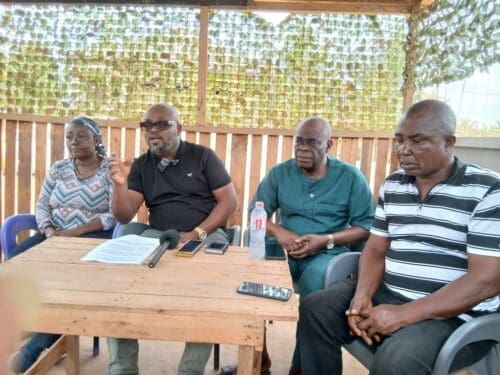
At a press conference held at CometHill at Brekusu on Friday October 9, 2026, Director of Comet Properties Limited, Nana Yaw Adom, alleged that groups of persons armed with dangerous weapons have entered portions of the company’s lands, destroyed property and attempted to sell disputed parcels to third parties.

He told journalists at a press conference that when the management of estate developing company confronted the illegal claimant to its land at Comet Estate, the developer claimed he had purchased the land from the Owoo family.
Nana Yaw Adom asserted that the company has petitioned President John Dramani Mahama to advise the illegal claimant to stop trespassing on its legally registered land.

He further claimed that whenever the company confronted the illegal developer, the individual would drop the names of top figures at the Jubilee House and within the police hierarchy.

He alleged these officials were actively supporting the developer’s encroachment on the company’s registered land, which is situated near the Brekusu Police Station.

He commended President John Dramani Mahama for his prompt response to the petition, noting that the President had directed the Crime Officer of the Accra Regional Police Command to intervene, investigate the matter, and ensure that the law was upheld.

In acting on President Mahama’s directive, a senior police officer invited both the management of Comet Estates and the illegal land developer to a meeting.

He noted that the police have instructed both parties to provide their legal indentures, certificates, and land documents so investigator can determine the true owner of the disputed property.

He pointed out that although the illegal claimant was warned to halt all development, he defied the order.

Instead, he hired masons and deployed heavily built land guards to continue constructing a house on the land, creating tension and insecurity within Comet Estate.

“As of today, Friday, October 9, 2026, while we were preparing to brief the press to expose these illegal activities, the masons and their laborers were busily constructing buildings on the disputed land, even though a special police investigator has been officially assigned to look into the matter,” Nana Yaw Adom revealed after conducting journalists around the site to give them firsthand information on exactly what is happening on the disputed land at Comet Estate.

According to him, some of the individuals allegedly involved have claimed to be acting on behalf of influential persons within the Ghana Police Service and political authorities at the Presidency.

The company, however, stressed that the allegations are claims that require independent investigation and verification.

Call for presidential investigation

Nana Yaw Adom called on President Mahama to institute an inquiry into the alleged claims of political and police connections made by persons the company identifies as landguard leaders.

He said petitions on the matter had already been submitted to the Presidency, Interior Minister and and appealed for direct intervention to restore what he described as peace and sanity to the Comet Estate.

«“Laws should work in Ghana. There should be order in Ghana,” Nana Yaw Adom said.»

The company also called on the national security authorities to assist in dealing with what it described as an organised group allegedly operating on its lands.

Allegations against persons identified as landguard leaders

Management specifically mentioned individuals it identified as Nii Sowah Shippi, also known as Mawuko, Kwabena Debrah and a Nigerian national identified as Jeremy.

According to the company, Mawuko is allegedly leading a group of landguards operating in the area, while some of the individuals are alleged to have claimed connections to powerful persons within the Police Service or political leadership.

Comet Properties alleged that such claims have made some police officers reluctant to arrest or investigate the individuals.

The company did not provide independent evidence at the press conference to establish that the named individuals are in fact acting on behalf of senior police or political officials.

The allegations therefore remain subject to investigation and the right of the accused persons to respond.

Company traces dispute to land ownership claims

Comet Properties said it was established in 2002 as a real estate development company specialising in converting undeveloped land into planned communities and providing infrastructure for residents.

Its flagship project, the company said, is the Comet Estate, located within the Akuapem South Municipality.

According to the company, the estate covers approximately 1,500 acres and currently has a population of about 15,000 residents, although its earlier description at the press conference referred to a potential population of about 20,000.

Management said the development was undertaken under the appropriate planning arrangements and that the company acquired its interests from traditional landholding families in Brekuso, Akorpman and surrounding communities.

It said the company subsequently obtained planning scheme approval from the Akuapem South Municipal Assembly.

Company disputes alleged overlap with Odai Ntow family lands

A significant part of the dispute, according to Comet Properties, concerns competing claims involving the Odai Ntow family of Ashongman and Kwabenya.

The company referred to the historical Bosompim v. Martei (1904) judgment and related judgment plan, as well as a statutory declaration said to have been registered in 1977.

According to Comet Properties, the relevant documents establish the boundaries of lands associated with the Odai Ntow family and demonstrate that those lands are distinct from the lands acquired from the Brekuso traditional landowners for development of the Comet Estate.

The company insists that its lands do not overlap with the lands claimed by the Odai Ntow family.

Management, however, alleges that some persons associated with the Odai Ntow family have repeatedly entered portions of the Brekuso lands occupied by Comet Properties and purportedly sold parcels to third parties.

The company further alleged that landguards have been used to enforce such transactions.

These claims were presented by Comet Properties and have not, in the material provided, been independently adjudicated or established by a court.

Owoo family dispute

The company also outlined a separate dispute involving the Owoo family of Accra.

According to Nana Yaw Adom, Comet Properties acquired additional lands from the Asona family of Brekuso in 2002, part of which involved approximately 67 acres released to the Owoo family pursuant to a settlement between the Owoo family and the Asona family.

He said the Owoo family subsequently sold approximately 25 acres of the released land to Comet Properties for what he described as valuable consideration of about GH¢400 million, which the company said was fully paid.

However, Comet Properties alleges that in 2013, the Owoo family subsequently entered into transactions involving the same area and began selling portions of land adjoining the 67-acre parcel.

The company claims that landguards were subsequently deployed in connection with those transactions, resulting in multiple legal disputes and confrontations.

Seven foundations allegedly destroyed

One of the most serious incidents cited by the company allegedly occurred in November 2024, when persons said to be associated with Mawuko allegedly entered disputed portions of the Comet Properties development.

The company claims that seven building foundations were destroyed, with the total value of the damage estimated at more than US$500,000.

According to Nana Yaw Adom, the incident was reported to the police, but the company was dissatisfied with the subsequent response.

He further alleged that despite legal action and an injunction obtained against Mawuko and others, the group allegedly continued to operate on the disputed lands.

Comet Properties claims that as many as 50 persons have been maintained on the land as part of the alleged landguard operation.

The company is therefore asking the authorities to enforce existing court orders and prevent further destruction or occupation of the disputed properties.

Security concerns

Management said the alleged activities have gone beyond an ordinary civil land dispute and have become a security concern because of the alleged use of armed groups, threats and destruction of property.

It argued that disputes over land ownership should be resolved through the courts and other lawful mechanisms rather than through the use of force.

The company also expressed concern that repeated changes in political administrations could be exploited by land actors who allegedly invoke the names of newly appointed political authorities to pursue claims over disputed properties.

According to the company, such conduct undermines confidence in Ghana’s land administration system and discourages private investment.

Impact on residents and investors

Comet Properties said the alleged insecurity poses a threat not only to its corporate interests but also to residents who have invested in homes and businesses within the estate.

The company described Comet Estate as a community of law-abiding residents who have invested substantial resources in the area and are entitled to protection under Ghanaian law.

It warned that continued clashes, alleged landguard activities and destruction of property could undermine the development of the community and create fear among residents.

Company seeks protection, enforcement of law

Nana Yaw Adom said Comet Properties was not asking for preferential treatment but for the enforcement of the law and protection of legitimate investments.

He urged the police, national security authorities and other relevant state institutions to investigate the allegations independently and ensure that persons found to have engaged in criminal conduct are dealt with according to law.

He also appealed to the President to investigate claims that persons involved in the alleged activities have links to senior officials within the Police Service or political authorities.

The company said it was prepared to provide relevant documents, including land acquisition records, planning documents, court processes, judgment plans and other materials relating to the disputed properties, to assist any official investigation.

Broader landguard challenge

The allegations come against the backdrop of Ghana’s longstanding struggle with landguardism, a phenomenon that has frequently been associated with violent enforcement of competing land claims, illegal sale of land, threats to developers and destruction of property.

Legal experts and civil society groups have repeatedly argued that land ownership disputes must be settled through established legal and customary processes rather than through private enforcement groups.

For Comet Properties, the immediate concern is that the alleged activities at its estate could escalate unless state institutions intervene.

The company maintained that it remains committed to the development of the Comet Estate but insisted that such investment can only continue in an environment where the rule of law is respected.

“We are a responsible corporate organisation and need a peaceful environment to carry out our business,” Nana Yaw Adom said, reiterating the company’s appeal for urgent state intervention.

Comet Properties Limited says it is seeking an independent investigation into the allegations, protection for residents and investors, and enforcement of all applicable court orders and laws governing the disputed lands

IJM Ghana Commends Ghana on Historic Upgrade to Tier 1 Status in the U.S. Trafficking in Persons Report

0

International Justice Mission (IJM) Ghana warmly congratulates the Government of Ghana and all stakeholders on Ghana’s upgrade from Tier 2 to Tier 1 in the United States Department of State’s Trafficking in Persons (TIP) Report. This prestigious recognition affirms Ghana’s sustained commitment and significant progress in preventing human trafficking, protecting survivors, and prosecuting offenders.

The Tier 1 ranking signifies that Ghana fully meets the minimum standards for the elimination of trafficking in persons. This achievement reflects years of coordinated action, strategic investments, strengthened institutional collaboration, and the unwavering commitment of government agencies, civil society organizations, development partners, the media, and citizens across the country.

IJM Ghana extends its heartfelt congratulations to:

  • The Ministry of Gender, Children and Social Protection (MoGCSP), particularly the Human Trafficking Secretariat, for its leadership in coordinating national anti-trafficking efforts and implementing Ghana’s National Action Plan.

  • The Office of the Attorney-General and Ministry of Justice for strengthening prosecutions and securing increased convictions of traffickers.

  • The Ghana Police Service, including specialized anti-trafficking and marine units working to combat child trafficking and exploitation, particularly on Lake Volta.

  • The Ghana Immigration Service and the Economic and Organised Crime Office (EOCO) for their contributions to investigations, victim identification, and efforts to tackle emerging forms of trafficking, including cyber-enabled exploitation.

  • The Ministry of Labour, Jobs and Employment Relations for efforts to strengthen labour migration safeguards and worker protections.

  • Members of Parliament, especially the Select Committees on Human Rights and Gender, for championing laws, oversight, and policies that advance the protection of vulnerable populations.

  • The National Commission for Civic Education (NCCE), media organizations, civil society actors, faith groups, traditional leaders, and development partners whose awareness creation, advocacy, and community engagement efforts have strengthened prevention and protection efforts nationwide.

  • Traditional and religious leaders whose voices and influence have helped drive the campaign.

  • Most importantly, the people of Ghana, whose vigilance, reporting of suspected trafficking, community action, and support for vulnerable children and families have been critical to this success.

A Milestone Marked by Tangible Results

The Tier 1 ranking was driven by measurable progress across prosecution, protection, and prevention efforts.

During the reporting period, Ghana significantly increased law enforcement action against traffickers, prosecuting 212 alleged traffickers and securing 28 convictions, while identifying 2,331 trafficking victims and referring all identified victims to appropriate services. The government also increased funding for victim assistance and anti-trafficking initiatives, expanded frontline training, strengthened international cooperation, and enhanced efforts to combat online scam operations linked to trafficking and forced labour.

Particularly encouraging is the increase in victim identification and referral, which demonstrates growing capacity among social welfare officers, law enforcement personnel, labour inspectors, immigration officers, and civil society organizations working together to ensure survivors receive the care and support they deserve.

Child Trafficking Remains a Critical Challenge

While this recognition is worth celebrating, it should also remind us that the fight against human trafficking is far from over.

The TIP Report notes that children in Ghana continue to face exploitation in forced labour, especially within inland and coastal fishing, domestic work, street hawking, agriculture, artisanal mining, quarrying, and herding. Child trafficking on Lake Volta remains a significant concern, and children from Ghana and neighbouring West African countries continue to be vulnerable to exploitation.

The report further highlights the increasing use of technology by traffickers to recruit and exploit victims through fraudulent job offers, cybercrime schemes, online scams, and deceptive migration opportunities.

These realities underscore the importance of sustained investments in child protection systems, survivor-centred services, community awareness, and coordinated law enforcement responses.

The Vital Role of Civil Society

Civil society organizations and NGOs have been indispensable partners in Ghana’s anti-trafficking journey. Throughout the reporting period, NGOs partnered with government agencies to provide survivor care, operate shelters, conduct public education campaigns, support investigations, build community resilience, train frontline officials, and strengthen prevention efforts in high-risk communities.

Organizations working directly with vulnerable children, families, and survivors continue to fill critical gaps in protection services and contribute invaluable expertise toward strengthening Ghana’s response to human trafficking.

Sustaining the Momentum

Despite the achievement of Tier 1 status, important challenges remain. Shelter capacity, particularly for adult survivors, remains limited. Additional investments are needed to strengthen anti-trafficking responses in rural communities, enhance specialized training on cyber-enabled trafficking crimes, improve survivor services, and address vulnerabilities that place children and adults at risk of exploitation.

This is the time to increase funding for human trafficking and child protection.

IJM Ghana encourages all stakeholders not to view Tier 1 as the termination of our efforts, but as a platform for deeper action and greater impact. Sustained progress will require continued collaboration, adequate resourcing of frontline institutions, strengthened accountability mechanisms, and a renewed commitment to protecting every person from violence, exploitation, and abuse.

Reacting to this development, IJM’s Director, West Africa Programme, Anita Budu, said:

“Ghana’s elevation to Tier 1 status is a significant national achievement that reflects the power of coordinated action and collective commitment. We commend the Government of Ghana and all stakeholders whose dedication has contributed to this milestone.

“At the same time, we recognize that thousands of children and vulnerable adults remain at risk of trafficking and exploitation. This achievement should inspire us to work even harder to ensure every child is safe, every survivor is protected, and every trafficker is held accountable.”

About IJM Ghana

International Justice Mission (IJM) is a global organization that protects the vulnerable and people living in poverty from violence and exploitation. We partner with local authorities in 33 programme offices in 19 countries to combat violence against women and children, abuse of power by public authorities, and various forms of human trafficking and forced labour.

We aim to strengthen justice systems, support survivors, and advocate for lasting change.

In Ghana, IJM partners with government institutions to address human trafficking and forced labour in the agricultural sector by strengthening the capacity of relevant authorities to identify, remediate, and prevent cases.

Citizen Kafui Appointed Media Relations Manager for EMY Africa

0

Ghanaian media professional and digital creator Citizen Kafui has been appointed Media Relations Manager for EMY Africa adding another significant responsibility to his growing career in media, communications and brand management.

With professional experience spanning GBC, Light TV, Citi FM, Channel One TV, 4Syte TV and entertainment and lifestyle portal GhanaWeekend Citizen Kafui brings a wealth of experience in media production, publicity, storytelling and audience engagement to his new role.

At EMY Africa he will lead the brand’s media engagements and publicity rollout supporting its communication efforts as the organisation continues to celebrate distinguished personalities, business leaders and individuals making meaningful contributions to society.

The appointment further strengthens Citizen Kafui’s growing portfolio in public relations and entertainment where he continues to work at the intersection of media, music and brand development.

He currently serves as Media Relations Manager for Ghanaian singer Gyakie a role that has seen him contribute to the artiste’s publicity and media engagements.

His latest appointment at EMY Africa marks another step in his professional journey reflecting his continued commitment to building strong brands, telling compelling stories and creating visibility for individuals and organisations making an impact.

Speaking on the new opportunity Citizen Kafui described the appointment as another challenge and an opportunity to grow professionally while contributing meaningfully to the industry.

“For me, this is another challenge to keep growing contributing to the industry building great brands and representing amazing people.

I look forward to this great opportunity and what we can achieve together,” he said.

As EMY Africa continues to expand its presence through its awards, events and Magazine publications Citizen Kafui’s appointment comes at a pivotal time for the brand with strategic media relations and engagement remaining central to amplifying its work and celebrating excellence.

Gyakie Unveils Artwork for New Single “Your Body” Ahead of October 16 Release

0

Ghanaian singer and songwriter Gyakie is gearing up for another exciting release as she unveils the official artwork for her upcoming single, “Your Body,” a smooth feel-good record expected to bring a fresh wave of energy to her growing catalogue.

Following a year marked by a string of releases and notable musical moments Gyakie is keeping the momentum going with the new single, scheduled for release on October 16, 2026.

The song is expected to build anticipation for Gyakie’s third EP The Dawn which is scheduled for release later this year.

The unveiling of the artwork offers fans an early glimpse into the creative direction of the upcoming release, building anticipation for what promises to be another exciting addition to the singer’s repertoire.

Known for her distinctive vocals captivating melodies and ability to connect with listeners Gyakie continues to explore her sound while maintaining the musical identity that has endeared her to audiences at home and abroad.

With “Your Body,” fans can look forward to a record designed to bring a feel-good atmosphere and get listeners moving as the countdown to its release begins.

The single also serves as another step towards the arrival of The Dawn EP Gyakie’s upcoming third EP project as she continues to build on her achievements and strengthen her position on the global music stage.

FlipTheMusic continues to play an influential role in strengthening Gyakie’s position as one of Ghana’s leading music artistes through its strategic support and efforts to expand her reach as she connects with audiences across borders.

As excitement builds around her next body of work, “Your Body” presents another opportunity for Gyakie to connect with her audience while keeping her musical journey moving forward.

Fans can mark October 16, 2026 on their calendars for the release of “Your Body” as anticipation builds for The Dawn EP and the next chapter in Gyakie’s evolving sound.

Pre-save Gyakie’s “Your Body” now and get ready for its official release.

Okada Riders Allegedly Brutalized, Shot Dead as Police Face Questions Over Handling of Case

0

Questions are being raised over the handling of a number of alleged assault, death threat and murder-related complaints in Ningo, with affected families accusing the police of failing to pursue some cases through the normal criminal justice process.

The complaints are linked to a wider dispute involving Nene Nartey Asamoah, who is described by some members of the community as the chief of Kopodor.

Information and documents made available to the family indicate that several complaints have been lodged at the Ningo and Prampram Police Stations over alleged attacks, threats and other incidents involving persons said to be associated with Nene Asamoah.

The allegations include claims that some victims were assaulted, threatened with death and, in some instances, that serious cases were not processed before the courts.

The complainants allege that police officers, instead of proceeding with investigations and prosecution where appropriate, have on some occasions advised the parties to resolve the disputes within the family.

They are questioning why allegations involving possible criminal offences would be referred for family settlement rather than being subjected to the applicable investigative and prosecutorial procedures.

Claims over attacks on Okada riders

One of the most serious allegations concerns attacks on commercial motorbike riders, commonly known as Okada riders, in the Ningo area.

According to information provided by the family and community sources, an Okada rider, Timothy teye Otubua, was allegedly killed in July after being severely beaten by persons described as land guards allegedly linked to Nene Asamoah.

His fellow Okada riders waited for him for some time, but when he did not return, they decided to follow up. They later found him at the village, lying in a pool of blood and dead.

The father of the deceased boy, Kwao teye Otubua says the family made several requests to the police to pursue the case in court, but those requests were allegedly refused.

He claims that the suspect, John Happy Asamoah, alias Nene Nartey Asamoah, continues to walk freely in the Kopodor community in Ningo and has allegedly issued threats to members of the deceased’s family.

According to the father, following the boy’s death, his fellow Okada riders went to observe the situation involving Nartey Asamoah.

He alleges that Nartey Asamoah, together with some of his alleged land guards and police officers, caused the arrest of 12 of the riders.

The father further alleges that the 12 men were beaten and subsequently detained at the Prampram Police Station cells.

The family subsequently reported the incident to the Prampram Police Station. The case was taken up by the CID, led by a female investigator identified as Madam Grace.

The account further alleges that other Okada riders subsequently travelled to the area to inquire about the circumstances surrounding the death and were also attacked.

The sources claim that as many as six Okada riders have since lost their lives in connection with the incidents.

They further allege that complaints were made to the Ningo-Prampram Police Station but that no meaningful action has followed.

Another allegation is that motorbikes belonging to some of the deceased riders were subsequently found at a property said to belong to Nene Asamoah.

These claims have not been independently established, and the circumstances surrounding the reported deaths, the identities of the perpetrators and the alleged recovery of the motorbikes require confirmation from the police and other relevant authorities.

Families question police response

The complaints also involve alleged assaults and threats against several individuals, including persons identified as Larseh Joshua, Addo and Isaac Tetteh Kwadwo.

Others, including Nii Akweh, Atteh Chenchenmah, Larseh Emmanuel, Arkuteeye, Sernor Kwao Stephen and Pastor Enoch Mensah, are alleged to have received death threats.

According to the complainants, the various matters were reported to the police at Ningo and Prampram, but the cases have allegedly not resulted in prosecutions.

The family further alleges that on occasions when Nene Asamoah was invited to the police station, he allegedly insulted or threatened complainants in the presence of police officers.

The allegations have prompted calls for the police hierarchy to review the handling of the complaints and establish whether proper procedures were followed.

According to the family, Nartey Asamoah and his associate, the Chief of Lakpleku, allegedly colluded with the police, while one Nene Simpin allegedly brought the matter to the family home, where the bereaved parents were asked to bury their son.

Dispute over Dankyira family house

The tensions have also extended to the Dankyira family house at Ningo, where members of the family allege that attempts have been made to demolish the property.

The Alipue, Chenchenma and Ashalley Botwe Gates are reportedly opposed to any demolition of the house.

In a letter dated September 30, 2026, lawyers representing the affected Gates reportedly called on Nene Asamoah to abandon any plans to demolish the property.

Documents cited by the family indicate that the house was constructed through contributions from members of the wider Dankyira clan drawn from several communities.

The family therefore maintains that the property belongs to the wider Dankyira family and that no individual should unilaterally determine its future.

Traditional authority dispute

The wider dispute has also generated questions about Nene Asamoah’s authority and his claim to the traditional position he occupies.

Some family members have challenged his authority over them and disputed his right to exercise control over family property.

The family also alleges that Nene Asamoah insulted the Gborbu Wulomo in the presence of senior police officers and later disregarded an invitation from the traditional authority.

The claims form part of a broader dispute involving land ownership, traditional authority and alleged activities of land guards in Ningo and surrounding communities.

The complainants are calling for the police administration to clarify the status of the various complaints and explain why some of the reported cases have allegedly not proceeded to court.

They insist that their concerns are not intended to interfere with traditional processes but that allegations involving assault, threats or possible loss of life should be investigated independently and dealt with according to law.

The allegations against Nene Asamoah, the alleged land guards and the police remain disputed and unproven. No finding of criminal liability has been established against the persons named in the complaints based on the information provided.

The Ghana Police Service and Nene Asamoah have not, in the material provided, given a public response to the allegations.

IEAG Boss Samson Awingobit Honoured At 2026 World Rice Conference For Sterling Contributions

0

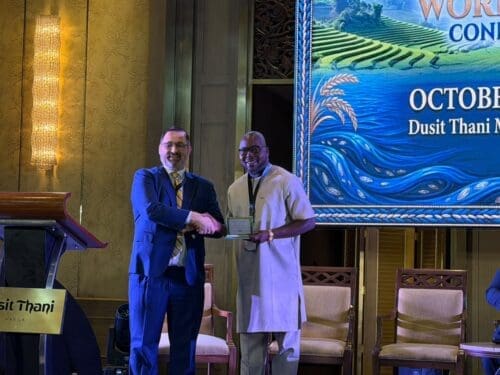
The Executive Secretary of the Importers and Exporters Association of Ghana (IEAG), Mr. Samson Asaki Awingobit, has received a Certificate of Appreciation at the 2026 International World Rice Conference in recognition of his active participation, knowledge-sharing and valuable contributions to the global rice industry.

The recognition was presented by the conference organisers, The Rice Trader and the International Commodity Institute, at the three-day event held from October 7 to 9 at the Dusit Thani Manila in the Philippines.

Mr. Awingobit also distinguished himself as a key contributor to this year’s conference, actively participating in discussions and sharing perspectives on issues affecting the global rice trade. His contributions provided an important platform for highlighting Ghana’s rice import and trade interests while strengthening engagement between Ghanaian businesses and international stakeholders across the rice value chain.

Mr. Awingobit’s recognition underscores his continued engagement with the international rice trade community and his efforts to strengthen collaboration among rice producers, farmers, importers and exporters across markets.

This year’s conference brought together key stakeholders from across the global rice value chain to exchange market intelligence, explore emerging trade opportunities and discuss developments shaping the future of rice production and commerce.

It marks the third time Mr. Awingobit has participated in the prestigious international gathering, having previously attended the 2024 edition in Manila, Philippines, and the 2025 conference in Phnom Penh, Cambodia.

Through his previous engagements, the IEAG Executive Secretary has helped connect Ghanaian rice importers with farmers, producers and trading partners in the Philippines and Cambodia, creating opportunities for Ghanaian businesses to establish commercial relationships and explore new markets.

The Association believes these engagements are important to strengthening Ghana’s rice supply chain, improving access to international suppliers and creating mutually beneficial partnerships that support the country’s wider trade interests.

The IEAG is confident that Mr. Awingobit’s continued participation in the conference will yield further benefits for Ghana by deepening international trade relationships, expanding business opportunities and improving access to market information for Ghanaian importers and exporters.

The Association has reiterated its commitment to pursuing strategic international engagements that promote trade facilitation, enhance private-sector competitiveness and advance Ghana’s position in the global trading environment.

Labadi–La Palm Beachfront: Turning a Coastal Challenge into Economic Opportunity

0

Story By: Felix Ernest Odamtten / Muhammad Faisal Mustapha….

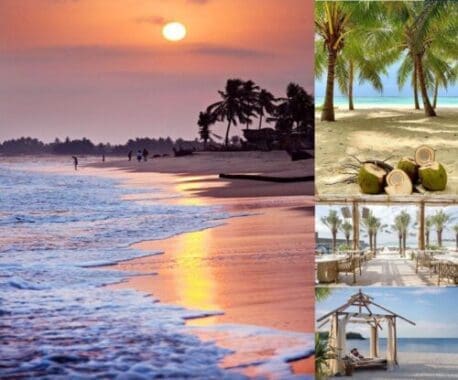
The clearance of unauthorised structures from the beachfront adjoining the Labadi Beach Hotel and La Palm Royal Beach Hotel has opened a new chapter in the long running effort to reclaim, restore and redevelop one of Accra’s most strategically located coastal tourism enclaves.

At the heart of the exercise is a proposition that extends beyond the removal of structures: the beachfront can become a properly planned tourism and hospitality destination capable of attracting visitors, creating jobs and generating sustainable economic opportunities for communities around Labadi.

Management of the two hotels say, the objective is not simply to take away livelihoods that have developed around the beachfront over the years, but to create a better organised environment in which economic activity can flourish on a more sustainable basis.

The challenge, therefore, is how to transform a contested and increasingly congested coastal space into an attractive destination without losing sight of the people whose livelihoods have been built around it.

For years, informal businesses and other activities have emerged around the beachfront, reflecting the economic importance of the area to residents and visitors.

Indeed, the continued unauthorised occupation has created serious safety, sanitation, environmental and operational concerns for the hotels and the wider beachfront.

Management’s position is that the assets being protected are not ordinary commercial properties. They form part of investments made with the contributions of Ghanaian workers and are ultimately intended to generate sustainable returns for members.

“These assets belong to the workers and pensioners of Ghana.”

The Trust’s intervention followed what it described as persistent unlawful occupation, encroachment and unauthorised activities on the beachfront adjoining and directly in front of the two hotels. The Social Security and National Insurance Trust (SSNIT) sought the intervention of the National Security Council Secretariat to help protect the properties and restore proper control of the area.

The Trust has identified several risks associated with the encroachment, including threats to the safety and security of hotel guests, employees, service providers and visitors, as well as unauthorised access to sensitive guest and operational areas.

There were also concerns over fire, sanitation, environmental and public health hazards, alongside the deterioration of the beachfront and the potential damage to the standards expected of internationally recognised hospitality facilities.

The environmental dimension is particularly important. Construction and other activities on the beachfront can place pressure on the coastal ecosystem, while poor sanitation and uncontrolled activity can undermine the quality of the beach and the experience of residents and visitors.

Yet the future of the enclave cannot be measured solely by the number of structures removed. Its success will ultimately depend on what replaces them and whether the redevelopment produces tangible benefits for the communities that have historically depended on the area.

SSNIT says young people from Labadi and surrounding communities will be considered for employment opportunities created by the redevelopment and subsequent operations, subject to the relevant recruitment requirements. The potential areas of employment are wide ranging.

Construction alone could generate opportunities for skilled and unskilled workers, while the completed destination could support jobs in hospitality, food services, tourism, entertainment, security, cleaning, maintenance, transportation and other related businesses.


“The objective is to create a better organised tourism environment capable of generating more sustainable and wider economic opportunities.”

This approach could provide an opportunity to move from fragmented informal economic activity towards a more structured local economy in which residents participate in the value chain created by tourism rather than remaining on its margins.

For that transition to succeed, however, community participation will be critical.

Management of the hotels recognises that the people of Labadi and surrounding communities have a legitimate interest in what happens to a major public facing asset located within their traditional and residential environment.

It has therefore indicated they will continue to engage chiefs, traditional authorities, community leaders and residents throughout the various stages of the redevelopment. Such engagements can help communicate the plans, address concerns and identify practical opportunities for local participation.

Meaningful consultation will also be important in managing expectations. A redevelopment of this scale will inevitably change the character of the area, and communities need clarity about employment opportunities, access, environmental safeguards and the future use of the beachfront.

Importantly, SSNIT says the beachfront will remain a public beach. The redevelopment is expected to commence soon after engagement with stakeholders, with an emphasis on cleaning and restoring the area to a safer, more attractive and properly managed environment while retaining public access.

That commitment could become one of the defining features of the project. A successful tourism destination does not necessarily have to mean exclusion; it can combine investment, hospitality, environmental responsibility and public enjoyment when properly planned and managed.

The redevelopment also comes at a time when Ghana is seeking to strengthen tourism as a source of foreign exchange, employment and local economic development. A well-managed beachfront destination in the heart of Accra could add another dimension to the city’s tourism offering and strengthen the country’s appeal to domestic and international visitors.

The proximity of the Labadi Beach Hotel and La Palm Royal Beach Hotel gives the enclave an existing hospitality foundation on which a broader destination could be developed. With appropriate planning, the surrounding beachfront could complement the hotels rather than remain a source of operational, environmental and security challenges.

For SSNIT, the economic argument is equally significant. Protecting and enhancing the value of its investment assets is part of its fiduciary responsibility, particularly because the ultimate beneficiaries are contributors and pensioners whose financial security depends on the effective management of the Scheme’s investments.

The real measure of the redevelopment, therefore, will not simply be the physical transformation of the beachfront. It will be whether the project succeeds in creating a cleaner and safer public beach, strengthening Ghana’s tourism proposition, opening legitimate economic opportunities for local people, protecting the coastal environment and improving the long term value of an important national investment.

Labadi and La Palm beachfront now stand at a crossroads: it can remain a contested coastal space characterised by unplanned activity, or it can evolve into a properly managed tourism and economic hub that works for visitors, residents, the hospitality industry and the workers and pensioners whose contributions underpin SSNIT. The way forward, ultimately, is redevelopment that protects the asset while ensuring that the benefits of its renewal extend beyond its boundaries.

Pursuing the Promise of AI: A Guide for African Nonprofits to Advance Their Missions

0

Insights from more than 40 nonprofit, funders, and other experts highlight practical lessons for deciding whether and how to use AI responsibly and equitably.

Artificial intelligence (AI) is creating new possibilities for nonprofits across Africa to expand access to services, strengthen programme delivery, and address challenges in areas ranging from health and education to livelihoods and agriculture. A new report from The Bridgespan Group examines how African nonprofits are beginning to use artificial intelligence to advance their missions—and offers a practical roadmap for organisations considering whether, where, and how AI could help.

“The question for nonprofits isn’t ‘how do we use more AI?’ but ‘what problem are we solving, and is AI the right way to solve it?’ This involves looking beyond the technology to the organisation’s data, people, governance, as well as the communities at the centre,” said Madhuri Mukherjee, Bridgespan partner and co-author of the research. “That’s how adoption becomes responsible, helping nonprofits reach more people and deepen impact.”

Pursuing the Promise: A Guide for African Nonprofits to Advance Their Missions with AI draws on interviews and discussions with more than 40 nonprofits and social enterprises, funders, experts, and intermediaries across Africa working on issues such as education, health, and livelihoods. The research examines how organisations have approached AI—from identifying a problem and testing a use case to embedding it in programmes and, in some cases, beginning to consider scale. It also explores the strategic and organisational choices nonprofits encounter along the way.

Although nearly all interviewees recognised AI’s potential, relatively few nonprofits reported using it directly in programmes or services. Many were already using AI for day-to-day productivity, an important starting point. The report focuses instead on “mission-driven AI”: applications that directly strengthen, scale, or create programmes and services.

While adoption paths vary, the research identifies four stages in the journey towards mission-driven AI:

  • Stage 1: Explore & prepare

Organisations move from general interest in AI to considering whether and how to use it to advance their missions. Key questions surround the problem being solved, whether AI is the right tool to address it, and assessing if the necessary data, language layer, and organisational readiness are in place

  • Stage 2: Prove & learn

Organisations pilot a specific use case to understand whether it works in real-world conditions and merits further investment. This also includes decisions to build, buy, adapt, or partner—and defining what success looks like

  • Stage 3: Embed & operate

If a pilot shows promise, organisations begin integrating it into regular programme delivery. At this stage, organisations consider shifts in internal structure—governance, talent, operating models, and long-term costs—to ensure it can be effectively sustained

  • Stage 4: Sustain or scale

Organisations consider whether and how the use case should continue or expand—to more users or geographies, through public systems, or through other ecosystem actors—and what it will take to sustain it over time. The report also emphasises maintaining the status quo or reassessing a use case as appropriate outcomes

Across the interviews, nonprofits also emphasised that mission-driven AI does not happen in a vacuum. Access to digital infrastructure, local and context-specific data, policy and regulation, and existing channels for reaching communities can all shape whether AI is effective and sustainable. The report highlights a role for funders and other ecosystem actors in addressing these gaps through flexible, stage-appropriate funding; shared infrastructure; technical and strategic support; and broader capacity building.

“The aim of our research is not to advocate for mission-driven AI adoption as an end goal for African nonprofits,” said Bridgespan principal and report co-author Aditi Sharma. “It is to help organisations make informed choices about where AI can genuinely advance their missions. The next few years present an important opportunity to shape how AI is used across the continent—and to ensure it is grounded in real needs, local contexts, and meaningful impact.”

Read the full report: https://www.bridgespan.org/insights/choosing-your-ai-path-a-framework-for-nonprofit-leaders-to-make-strategic-choices

PawaPay becomes one of the first licensed PSPs in Mozambique

0

New Bank of Mozambique licence enables direct merchant onboarding across one of Africa’s fastest-growing mobile money markets

PawaPay, a leading pan-African payments aggregator, has been granted a Payment Service Provider (PSP) licence by the Bank of Mozambique through its local subsidiary, Quidexplus Mozambique.

The authorisation makes PawaPay one of the first companies to be licensed to operate as a PSP in Mozambique, giving merchants a regulated route into one of Africa’s most active mobile money markets.
The licence allows PawaPay to onboard merchants directly in Mozambique and provide regulated payment services across the country.

Mozambique’s mobile money market now exceeds 12 million active accounts across three operators: M-Pesa (Vodacom), E-Mola (Movitel) and mKesh (Tmcel).

Until now, limited licensed payment infrastructure has restricted how merchants operate at scale in the market.

“Mozambique has been one of the most active mobile money markets on the continent for years, but merchants have had no reliable way to operate here at scale,” said Ilídio Matchebe, Mozambique Country Director at PawaPay. “Becoming one of the first PSPs licensed by the Bank of Mozambique changes that. We can now onboard merchants directly and connect them to the operators their customers already use day to day.”

The Mozambique licence sits alongside PawaPay’s existing regulated presence across 23 African markets, where the company processes around 7 million transactions a day for customers operating in sectors including ride-hailing, remittance, retail and NGOs.

The licence enables PawaPay to begin commercial operations immediately, with merchant onboarding expected to begin in the coming days.

The company is also in advanced discussions with M-Pesa, E-Mola and international remittance providers around expanding inbound payment flows into Mozambique.

Thales selected by Royal Air Maroc to digitalise flight operations with AvioBook Flight

0
  • Thales is proud to support Royal Air Maroc’s ambitious growth strategy with scalable, future-ready digital solutions that enhance operational excellence and long-term sustainability.
  • Under this 5-year agreement, pilots across Royal Air Maroc aircraft will be equipped with AvioBook Flight, the cutting-edge Electronic Flight Bag (EFB) solution, developed by AvioBook, a Thales Group company.
  • With AvioBook Flight, the airline will enhance operational efficiency, support fuel optimisation, and streamline pilot and ground staff workflows.

Through this new contract, Thales will provide Royal Air Maroc with the most innovative Electronic Flight Bag technology platform in the industry. AvioBook Flight is the only fully-integrated Electronic Flight Bag solution on the market that streamlines and enhances efficiency across every phase of flight operations – before, during, and after each flight.

AvioBook Flight’s comprehensive software is designed to mitigate safety risks, enhance compliance, add technology redundancy and resiliency, and increase environmental sustainability, while enabling shorter turnaround times. Drawing on more than a decade of experience, AvioBook Flight is a proven solution that sets itself apart through seamless integration with back-office systems and functionalities tailored to meet users’ real-world needs. AvioBook has extensive experience in the development of adaptable and flexible solutions, with previous implementations on 70 airlines around the world.

This contract marks a new milestone in the long-standing partnership between Thales and Royal Air Maroc, notably in In-flight Entertainment, maintenance and cybersecurity.

The announcement comes as Thales takes part in the Marrakech Airshow 2026, held from 7 to 10 October at the Royal Moroccan Air Force Base in Marrakech. At this 8th edition of the show, Thales is presenting its latest solutions for civil aviation, defence and cyber & digital, and meeting with its Moroccan customers and partners, reaffirming its commitment to the development of the Kingdom’s aerospace ecosystem.

“We are proud to provide Royal Air Maroc with our market-leading software solutions that align with the airline’s ambitious digitalisation and expansion plans as they grow their fleet to 200 aircraft by 2037. We look forward to contributing to the airline’s evolution, positioning high technology at the heart of its development.” Frédéric Dru, CEO AvioBook, a Thales Group Company.

“This agreement reflects Thales’ long-standing commitment to Morocco and to supporting the Kingdom’s ambitions. As Royal Air Maroc pursues its fleet expansion and strengthens its role as a leading carrier, we are proud to contribute with scalable digital solutions that enhance competitiveness, operational excellence and sustainability. Through innovation and local engagement, Thales remains fully aligned with Morocco’s vision for a modern, resilient and globally connected aviation sector.” Yan Levy, CEO of Thales in Morocco

Agana wants binding national plan from constitutional review

0

Roger Agambire Agana, President of the Institute of Financial and Economic Journalists (IFEJ), wants Ghana’s constitutional review to produce a long-term development plan, backed by law, that no incoming government can set aside.

He also wants the rules on public appointments rewritten so that fewer posts go to people who already hold office, while large numbers of graduates and young Ghanaians cannot find work.

His call comes as the reform process moves from consultation to drafting. On 28 August 2026, Attorney-General Dr Dominic Akuritinga Ayine inaugurated an 11-member Constitution Review Implementation Committee, chaired by Presidential Legal Counsel Marietta Brew Appiah-Oppong, to turn accepted proposals into a working framework. Agana, who founded NewsGhana and serves as its Managing Editor, said that stage will decide whether the exercise changes anything.

“If we are always having constitutional review committees, they sit in one government and the other government comes and their report is useless, what are we achieving?” he asked in an interview.

A record of unfinished reviews

The history supports his concern. President John Dramani Mahama set up the committee chaired by Professor H. Kwasi Prempeh in January 2025, partly to find out why earlier efforts had stalled. Those efforts included the 2010 Constitution Review Commission and a 2023 consultative committee. The Prempeh committee handed its final report to the President on 22 December 2025.

Agana said every accepted recommendation should come with a timeline and a named institution responsible for moving it into law and practice. In his view, Ghana already understands most of its problems. What it lacks is a set of rules that binds every government that follows.

“Our politicians know what we need to do to develop,” he said. “We need to change our laws and our Constitution to meet what we want in Ghana.”

Plans that outlast elections

Planning sits at the centre of his case. Parties should still campaign on their own ideas, he said, but those ideas should fit inside a national plan that runs beyond the four-year electoral cycle. A party that wins power should not have to restart the country’s development from zero.

“If it is 20 years, 20 years, we should be achieving it,” he said. “You can do one or two programmes of your own, but the rest should be what the country needs.”

That continuity, he argued, would let the state plan roads, schools, industry and jobs over several years. It would also end the cycle in which one government launches a programme and the next abandons or rebrands it.

He drew a clear line between the Constitution and ordinary legislation. The Constitution should set the broad rules. Acts of Parliament should supply the targets, reporting duties and penalties for institutions that miss agreed standards. Loading administrative detail into the Constitution itself, he warned, would be a mistake.

Appointments and a narrow circle

Agana’s second target is the way public posts are filled. He pointed to MPs who double as ministers and to officials who move from one political appointment to the next while qualified Ghanaians stay outside government.

He said his objection is to the structure that allows that concentration, not to any individual appointee. He also rejected the argument that the same experienced hands must stay because they know the system.

“This is not about experience. What are you talking about?” he said. Officials retire, fall ill or die, he noted, and the state carries on, so it should be training successors all the time.

“If government is giving employment, it should be able to absorb as many Ghanaians as possible, not just a few people for political appointments,” he said.

He wants wider recruitment tied to clear rules on merit and performance, with every office holder given defined targets and assessed against them. State-owned enterprises, he said, need the same discipline to limit political discretion over how they are run.

The Prempeh committee reached similar ground. It recommended separating the executive from Parliament, and it proposed constitutional oversight of state-owned enterprises to protect them from over-politicisation.

Agana framed the Parliament question in terms of scrutiny. When legislators join the executive, he said, the country should ask whether the House can still hold that government to account. A reformed system would let the President recruit from a wide pool while MPs concentrate on law-making, representation and oversight.

Results over announcements

He wants the review to examine how much economic activity and decision-making is concentrated in Accra, and how stronger local government could give people elsewhere a greater stake in development. The Prempeh report also proposed changes to local governance as Ghana considers electing its district chief executives.

Governments and public bodies, Agana said, should have to show how they spend money, what they deliver and who answers for missed targets. He said a country with limited resources should judge its system by what reaches ordinary citizens, not by the number of ministries or announcements.

“We have unemployed graduates, a lot of unemployment,” he said. “These jobs could have also gone to other people who are equally Ghanaian, who can equally work for Ghana’s progress.”

He insisted that reform must belong to no single party. Ghana has lived under several constitutional arrangements since independence, ending with the 1992 Constitution, and he sees the present review as the next stage of that adaptation.

The implementation committee must now weigh the government’s position paper against the Prempeh report and decide which proposals go forward.

Ghana records 450 cases of suspected yellow fever in four months

0

Ghana’s Health Minister Kwabena Mintah Akandoh disclosed during the health sector’s media engagement in Accra, the capital, on Wednesday that the country had recorded at least 450 cases of suspected yellow fever over the past four months.

“The suspected yellow fever cases were around 450 from June to September. Of these suspected cases, 74 were from the Upper West (Region), and three were confirmed,” Akandoh said.

According to the minister, the Ministry of Health has intensified surveillance and response measures, particularly in northern Ghana, with the National Rapid Response Team deployed to the Upper West Region, where confirmed cases have been recorded.

Moreover, the minister said laboratories have been equipped with the necessary reagents to support the detection and confirmation of suspected cases, and designated areas in district hospitals have been isolated to support the management of suspected and confirmed cases.

Akandoh urged the public to remain calm and support the response efforts by the health ministry, as adequate measures are in place to contain any emergency. There was no indication from the minister of any deaths from the confirmed cases yet.

According to the World Health Organization, Ghana recorded 202 suspected yellow fever cases in 2021, including 70 confirmed cases and 35 deaths.

Apple Music Announces tg.blk as October’s Featured Artist for Rap Life Africa

0

Apple Music’s Rap Life Africa playlist will feature tg.blk this month, following the release of her long-awaited new EP, Besides You. The six-part project is a dive into sensuality, soaked in the sunshine of her coastal hometown of Mombasa, and marks an elevation of the sound she has been developing since her landmark 2024 EP IT’S NOT THAT DEEP, which earned streams in the tens of millions.

Besides You is the first in a trilogy of EPs that will dissect the arc of a relationship, from the moments we obsessively replay in our minds to those we would rather forget. This first chapter captures the flush of new love, the head-over-heels obsession where all the red flags look green. The EP arrives alongside the single “Squeeze Me?”, which captures the thrill and fear of a new crush.

The project includes the dreamy, jazz-inflected “Clutch My Bag”, which conjures the pastel hues of Tyler, The Creator and Flower in Bloom, while “Stop It” is a confident declaration aimed at keyboard warriors. “So Bad”, meanwhile, is the track that kicked off the project, setting the tone with its swooning, sexy, and playful energy.

This month, Rap Life Africa will also spotlight Sammie Heavens and Nasty C’s “TELL DAT TO DA OPS”, a playful collaboration that blends modern trap elements with playful harmonies and lyrics. The track embraces a tone of self-belief and confidence, touching on the inner swagger that comes with understanding yourself and moving through the world with conviction.

Also featured is Loatinover Pounds’ “My Life”, from his latest project Ground 2 Glory. The track forms part of a new chapter for the Pretoria hip-hop heavyweight following the impact of his acclaimed album Pray 4 Pitori. With Ground 2 Glory, Loatinover Pounds turns his attention to what comes after the struggle, exploring ambition, success, responsibility and moving from survival to achievement.

Spotlight On

For tg.blk, music has always been rooted in community, from making songs with friends in high school to seeking out like-minded collaborators online. Her influences have expanded from the 80s R&B and Funk she was raised on to the beat-making alchemy of Timbaland and boom-bap. Working independently with little more than Logic and a microphone in her bedroom, she has developed a distinctive sound and built a growing cult following.

First To Know

At the centre of Besides you is tg.blk’s fascination with love in its most intoxicating early stages. “I’m always putting a bunch of pressure on myself to be something bigger than I am. I love love, and it’s all I want to talk about at the moment,” she says. “The EP to me feels like the beginning of most of my relationships. It’s exciting, sexy, fun and obsessive. All I want to be is besides you.” Speaking on being selected for Rap Life Africa, tg.blk tells Apple Music, “It feels great to be chosen and I’m so proud of myself. I do sing a lot now but rap is where I started so it’s really nice to stay connected to that part of myself.”

Press Play

Rap Life Africa serves as a companion to Apple Music’s flagship Hip-Hop playlist, Rap Life.

Entertainment Week Ghana sets November summit, plans creative economy report

0

Entertainment Week Ghana will hold its 2026 summit at Bloombar on 28 November. The organisers also plan to publish their first report on the country’s creative economy, as they try to turn the festival into a source of industry data.

They said the summit will gather creatives, founders, investors, brands and executives for discussions on artificial intelligence (AI), technology, finance and the creative economy. Businesses chosen from the event’s Creative Economy Incubator will be put in front of investors there.

An art exhibition with Sankofa Gallery follows on 29 November. In December, the programme returns with the second Atalé fashion party and the Airwaves music festival, timed for Ghana’s year-end festive season.

The planned report is the main departure from last year. The organisers have given no date or detail yet. They said the report will cover jobs, investment, consumer behaviour and business activity across Ghana’s creative industries. Creators, investors and policymakers often cite the lack of reliable data on those industries as a barrier to funding.

Incubator’s second round

The Creative Economy Incubator and Deal Room is running for a second year. According to the organisers, the first round drew more than 50 applications. The winner, Seudio, received GH¢50,000 to develop its business.

This year’s round will focus on AI, technology and capital. It is open to start-ups working on media, fashion technology and e-commerce, creator tools, streaming and distribution, fan engagement, music, gaming, sport, film and event technology. Selected founders will get mentorship and advice on legal matters, monetisation and fundraising. Paystack, WeWire and Google are listed as partners.

The organisers have not said when applications close or how much prize money is on offer this year.

After a December debut

Entertainment Week Ghana launched in December 2025. Joseph Adjei, Chief Executive of the media firm BlacVolta, said at the time that the idea grew out of his team’s three and a half years documenting festive-season events.

The organisers said the first edition was backed by the Ghana Tourism Authority, the National Film Authority, the Black Star Experience and the Ministry of Youth Development and Empowerment. It also included a film programme with Idris Elba’s Akuna Pod, and the Airwaves Beach Festival with Lynx Entertainment.

BlacVolta, PartyXtra and Q Africa are behind the 2026 edition.

ADEMAN out with debut Gospel single ‘Turn Up For Me’

0

Ghanaian gospel artist ADEMAN has released a powerful new single titled ‘Turn Up For Me,’ a faith-filled song that speaks to the assurance that God will fight for His children in moments when they feel overwhelmed, challenged, or unable to fight their battles alone.

Produced by Ivan, ‘Turn Up For Me’ draws its message from a deeply personal place of surrender and dependence on God. The song presents a believer’s cry for divine intervention, trusting that God will step into the battle, wrestle for his soul, and provide the strength needed to overcome life’s struggles.

Rather than focusing solely on the difficulties believers face, ADEMAN shifts the attention toward God’s power and faithfulness. ‘Turn Up For Me’ captures the moment when a person recognizes that some battles are beyond human strength and chooses to place complete trust in God.

The song’s gospel message centers on the conviction that God does not abandon His people in their most difficult moments. Through its heartfelt delivery and spiritually charged lyrics, ADEMAN encourages listeners to surrender their fears, struggles, and battles to God.

Play

With Ivan’s production providing the musical foundation, ADEMAN delivers ‘Turn Up For Me’ as both a personal declaration of faith and an encouragement to anyone going through a difficult season. The song ultimately carries a simple but powerful message: when the battle becomes too much to handle, God can step in and fight for you.

Elite PR shortlisted for agency award at WAFRIC Awards

0

Accra-based public relations firm Elite PR has been shortlisted for PR Agency of the Year at the 2026 West African Citizens Awards (WAFRIC Awards), the agency said on Friday, 9 October 2026.

The agency said it was named on the organisers’ newly released shortlist for the category. It did not say how many other agencies are in contention or when the winners will be announced.

Elite PR was founded in October 2020 by Francis Amissah, who uses the nickname “Banks”. It grew out of TalkMediaGhana, an entertainment media platform he set up earlier. Most of its clients are musicians, entertainers and public figures in Ghana and the diaspora.

In a statement, Amissah said the nomination reflected the agency’s work for its clients. “We’re grateful to be recognised alongside some of the industry’s finest,” he said.

According to the agency, the WAFRIC Awards have recognised individuals and organisations across West Africa for the past five years. This year’s edition runs under the theme “Recognizing the Unseen. Celebrating the Exceptional.”