

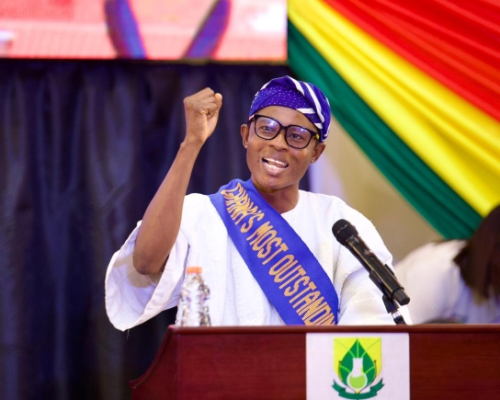
Richard W. Tiimob of Savelugu Senior High School has been named Ghana’s Most Outstanding Teacher at the 2025 Ghana Teacher Prize ceremony held at the University of Health and Allied Sciences in Ho, using the platform to call for fundamental shifts in how educators approach classroom instruction. His teaching philosophy centers on developing students as creators of knowledge rather than passive recipients of information.
Speaking on Asaase Radio’s Breakfast Show Monday, Tiimob rejected traditional tabula rasa concepts that treat students as blank slates waiting to be filled with information. “I don’t consider my learners as tabula rasa. They have a lot of ideas, but if you don’t give them the opportunity, they will not know what they are capable of doing,” he said. “So I direct my learners at the level of actors to ensure they take control of the learning process while I serve as a guide.”
The Northern Region educator emphasized that his approach focuses on mentorship, international exposure, and community-based learning. Connecting students with peers across the world helps them share ideas without feeling limited by their environment, while community collaboration reinforces links between classroom instruction and real-life challenges that students will eventually face.
Tiimob encourages students to use locally available materials to build digital and learning tools, developing problem-solving and innovation skills that transcend memorization of textbook content. This practical orientation reflects growing recognition that Ghana’s educational system needs graduates who can apply knowledge creatively rather than simply recall facts during examinations.
His passion for teaching traces back to childhood when he developed habits of learning ahead of class to teach peers. “I developed a strategy to learn ahead of time so I could tutor my peers,” he recalled. “Later, I realised that was the foundation God had laid for me to become a teacher.” This early peer teaching experience shaped his understanding that effective education requires more than delivering content; it demands understanding how students actually learn.
Offering advice to aspiring educators, Tiimob stressed that teaching requires stepping beyond lesson delivery and assessment. “If you want to take the universal path as a teacher, you have to take an extra step beyond the classroom,” he said. “You must understand that every learner has unique potential, and it is your duty to identify and nurture it.”
Vice President Naana Jane Opoku-Agyemang attended the October 5 ceremony, joining hundreds of educators, policymakers and stakeholders for the event themed “Elevating the Status of Teachers for Quality Education.” Her presence signals governmental attention to teacher recognition at a moment when educator motivation and retention remain persistent challenges.
Tiimob’s recognition comes amid renewed calls for improved educational resources in underserved areas and greater investment in teacher motivation and training. Ghana’s educational system continues grappling with resource disparities between urban and rural schools, inadequate infrastructure, and teacher shortages particularly affecting remote communities.
The learner-centered approach Tiimob advocates represents departure from instructional methods still dominant in many Ghanaian classrooms where teachers lecture, students copy notes, and examinations test memorization rather than comprehension or application. Educational reformers have long argued that such methods produce graduates who struggle adapting to workplace demands requiring critical thinking and creative problem solving.
Whether Tiimob’s philosophy can scale beyond exceptional individual teachers to systemic transformation remains uncertain. Ghana’s educational challenges include overcrowded classrooms, limited teaching materials, examination systems emphasizing rote learning, and teacher training programs that may not adequately prepare educators for learner-centered methodologies.
The emphasis on international exposure and community collaboration reflects recognition that 21st century education must prepare students for interconnected global contexts while remaining grounded in local realities. Students need skills navigating information from multiple sources, collaborating with diverse peers, and applying knowledge to community challenges rather than treating education as abstract exercise disconnected from lived experience.
Tiimob’s success using locally available materials addresses resource constraints that often excuse educational shortcomings. His approach demonstrates that effective teaching doesn’t necessarily require expensive imported equipment but rather creativity in leveraging available resources toward meaningful learning objectives.
The award ceremony at UHAS marked culmination of processes beginning months earlier when teachers across all 16 regions competed for recognition. Selection criteria emphasized professional competence, instructional effectiveness, community engagement, and contributions extending beyond minimum job requirements.
Ghana’s teaching profession faces ongoing struggles around status, compensation, and working conditions that affect recruitment and retention of talented educators. Recognition programs like the Ghana Teacher Prize attempt to elevate teaching’s social standing while highlighting excellence that deserves emulation.
Whether Tiimob’s advocacy for holistic, learner-centered education influences broader policy discussions or inspires fellow teachers toward similar approaches will determine his impact beyond personal achievement. Outstanding teachers can serve as models for professional development or remain isolated exceptions whose excellence doesn’t translate into systemic improvement.
For now, his message challenges prevailing assumptions about what effective teaching requires: not just subject matter expertise and classroom management skills, but genuine commitment to understanding each student’s unique potential and creating conditions where that potential can flourish.

