

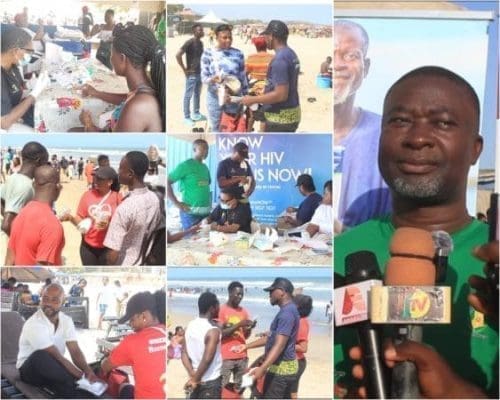
Ernest Amoabeng Ortsin, President of the Ghana HIV and AIDS Network (GHANET), has emphasized both the strides made in Ghana’s HIV response and the urgent need to address funding gaps threatening sustainability.
However, he warned that dwindling support from international donors, particularly the U.S. President’s Emergency Plan for AIDS Relief (PEPFAR), risks reversing gains.
Mr Ortsin made the above statement amidst the Easter Monday festivities at La Pleasure Beach, where the Ghana HIV and AIDS Network (GHANET) spearheaded a crucial safe-sex campaign, offering free HIV Self-Testing Kits (HIVST) and condoms to holidaymakers.
The initiative aimed to promote safer sexual practices and empower individuals to know their HIV status, all while enjoying the festive holiday atmosphere.
Amidst the lively Easter Monday celebrations, GHANET representatives engaged with individuals and groups, offering information about HIV prevention and the benefits of self-testing. The distribution of condoms and HIVST kits was met with positive reception, as many beachgoers welcomed the opportunity to access these essential tools for sexual health.
“We are here today to reach people in their own environment and make these important resources readily available,” stated Bernice Ababio, Administrative Manager at GHANET. “Easter Monday is a time for celebration, and we want to ensure that everyone can enjoy themselves responsibly and prioritize their health.”
The HIV Self-Testing Kits allow individuals to discreetly and conveniently test for HIV in the privacy of their own homes. This initiative is a significant step towards increasing HIV testing rates and achieving the national goal of ending the AIDS epidemic by 2030.
The campaign’s message, “Let us end HIV stigma and build a healthier, safer future together,” resonated strongly with many who received the kits and condoms. By providing access to testing and promoting open conversations about sexual health, GHANET is working to break down the stigma associated with HIV and encourage proactive health-seeking behaviour.
In an exclusive interview granted at the event, the President of GHANET, Mr. Ernest Amoabeng Ortsin, shed light on the initiative’s success, the current state of Ghana’s battle against HIV, and critical funding challenges facing the national response.
“Today, as families gather and people enjoy the Easter Monday picnic at the beach, we recognize a crucial opportunity to engage with them on a vital health issue, Mrr. Ortsin stated. “Knowing that moments of leisure can sometimes lead to sexual encounters, and with the persistent challenge of HIV, we decided to leverage this festive occasion to promote HIV self-testing and distribute condoms, empowering individuals to protect themselves and know their status.”
Mr. Ortsin expressed satisfaction with the campaign’s initial impact. “Our target for today was to have 500 individuals undergo HIV self-testing. I am pleased to report that we have already surpassed the 300 mark and are optimistic about reaching our goal by the end of the day. Furthermore, our target was to distribute 100,000 condomr yesterday and today. Remarkably, we have already distributed over 115,000 condoms, exceeding our initial expectations.”
Turning to the national HIV landscape, Mr. Ortsin acknowledged both progress and ongoing challenges. “While the national HIV prevalence stands at 1.53%, the 2023 reports indicate a concerning trend of new infections. In that year alone, Ghana recorded 17,000 new HIV infections, and over 35,000 individuals received a first-time diagnosis last year. This underscores the fact that HIV remains a significant public health concern, and the need for continued testing and awareness campaigns is paramount.”
He emphasized the importance of early detection and treatment. “Treatment for HIV in Ghana is free, and currently, over 150,000 people are on treatment. We urge everyone to get tested, know their status, and access this vital support. Early treatment not only improves the health of individuals living with HIV but also prevents transmission to loved ones, particularly from mothers to their unborn children.”
However, Mr. Ortsin raised a critical concern regarding funding for HIV programs. “The recent stop-work order from the US government has dealt a significant blow to our funding efforts. Therefore, we implore the government to fulfill the commitment outlined in the 2025 budget and allocate more domestic resources towards the fight against HIV and AIDS. With the global goal of eliminating the disease by 2030, sustained and increased government commitment is essential.”
He specifically highlighted the urgent need for the National HIV and AIDS Fund. “The withdrawal of US government funding necessitates the immediate operationalization of the National HIV and AIDS Fund. Without dedicated domestic resources, our national campaign against HIV will be severely impacted.”
Despite the funding challenges, Mr. Ortsin lauded the public’s response to the safe-sex campaign at La Pleasure Beach. “We are very encouraged by the number of people who have voluntarily come forward to take condoms and the enthusiasm for HIV self-testing. What’s particularly noteworthy is that some individuals are choosing to test here with our support, while others are taking the kits home for private self-testing.”
He elaborated on the follow-up process for HIVST. “When we distribute the kits, we also collect contact details to ensure proper follow-up. Our network of NGOs operates in 75 districts across the country, and they routinely contact individuals who receive the kits to understand their experience, how they used them, and to encourage them to share their results. For those who test positive, we facilitate confirmatory testing and link them to treatment.”
Mr. Ortsin highlighted the positive impact of the self-testing initiative since its inception in 2023. “I am proud to announce that through this program, we have successfully linked over 346 individuals across the country to HIV treatment. These are people who might not have otherwise known their status and could have inadvertently spread the virus. Now, they are aware, and the majority are receiving the care they need.”
The success of the safe sex campaign at La Pleasure Beach underscores the importance of community engagement and accessible testing in the ongoing fight against HIV in Ghana. However, the urgent call for increased government funding and the operationalization of the National HIV and AIDS Fund remains a critical factor in sustaining and expanding these vital efforts towards achieving the national goal of ending the AIDS epidemic.
By Kingsley Asiedu

