

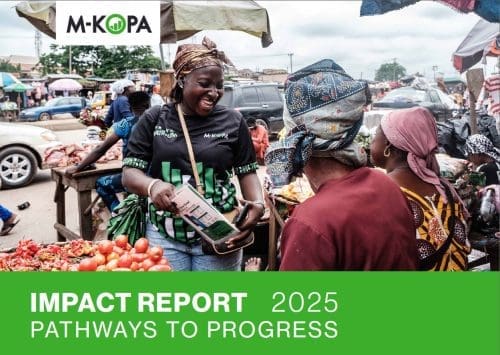
M-KOPA has crossed a significant milestone by serving 3 million active customers, marking a breakthrough moment for Africa’s vast informal economy where 89% of jobs in Sub-Saharan Africa are in the informal sector. The London-based fintech company announced Tuesday that customer satisfaction has surged, with nine out of ten users reporting improved quality of life through access to previously unavailable financial services.
The achievement represents more than numerical success for the company that targets “Every Day Earners” – micro-entrepreneurs operating outside traditional banking systems. Since its 2011 launch, M-KOPA has extended credit access to 7 million total customers across Kenya, Uganda, Ghana, Nigeria, and South Africa, deploying over $2 billion in financing that would otherwise remain inaccessible to this demographic.
“What matters most to us is how many people we’re actively serving every day, those who stay engaged with us over time,” said Jesse Moore, Co-Founder and Chief Executive Officer. Customer feedback validates the approach, with satisfaction rates climbing from 80% to 90% year-over-year.
The company addresses a critical infrastructure gap in Sub-Saharan Africa, where 60% of the population has internet coverage but only 27% can afford access. M-KOPA’s solution centers on smartphone financing with flexible daily repayment structures that mirror how informal workers actually earn income.
Since 2020, the platform has enabled 2.5 million first-time smartphone users, with 81% of women customers reporting they couldn’t afford devices without M-KOPA’s intervention. The impact extends beyond connectivity – 70% of customers use their smartphones to generate income, while 59% report higher earnings since ownership began.
For many users, M-KOPA represents their first encounter with formal financial services. Fifty-five percent of customers are accessing their inaugural formal financial product, while 67% are obtaining health insurance for the first time. These statistics underscore the massive underbanked population across Africa’s emerging economies.
In 2025 alone, 1.3 million smartphones were sold, bringing the cumulative total to 6.4 million since 2020, demonstrating sustained demand for accessible technology financing. The company’s agent network has expanded to over 35,000 representatives, growing 17% annually, with 57% reporting M-KOPA as their first income opportunity.
Women constitute 45% of the agent network and 40% of all customers, with 86% reporting improved quality of life. Local procurement spending reached $236 million across all markets in 2024, creating additional economic ripple effects in communities where formal employment remains scarce.
The fintech has also ventured into sustainable transportation, financing over 4,000 electric motorbikes and facilitating 127,700 circular economy products, resulting in 46,000 tonnes of carbon dioxide emissions avoided.
M-KOPA’s recognition extends beyond customer metrics. The Financial Times has named it among Africa’s Fastest-Growing Companies for four consecutive years, while CNBC included the company in its World’s Top Fintech Companies 2025 list. The company is on track for $400M in revenue this year, having raised over $300M from investors.
The company operates across five interconnected pillars designed to scale individual inclusion into community transformation: financial inclusion, connectivity, prosperity, sustainability, and local market development. This comprehensive approach differentiates M-KOPA from traditional financial service providers that typically focus on single-product offerings.
Moore’s company employs over 2,000 full-time staff alongside its extensive agent network, processing more than 1 million daily payments through its proprietary technology platform. The system accommodates micro-repayment models that align with irregular income patterns common in the informal economy.
As M-KOPA targets 10 million Every Day Earners by decade’s end, the company’s growth trajectory reflects broader trends in African financial inclusion. Mobile money contributed to a near-doubling of account ownership rates between 2011 and 2022 across the region, with technology-enabled solutions driving unprecedented access to financial services.
The milestone achievement occurs amid growing recognition that traditional banking models inadequately serve Africa’s economic reality, where informal sector workers generate substantial economic activity but remain largely invisible to conventional financial institutions.

