

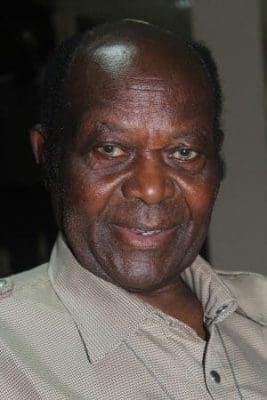
His demeanor belies his age. Seated among younger journalists attending a media training workshop organised by HelpAge International’s Tanzania office this month, the 79-year-old Mzee Clement Kwezi Nsherenguzi is an active participant.
 Mzee Clement (Mzee is a Swahili word for respectable older man) listens and actively contributes to debates. He is quick to put up his hand to ask questions. He disputes misrepresented facts and offers correct versions instead. He is full of energy and enthusiasm and his life depicts the vivacity with which the Saidia Wazee Karagwe (SAWAKA), an affiliate of HelpAge International in Tanzania and whose board he chairs, runs.
Clement’s story
Born in Karagwe in northern Tanzania, Clement has led a varied and exciting life. He has travelled, lived and worked across the world, including Germany, Italy, Greece, the UK, Belgium, the US and Canada.
His foreign tours began when he went to study economics in Berlin, Germany in the 1960s, graduating with a master’s degree in economics, which led him to work for the United Nations Development Programme.
He went on to study journalism and film, working as a journalist in Germany towards the end of the decade, before returning to work for the East Africa Community in Jinja, Uganda.
Tanzania’s founding President Julius Nyerere brought him back in 1971 so that he could help set up and launch the Tanzania Film Company. The film company was solely in charge of importing and films for the Tanzanians. Later Clement spearheaded Tanzania’s domestic film production.
He left in 1975 to join Tanzania Tours Limited – a company tasked with selling Tanzania to the world and bring in tourists and then later worked on tourism at the Tanzanian embassy in Germany.
It was 1994 when Clement found his calling to help Tanzania’s older people. He was inspired by the fallout of the genocide in Rwanda, which saw of thousands of refugees seeking sanctuary in neighbouring countries, including in Tanzania.
He returned from retirement to found Saidia Wazee Tanzania (SAWATA), which translates to “help Tanzania’s older people” in Swahili.
From national to local
SAWATA served as the national base for the work in Tanzania. He however saw SAWATA was not an effective enough platform for providing effective advocacy to Tanzania’s older population as the national platform was big for his resource-poor organisation to manage.so together with his team led by the late Kazimoto who at the time chaired SAWATA, they retreated to their home district of Karagwe to establish the local chapter SAWAKA.
“We realised that as a small team, and hard on resources, we would not effectively represent older persons in the entire country,” Clement said adding that they opted to retreat to their home districts and form small chapters from where they could achieve more in each locality.
From just 17 people at the start, SAWAKA’s membership has grown to over 7,000 across 70 branches in Karagwe and Kieerwa districts of northern Tanzania.
It has helped younger people too, building a hostel that many women in school around Karagwe use. Clement attributes the presence of this hostel to the exemplary performance of girls in the local schools.
Involvement in advocacy
During the last International Day of Older Persons on October 1, SAWAKA hosted over 600 people including the region’s commissioner – the most senior state official locally – to discuss issues that affect older people.
Some of the immediate outcomes included Radio and TV Talk shows in relation to challenges facing older people and how they can be solved, relevance of the International Day of Older People and the need to call for UN Convention on the rights of older people.
Further, the group conducted two press conferences with Journalists in Kagera Region over universal pension and regulation of the National Ageing Policy, exhibition of photos work with older people during the commemoration of the International day of older people and engagement with political party leaders /candidates that were aspiring for the Presidency during their campaigns in the region.
SAWAKA members shared their manifesto with the president Dr John Pombe Magufuli during the campaigns for presidency and called for Universal Pension for older people , free medical services and regulation of the National Ageing Policy when he forms the next government.
Clement has spent over five years advocating for pensions – consistent writing letters to ministers arguing his case. He has also used every opportunity given him in public meetings to talk about the need to create enabling environments for older people to participate in national development.
He is thankful to the semi-autonomous government of the Tanzanian island Zanzibar, which has led the way on the issue of pensions.
When the island’s government passed a law for universal pensions to be provided to all older people beginning April 2016, the Tanzanian government followed suit. It now promises pensions of Tsh 10,000 (£3) to older persons above 70 per month.
“This is some victory for us” says Clement, although adding that it is just a start as those over 60 are excluded.
Continuing his press work
Clement by no means left his journalism work behind in Germany. He is an active member of Karagwe Press Club, regularly reports for Redio Fadeco Karagwe, and has contributed to the Daily News, a leading English newspaper run by the government, and other private Swahili publications.
His topics of interest include economic reform and the need for the government to connect rural Tanzania to grid energy.
Speaking about the media workshop he was attending, Mzee Clement says he was very encouraged to see many journalists interested in issues that affect older people.
Find out more about HelpAge’s work in Tanzania and the work of SAWAKA.
About SAWAKA
SAWAKA Karagwe is a local NGO legally registered under the Non Governmental Organization Act No 24, 2002. SAWAKA Karagwe is independent and has its board of management and accounts.
Vision
SAWAKA KARAGWE Vision is to enhance coordinated promotion of the welfare of the vulnerable older people, and other vulnerable groups of the community such as orphans and vulnerable children, disabled etc.
Mission
SAWAKA mission is to improve the standard of living of older people and other vulnerable groups particularly those who are living in poverty, oppression and difficulties in Tanzania.
Objectives
The objectives for which the organization was formed are as follows;
– To encourage and promote the formation of groups of older people and vulnerable orphaned children, and support such forums where they can meet and exchange ideas and experience with the aim of supporting each other.
– To identify, facilitate and supplement the execution of programs and projects intended for promoting and improving the welfare of older people and other marginalized groups of the community.
– To mobilize, provide and distribute relief support to the most needy.
– Advocacy and lobbying with and for the rights of the aged population and other disadvantaged group
Source: Henry Neondo

