

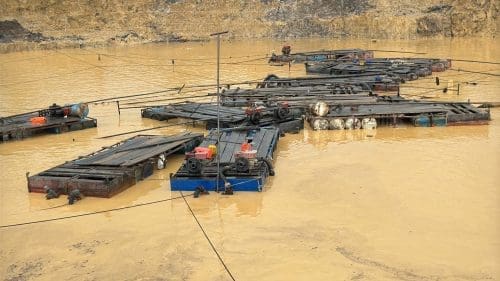
A prominent civil society organization has intensified pressure on President John Dramani Mahama to declare a state of emergency over illegal mining, citing irreversible environmental destruction and questioning his administration’s commitment to tackling the crisis.
The Centre for Democratic Movement (CDM) has called for urgent and extraordinary measures to combat illegal mining, warning that Ghana’s rivers, forests, and farmlands face catastrophic destruction without decisive intervention. The organization declared that emergency powers are “long overdue” given the unprecedented scale of environmental devastation across the country.
In a strongly worded statement released Monday, the advocacy group accused successive governments of failing to enforce environmental laws while political patronage and elite complicity shield offenders from prosecution. The organization specifically highlighted the deteriorating condition of major water bodies including the Pra, Ankobra, and Offin rivers, which continue suffering severe contamination from mining activities.
The CDM’s intervention directly challenges President Mahama’s recent position on emergency declarations. The President has stated he remains “reluctant to declare a state of emergency in the fight against illegal mining because existing laws already give the government enough powers to act”, marking a significant shift from his opposition-era stance.
The rights group highlighted this apparent policy reversal, noting that Mahama previously characterized illegal mining as a “national emergency” requiring emergency powers while serving as opposition leader. The CDM accused political leaders of “opportunism and inconsistency” in addressing the mining crisis, describing the President’s changed position as raising questions about political convenience over principle.
Environmental experts warn that Ghana faces its worst illegal mining surge in decades, driven by record global gold prices approaching $3,000 per gram. Recent assessments indicate over 960 families have lost farmlands to illegal mining activities, while water security remains under severe threat.
The organization’s statement emphasized that rural livelihoods are collapsing as water pollution and soil degradation cripple farming and fishing communities. The CDM warned that agricultural productivity faces long-term damage from contaminated water sources and degraded farmland, threatening food security across affected regions.
Multiple advocacy groups including the Ghana Coalition Against Galamsey have joined calls for emergency declarations, citing over 7,000 excavators causing mass environmental destruction nationwide. The coordinated pressure reflects growing civil society frustration with current government responses to the crisis.
Government Communications Minister Felix Kwakye Ofosu recently clarified that President Mahama is not opposed to emergency declarations but believes timing remains crucial for effectiveness. The administration maintains that existing legal frameworks provide sufficient authority for enforcement actions.
The CDM statement specifically called on Parliament, the Judiciary, and civil society organizations to hold the Executive accountable for environmental protection failures. The group emphasized that citizen welfare and environmental preservation form the foundation of national prosperity and sustainable development.
The government has highlighted some anti-galamsey measures, including suspending new mining licenses in forest reserves and establishing a national task force for enforcement activities. However, critics argue these steps remain insufficient given the crisis scale and urgency.
The debate over emergency powers reflects broader governance challenges as authorities balance economic interests with environmental protection. The CDM previously criticized the administration’s US$279 million allocation to the Ghana Gold Board (GOLDBOD) while failing to commit funds for land or river reclamation efforts.
Legal experts note that state of emergency declarations would expand government powers for enforcement actions, including enhanced security operations and accelerated judicial processes. However, such measures require careful constitutional consideration and parliamentary approval processes.
The organization concluded its statement with stark warnings about Ghana’s environmental future, stating that rivers dying, farms collapsing, and community displacement cannot be resolved through “rhetoric or political maneuvering.” The CDM emphasized that immediate action remains essential to prevent permanent ecological damage.

