

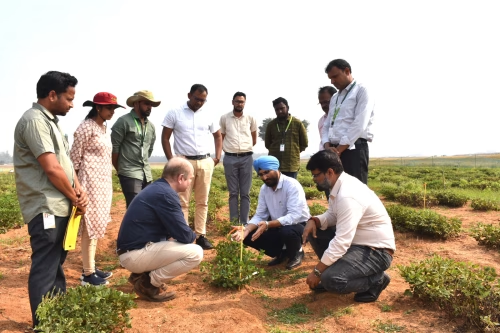
Agricultural researchers at the International Crops Research Institute for the Semi-Arid Tropics (ICRISAT) have achieved a scientific breakthrough that could save global groundnut farmers hundreds of millions of dollars annually by identifying genetic markers for resistance against stem rot disease that devastates up to 80% of crops.
The landmark study, published in the Plant Genome journal, mapped 13 genomic regions and 145 candidate genes linked to stem rot resistance, creating unprecedented opportunities for developing disease-resistant groundnut varieties that could transform farming across Africa and Asia where the crop serves as a nutritional and economic lifeline.
ICRISAT Director General Dr Himanshu Pathak emphasized the transformative potential of the discovery, noting that resistant varieties could prevent catastrophic yield losses while reducing farmers’ dependence on costly and environmentally damaging fungicides. “This advance demonstrates the high return on investment that agricultural research brings to national economies, converting scientific discovery into practical solutions that safeguard farmers against one of the most destructive groundnut diseases,” he stated.
The breakthrough addresses one of agriculture’s most persistent challenges in semi-arid regions where groundnuts provide essential protein and oil for over 500 million people. The crop is cultivated on more than 30 million hectares globally, with annual production reaching 50 million metric tons, making it crucial for food security in developing economies.
Stem rot disease, caused by the soil-borne fungus Sclerotium rolfsii, represents the most significant threat to groundnut production worldwide, particularly affecting smallholder farmers who lack resources to implement expensive control measures. The disease can reduce yields by up to 80%, threatening both individual livelihoods and national agricultural economies in countries like India, Nigeria, and China that dominate global production.
The research team identified three key genes – AhSR001, AhSR002, and AhSR003 – that explain nearly 60% of resistance mechanisms, providing plant breeders with precise tools for developing superior varieties. This genetic mapping represents years of meticulous research conducted across ICRISAT’s specialized disease screening facilities and genomics platforms.
Dr Stanford Blade, Deputy Director General for Research and Innovation at ICRISAT, highlighted how the institute’s unique resources made the breakthrough possible. The study leveraged ICRISAT’s extensive gene bank collections, advanced genomics capabilities, and field-based disease screening infrastructure to unlock the genetic basis of resistance.
The economic implications extend far beyond individual farms, with resistant varieties potentially saving national economies millions in reduced fungicide imports and increased agricultural productivity. For countries heavily dependent on groundnut exports, such enhanced varieties could strengthen their competitive position in global markets while improving farmer incomes.
Principal Scientist Dr Manish Pandey explained that the identified genetic markers will accelerate the development of resistant varieties through marker-assisted breeding, dramatically reducing the time required to introduce new cultivars to farmers. This fast-tracking capability means farmers could access improved varieties years sooner than traditional breeding methods would allow.
The collaborative research involved partnerships with the Indian Council of Agricultural Research (ICAR), the Indian Institute of Groundnut Research, the Chinese Academy of Agricultural Sciences, and Acharya N.G. Ranga Agricultural University. Financial support came from the Bill and Melinda Gates Foundation and ICAR, demonstrating international commitment to addressing agricultural challenges in developing regions.
For African farmers, particularly in Nigeria which produces over 4 million tons annually, the breakthrough offers hope for stabilizing production and income streams that climate change and disease pressure have made increasingly unpredictable. Similar benefits extend to Asian producers where groundnuts form integral parts of both subsistence and commercial farming systems.
The discovery also addresses environmental sustainability concerns associated with current disease management practices. Fungicide treatments provide only partial control while contributing to soil degradation and resistance development in pathogens, making genetic resistance a more durable and eco-friendly solution.
Implementation of these research findings will require coordinated efforts between research institutions, seed companies, and agricultural extension services to ensure rapid variety development and farmer adoption. The success of this genetic breakthrough ultimately depends on translating laboratory discoveries into field-ready varieties that farmers can access and afford.
The study represents a significant advancement in genomics-assisted breeding for crop improvement, demonstrating how modern molecular tools can address traditional agricultural challenges that have constrained productivity and threatened food security across developing economies for generations.

