

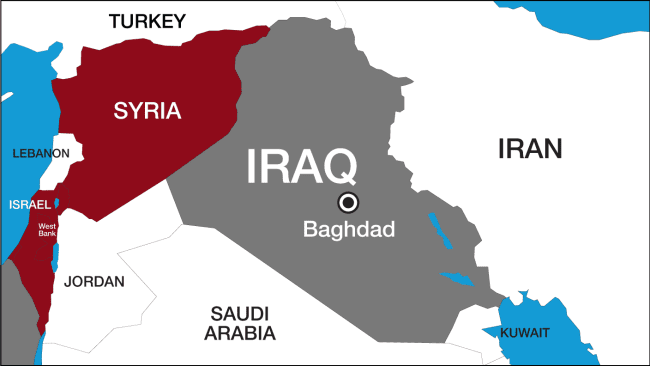
The US-led coalition ended its military mission in Iraq on 30 September. Its departure removes the reason hardline Iran-aligned factions have long given for refusing to surrender their weapons.
The Pentagon said the United States and its partners had formally concluded Operation Inherent Resolve in Iraq, in line with a joint statement the two countries issued in September 2024. The last coalition troops left the autonomous Kurdistan region in the north. Iraqi forces marked the withdrawal with a military parade in Baghdad.
The pressure now shifts to Baghdad. Prime Minister Ali al-Zaidi, who took office this year with Washington’s backing, has pledged to bring all weapons under state control. The most hardline armed groups, chiefly Kataeb Hezbollah and Harakat Hezbollah al-Nujaba, had said they would not disarm until foreign troops left.
At a ceremony on Wednesday, Zaidi said a new phase had begun, defined by Iraqi sovereignty, stronger institutions and forces ready to take charge. He declared 1 October Sovereignty Day. Two days earlier, the heads of the executive, legislature and judiciary had jointly called the withdrawal a national milestone. They also said weapons held outside state authority must be dealt with according to timelines set by the government.
Those timelines have already slipped. The government had set 30 September as a deadline for the factions to disarm, but it withdrew the date as negotiations continued.
Kataeb Hezbollah welcomed the withdrawal as a first step towards what it called full sovereignty. It also warned that a government that failed to serve its people “will be brought down by all possible means.” Some factions say the troop departure alone will not satisfy them. They are also demanding an end to what they describe as American political and economic interference in Iraq.
So far, only two prominent pro-Tehran groups, Asaib Ahl al-Haq and Kataib Imam Ali, together with cleric Moqtada al-Sadr’s Saraya al-Salam, say they have placed their weapons under state authority. The government is also under pressure from Washington and from Sunni and Kurdish political blocs to bring every faction into line.
Zaidi’s security adviser described the end of the mission as a move to longer-lasting bilateral ties with coalition member states rather than an end to cooperation.
The coalition arrived in 2014 after Islamic State (IS) seized large parts of Iraq and Syria and carried out mass killings. IS lost its territory in Iraq in 2017 and in Syria in 2019, but coalition forces stayed on to hunt its remaining cells.
The Iran-backed factions and the coalition both fought IS, but the continued foreign presence later turned them against each other. The factions launched repeated drone and missile attacks on coalition positions, and the United States struck back several times, killing some of their commanders. Under the 2024 agreement, troops withdrew from bases across Iraq in stages until only the Kurdistan region still hosted them. The coalition had already left Syria earlier this year.
Iraqi officials say the fight against IS is not over and now rests mainly with Iraq’s own security forces. In the Kurdistan region, which came under more frequent attack as regional conflict involving Iran widened, residents and officials are asking how they will stop drone attacks without the coalition’s air defences.

