

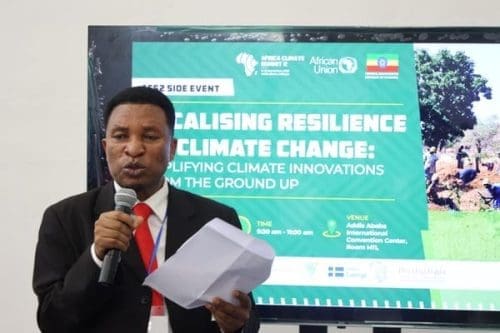
The Pan African Climate Justice Alliance officially launched a pioneering climate fund Tuesday designed to channel financing directly to grassroots African communities, addressing longstanding inequities in global climate finance as continental leaders gather for the Second Africa Climate Summit.
The Climate Justice Impact Fund for Africa, launched alongside the Africa Just Resilience Framework, represents a historic shift toward African-owned climate financing that prioritizes locally-led adaptation solutions over traditional top-down approaches.
Dr. Mithika Mwenda, Executive Director of PACJA, described the launch as addressing fundamental injustices in global climate finance. Africa bears the heaviest burden of climate change impacts while receiving disproportionately small shares of available resources, he said, with existing systems remaining rigid and exclusionary.
“CJIFA was born to change this narrative,” Mwenda stated. “It is a flexible, Africa-owned financing mechanism designed to support locally led adaptation, build the capacity of community-based organisations and de-risk indigenous innovations so that they can be scaled and sustained.”
The fund has already demonstrated impact across the continent. CJIFA has dispersed 64 grants across 17 African countries, enabling solutions ranging from women-led clean energy cooperatives in Kenya to Indigenous soil regeneration projects in Senegal. Individual grants range from $5,000 to $8,000 per organization, with projects implemented within 6 to 12 months.
International partners expressed strong support for the community-focused approach. Joachim Beijmo, Head of Regional Development Cooperation at Sweden’s Embassy in Addis Ababa, emphasized that substantial financing exists but remains inaccessible to local communities who need it most.
“Climate finance should be flexible, supporting local ownership, innovative and inclusive,” Beijmo stressed, highlighting Sweden’s commitment to supporting local actors and organizations in climate adaptation efforts.
Adam Drury, UK Ambassador to the African Union, underscored the fund’s timely arrival as Africa warms faster than the rest of the world while facing unprecedented climate impacts. He advocated for inclusive access ensuring climate finance reaches marginalized groups.
“More finance needs to go to adaptation, not just mitigation, because resilience is best built by the people who live in that environment,” Drury emphasized, reflecting growing recognition that adaptation requires community-level expertise and leadership.
Success stories from existing beneficiaries demonstrate the fund’s effectiveness. Shampi Anna, Programme Manager of Northern Vision CBO, shared how her organization’s CJIFA grant enabled innovative water management solutions that neighboring communities then replicated independently.
“When we started drawing water using solar pumps into fishponds and later draining it into farms, it gave successful results. We were happy to see neighbors replicating the same in their own gardens,” Anna explained, illustrating how small grants can catalyze broader community adoption.
The launch occurs during the Second Africa Climate Summit in Addis Ababa, which brings together leaders, innovators, and communities to drive Africa-led climate action and sustainable development. The summit aims to mobilize billions for renewable energy, sustainable agriculture, green housing, and gender-focused financing ahead of COP30.
Joseph Ng’ang’a, CEO of ACS1 and AFCEN, commended CJIFA’s achievements and pledged that AFCEN would contribute one percent of revenue toward adaptation efforts. He praised PACJA for demonstrating a financing model that reaches traditionally underserved communities.
“By deploying 64 grants across 17 countries, we can avoid creating new initiatives and instead focus on maximizing the impact of our existing projects,” Ng’ang’a stated, emphasizing efficiency in climate finance deployment.
The Climate Justice Impact Fund specifically targets community-based organizations, Indigenous groups, women-led initiatives, youth enterprises, and informal networks across Africa. This focus addresses gaps in traditional climate financing that often bypasses the communities most vulnerable to climate impacts.
PACJA’s approach aligns with broader calls for climate finance reform. African Group of Negotiators and PACJA have called for reframing global climate action to be science-driven and responsive to Africa’s growing climate vulnerability.
The fund represents recognition that effective climate adaptation requires community ownership and local knowledge systems often overlooked by international financing mechanisms. By providing direct support to grassroots actors, CJIFA aims to demonstrate scalable models for community-centered climate resilience.
As Africa faces increasing climate disasters, adapting to a warmer planet will require centering and upscaling local solutions, making initiatives like CJIFA critical for continental climate resilience strategies.
The launch positions Africa as a leader in innovative climate financing approaches that prioritize equity, local ownership, and community empowerment over traditional donor-driven models.

