

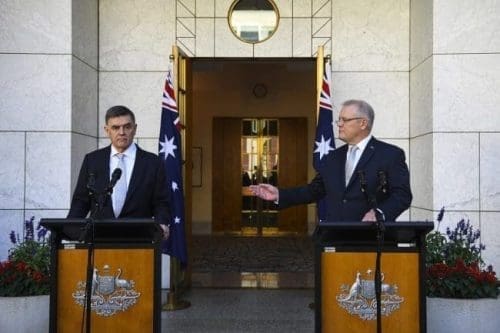
Prime Minister Scott Morrison has declared that restarting the economy is Australia’s next challenge in the fight against coronavirus.
The National Cabinet, which consists of Morrison and state and territory leaders, met on Tuesday to discuss getting Australia back to work.
As of midday on Tuesday, Australia had 6,849 confirmed cases of COVID-19 and 96 people died.
According to data released by the Australian Bureau of Statistics (ABS) on Tuesday, almost 1 million Australians have lost their jobs since the introduction of social distancing measures in March.
As a result restrictions are costing the economy 4 billion Australian dollars (2.5 billion U.S. dollars) per week, Treasurer Josh Frydenberg said.
The ABS found that the total employee jobs decreased 7.5 percent, while total wages paid by employers dropped 8.2 percent, between March 14 and April 18.
The ABS noted that the fall in job numbers was getting steeper rather than flattening in mid-April.
“Looking at the week-to-week changes, the decrease in the number of jobs in the week ending April 18 was 1.5 percent, which was larger than the 0.3-percent decrease in week ending April 11,” Bjorn Jarvis, the head of ABS labour statistics, said in a statement.
Food services and accommodation staff have been the hardest-hit with more than one-third losing their jobs, followed by arts and recreation services where 27 percent of staff are out of work.
The data also showed that jobs in accommodation and food services worked by people aged 20-29 and people over 70 decreased the most (-40.8 percent and -43.7 percent).
In response, Morrison said the National Cabinet was intent on keeping the economy moving in the safest way possible.
“To get Australians back to work, we have to get Australians back to work in a safe economy. We are trying to find what that safe economy looks like, so we can move towards that,” he told reporters.
“The National Cabinet are not in any way unaware of the serious implications of the decisions we have had to take now over many months, and that is why we are not seeking to delay any time at all in terms of trying to get things moving again, but we must be able to move them forward safely.”
Jacinda Ardern, the PM of New Zealand, joined Tuesday’s National Cabinet meeting to discuss the potential of allowing international travel between Australia and New Zealand.
However, Morrison said negotiations on the idea would likely take months.
“The Prime Minister and I have been now for several weeks been talking about a safe travel zone between Australia and New Zealand,” he said.
“It is still some time away. It is important to flag it because it is part of the road back, at some point both Australia and New Zealand connect with the rest of the world again, the most obvious place for that to start is between the two countries.”
The National Cabinet will meet again on Friday to plan the details of a three-step framework to gradually remove baseline restrictions, with the aim to “to enable Australians to live in a COVID-19 safe economy,” according to the statement from Morrison on Tuesday. Enditem

