

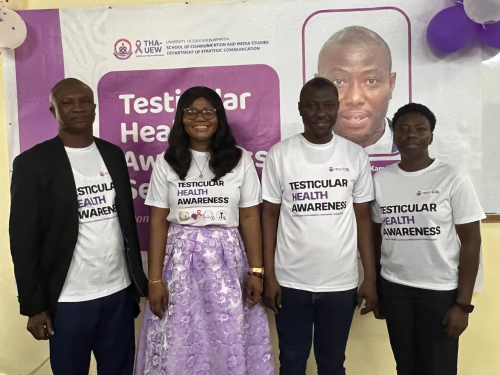
The University of Education, Winneba (UEW) has launched Ghana’s first academic-based testicular health awareness campaign, with the institution’s health director describing the male reproductive organ as the most continuously active in the human body.
Dr John Kanyiri Yambah, Director of University Health Services at UEW, made the statement during a groundbreaking seminar organized by the School of Communication and Media Studies (SCMS) to address neglected aspects of men’s health in Ghanaian society.
“The testes are an integral part of the male reproductive system, and not equal to the male reproductive system and that is also different from the prostate,” Dr Yambah explained to students and faculty members. His assertion aligns with medical research showing the body produces fresh sperm daily, with complete regeneration occurring approximately every 64 days.
The physician emphasized the dual functionality of testicles in both hormone production and continuous sperm generation, noting that this constant biological activity requires careful attention to environmental factors affecting testicular health.
Dr Yambah specifically warned against wearing tight clothing, particularly boxer shorts that restrict proper air circulation around the scrotum. The medical expert explained that optimal sperm production requires specific temperature conditions, making clothing choices a significant factor in male reproductive health.
The seminar represents the first time a Ghanaian university has formally addressed testicular health as part of academic coursework, with Masters students in Social Campaign Planning and Management organizing the event to fill gaps in public health awareness.
Ghana’s healthcare system has traditionally focused more extensively on female reproductive health, leaving male-specific concerns with limited public discourse and education. The UEW initiative addresses this imbalance by bringing testicular health into mainstream academic and public health conversations.
Medical professionals note that testicular health issues, including cancer, infections, and fertility problems, often go undiagnosed due to cultural taboos and lack of awareness. Early detection and prevention strategies require men to understand normal testicular function and recognize warning signs.
The university’s approach combines medical education with strategic communication, training future professionals to develop effective public health campaigns targeting male reproductive wellness. This interdisciplinary method aims to create sustainable awareness beyond the academic environment.
Dr Yambah’s presentation included practical recommendations for maintaining testicular health, emphasizing the importance of regular self-examinations, appropriate clothing choices, and seeking medical attention for unusual symptoms or changes.
The seminar attracted significant participation from both male and female students, indicating growing recognition that reproductive health education benefits entire communities rather than single gender demographics. Faculty members noted increased student engagement with topics previously considered too sensitive for academic discussion.
University officials plan to expand the testicular health awareness program to include community outreach, potentially reaching broader populations across the Central Region. The initiative could serve as a model for other Ghanaian universities seeking to address neglected health topics.
Research indicates that male factors contribute significantly to approximately 30% of infertility cases, making testicular health education particularly relevant for couples planning families.
The timing of UEW’s campaign coincides with global movements encouraging men to take greater responsibility for their reproductive health, challenging traditional gender roles that place primary fertility concerns on women.
Students participating in the seminar expressed appreciation for addressing health topics rarely discussed in formal educational settings, with many noting they had never received comprehensive information about male reproductive anatomy and function.
The success of the inaugural testicular health seminar may influence curriculum development across Ghana’s university system, potentially integrating male reproductive health education into medical, nursing, and public health programs nationwide.
Dr Yambah concluded the presentation by encouraging men to approach testicular health with the same seriousness applied to other vital organs, emphasizing that prevention and early intervention remain the most effective strategies for maintaining reproductive wellness throughout life.

