

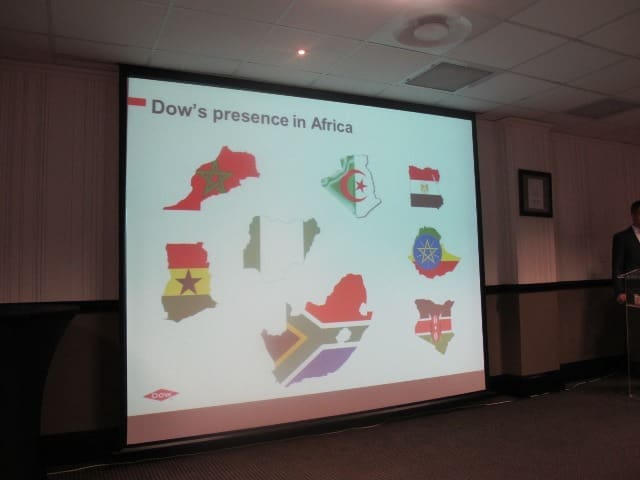
Dow Chemical says it is committed to sustainability and the important role of flexible plastic packaging in spurring economic development to ensuring a more sustainable world.
 Diego Donoso, Business President for Dow Packaging and Specialty Plastics said in Johannesburg in South Africa during an encounter with journalists from across the continent.
Donoso said, “Demand for more sophisticated shopping and retail in Africa is increasing. Consumers have rising disposable income, and they want food which is fresh, healthy and conveniently packed.”
He expressed the readiness of Dow Chemical in undertaking the necessary investment to ensure food spoilage in the world was reduced.
“We are ready for the growth of Africa, we are ready for investment in Africa to engender job opportunities and growth,” the Business President for Dow said.
The United Nations Environment Program (UNEP) in a report titled “The environmental crisis: The environment’s role in averting future food crisis” estimates that roughly one third of food produced in the world for human consumption every year, approximately 1.3 billion tonnes gets lost or wasted.
Every year, consumers in rich countries waste almost as much food (222 million tonnes) as the entire net food production of Sub-Saharan Africa (230 million tonnes).
In developing countries food waste and losses occur mainly at early stages of the food value chain and can be traced back to financial, managerial and technical constraints in harvesting techniques as well as storage –and cooling facilities.
Africa is the world’s fastest growing region after Asia, together with the Middle East. In total, 45 percent of Gross Domestic Product (GDP) growth on the continent comes from consumer-facing sectors, pointing to rising consumer power and income.
The continent is also undergoing rapid urbanization, with 40 percent of the population now living in cities.
As a consequence, food safety, shelf life and supply chain transportation assume greater importance as food will have to travel much longer distances to supply growing urban populations.
Javier Constante, Commercial Vice President, Packaging & Specialty Plastics for Dow Chemical in-charge of Europe, Middle East and Asia expressed concern about food wastage globally.
He observed, “People do not have enough to eat in the world and it is not right to throw food away.”
Dana Mosora, Sustainability Director for Dow Packaging and Specialty Plastics for Europe, Middle East and Africa observed flexible plastic packaging plays a key role in reducing food spoilage and waste.
“Flexible plastic packaging is often the most efficient when it comes to reducing food spoilage and waste, but until now, it has also been more difficult to recycle. Therefore Dow is working closely with all industry members to develop more sustainable and appropriate solutions,” he said.
Dow combines the power of science and technology to passionately innovate what is essential to human progress.
The company is driving innovations that extract value from the intersection of chemical, physical and biological sciences to help address many of the world’s challenging problems such as the need for clean water, clean energy generation and conservation, and increasing agricultural productivity.
It currently operates in approximately 180 countries and in high growth sectors such as packaging, electronics, water, coatings and agriculture.
In 2014, Dow had annual sales of more than $58 billion dollars and employed approximately 53,000 people worldwide.
The company’s more than 6000 product families are manufactured at 201 sites in 35 countries across the world. Enditem.
Source: Roger A. Agana, Johannesburg (South Africa)

