

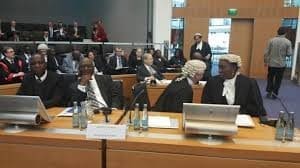
Key players and analyst in the petroleum industry and legal brains have hinted that, it will not be surprising if the final verdict of the Germany-based International Tribunal on the Law of the Sea (ITLOS) over disputed oil fields in the Atlantic Ocean involving Ivory Coast and Ghana agrees to international unitization.

The analysts made their comments with strong convictions that, the possible amicable solution is the international unitization as was in the of the Esat Timor and Australia case some years ago.
This will allow further exploration activities into contested areas of the ocean by two countries which has currently been suspended by the ITLOS in its last month ruling.
The exploration and development and production will be done jointly with the two countries participating actively and benefiting in the according to an agreed formula the proceeds from the operations those oil fields.
Unitisation of the field would enable it to be treated as one as far as exploitation, regulation, revenue taxation, management and others purposes are concerned, giving certainty to investors by providing a financial framework and international legal basis for development of the field.
Ivory Coast is contesting Ghana?s claim to a portion of the sea said to hold significant deposits of oil and gas resources.
After failed attempts to negotiate the dispute amicably, Ghana referred the matter to ITLOS for arbitration.
Dr. Amin Adams of The African Center for Energy Policy and Lawyer Ali-Nakyea Abdallah, a tax and energy expert who spoke to economy times in Kumasi recently had said the ?best option? for amicable solution to the sea border dispute between the two countries could be international unitization.
A communication officer of the largest Africa?s leading independent oil and gas exploration and production company, Tullow Oil plc in a discussion with the economy times agreed to the assertions of possible international unitization between Ghana and Ivory Coast and noted that, they have no problems if to operate on the governments wish.
However, in efforts to amicably settle the difference to ease the tension that is gradual building up between the two countries, the presidents of Ghana and Ivory Coast recently held talks on a maritime dispute hanging over oil projects near their shared border, the two sides said in a joint statement released in Accra.
The talks held in Geneva between Ghana?s John Mahama and Ivory Coast?s Alassane Ouattara were brokered by former UN Secretary General Kofi Annan, the statement said.
The Tribunal recently delivered a cautious ruling that triggered celebrations in after Ivorian officials filed an interim application seeking to restrain Ghana from continuing with Oil Exploration and Production activities in the disputed area which imposed a ban on new drilling.
?The two presidents, true to the mutual vision of regional integration, have decided to engage in a process aimed at achieving cooperation as prescribed by the ITLOS,? the joint statement said.
The two presidents reiterated their commitment to talks promoting regional integration for the benefit of their respective countries, it said, without giving any further details.
A source close to Annan earlier said the presidents would not be discussing the delimitation of the border, since that is under the jurisdiction of the ITLOS.
Last month?s decision by the tribunal was regarded as positive for Ghana and British oil firm Tullow, which leads a consortium developing the TEN field, where it has already drilled the wells it needs to start production.
The tribunal did not judge the merits of the dispute, on which a final ruling is not expected until 2017.
Analysts have said that precedent suggests it is unlikely to redraw the current equidistant maritime boundary.
However, Ghana says it will not terminate diplomatic talks with neighboring Ivory Coast, despite a raging maritime border dispute between the two nations.
This was in response to Minority Spokesperson in parliament on Energy, Hon KT Hammond, who called the application by the Ivoirians betrayal of trust and asked the President Mahama administration to terminate diplomatic talks aimed at resolving the impasse.
But, Petroleum Minister, Emmanuel Armah Kofi Buah disagreed and said Ghana will continue to engage with Abijan.
?Our relationship with Ivory Coast is excellent we engage with them in different areas including trade, power etc. and that is going to continue. On the specific issue over the dispute I think the court order is very clear on engaging with Ivory Coast and we are going to do that we will respect the ruling by the court. We will always engage Ivory Coast our future as two countries is tied and we will continue to talk?. He stressed.
Emmanuel Armah Kofi Buah adds that Ghana will do whatever it takes within the law to ensure her investments in the disputed fields do not go waste.
Talking of international unitization, it necessary to dive a little deeper into the explanation of such agreements and give examples in the world.
A typical case of international unitization which restored calm and killed tension between two countries is the Sunrise International Unitization Agreement.
This agreement is officially known as the Agreement between the Government of Australia and the Government of the Democratic Republic of Timor-Leste relating to the Unitisation of the Sunrise and Troubadour Fields.
The Sunrise International Unitisation Agreement (Sunrise IUA) was made to enable the exploitation of the Sunrise and Troubador petroleum and gas fields in the Timor Sea, together known as the Greater Sunrise field, which straddle the border between the joint petroleum development area (JPDA) established under the Timor Sea Treaty and Australian territorial waters as determined by the 1972 seabed boundary agreement between Australia and Indonesia.
The agreement deemed 20.1% of the resources of the Greater Sunrise field as lying within the JPDA, attributing 20.1% of production from it to the JPDA and 79.9% to Australia. With East Timor getting 90% of the revenue of the JPDA, it effectively was only going to receive 18.1% of the revenue from the field.
This share ratio was amended to both Australia and East Timor getting equal share of the upstream revenue from the field with the signing of the Treaty on Certain Maritime Arrangements in the Timor Sea (CMATS) in 2006. By virtue of this, this agreement is ?read together? with CMATS and the Timor Sea Treaty.
The Sunrise IUA was signed in Dili, East Timor on 6 March 2003 by then Australian Minister for Foreign Affairs Alexander Downer and Ana Pessoa, East Timor?s Minister of State for the Presidency of the Council of Ministers. The agreement came into force on 23 February 2007 by virtue of the coming to force of CMATS on the same day.
CMATS also puts on hold the right by both countries to claim sovereign rights, discuss maritime boundaries or engage in any legal process in relation to maritime boundaries or territorial jurisdiction for 50 years which is the duration the treaty is in effect.
CMATS is one of three treaties concerning the exploitation of gas and petroleum in the Timor Gap and is to be ?read together? with the other two treaties, namely the Timor Sea Treaty of 2002 and the Sunrise International Unitization Agreement (Sunrise UIA) of 2003.
CMATS was signed in Sydney on January 12, 2006 by Australian Foreign Affairs Minister Alexander Downer and his East Timorese counterpart Jose Ramos-Horta. It came into force on February 23, 2007 with the exchange of notes in Dili, East Timor. The East Timor parliament had ratified the treaty while Alexander Downer invoked the national interest exemption to fast-track ratification at the Australian Parliament.
Contents of the the ?Timor Gap? included: Treaty provisions; Without prejudice to the final settlement of borders; Treaty duration; Moratorium; Existing petroleum exploitation to continue and Timor Sea Treaty terms stay.
The others are: Negotiations for permanent boundaries; Division of Greater Sunrise? revenues; Treaties governing petroleum resources exploitation; Water column jurisdiction; Timor-Leste/Australia Maritime Commission; No further re-apportionment of Greater Sunrise revenue; Duration of CMATS; Entry into force.
It is therefore eminent to ask the question that is the government and regulators of the Ghanaians petroleum industry ready for such verdicts from the ITLOS? If yes, what models of such agreement have they studied and are conversant with. What contents are possible to be considered in a likely case Ghana is to sign such treaty with Ivory Coast.
Attempts to get answer to these questions from the Ministry Of Petroleum and the Ghana?s Petroleum Commission has proof futile as they declined to speak on such assertions.
Source: Adnan A. Mohammed

