

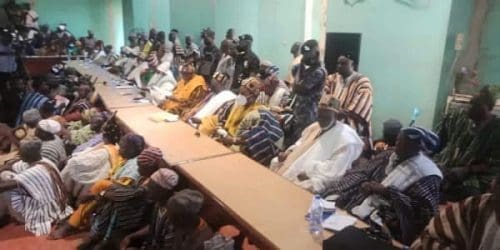
Ghana’s Minister for Local Government, Chieftaincy, and Religious Affairs, Ahmed Ibrahim, has proposed a new committee to resolve chieftaincy disputes without political influence, emphasizing the need to preserve traditional governance while upholding democratic principles.
The initiative aims to address recurring conflicts over leadership succession, which often escalate into community divisions or violence.
Ibrahim announced plans to establish a dedicated, non-partisan body to handle cases beyond existing judicial committees, stressing that chieftaincy matters “must not be politicized.” Speaking on Starr FM, he highlighted the importance of codifying succession lines to prevent power vacuums. “We must enforce established lines of succession so that when a chief passes, there is a clear and legally recognized process,” he said.
The proposal responds to decades of clashes, such as the 2019 Dagbon conflict, where competing factions clashed over leadership. Ibrahim argued that unchecked individual freedoms undermine communal harmony, stating, “Your rights end where another person’s begins.”
Critics warn of potential friction between state-imposed frameworks and customary practices, particularly among ethnic groups like the Akan and Ga, whose succession traditions vary. Current laws empower traditional councils to mediate disputes, but enforcement remains inconsistent.
The ministry has yet to detail how the committee would interact with existing structures like the National House of Chiefs or address concerns about overreach. Analysts suggest success hinges on blending legal rigor with cultural sensitivity, noting parallels to Botswana’s hybrid governance model, which integrates traditional leaders without granting political roles.
Ghana’s 1992 Constitution bars chiefs from partisan activities but recognizes their authority over land and custom. Ibrahim’s plan seeks to modernize this balance as the nation grapples with preserving heritage amid democratic evolution.

