

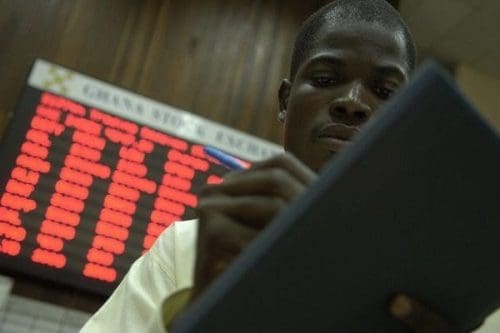
The Ghana Stock Exchange (GSE) Composite Index surged 162.20 points on Wednesday, closing at 8,330.55 as telecoms and banking stocks drove moderate trading that saw over 1.1 million shares change hands.
The benchmark index’s 2% single-day gain came primarily from activity in Scancom (MTNGH), Ecobank Transnational (ETI), and SIC Insurance, which together accounted for the bulk of Wednesday’s 1.15 million shares traded. Total transaction value reached GH¢3.12 million during trading session 7061.
MTN Ghana led volume with 505,273 shares traded, climbing GH¢0.15 to close at GH¢4.50. The telecoms giant maintains a market capitalization of GH¢59.56 billion and trades at a price-to-earnings ratio of 8.20, offering investors a 1.78% dividend yield.
Ecobank Transnational followed with 371,913 shares, while SIC Insurance rounded out the top three with 247,582 shares. Enterprise Group posted the day’s most significant price movement in percentage terms, gaining GH¢0.15 to reach GH¢3.35—a 4.5% jump that suggests renewed investor interest.
GCB Bank edged up a pesewa to GH¢14.11, maintaining its position as one of the market’s more attractively valued banking stocks. With a P/E ratio of just 2.23 and dividend yield of 7.09%, the bank offers income-focused investors compelling metrics compared to sector peers.
The Financial Stocks Index, which tracks the performance of listed banks and financial institutions, gained 3.20 points to settle at 3,802.51. That modest advance suggests Wednesday’s rally was broad-based rather than concentrated in a single sector.
Year-to-date, the Composite Index has climbed 0.70% while the Financial Stocks Index is up 0.60%—relatively muted gains that reflect the cautious sentiment that’s characterized Ghanaian equity markets through much of 2025. However, the index has gained 10.64% over the past month, suggesting momentum may be building.
Wednesday’s activity represents a decline from Monday’s more robust 2.07 million shares worth GH¢8.37 million, but exceeded Tuesday’s 1.02 million shares valued at GH¢4.00 million. The weekly pattern suggests liquidity remains uneven, with institutional investors picking their entry points carefully.
Thirty ordinary shares traded on the main market, with notable activity beyond the top three including ACCESS, ADB, CAL, GGBL, RBGH, SOGEGH, TOTAL, and UNIL. The diversity of active stocks indicates retail participation alongside institutional flows.
The Ghana Alternative Exchange (GAX), designed for small and medium enterprises, saw no trading activity despite five listed companies—SAMBA Foods, MMH, HORDS, IIL, and DIGICUT. That dormancy continues to raise questions about whether the alternative market provides sufficient liquidity to attract serious capital.
Similarly, the Odd Lot Market, where investors trade share quantities below standard board lots, recorded zero activity across all 31 listed equities. The inactivity suggests small retail investors remain sidelined, possibly deterred by transaction costs or market uncertainty.
Total Ghana’s P/E ratio of 12.31 and dividend yield of 6.94% position it among the market’s more balanced investment options, offering both growth potential and income. Standard Chartered Bank Ghana, with a P/E of 6.51 and yield of 5.96%, presents similar characteristics for conservative investors.
AngloGold Ashanti maintains the largest individual market capitalization at GH¢18.64 billion, though its shares didn’t feature prominently in Wednesday’s trading. Tullow Oil follows at GH¢17.43 billion, with MTN Ghana’s GH¢59.56 billion making it the exchange’s heavyweight by valuation.
Total market capitalization across all listed companies stands at GH¢164.61 billion, a figure that places the GSE among sub-Saharan Africa’s mid-tier exchanges. The market’s relatively modest size means individual large trades can move prices significantly—a double-edged sword for investors.
The exchange’s positive momentum comes as food and beverage as well as ICT sectors accounted for nearly three-quarters of trading value in the first seven months of 2025. That concentration highlights how dependent market performance remains on a handful of blue-chip names rather than broad-based economic expansion.
For investors, Wednesday’s gains offer encouragement but shouldn’t obscure underlying challenges. Trading volumes remain well below levels seen during the market’s more robust periods, and the lack of GAX activity suggests Ghana’s capital markets aren’t yet effectively channeling investment to smaller enterprises.
The question facing market participants is whether this week’s uptick signals a sustainable rally or merely represents profit-taking reversals after recent declines. With the index up sharply in a single session but year-to-date gains still modest, the market appears caught between competing narratives about Ghana’s economic trajectory.
What’s clear is that MTN Ghana and the major banks continue driving whatever momentum exists. Until trading broadens beyond these established names, the GSE’s gains will remain vulnerable to sentiment shifts around a narrow group of counters that institutional investors can’t easily avoid.

