LATEST ARTICLES

Sekondi-Takoradi: how a 1928 harbour fused two towns

0

When the Gold Coast’s colonial government opened a deep-water harbour at Takoradi in 1928, it changed more than the colony’s trade routes. The port pulled a small coastal settlement level with its older and better-connected neighbour, Sekondi. Within 18 years the two towns had become one city.

A set of Gold Coast-era photographs shared by Fante Voice Studios on social media, and reported by GhanaWeb on 10 October 2026, has renewed interest in that history. The images show how separate the towns once were, and how much of Sekondi’s early character came from its Fante residents.

Sekondi came first

Sekondi is the older settlement. The Sekondi Takoradi Metropolitan Assembly has suggested that Sekondi was already a town by 1894, decades before Takoradi had much to its name.

The railway gave it an early lead. A railway and a deep-water seaport were built in Sekondi and Takoradi in 1903 and 1928, after which both became important economic centres. The line linked Sekondi’s coast to the gold-mining districts inland and to Kumasi. Government offices and institutions settled in Sekondi, and it served as the area’s administrative centre.

A harbour few believed in

Takoradi’s rise was not inevitable. A study of the city’s economic history, published in an academic journal, describes a private bid to develop the site long before the state moved. Around 1903, a man named Lefeber spotted Takoradi’s potential as a harbour town. His successor kept paying rent on the land in the hope that a port would follow, while the colonial government focused on building a harbour at Sekondi instead.

The faith ran out. Around 1913 the rent payments stopped because the leaseholders no longer believed Takoradi would ever get a harbour.

They were wrong. The harbour was built in 1928 as part of the 10-year development plan of Gordon Guggisberg, then governor of the Gold Coast. It became West Africa’s first artificial harbour and was served mainly by rail. Shipping companies, trading firms and workers followed the cargo, and Takoradi grew quickly as the colony’s commercial gateway.

During the Second World War the port and a neighbouring airfield became a staging point on an Allied air route that ferried aircraft across Africa to the North African front.

Union in 1946

As both towns spread along the coast, the gap between them closed. The two were formally amalgamated on 2 December 1946, combining Sekondi’s administrative role with Takoradi’s port economy.

The names themselves carry older traces. Researchers note that “Takoradi” and “Sekondi” are local forms of the Prussian names “Taccarary” and “Secundis”, recorded during the 17th century when European trading powers competed along this stretch of coast.

Today Sekondi-Takoradi is the capital of both the Sekondi-Takoradi Metropolitan Assembly and the Western Region. Since Ghana began producing oil from the offshore Jubilee field in 2010, the metropolis has also become the main onshore base for the industry, and academic work has described it as West Africa’s newest oil city.

Faces from Sekondi’s past

The photographs shared by Fante Voice Studios focus on Sekondi before the merger. They show Fante women and girls, artisans and community groups, with the town named as the location. One image, captioned as Morphy’s Hotel, is presented by the collection as an example of Fante-built architecture.

The captions also bring out how outsiders wrote the name of the people. Gold Coast-era documents use spellings such as “Fanti”, “Fantee” and “Fantyn”. “Fante” is the standard modern English form, while speakers of the language use “Fantse”.

The Dutch built a fort at Sekondi in 1642. It now serves as a lighthouse.

Jomoro MP, Nzema chief court investors for coconut factory

0

Jomoro MP Dorcas Affo-Toffey has met the Paramount Chief of the Western Nzema Traditional Area and prospective investors over a planned coconut processing factory in the Western Region municipality.

The investors, who have not been named, are studying whether a plant in Jomoro could turn locally grown coconuts into higher-value products for domestic and export markets. Affo-Toffey said the factory could create jobs for young people, widen markets for coconut farmers and raise incomes across the municipality.

The project is still at the feasibility stage. No investment amount, processing capacity, supply arrangement or construction timeline has been made public.

For Nzema farmers, the question is whether a processor would pay better and more reliable prices than the current trade in raw nuts. Coconuts can be processed into oil, milk, desiccated coconut and other foods, while husks and shells can supply fibre and industrial products. A plant’s value to farmers would depend on how it buys its raw material and on whether local supply is large and steady enough to keep it running near capacity.

The meeting follows a push by traditional leaders to revive the crop. In August, Awulae Kwasi Amakyi III, the Paramount Chief, told the Jomoro Development Conference at Half-Assini that the area would revive its coconut industry rather than turn to illegal mining. He said Jomoro needed processing factories to add value to its coconuts, and described the once-thriving industry as a former mainstay of employment in Nzema.

The Western Region is the centre of Ghana’s coconut production. In 2022, the then regional minister said it supplied more than 80 per cent of the country’s coconuts for local use and export. The Jomoro and Shama districts received new coconut seed gardens under a regional replanting programme launched in 2020.

Ashanti inflation hits 9.8% as Western prices fall in September

0

Inflation in Ghana’s Ashanti Region reached 9.8 per cent in September 2026, nearly double the national rate, while prices in the Western Region fell, Ghana Statistical Service (GSS) data show.

Figures released on 7 October put national inflation at 5.2 per cent. Ashanti recorded the highest regional rate, followed by the Eastern Region at 7.8 per cent. Greater Accra came in below the national average at 3.4 per cent. The Western Region recorded a rate of minus 0.5 per cent, meaning its consumer basket cost slightly less than a year earlier.

The spread shows how little the national average says about any one household. The 10.3-point gap between Ashanti and Western means two families buying similar goods can face very different price trends depending on where they live. For businesses and workers in Kumasi and the wider Ashanti Region, the cost of living is rising at close to the pace the whole country saw a year ago, when national inflation stood at 9.4 per cent.

A regional rate measures how fast prices are changing, not how expensive a place is. Faster inflation in Ashanti does not mean living there costs more than in Accra, only that prices there have risen more quickly over the past 12 months.

Nationally, inflation rose for a second straight month, from 5.0 per cent in August. Prices rose 1.1 per cent over the month, after falling 1.0 per cent in August. Food inflation climbed to 4.0 per cent from 3.0 per cent, driven by fresh tomatoes, up 153.4 per cent on the year, and ginger, up 100.4 per cent. Some staples moved the other way: lime prices fell 29.9 per cent and maize 26.4 per cent.

Locally produced items drove about 86 per cent of inflation, which Government Statistician Dr Alhassan Iddrisu described as largely homegrown. National inflation remains below the lower bound of the Bank of Ghana’s medium-term target of 8 per cent, plus or minus 2 points.

Rent becomes Ghana’s second-biggest inflation driver in September

0

Rent payments accounted for 13.9 per cent of Ghana’s 5.2 per cent inflation rate in September 2026, second only to fresh tomatoes, Ghana Statistical Service (GSS) data released on 7 October show.

Fresh tomatoes contributed 20.3 per cent of the headline rate and ginger 9.9 per cent. Prices of the two items rose 153.4 per cent and 100.4 per cent from a year earlier. The share figures measure each item’s contribution to overall inflation and reflect its weight in the consumer basket, not how much its price rose.

Rent’s place near the top of the table points to where the next price pressure lies. Food inflation is volatile and can swing back quickly once supply improves. Housing costs are stickier. Government Statistician Dr Alhassan Iddrisu said services inflation, at 8.3 per cent, was rising twice as fast as goods inflation, at 4.2 per cent. He said services “are the last hurdle for us to deal with.” Housing, water, electricity and gas recorded the highest inflation of any category, at 10.3 per cent.

Headline rate still low

Inflation rose for a second straight month, from 5.0 per cent in August, after falling to 3.2 per cent in March. It remains well below the 9.4 per cent recorded in September 2025 and below the lower bound of the Bank of Ghana’s medium-term target of 8 per cent, plus or minus 2 points. Food inflation rose to 4.0 per cent from 3.0 per cent, while non-food inflation eased to 6.2 per cent from 6.8 per cent. Locally produced items accounted for about 86 per cent of inflation, which the GSS described as largely homegrown.

The upfront cost the index misses

The price index does not capture the lump sums many tenants must pay before moving in. Landlords in Accra, Kumasi and other cities commonly demand one or two years’ rent in advance. That is illegal under the Rent Act, 1963 (Act 220), which caps advance rent at six months for tenancies longer than six months and two months for shorter ones.

The state has stepped up enforcement this year. In March, President John Mahama urged tenants to report landlords who demand more. The Rent Control Department said it would prosecute offenders from 1 April. In June, Acting Rent Control Commissioner Frederick Opoku told tenants to gather evidence and report violations. He also announced compulsory registration of landlords on a digital database.

The department’s capacity is limited. Opoku said in April that it had only 185 staff nationwide and described it as poorly resourced. It plans to introduce a standard tenancy agreement by November 2026.

Some landlords argue that long advances pay for repairs and building work. They have warned that tighter limits could push rents up.

Ghana’s mobile money boom leaves most businesses behind

0

Ghanaians moved GH¢518.8 billion through mobile money in August 2026, yet most of the country’s businesses still do not accept digital payments, according to central bank data and census-based research.

The gap between how Ghanaians pay and how firms get paid is now one of the clearest weak points in the country’s shift away from cash. It matters for small businesses in particular. Firms that keep no digital record of their sales struggle to show lenders what they earn, which shuts many of them out of credit.

Consumers moved first

Bank of Ghana figures show the value of mobile money transactions rose from GH¢323.2 billion in June 2025 to GH¢492.9 billion in June 2026, an increase of more than 50 per cent. Volumes reached 954 million transactions in June alone. Values rose again in July and August.

Across 2025, mobile money transactions totalled GH¢4.54 trillion, up 50.8 per cent on 2024. The infrastructure is extensive: about 546,000 active agents, and 26.4 million active accounts out of 85.8 million registered as of August.

Firms lag behind

Businesses tell a different story. A study by the Ghana Statistical Service and the Retail Finance Distribution (ReFinD) research initiative at the Institute of Statistical, Social and Economic Research (ISSER) found that only about 37 per cent of firms accept or use digital payments. The study drew on the 2024 Integrated Business Establishment Survey. By contrast, nearly 95 per cent of individuals surveyed had paid digitally as consumers.

“This large gap between individual and business use tells us there’s strong potential,” said Francis Annan, the initiative’s co-lead.

Adoption is uneven. It stood at 38.4 per cent in services, 34.9 per cent in industry and 22.4 per cent in agriculture. Formal firms were far more likely to go digital than informal ones, at 56.7 per cent against 35.2 per cent. Use is concentrated in Greater Accra and regional capitals, with businesses in northern Ghana less likely to take part.

Even firms that have adopted digital payments mostly rely on personal mobile money accounts, which the researchers describe as the costliest and riskiest option for business. Merchant accounts are cheaper and more efficient. The researchers found that firms using merchant accounts recorded better revenue growth. Owners cited limited knowledge, cost, taxes and fraud concerns as the main barriers.

Why records matter for credit

The link to financing is where the stakes rise. A business that takes payments digitally builds a transaction history that a bank can assess. A business that runs on cash usually cannot prove its cash flow.

That matters more now that borrowing costs are falling. The average lending rate dropped to 15.9 per cent in August 2026 from 24.2 per cent a year earlier, Bank of Ghana data show. Cheaper credit helps only firms that can show they are creditworthy.

The researchers have recommended stronger cybersecurity, wider digital infrastructure outside the main cities, incentives for women-led businesses and better financial literacy among business owners.

Mahama says government no longer crowds out private borrowers

0

President John Mahama says government has stopped crowding businesses out of the credit market, citing lower interest rates, during a visit to drinks maker Kasapreko reported on 9 October 2026.

Speaking at the Ghana Stock Exchange-listed company’s production facility, Mahama said heavy state borrowing had previously soaked up bank credit. He said that left little for private firms and pushed the interest rates they were charged to excessive levels.

“We are exercising fiscal discipline, making sure government lives within its means,” he said. He added that the aim was to create room for the private sector to grow.

The claim matters because the cost of credit decides whether manufacturers like Kasapreko can expand and hire. Official data show borrowing costs have fallen sharply, though not as far as some of the President’s examples suggest.

Mahama said commercial lending rates had dropped from highs of around 32 per cent, and that some businesses were now borrowing at rates as low as nine per cent. Bank of Ghana data put the average lending rate at 15.9 per cent in August 2026, down from 24.2 per cent a year earlier. The World Bank’s latest Ghana Economic Update said average lending rates fell from about 27 per cent in June 2025 to 15.6 per cent in June 2026. Rates still vary widely between banks and borrowers, with some lenders charging up to 30 per cent.

The decline followed deep cuts by the Bank of Ghana, which lowered its policy rate from 28 per cent in April 2025 to 14 per cent by March 2026. It has held the rate there since, most recently on 24 September, as inflation edged up to 5.2 per cent in September.

The President also pointed to a surge in foreign direct investment, which he said rose from $624 million in 2024 to $2.62 billion in 2025. The Ghana Investment Promotion Authority’s 2025 report confirms the $2.62 billion figure. However, Bank of Ghana data show that 95.4 per cent of net inflows on a balance of payments basis came from reinvested earnings of firms already operating in Ghana, not new money.

Mahama urged Ghanaian entrepreneurs to follow foreign investors and expand, and praised Kasapreko’s growth into export markets.

Bloom Africa injects GH¢1.13bn into Prudential Bank, eyes regional network

0

Mauritius-based Bloom Africa Holdings has completed a GH¢1.13 billion capital investment in Prudential Bank, a Ghanaian-owned lender, as the group pursues a West African banking network.

Prudential Bank announced on 9 October 2026 that the deal had closed after approval from the Bank of Ghana. The money came through Bloom Africa Holdings Ghana Limited, a wholly owned subsidiary of the Mauritius holding company.

The bank said the capital lifts it above the Bank of Ghana’s minimum capital requirement. It said the funds will support more lending to small and medium-sized enterprises and corporate clients, as well as spending on technology and digital banking.

“This investment significantly strengthens Prudential Bank,” said Ebow Quayson, the bank’s acting managing director.

For Bloom Africa, Ghana is the largest market yet in a West African expansion built largely on acquired banks. Its subsidiaries operate as Bloom Bank Africa in The Gambia, Sierra Leone and Liberia. Those banks were previously Skye Bank Gambia, Keystone Bank Sierra Leone and Global Bank Liberia. In 2024 the group drew backing from the Fund for Export Development in Africa, the impact investment arm of the African Export-Import Bank (Afreximbank), to support that expansion.

Gabriel Edgal, Bloom Africa’s board chairman, said the group wants to build African institutions that can finance trade and help businesses grow beyond their home markets. He said Prudential’s knowledge of its Ghanaian customers would anchor that plan, linking them to capital and opportunities elsewhere on the continent. Edgal also leads Oakwood Green Africa, an associate company of the group.

Prudential Bank, founded as a privately owned Ghanaian bank, has until now described itself as wholly Ghanaian-owned. The bank has not disclosed the size of the stake Bloom Africa now holds, how much of the new capital will go to small-business lending, or any lending targets.

Wontumi says GH¢30m Exim Bank case is civil debt

0

Bernard Antwi Boasiako, the former New Patriotic Party Ashanti chairman known as Wontumi, has asked the High Court to declare his GH¢30 million Exim Bank case a civil dispute.

In a filing reported on 8 October 2026, he and his company, Wontumi Farms Limited, argue that the dispute is a civil debt that has been wrongly treated as a crime. They say the Economic and Organised Crime Office (EOCO) has overstepped its mandate by acting as a debt collector for the bank.

They point to the security attached to the loan. Antwi Boasiako personally guaranteed repayment in the event of default, and the Ghana Export-Import Bank agreed to take out insurance on the loan. They are asking the court to send the matter to the civil courts. They also want it to direct the bank to recover any outstanding balance through the mortgage, his personal guarantee or the insurance cover.

If the court grants the application, the criminal prosecution would effectively end and the dispute would become a matter of recovering a debt.

Antwi Boasiako is standing trial with Thomas Antwi-Boasiako, who is at large, and Wontumi Farms Limited over an alleged GH¢30 million loss to the bank. The prosecution alleges that the two men obtained about GH¢14.302 million from Exim Bank in 2018 by false pretences. It alleges that a pro forma invoice for farm machinery was used to support the loan application, and that money was later withdrawn from the company’s accounts for personal use. None of the allegations has been tested at trial.

The state filed an amended charge sheet on 22 September after plea discussions with the defence broke down. It retains a charge of uttering a forged document under Section 169 of the Criminal Offences Act, 1960. The accused were first arraigned on 18 May 2026 and will have their pleas taken afresh on the amended charges.

Antwi Boasiako is currently serving a prison sentence after his conviction in a separate illegal mining case.

The Accra High Court will resume hearing the Exim Bank case on 13 October 2026 at 10.30am.

UTAG-UG threatens strike from 19 October over research allowance

0

The University of Ghana branch of the University Teachers Association of Ghana (UTAG-UG) threatened to withdraw teaching from 19 October 2026 unless members’ Book and Research Allowance is paid.

In a notice to the National Labour Commission dated 9 October, the branch gave the government until Friday, 16 October, to pay the 2026 allowance. It said members would withdraw all teaching and related services from the following Monday if the money had not arrived.

The branch said the delay breaches a 2020 Memorandum of Agreement between UTAG and the government, which it said requires the allowance to be paid by the end of August each year.

A walkout at the country’s largest public university would disrupt the new academic year at Legon. It would also add to pressure from other unions in the sector. The Technical University Teachers’ Association of Ghana (TUTAG) has been on strike since 1 October.

The allowance helps lecturers buy books and academic materials, fund research and attend scholarly events. It has been a recurring flashpoint this year. In June, UTAG’s national leadership threatened a nationwide strike over the Finance Ministry’s delay in releasing the dollar exchange rate used to calculate the allowance. It later set a 30 June deadline for the government to resolve outstanding conditions-of-service issues, and suspended planned action in early July after government assurances.

There are signs that payment is moving. TUTAG President Professor Deodat Adenutsi said on 1 October that a letter from the Ghana Tertiary Education Commission, dated 28 September, confirmed funds had been released on the government’s financial management system for first-batch payments by individual institutions. He said TUTAG no longer treated the allowance as a ground for its own strike. TUTAG is instead striking over unpaid post-retirement contracts and other conditions of service.

Dutch seek Ghana’s help to choke Bolle Jos supply lines

0

The Netherlands is seeking Ghanaian help to cut supply lines of fugitive Dutch trafficker Jos Leijdekkers, known as Bolle Jos, after cocaine shipped from Ghana was seized in France.

Dutch Justice and Security Minister David van Weel is backing efforts to bring Ghanaian authorities into the pursuit, the Dutch newspaper De Telegraaf reported. The form of the cooperation is still being worked out but could include sending Dutch police officers to Ghana, the paper said.

The move puts Ghana at the centre of one of Europe’s most prominent manhunts. Leijdekkers is the Netherlands’ most wanted criminal. Dutch authorities believe he is hiding in Sierra Leone, and The Hague has tried for months without success to secure his extradition from Freetown.

The trigger was a seizure in early September 2026, when French customs at the Port of Dunkirk found nearly 3.9 tonnes of cocaine in a container of plastic waste shipped from Ghana. French authorities valued the drugs at about €225 million (about US$260 million). De Telegraaf and Belgian media have linked the shipment to Leijdekkers’ network.

Four Ghanaians have since been arraigned before the High Court in Accra on charges of conspiracy to export narcotic drugs and exporting narcotic drugs. They have pleaded not guilty. The Narcotics Control Commission (NACOC) has said the suspects were under surveillance for one to two years before their arrest. It said intelligence showed that Leijdekkers himself had not entered Ghana, although associates operated from the country.

NACOC has said Ghana will not be a safe haven or transit point for international drug trafficking groups. President John Mahama has ordered an inter-agency task force to draw up a plan to stop drug trafficking through Ghana’s borders.

Europe is also stepping up pressure on Sierra Leone. The European Commission has suspended about €18 million in 2026 budget support to the country, which Van Weel said was because of its failure to cooperate on extradition. The Netherlands wants a further €22.5 million earmarked for 2027 withheld if Leijdekkers is not handed over. It is also pursuing European measures to freeze his assets and restrict his movements.

A Dutch court sentenced Leijdekkers in his absence to 24 years in prison for trafficking nearly seven tonnes of cocaine.

GES brands SHS placement ‘goro boys’ scammers, urges official help

0

The Ghana Education Service (GES) in remarks published on 10 October 2026 urged parents not to pay “goro boys” promising senior high school places, calling the middlemen criminals and scammers.

Daniel Fenyi, the GES head of public relations, told GhanaWeb TV’s Lowdown show that the Service has no dealings with people who claim they can influence placement for a fee. “They are criminals. They are scammers. We don’t work with them,” he said.

The warning targets the families still caught in this year’s self-placement process. Parents who pay middlemen risk losing their money with no school place to show for it.

Under the 2026 Computerised School Selection and Placement System, about 527,000 students were placed automatically. That left roughly 13 per cent of candidates to choose schools themselves through the self-placement portal. Official figures put the number eligible for self-placement at 53,887, of whom 33,726 had secured schools by mid-September. The Education Ministry then extended the exercise to 18 September.

Fenyi said parents struggling with the process should go to their children’s former school heads, district education offices or the placement resolution centres. GES runs 17 such centres nationwide, with the national centre at GNAT Hall in Accra. He said official staff there handle cases, including families who have trouble using the online system.

He asked parents who had already lost money to share details that could help trace the middlemen, such as phone numbers, names, payment records and photographs. Many victims, he said, have been unwilling to come forward.

This year’s placement drew complaints of long queues at resolution centres, particularly in Accra and the Ashanti Region. In September, Fenyi said 15 of the 17 centres were running smoothly. He argued that the pressure in those two areas did not amount to a national crisis, noting that there were about 800,000 places for just over 600,000 students.

Assafuah seeks GTA CEO’s suspension over World Cup visa list

0

Minority MP Vincent Ekow Assafuah on 10 October 2026 called for the suspension of Ghana Tourism Authority chief Maame Efua Houadjeto, alleging her agency misrepresented World Cup visa applicants.

Speaking on JoyNews’ Newsfile, Assafuah said a document submitted to the United States Embassy listed more than 30 people as members or affiliates of the Ghana Tourism Authority (GTA) board, though the board has about 11 members.

“Over 30 people were misrepresented to the US Embassy as board members,” he alleged. He said the CEO should step aside so the matter could be investigated without interference.

The claim deepens a controversy over how Ghanaian public institutions handled visa arrangements for the 2026 FIFA World Cup in the United States, Canada and Mexico. Assafuah is the Ranking Member on Parliament’s Youth and Sports Committee and the New Patriotic Party MP for Old Tafo. He also cited a WhatsApp exchange in which, he said, a person who was not on the board admitted obtaining a US visa on that basis. He did not name the individual.

He challenged the Sports Ministry’s account of when it began dealing with the embassy over the tournament. The ministry has said formal engagement started around March or April 2026. Assafuah produced an email dated 3 February 2026 from the embassy’s public diplomacy section, which invited stakeholders to a third World Cup meeting and referred to an earlier meeting on 22 October 2025.

Houadjeto has previously denied involvement in the visa controversy, and the GTA has denied collecting money for US or Canadian visas. A special aide to the Sports Minister said on 10 October that the US Embassy treated the National Sports Authority, the Ghana Football Association and the GTA as separate entities for visa applications. He also said the ministry was not shielding anyone.

Assafuah’s demand is a call for investigation and does not amount to a finding of wrongdoing.

The new allegation adds to claims the Minority made at a press conference on 7 October. There, Assafuah alleged that the US Embassy verified only two of 50 people the GTA submitted as media personnel. The Minority also called for the removal of Sports Minister Kofi Adams and the GTA chief executive.

President John Mahama has asked National Sports Authority Director-General Yaw Ampofo Ankrah to step aside while police investigate the visa arrangements.

Okoe Boye demands apology for nurse in Ghana Jollof case

0

Opposition figure Bernard Okoe Boye has demanded an apology for Salomey Awiti Baffoe, the nurse charged in the Ghana Jollof case, saying on 10 October 2026 her detention was unjustified.

Dr Okoe Boye, the New Patriotic Party’s (NPP) Greater Accra Regional Chairman, made the remarks on Channel One TV’s The Big Issue. He questioned how the prosecution could treat Baffoe as a threat to the state while she was in custody, then raise no objection to her release on bail. He also noted that the case has now been adjourned to February 2027. He suggested some officials had wanted to show her where power lay.

“I want those involved to come and apologise to her,” he said. He added that protecting individual liberty should be a priority whichever party is in government.

The comments widen the political argument over a prosecution that has drawn protests since Baffoe’s arrest. They also highlight a gap at the centre of the case: the High Court refused her bail in September, yet the prosecution did not oppose it at the Circuit Court on 5 October.

Baffoe, 40, is a senior nursing officer based at Hansua, near Techiman in the Bono East Region. Police took her from her home on the night of 13 September. She is charged with abetment of crime, namely publication of false news, under the Criminal Offences Act, 1960, and has pleaded not guilty. None of the allegations has been tested at trial.

The prosecution alleges that she acted as a liaison for Barbara Asantewaa Kodua, whom police identify as the operator of the Ghana Jollof TikTok account. Police have declared Kodua wanted and believe she is in the United Kingdom.

The High Court in Accra refused Baffoe bail on 24 September. It cited concern that her release could interfere with ongoing investigations involving cyber-related evidence. On 5 October, the Adenta Circuit Court granted her bail of GH¢100,000 with two sureties, after the prosecution, led by Deputy Attorney-General Dr Justice Srem-Sai, said it did not oppose the application. She must report to the police at Hansua every two weeks. Her lawyer is Nana Agyei Baffour Awuah, the NPP Member of Parliament for Manhyia South.

The case resumes on 17 February 2027.

GES reports progress on teacher pay as NAGRAT warns

0

The Ghana Education Service (GES) says paperwork for promoted teachers is largely done after unions suspended their strike on 9 October 2026, but one union has threatened fresh action.

Daniel Fenyi, the GES head of public relations, told GhanaWeb TV’s Lowdown show that about 60,000 promoted teachers did not see their new ranks reflected in their September salaries. He said the Service had finished documentation for one batch and was processing about 30,000 more. He said the Ministry of Education had ordered the papers to be ready within a week so the Controller and Accountant-General’s Department can adjust salaries. He expressed confidence that GES would meet the ministry’s 30 October deadline.

Fenyi called the teachers’ concerns legitimate. “If you touch them, you have touched the hearts of the next generation,” he said.

The timeline matters because the suspension is conditional. The National Association of Graduate Teachers (NAGRAT) said on 10 October that it would resume its strike if the government fails to start paying the 20 per cent deprived-area allowance in January 2027. NAGRAT President Jacob Anaba told Channel One TV’s The Big Issue that the allowance has been pending since 2009. He said it is vital to keeping teachers in remote communities, where many leave within a year or two.

NAGRAT, the Ghana National Association of Teachers and the Pre-Tertiary Teachers’ Association of Ghana suspended their two-week strike after talks with the Council of State and the Fair Wages and Salaries Commission. They have told members to return to the classroom on Monday, 12 October.

The strike centred on three issues: salary adjustments and arrears for promoted teachers, the deprived-area allowance, and a new collective agreement to replace the one that expired in June 2026. Fenyi said talks between the unions and the Fair Wages and Salaries Commission on the agreement would continue. He said consultations on the allowance are scheduled to run until January 2027.

Reported figures on the promotion payments differ. Earlier accounts of the deal said the first batch of arrears would go to about 51,000 teachers by 16 October, with the remainder due by the end of the month. Under the same commitments, a digital support allowance is to be paid in November and the continuous professional development allowance in December.

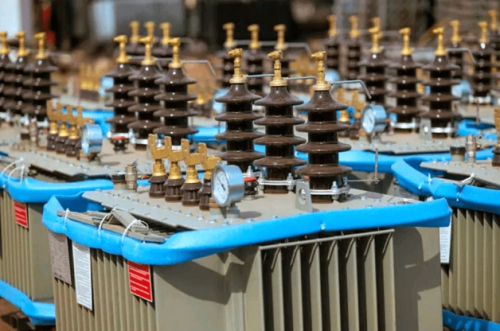
Yendi MP Jofa and predecessor Farouk Mahama row over transformer

0

Yendi MP Abdul-Fatawu Alhassan Jofa has accused his predecessor, Farouk Aliu Mahama, of misleading residents of Nayilifong, where the former MP donated a transformer, GhanaWeb reported on 10 October 2026.

The row, in the Yendi Municipality of the Northern Region, pits the constituency’s National Democratic Congress (NDC) MP against the New Patriotic Party (NPP) politician he unseated in the December 2024 election.

Farouk Mahama donated a 100kVA transformer to the community, according to a MyJoyOnline report on 9 October. Residents turned out in large numbers to watch it being offloaded, and some praised him for continuing to support the area after losing his seat. The report said Nayilifong had suffered erratic power supply for months, hurting businesses, students and households.

GhanaWeb reported that the Nayilifong Saasigli area had been without power for about 24 days. It said Jofa then arrived in the community with two transformers of his own after learning of his predecessor’s donation. Residents angry over the outage reportedly drove away the MP’s supporters.

According to GhanaWeb, Jofa blamed Farouk Mahama for the confrontation, accusing him of stirring up residents and lying to them. He also accused him of spreading falsehoods while he was MP.

Farouk Mahama, son of former Vice-President Aliu Mahama, represented Yendi for one term from 2021 before losing the seat to Jofa.

NPP government studied BRICS membership in 2023, Ablakwa says

0

Foreign Affairs Minister Samuel Okudzeto Ablakwa said on 10 October 2026 that the New Patriotic Party’s own government studied BRICS membership in 2023, as he hit back at its criticism.

Speaking on TV3’s The KeyPoints, Ablakwa cited what he described as an October 2023 technical committee report from the Akufo-Addo administration. He said the Ministry of Foreign Affairs convened officials from selected ministries to review a concept note and advise the government on the consequences of Ghana joining the bloc or staying out. He read from the report on air, saying it had recognised the value of the vision behind BRICS.

The exchange matters because the bid is now a live policy decision rather than an idea. Cabinet has approved a formal application, which Ablakwa announced in Accra on 6 October during a visit by India’s External Affairs Minister, Dr Subrahmanyam Jaishankar. The minister’s argument is that the opposition is attacking an option its own government examined while in power.

Ablakwa accused NPP critics of portraying membership as frightening and dangerous, and of warning that it would anger the International Monetary Fund. He said they were putting partisan point-scoring ahead of a question that would shape Ghana’s economic future.

“This is a very serious national matter, which is about our destiny,” he said.

He urged critics to engage with the facts and argued that membership would add to Ghana’s partnerships rather than replace them. On 6 October he said Ghana would remain in the IMF and the World Bank while widening its options among Global South economies.

Admission is not in Ghana’s hands alone. Jaishankar said India supported Ghana’s aspirations but that the bloc’s members would have to consider the application collectively. India holds the rotating BRICS chair for 2026 and hosted the group’s summit in New Delhi on 12 and 13 September.

BRICS was founded by Brazil, Russia, India and China, and South Africa joined soon after. Since 2024 it has expanded to include Egypt, Ethiopia, Iran, the United Arab Emirates and Indonesia.

On 6 October, Ablakwa did not say when Ghana would submit its application or whether it would seek full membership or the bloc’s lighter partner status.

Ghana set to revise mining bill with 20-year lease cap

0

Ghana is expected to replace a mining bill capping new leases at 15 years with a version setting a 20-year limit, Reuters reported on 9 October 2026, citing three sources.

Two senior government officials and a mining executive told the news agency that the revised Minerals and Mining Bill, 2026, would raise the cap to 20 years. A mines ministry official told Reuters the shorter term had been a mistake in the document sent to Parliament. None of the sources said when the new version would go before lawmakers.

Lease length goes to the heart of mining investment. A shorter term gives companies less time to recover the cost of building a mine before they must seek renewal. Current law allows leases of up to 30 years. The draft laid in Parliament would have capped new leases at 15 years or the projected life of the mine, whichever is shorter.

The 20-year figure is not new. Lands and Natural Resources Minister Emmanuel Armah-Kofi Buah set it as government policy in a statement on 15 July 2026. That reversed a 15-year cap officials had floated during consultations in July 2025. The bill was laid and gazetted on 26 May, before his statement, and it carried the shorter term.

The Ghana Chamber of Mines has pushed back on how the bill has been reported. In a rejoinder on 7 October, it challenged a 30 September Reuters report that said the bill would give the state special share rights in mining companies. The chamber said the mines minister already holds that power under Section 60 of the Minerals and Mining Act, 2006 (Act 703). It said the new bill largely carries the power over, but with tougher penalties for companies that fail to comply.

Ken Ashigbey, the chamber’s chief executive, said talks with the authorities had produced “good compromise positions”, including the 20-year term. He said the industry would take its remaining concerns to Parliament.

The mines ministry and the Minerals Commission did not immediately respond to Reuters’ requests for comment.

South Africa’s Navi Pillay wins Nobel as US sanctions ICC

0

South African jurist Navi Pillay won the 2026 Nobel Peace Prize on 9 October, becoming her country’s fifth laureate, hours before Washington sanctioned the International Criminal Court she once served.

The Norwegian Nobel Committee honoured Pillay, 85, for her efforts to promote peace and international law. Committee chair Jørgen Watne Frydnes announced the award in Oslo. The committee said she had been instrumental in ensuring that war crimes, crimes against humanity and genocide are prosecuted.

The timing turned the prize into a test of how far the world’s major powers still back international justice. Later the same day, US Secretary of State Marco Rubio announced sanctions on the International Criminal Court (ICC) as an institution, not just its officials. The measure bars US companies and financial services from dealing with the court. The Treasury gave firms six months to wind down their business with it.

The ICC called the sanctions an attack on the rule of law and said its work would continue. Canada, Denmark, France, Germany, Italy, Japan, the Netherlands and the United Kingdom said in a joint statement that they strongly disagreed with Washington’s move.

Pillay joins Albert Luthuli, Desmond Tutu, Nelson Mandela and FW de Klerk as South African Peace Prize winners. She learned of the award at a conference in the Nuremberg courtroom where Nazi leaders were tried after the Second World War. Reacting there, she joked about President Donald Trump’s public campaign for the prize: “If you clap a little bit more, I may share this prize with Trump.” She dedicated the award to survivors of international crimes and to those defending international criminal justice.

Born in Durban in 1941 to a family of Indian Tamil descent, Pillay worked as a lawyer under apartheid. She defended political prisoners and won them access to lawyers. In 1995 she became the first non-white woman to sit on South Africa’s High Court. She then served as a judge on the International Criminal Tribunal for Rwanda, which established that rape and sexual violence could amount to genocide. She later served as an ICC judge and as UN High Commissioner for Human Rights. She now sits at the International Court of Justice in the genocide case against Myanmar.

The award drew a sharp response from Israel. Pillay chaired the UN commission that concluded in 2025 that Israel had committed genocide in Gaza, a finding Israel rejects. Prime Minister Benjamin Netanyahu said the Nobel Committee had lost its moral compass and accused Pillay of lies. The Geneva-based monitoring group UN Watch also condemned the choice, accusing Pillay of long-standing bias against Israel.

UN Secretary-General António Guterres called her a steadfast and independent voice of justice. South African President Cyril Ramaphosa also congratulated her on the award.

Washington’s campaign against the court has escalated through 2026. Rubio said in July that the United States would dismantle the ICC “brick by brick” if necessary. In September, at the UN General Assembly, Trump urged all member states to quit the court. Neither the United States nor Israel is a party to the ICC.

The prize will be presented in Oslo on 10 December 2026.

NPP elections: the big names delegates turned away in Kumasi

0

The New Patriotic Party’s (NPP) national executive elections on 3 October 2026 ended several leadership ambitions. They also exposed how far pre-election polls had misread the mood of more than 7,000 delegates at the Baba Yara Sports Stadium in Kumasi.

The sharpest case was the general secretary race. A University of Ghana research poll published in September found that 74.2 per cent of surveyed delegates expected former Subin MP Eugene Boakye Antwi to win. He finished third with 162 votes.

The results matter beyond the individuals involved. The executives elected in Kumasi will rebuild the opposition party after its 2024 defeat and run its organisation into the 2028 general election. Here is how the most prominent losers fared.

Boakye Agyarko

Former Energy Minister Boakye Agyarko lost the national chairmanship to former General Secretary John Boadu by 840 votes. Boadu polled 2,888 votes to Agyarko’s 2,048, while former National Chairman Paul Afoko took 490.

Boadu’s win completes a comeback. He lost the general secretary post to Justin Frimpong Kodua in 2022 and now returns as chairman, working alongside the man who unseated him.

Agyarko accepted the result in a statement on 4 October. “I stand fully and resolutely ready to support Chairman John Boadu,” he said, and he also pledged support for flagbearer Dr Mahamudu Bawumia.

Eugene Boakye Antwi

No candidate fell further short of expectations. Boakye Antwi had campaigned on the argument that no NPP general secretary who lost a general election had ever been retained. He pointed to the party’s loss of about 50 parliamentary seats in 2024, which handed the National Democratic Congress a two-thirds majority.

Delegates disagreed. Kodua kept his job with 4,486 votes. Former Ngleshie Amanfro MP Sylvester Tetteh came second with 1,340, ahead of Boakye Antwi’s 162 and Dr Charles Dwamena’s 126.

The University of Ghana poll had also found 76.6 per cent of respondents naming Boakye Antwi as their preferred candidate. A separate Global InfoAnalytics survey had pointed the other way. It put Kodua on 36 per cent and Boakye Antwi on 10 per cent, with 46 per cent undecided.

Dr Mustapha Abdul-Hamid

Former Information Minister and ex-National Petroleum Authority chief executive Dr Mustapha Abdul-Hamid missed out on a vice-chairmanship by 31 votes. He polled 2,956 votes and finished fourth in a 13-candidate race for three seats.

The winner of that race was Kojo Fosu Boadu, known as Kojo Bamba, a former leader of the pro-NPP Delta Force group. He topped the field with 3,116 votes. Henry Nana Boakye, known as Nana B, came second with 3,061. Global InfoAnalytics had put Bamba on just 17 per cent before the vote.

Nana Akomea

Nana Akomea, a former Information Minister and close ally of Dr Bawumia, did win a vice-chairmanship. His 2,987 votes left him third, however, 129 behind Bamba, the former Delta Force leader whom many in the party had not expected to top the poll. The ranking matters: the first vice chairman runs the party’s affairs whenever the national chairman is absent.

Chris Lloyd Nii Kwei Asamoah

As outgoing Deputy National Youth Organiser, Chris Lloyd Nii Kwei Asamoah went into the race to succeed Salam Mustapha with an inside track. He left with 46 votes, fifth of six candidates.

Abanga Fuseini Yakubu won the post with 1,550 votes, a margin of 919 over runner-up Clement Opoku Gyamfi, who polled 631. Michael Osei Boateng took 78 votes and Vera Oye Bram-Larbi 44.

Alfred Ababio Kumi

Alfred Ababio Kumi, popularly known as Adenta Kumi, finished last in the same youth organiser contest with 25 votes. That is less than two per cent of the winner’s total.

Voting took place at 31 polling stations at the stadium under the supervision of the Electoral Commission, which declared the results in the early hours of 4 October.

Musk’s ex-wife says he cut trans daughter’s health insurance

0

Elon Musk’s former wife Justine Wilson alleges in a new documentary that he cut off their transgender daughter’s health insurance a day after sending her a message of love.

Wilson makes the claim in Musk, a near four-hour film by Oscar-winning director Alex Gibney about the Tesla and SpaceX chief’s life and career. Musk did not take part in the film and has dismissed it as a “hit piece”.

According to Wilson, after their daughter Vivian came out as transgender, Musk asked her to tell Vivian he would always love her. She alleges that he ended Vivian’s health insurance the following day.

The allegation adds a specific new accusation to a family rift that has played out in public for years. Vivian Jenna Wilson, now 22, petitioned a court in 2022 to change her name and gender. In the petition, she said she no longer wished to be related to her father in any way. Musk has since said on X, the platform he owns, that he “lost” her to the “woke mind virus”. In the film, Wilson says those posts hurt Vivian deeply and that Musk never tried to mend the relationship.

Wilson says the tension began when Vivian was a child. She describes her as the most openly defiant of the five children she raised with Musk. She recalls an incident when Vivian was about six, in which Musk allegedly asked the child whether she wanted to be a winner or a loser.

Wilson also says Musk treated Vivian’s transition as though a child had died. She says she rejected that comparison, reminding him that they had lost a real child: their first son, Nevada, died at 10 weeks old in 2002. The couple married in 2000 and divorced in 2008.

Musk has attacked the film repeatedly on X since its premiere at the Venice Film Festival. His lawyer, Alex Spiro, has threatened a defamation suit, but over a separate segment. That segment features his former partner Ashley St. Clair and, Spiro argues, implies Musk used Starlink to sway the 2024 US presidential election.

Gibney has said he invited Musk to be interviewed and that Musk declined. Gibney’s production company, Jigsaw Productions, has defended the documentary as fact-based.

Distributor Bleecker Street opened the film in New York and Los Angeles on 9 October. A wider US theatrical release begins on 16 October.

Gbande says Mahama appointees feuding, renews call for reshuffle

0

Ghana’s ruling National Democratic Congress (NDC) official Mustapha Gbande has accused some of President John Mahama’s ministers of feuding with their deputies, in an interview reported on 10 October 2026.

Gbande is an NDC deputy general secretary and a Deputy Director of Operations at the Office of the President. Speaking on Asempa FM, he said the rivalries go beyond ministries. He said some chief executives of state agencies were not on working terms with their own deputies.

“There are ministers who don’t talk to their deputies,” he said.

He also alleged that some appointees were paying journalists to attack one another. He named no one and gave no evidence.

The remarks matter because they come from a party official who works inside the Presidency. They are also a public admission of strain within a government less than two years into its term. Gbande warned that the infighting could undermine Mahama’s performance and frustrate NDC supporters, who expect appointees to focus on delivering the government’s promises.

He said some of those now in office had contributed little when the party was campaigning to win power. Now that they hold positions, he said, they were using them to fight internal battles. He criticised the idea that party leaders should keep quiet about this out of loyalty.

Gbande said he had raised the matter with the President directly. He said he had repeatedly pressed for a reshuffle, and that some in the party had responded by suggesting he should be removed as well. He said his job at Jubilee House, the seat of the Presidency, was the reason he had held back from speaking more forcefully.

Mahama has already made changes this year. On 8 June, the Secretary to the President, Callistus Mahama, said the President would review all ministers and heads of state institutions to decide whether they would be kept, moved or removed.

The first reshuffle followed on 7 August. Mahama nominated Dr Zanetor Agyeman-Rawlings as Environment Minister and Majority Leader Mahama Ayariga as Local Government Minister, and moved Kenneth Gilbert Adjei to Defence. On 26 August, he swapped the labour and special initiatives portfolios and moved Deputy Defence Minister Ernest Brogya Genfi to a presidential adviser role.

Naturopath Nyarkotey Obu now called to Bar in two countries

0

Ghanaian naturopath Raphael Nyarkotey Obu, called to the Gambian Bar in 2024, joined the Ghana Bar on 9 October 2026, according to a statement from the African Naturopath Report.

The statement said his name appeared on the published list for Ghana’s 63rd Call to the Bar, at which the General Legal Council admitted 1,568 new lawyers at a ceremony in Teshie, Accra.

Nyarkotey Obu qualified through the Gambia Law School in Banjul and was called to the Bar in The Gambia in November 2024. In a 2025 newspaper feature, he wrote that his Gambian legal education cost him about $30,000, and that he had to resit Legislative Drafting three times before passing.

Being called in both countries does not mean he can practise in both. Foreign graduates called to the Gambian Bar are barred by statute from practising law in The Gambia, a Daily Graphic feature on Ghanaian students at the Gambia Law School has noted.

Nyarkotey Obu leads a naturopathic training college in Ghana and is founding president of the African Naturopathic Federation. He has long campaigned for laws to regulate traditional and alternative medicine. In 2023 he lectured in The Gambia on legislation to regulate the country’s traditional healers.

The statement said he would use his legal training to work on practitioner regulation, training standards, professional accountability and patients’ rights in complementary and alternative medicine.

World doctors’ body asks UN to name attackers of healthcare

0

The World Medical Association has urged the United Nations to name states and armed groups that attack healthcare, under a declaration announced in Rotterdam on 10 October 2026.

The Declaration of Rotterdam on the Protection of Medical Neutrality was adopted at the global physicians’ body’s General Assembly in the Dutch port city, held from 7 to 10 October. Beyond naming attackers in UN reporting, the World Medical Association (WMA) wants the UN to appoint a Special Rapporteur on protecting health in armed conflict and other violence.

The declaration comes as accountability for attacks on medical care remains close to non-existent. In August, the World Health Organization (WHO) said it had verified more than 10,400 attacks on healthcare across 29 countries and territories since 2018. Those attacks killed about 5,700 people and injured over 8,500. Altaf Musani, a WHO emergencies director, said not one of them had yet entered an accountability process.

The pace has not slowed. WHO recorded 914 attacks in 2026 up to mid-August, with 911 deaths. Ukraine, Lebanon and the Palestinian territories accounted for most incidents. Attacks were also recorded in Sudan, Myanmar, Syria, Iran, Nigeria and the Democratic Republic of Congo.

Under the declaration, medical neutrality rests on two duties. Doctors and other health workers must treat patients impartially and keep out of military operations. States, de facto authorities and warring parties must in turn protect health workers and facilities. The text states that medical ethics in war are the same as in peace. It also says international humanitarian law protects healthcare whether or not it displays the red cross or other protective emblems.

The WMA widened its definition of an attack to include cyberattacks, the use of artificial intelligence, and the arbitrary arrest, detention, torture or ill-treatment of health workers. It said doctors keep the right, and in some cases the duty, to document and report suspected violations of international humanitarian law.

“The principles of medical ethics do not change in times of war,” WMA President Dr Jung Yul Park said.

The association called on warring parties to guarantee patients safe access to care. It also asked them to free, without conditions, all health workers held solely for treating patients. It urged governments to train their armed forces on the protections owed to medical care. It also asked them to ensure violations are independently investigated or referred to bodies such as the International Criminal Court.

The declaration also commits the WMA’s member national medical associations to speak out publicly against breaches of medical neutrality, including those committed by their own governments. They are to support colleagues who face reprisals for providing impartial care.

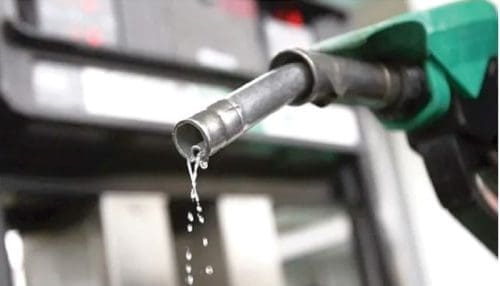
NNPC’s petrol discount is subsidy by another name

The announcement of cheaper petrol often arrives before anyone explains how it will be paid for. A commuter who hears that pump prices will fall for 30 days thinks of tomorrow’s journey and the fare home. He is not at the filling station to study fiscal arrangements. He wants to know what a litre costs today, and what it will cost when the 30 days end.

That is where the national conversation must begin. A discount does not come from thin air. Petrol must still be refined, bought, transported, stored and sold. If the retail price falls, someone absorbs the difference. The pump attendant can announce the new price, but the pump cannot tell us whose ledger is carrying the burden.

Who pays for “at cost”

On 8 October, Finance Minister Taiwo Oyedele announced that NNPC Limited would sell petrol at cost for 30 days in the first instance, with priority for public transport operators. The Presidency says NNPC Retail will give up its retail margin. The government has not said where the fuel will come from, what NNPC will pay for it, how big the discount per litre will be, or whether any supplier has agreed to sell below commercial value.

If NNPC buys petrol from the Dangote Refinery at the full market rate, Dangote receives its agreed price. The discount must then be carried by NNPC, reimbursed by the government or financed some other way. If Dangote or any other supplier is being asked to give up part of its price, that concession should be declared openly.

Selling at cost does not settle the question. If NNPC forgoes a margin it would normally earn, the consumer gains and the company loses income. In economic terms that is a subsidy, even if the Treasury writes no cheque. Because NNPC is publicly owned, the lost margin reduces its profit, retained earnings and future dividends. The cost is less visible than a budget allocation, but citizens still bear it.

How other countries handled temporary relief

Nigeria is not the first country to try short-term relief at the pump. Several Global North economies have used temporary fuel discounts or tax cuts. Their experience shows that such measures work best when they are open about cost, limited in time and properly monitored.

Germany cut its fuel tax for three months from 1 June 2022, through a measure known as the Tankrabatt, and let it lapse at the end of August. Independent studies later found the cut was almost fully passed on to petrol buyers but only partly to diesel buyers, which shows why monitoring matters.

France introduced a state-funded pump discount of 18 euro cents a litre in April 2022. It raised the discount to 30 cents from September, cut it to 10 cents from mid-November and ended it on 31 December 2022. In 2023 it was replaced by a targeted 100-euro allowance for lower-income workers who drive to work.

The United Kingdom cut fuel duty by 5p a litre in March 2022, initially for 12 months. The Treasury estimated its cost at about £2.4 billion. The cut has since been extended several times and is now due to run until the end of 2026.

In Canada, Alberta stopped collecting its 13-cent-per-litre provincial fuel tax from 1 April 2022. It linked the relief to world oil prices and reviewed it every quarter. The provincial government put the full-year cost at about 1.3 billion Canadian dollars.

These examples show that temporary fuel relief can be delivered without weakening national institutions, provided the rules are clear and the financial consequences are public.

Why the initiative can be supported

There is a defensible case for short-term relief, particularly if public transport operators receive the benefit and pass it on through lower fares. Nigeria’s economy is heavily dependent on transport, and commuters bear the brunt of rising energy costs. A targeted discount can ease inflationary pressure, support small businesses and steady household spending.

But the scheme needs clear operating rules. The government should explain how transport operators will be identified, how discounted fuel will reach them and how it will check that passengers actually benefit. Without such safeguards, the discount may reach the vehicle’s tank while the fare stays where it is.

Nigeria can borrow from practice elsewhere. That means naming the funding source, fixing the duration and publishing the cost to NNPC. It also means monitoring and evaluating the relief before any extension is considered.

The constitutional question

NNPC’s shares are held on behalf of the Federation. The Petroleum Industry Act requires the company to operate commercially and profitably. The Constitution counts dividends from the Federal Government’s shareholdings among the revenue payable into the Federation Account, the common purse of the federal, state and local governments.

If a policy predictably reduces NNPC’s earnings, all three tiers of government have legitimate grounds to ask what income has been surrendered, who authorised the concession and what it will cost. Transparent accounting is a constitutional necessity.

Timing and public trust

The presidential election is scheduled for 16 January 2027. That date does not prove an electoral motive. But the government should expect citizens to ask whether relief at the pump is also politics at the pump. Clear rules, fixed timelines and published accounts would answer that question more credibly than any verbal denial.

Beyond the politics lies an economic point that cannot be ignored: in substance, this arrangement brings subsidy back through the back door. The government may call it a discount, a margin waiver or a temporary price adjustment, but the mechanism is the same. If petrol is sold below its true commercial cost, someone absorbs the difference, whether NNPC, a supplier or the Treasury. That is what a subsidy is. It may not appear as a line in the national budget or be debated in the National Assembly, but a subsidy routed through a state-owned company is still a subsidy.

That is why citizens will question both the timing and the structure of the scheme. Relief introduced three months before a national election will attract scrutiny, especially when its financial design resembles the subsidy regime the government removed in 2023 as unsustainable. If NNPC’s margins are being squeezed to make petrol cheaper, the Federation is indirectly funding the discount through lower dividends and weaker future earnings.

Nigerians deserve to know whether this is a strategic intervention or a disguised subsidy. They deserve to know who is paying the difference, how long the arrangement will last and what will stop it from quietly becoming permanent. Without that disclosure, the scheme risks looking like a return to subsidy without parliamentary debate, budget visibility or public accountability.

What must be disclosed

The government should publish:

  • the price NNPC pays for the fuel;
  • the exact discount per litre;
  • who is absorbing the difference;
  • the projected effect on NNPC’s earnings;
  • the criteria for identifying public transport operators.

It must also say plainly what happens after 30 days.

Until then, Nigerians have been told only that petrol will be cheaper. They have not been told who is underwriting the reduction, how long it will last or what institutional sacrifice sustains it. The government may call it a discount, a margin waiver or a price adjustment. The name does not matter. The bill will still arrive, and the nation deserves to know whose name is written on it.

Professor Ojo Emmanuel Ademola is a professor of cybersecurity and information technology management, a chartered manager and General Evangelist of Christ Apostolic Church Nigeria and Overseas.

US freezes green card sponsorship at Microsoft, Indian IT firms

0

On 8 October 2026, the US Labor Department stopped processing green card sponsorships from Microsoft, Adobe and six IT outsourcers, including four Indian giants, citing alleged visa abuse.

The suspension covers the Permanent Labor Certification programme, known as PERM, which is the first step for most employer-sponsored green cards. Besides Microsoft and Adobe, it applies to Cognizant, Infosys, Tata Consultancy Services, Wipro, HCL Technologies and Capgemini. The Labor Department will not accept new applications from these companies and has stopped work on pending ones.

The move affects foreign professionals already working in the United States who were counting on these employers to sponsor them for permanent residency. Their H-1B work visas remain valid. However, their green card cases have stalled, and H-1B extensions that depend on a pending PERM case could be delayed.

Labor Secretary Keith Sonderling said the six IT services firms were suspended because of concerns about systemic abuse, while Microsoft and Adobe are subject to multiple active federal investigations. No charges have been announced against any of the companies.

Vice President JD Vance focused on Microsoft at the announcement. He said the company cut 6,000 American jobs in 2025 while receiving 6,300 H-1B visa approvals and almost 3,000 green cards. He also said Microsoft filed 3,682 PERM applications, about 1,000 of which appeared to overlap with roles held by laid-off staff. Vance said each worker Microsoft let go had been replaced by one and a half foreign workers, whom he likened to indentured servants.

Microsoft rejected the picture in a statement, saying “the vast majority of Microsoft employees in the United States are Americans.” The company said it filed petitions only for workers who met the visa category’s standards and that its H-1B wages are among the highest of all filings. It also said most of its applications were for people already on its payroll.

Asked why President Donald Trump honoured Microsoft chief executive Satya Nadella on the same day, Vance said Washington would keep its good relationship with the company. He said the government would still block its permanent residency applications until it showed it was serious about putting American workers first.

The suspension has no fixed end date. Sonderling said it would last as long as needed and that the administration wanted the companies to change their behaviour. The announcement came less than four weeks before the 3 November midterm elections, as the administration steps up action on immigration and foreign hiring.

For India’s outsourcing industry, the blow was not the first. On 8 September, Labor Department Inspector General Anthony D’Esposito suspended Cognizant’s PERM filings. The next day, Indian IT stocks lost about 550 billion rupees in market value, with Infosys falling about six per cent.

The suspensions stem from an investigation into fraud in the H-1B and PERM programmes that the inspector general opened in July. Officials said in July that dozens of subpoenas had been issued and that whistleblowers had flagged some of the largest sponsoring companies.

US consumer sentiment slides as current conditions hit record low

US consumer sentiment on current economic conditions sank to a record low in October as high prices and borrowing costs squeezed households, University of Michigan data showed on 9 October 2026.

The Current Economic Conditions index dropped to 44.7 from 50.9 in September, a fall of 12.2 per cent in one month. Bloomberg reported that the measure had reached an all-time low. The headline Index of Consumer Sentiment slipped to 46.3, its weakest reading since May and below the 47.6 median forecast in a Bloomberg survey of economists. May’s reading was a record low for the index.

The figures land 25 days before the US midterm elections, and they show rising prices hurting poorer households most while expectations of future inflation keep climbing.

Joanne Hsu, director of the university’s Surveys of Consumers, said buying conditions for durable goods fell sharply because of high prices and borrowing costs. Sentiment dropped steeply among lower-income consumers and those with smaller stock portfolios, which she described as “groups that have fewer resources to weather increases in prices.”

Gains among Democrats and Republicans were cancelled out by a decline among independents, Hsu said. She added that consumers of every political leaning agree the economic outlook has softened since the start of the year, before the Iran conflict.

Households now expect prices to rise 4.7 per cent over the next year, up from 4.6 per cent in September and well above the 3.4 per cent recorded in February, before the conflict began. Five-year expectations rose to 3.5 per cent from 3.4 per cent, against a 2024 range of 2.8 to 3.2 per cent. Both measures rose for a second straight month to their highest levels since May.

Fuel is a large part of the strain. Petrol prices have climbed by more than $1.50 a gallon on average since the war began and have stayed above $4 a gallon since midsummer, according to motoring group AAA. A US gallon is about 3.8 litres.

The survey did carry one brighter signal. The Index of Consumer Expectations rose to 47.3 from 46.3, its first increase since July, as respondents grew slightly more hopeful about their personal finances and business conditions over the coming year. Overall sentiment remains 13.6 per cent lower than a year ago.

Gloomy surveys have not yet translated into weaker spending. Retail sales rebounded sharply in August, helped by purchases of a range of goods and spending at bars and restaurants.

The university will publish final October figures on Friday, 23 October 2026, at 10am Eastern Time, which is 2pm in Accra.

The Hope Of Ghana Youth In Sports: Kwadwo Baah Agyemang

0

Story by: Bernard Nyankomago Kwasi

As politicians gather their acts together to hit the various campaign platforms to canvass for votes whether in internal or national elections, Ghanaians, especially the youth will surely be waiting for their vision in sports development.

Over the years, one fine politician who has demonstrated great and good heart for sports, especially football is Honourable Kwadwo Baah Agyemang (KBA), former MP for Asante Akim North Constituency.

Apart from the opportunities he has given to some Ghanaian youth, particularly football talents in Asante Akim North through his SportsLife Academy, he has also followed the domestic league and national teams with keen interest.

KBA, as he is well known loves football to the hilt. It was therefore a step in a right direction when President Akufo Addo appointed him as Board Chairman for the National Sports Authority (NSA). He delivered his work to perfection despite the unnecessary pressure he encountered from some Ghanaians at a point in time.

He was also the President for Teqball Federation in Ghana and Chairman for Asante Akim North, South, Central and Bosome Freho District Football Association.

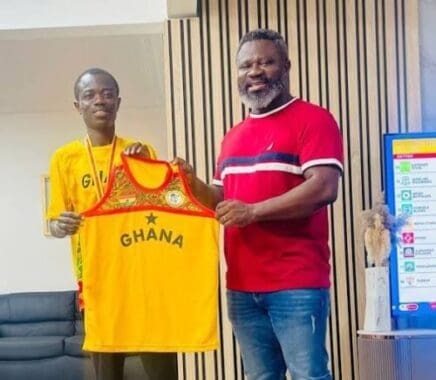
In addition to his vast contribution to sports and as means of serving his people, Hon. KBA further introduced Asante Akim Marathon which brought to limelight William Amponsah, Ghana’s current record holder in Long Distance. With this scintillating achievement, many expect him to assume the office of the Sports Ministry one day.

Very soon, the NPP will go to the polls to elect their Parliamentary candidates for the 2028 general elections. For the people of Asante Akim North Constituency, there is absolutely no need for any prophet to advice delegates, before they will give power to the visionary Kwadwo Baah Agyemang to help unearth the youth who have abundant talents and huge potentials in football especially.

Admitedly, there is no way sports can be sidelined when talking about avenues to create jobs for the youth in the country. This is where some politicians have failed to utilise over the years.

Since Ghana attained Independence on 6th March, 1957 – exactly 69 years ago, sports have always propelled the nation to great heights in the international front.

Talk of the world titles that boxing heroes like D.K Poison, Azumah Nelson, Ike Quartey, Joshua Clottey, Joseph Agbeko, Isaac Gogde and the likes have won for Ghana.

The Black Stars outstanding achievements on the continent in 1963, 1965, 1978 and 1982 can also not be ingnored likewise the exploits of our junior national teams in 1991, 1993, 1995 and the famour Black Satelites victory in 2009 in Egypt.

In athletics and other sporting disciplines, Ghana has incredibly paid their dues globally. But at moment, no Ghanaian is enthused with the state of our games.

The Black Stars, which used to be the nation’s biggest hope have failed miserably in all quarters. GFA President, Kurt E S Okraku and his so called Exco and management members have mismanaged and mishandled things leaving football enthusiasts in devastating and pensive mood.

It’s time to bring on board ex footballers, administrators and politicians who are endowed with deep knowledge in the game and Hon. Kwadwo Baah Agyemang should be one of them.

Jenora Kwaning to Defend Doctor of Philosophy in Public Law Dissertation at UIPM Indonesia

Doctoral Viva Voce scheduled for Wednesday, 14 October 2026, to examine research on good politics, constitutional governance and the rule of law.

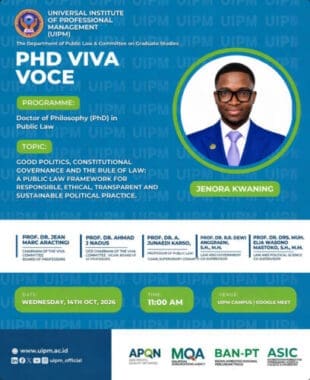
PhD Candidate Jenora Kwaning is scheduled to undertake his doctoral Viva Voce in Public Law on Wednesday, 14 October 2026, at the Universal Institute of Professional Management (UIPM), Indonesia.

The examination forms part of his Doctor of Philosophy in Public Law programme and will focus on his dissertation titled:

“GOOD POLITICS, CONSTITUTIONAL GOVERNANCE AND THE RULE OF LAW: A PUBLIC LAW FRAMEWORK FOR RESPONSIBLE, ETHICAL, TRANSPARENT AND SUSTAINABLE POLITICAL PRACTICE.”


The Viva Voce is scheduled for 11:00 a.m. at the UIPM campus, with Google Meet also indicated as the examination venue.

The doctoral examination will provide an opportunity for Kwaning to present and defend his research before the academic committee, respond to questions and demonstrate his understanding of the legal and governance principles examined in his thesis.

The examination is associated with the Department of Public Law and the Committee on Graduate Studies.

Research Focus: Good Politics, Constitutional Governance and the Rule of Law

Kwaning’s doctoral research examines the relationship between good politics, constitutional governance and the rule of law, with a focus on developing a Public Law framework for responsible, ethical, transparent and sustainable political practice.

Public Law provides the legal and institutional foundations for understanding the exercise of public authority, constitutional responsibilities, administrative accountability and the protection of legal rights.

The thesis brings these principles into a broader discussion of political conduct, institutional integrity and the standards that can guide responsible governance.

By examining the intersection of law and political practice, the research seeks to contribute to academic discussions on how constitutional principles and legal frameworks can inform political responsibility, transparency and sustainable institutional development.

The study also raises questions about the relationship between legal accountability and ethical conduct in public institutions, as well as the role of constitutional governance in promoting responsible political practice.

Board of Professors for the Doctoral Committee

The doctoral examination is associated with a Board of Professors comprising senior academics and legal scholars with backgrounds in law, public law, government and political sciences.

The committee members and their stated roles are:

1. Prof. Dr. Jean Marc Aractingi
Chairman of the Board of Professors and Viva Committee

2. Prof. Dr. Ahmad J. Naous
Vice Chairman of the Board of Professors and Viva Committee | Professor of Strategy Execution

3. Prof. Dr. A. Junaedi Karso, SH
Chair, Supervisory | Professor of Public Law

4. Prof. Dr. R.R. Dewi Anggraeni
Co-Supervisor | Professor of Law & Government

5. Prof. Dr. Drs. Muh. Elia Wasono Mastoko
Co-Supervisor | Professor of Laws & Political Sciences


The committee’s stated composition reflects the multidisciplinary scope of the doctoral research, which connects Public Law with constitutional governance, political institutions and the principles of responsible political practice.

The Viva Voce will provide the formal academic setting for the candidate to explain the research, respond to questions and engage with the committee’s assessment of the thesis.

The Importance of the Viva Voce
A doctoral Viva Voce is an oral examination in which a candidate discusses and defends their thesis before appointed academic examiners. The process typically examines the candidate’s knowledge of the subject, the coherence of the research, the appropriateness of the methodology and the contribution the work may make to existing scholarship.

For Kwaning, the examination represents an important milestone in his Doctor of Philosophy in Public Law programme.

His thesis places the concept of good politics within a legal framework that considers constitutional principles, the rule of law, ethical responsibility, transparency and sustainability.

The examination will allow the academic committee to engage with the research arguments and assess the thesis in accordance with the institution’s applicable doctoral examination procedures.

The final academic outcome will depend on the committee’s assessment and the fulfilment of any requirements imposed by the institution.

Public Law and Responsible Political Practice

Constitutional governance and the rule of law are central subjects in contemporary legal scholarship. They inform discussions about the limits of public power, institutional accountability, administrative justice and the legal responsibilities of public authorities.

Kwaning’s research brings these themes together with the principles of ethical conduct, transparency and sustainability.

The proposed framework offers a basis for examining how Public Law can inform the standards and institutional arrangements associated with responsible political practice.

The subject is relevant to legal academics, governance researchers, policymakers, political institutions and students interested in constitutionalism, public administration and political accountability.

Through the doctoral examination, the research will undergo formal academic scrutiny concerning its arguments, methodology and potential contribution to the field.

Examination Details
– Candidate: Jenora Kwaning
– Academic Status: PhD Candidate
– Programme: Doctor of Philosophy in Public Law
– Examination: PhD Viva Voce
– Date: Wednesday, 14 October 2026
– Time: 11:00 a.m.
– Venue: UIPM Campus | Google Meet
– Institution: Universal Institute of Professional Management (UIPM), Indonesia
– Department: Department of Public Law
– Graduate Studies Body: Committee on Graduate Studies
– Institutional Website: www.uipm.ac.id

Dissertation Title: Good Politics, Constitutional Governance and the Rule of Law: A Public Law Framework for Responsible, Ethical, Transparent and Sustainable Political Practice.

As Kwaning prepares to defend his dissertation, the examination will mark a significant stage in his doctoral academic journey and provide a formal opportunity to discuss the relationship between Public Law, constitutional governance and responsible political practice.

Further information about the examination and its outcome may be communicated following the completion of the relevant academic procedures.

Lands Minister Armah-Kofi Buah joins 1,568 new lawyers at Bar

0

Lands and Natural Resources Minister Emmanuel Armah-Kofi Buah was called to the Ghana Bar on 9 October 2026, one of 1,568 new lawyers admitted by the General Legal Council.

The admission allows Buah, the Member of Parliament for Ellembelle, to practise as a barrister and solicitor of the Supreme Court of Ghana. As minister, he oversees land administration, mining and forestry, areas run largely through statute and regulation.

He was not the only cabinet member called that day. Communications, Digital Technology and Innovations Minister Samuel Nartey George was also admitted, along with Citi FM Eyewitness News host Umaru Sanda Amadu and former Eastern Regional Minister Seth Acheampong. Buah and George had attended a black-tie Call to the Bar dinner in Accra two days earlier, on 7 October.

The minister’s links to law go back to his student years. According to his ministry, Buah holds a Bachelor of Arts in Social Science with a major in law from the Kwame Nkrumah University of Science and Technology. He also holds a Graduate Diploma in Law from the University of Law in the United Kingdom and a Master of Science in Management from the University of Maryland. He was born at Atuabo in the Western Region in 1966.

Buah has represented Ellembelle since 2009. He served as Minister for Energy and Petroleum from 2013 to 2016 under John Mahama’s first administration. President Mahama named him Lands Minister in January 2025.

The ceremony was the Ghana School of Law’s 63rd Call to the Bar. It took place at the International Central Gospel Church’s Christ Temple on Teshie Bush Road in Accra. Chief Justice Paul Baffoe-Bonnie, who chairs the General Legal Council, opened the session. Attorney-General and Minister for Justice Dr Dominic Akuritinga Ayine also attended.

The cohort is large for a profession of Ghana’s size. The General Legal Council has said the number of lawyers in Ghana grew from just over 2,000 in 2010 to more than 6,500 in 2024.

The intake also comes during an overhaul of legal training. Parliament has passed the Legal Education Reform Bill, 2026, and Baffoe-Bonnie has said the new regime will widen opportunities while keeping standards. Under the changes, students can now choose to be enrolled at either an October or a March call.

Ghana’s tree crops regulator tightens rules as export push grows

0

Ghana is trying to build a second farm export engine alongside cocoa, and its tree crops regulator is using licences, floor prices and traceability rules to get there.

The Tree Crops Development Authority (TCDA), set up under the Tree Crops Development Authority Act, 2019 (Act 1010), regulates six crops: cashew, coconut, oil palm, rubber, mango and shea. Cocoa sits outside its remit, under the Ghana Cocoa Board. Chief Executive Officer Dr Andy Osei Okrah has set a target of about US$12 billion in annual revenue from the six crops by 2030, and has said they collectively have the strength to do far more for the economy than cocoa.

Whether that happens depends less on planting than on whether Ghana can prove where its crops come from, keep quality high and capture more of the value at home.

Enforcement first

The TCDA has moved from promotion to policing. At a stakeholder forum in Wa, Okrah warned that buying below statutory floor prices, trading without an operational licence and fronting for foreign buyers could lead to arrest and prosecution, as the authority rolls out its powers region by region under Legislative Instrument (L.I.) 2471. A digital licensing and traceability system is meant to enforce quality and moisture standards.

A mandatory conveyance certificate system now covers the movement of the six crops and ties into the Forestry Commission’s road checkpoints. Some traders have called it an extra burden. Okrah has rejected that, describing it as a tool to curb illegal trade and improve traceability. The authority has also deployed its first cohort of compliance and enforcement officers in the cashew trade.

Why proof of origin matters

Buyers in Europe and elsewhere increasingly demand evidence that commodities were not grown on deforested land and were produced without exploitation. For smallholder crops such as cashew and shea, which are often gathered across scattered plots and pass through several traders before export, that is hard to show. Okrah has named data and traceability among the authority’s top priorities, saying the sector needs reliable information on farmers, farms, production and trade.

Keeping more value at home

Ghana has long shipped most of its raw cashew nuts abroad, much of it to Asian processors. Under the government’s Feed the Industry initiative, L.I. 2471 allows the authority to reserve a share of raw materials for local processors. Okrah has also pushed commercial use of the cashew apple, usually discarded, and courted investors at the Ghana-UK Investment Summit in London in June, pointing to a global shea market projected at US$5.5 billion by 2033.

At the TCDA’s first summit and exhibition this year, President John Dramani Mahama announced a US$200 million government commitment to tree crop processing, productivity and private investment. The authority said the event drew about US$500 million in expressions of investor interest and outlined plans for 16,000 hectares of new plantations spread across all 16 regions.

Risks

Expansion brings exposure. Okrah has warned of climate change, pests and disease, citing powdery mildew in some cashew-growing areas. And floor prices only help farmers if buyers can be made to respect them in remote districts where the authority’s officers are thin on the ground.

The authority has said a farm inputs project launched at Asante Mampong in August will run from 2026 to 2032.