

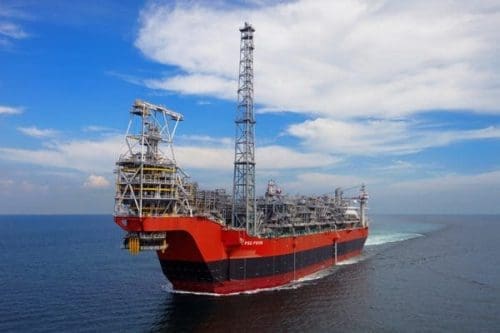
Almost all energy experts have expressed worries over frequent irregular breakdowns of the FPSO vessel.

Aside, the Minister for Petroleum, Emmanuel Armah Kofi Buah expressing his discomfort with the current rate of damage which may take between one month to two month additional days to have the FPSO fully repaired likely in Dubai or Singapore.
The minister revealed that, repair works on the FPSO Kwame Nkrumah, is not likely to be completed on the set date because of a significant setback to resolve the fault on the vessel.
The vessel’s turret have suffered some damage, making it difficult to receive crude oil from subsea pipes.
Energy think-tank, Africa Centre for Energy Policy (ACEP) has also alarmed that, the current situation have dire implications on the country’s electricity generation.
According to Dr Ishmael Ackah, Head of Policy Unit at ACEP, as a result of the breakdowns, there is a production shortfall because the country loses about 230MW from the AMERI which uses natural gas from the Atuabo which also gets its supply from the FPSO.
The AMERI Plant uses natural gas from the FPSO and since it is not designed as a dual fuel plant, it has to be shut down when the FPSO is down.
DrAckah explained that the irregular breakdowns have negative consequences for Ghana’s power sector as the Aboadze thermal plant also depend on gas from the Atuabo gas processing plant.
Various challenges have hindered the delivery of a potential 120 million standard cubic feet of gas a day from the FPSO Kwame Nkrumah to the processing plant at Atuabo.
Since gas production commenced, Tullow Ghana has undertaken several unplanned shutdowns of the FPSO Kwame Nkrumah as a result of faulty compressor.
“When it is down, we lose revenue because we are not able to produce, and even if we do, the cost of production using Light Crude Oil (LCO) is high because we have to pay cost of maintenance and other things we need to do to bring it back to work,” DrAckah said.
Additionally, the Head of Policy at ACEP maintained that the frequent breakdowns increasedthe cost of production of power. He said if there is no gas for the FPSO, the country would have to buy light crude oil for TAPCO and Takoradi International Company (TICO).
“Since they are quite expensive, what it means is that cost of production of power would go up.Some have estimated that if FPSO Nkrumah is not running, for Cenit, T1, Tapco and Tico, VRA would need about $30 million a month to buy fuel to run these plants and that is a major problem,” DrAckah lamented.
Information gathered indicated that, even before the planned shutdown, a turret bearing problem of the FPSO forced Tullow to reduce daily average production from 100,000 barrels to a little over 30,000 barrels from March 9, 2016 till the FPSO was shut down on March 20, 2016.
Following an inspection of the turret area of FPSO Kwame Nkrumah by Sofec, the original turret manufacturer, it was confirmed that the bearing has been damaged and is no longer able to rotate as originally designed.
Tullow said a root-cause analysis is ongoing and a project team is assessing which long-term remediation option is most appropriate.
Initial feasibility studies by the team have confirmed that the bearing issue can be fully resolved.
According to Tullow, Sofec will now undertake further offshore examinations and Tullow will work with Sofec to determine what further measures will be required.
Already the Tema Thermal Power Plant (TT1) has been shut down due to inadequate Light Crude Oil (LCO) in the Tema power enclave.
There are indications that the limited crude oil available was being used to operate the 110-megawatt Cenit Power Plant.
This situation, coupled with limited gas from Nigeria – which is being used by SunonAsogliThermal Power Plant to generate some 90MW out of its 200MW capacity – and the lack of lean gas from Ghana Gas due to the shutdown of FPSO Kwame Nkrumah, has resulted in overdrafting of hydro dams to close the deficit in power generation.
According to Dr Ishmael Ackah government as a result has compelled the Volta River Authority (VRA) to run all six turbines of the Akosombo Dam during peak hours in the past three weeks to avoid severe power cuts (Dumsor).
Because of the low level of water in the lake, each unit of Akosombo generates 125 megawatts, translating into 750MW during peak hours.
During off peak, Akosombo operates five turbines, which is still above the two or three turbines engineers have recommended.
He condemned the action since it is in total disregard for advice of VRA engineers, who said the dam should be operating only two turbines at current water level, which was at 237.92 feet last Friday, April 22, 2016.
The minimum operating water level for the Akosombo Dam is pegged at 240 feet, but VRA engineers advised that running two turbines at current water level of 237 feet would not cause any harm since it once operated the dam with two turbines at a water level of 235 feet.
Kpone Hydro Generating Station and Bui Hydro Dam are also said to be overdrafted during peak hours. Each unit of Bui generates 100MW, translating into 400MW during peak hours.
Overdrafting of a Hydro Dam results in faster depletion of water levels, which could force total shutdown of the dam.
ACEP is therefore advocating a total audit of the FPSO Kwame Nkrumah and total production maintenance of the vessel.
“Contract independent auditors; let them audit the FPSO to make sure that we identify the defects and put in place measures before they occur,” DrAckah has said.
He urged government and the Jubilee partners to, next time,use competitive bidding to procure goods and services such as the FPSO.
Source: Adnan Adams Mohammed

