

Informal recyclers and tricycle operators hold the key to transforming a public health crisis into a multi-billion-cedi growth sector
Ghana’s informal waste economy, long dismissed as a fringe activity, could generate up to GHS 47.9 billion in annual economic benefits by 2032 if the government formally integrates informal waste workers into a structured and investment-backed system, according to a new study by the Institute of Statistical, Social and Economic Research (ISSER) at the University of Ghana.
The study, titled “An Economic Analysis of the Benefits of Adequate Investment in Waste Management and Sanitation in Ghana,” projects that with sustained investment and the formal integration of aboboyaa operators, scrap dealers, and community recyclers, Ghana could realise these gains through reduced healthcare costs, increased labour productivity, and expanded recycling and energy value chains. The researchers argue that waste management should no longer be viewed solely as a sanitation challenge but as a strategic economic sector capable of driving job creation, improving public health, and contributing to energy production.
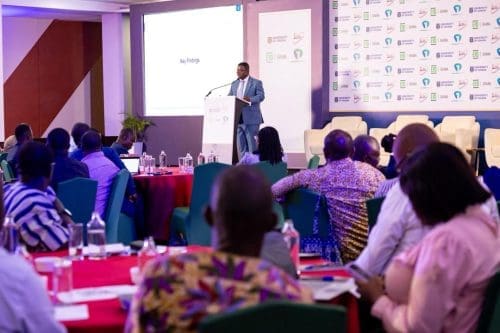
Presenting the findings in Accra, ISSER Director Professor Peter Quartey said the economic logic was clear. “We have treated waste as a liability for decades. The evidence now shows it is a high-value economic resource. If we invest deliberately and bring informal operators into a structured system, this sector can generate billions annually for the Ghanaian economy,” he said.
The study’s findings on the cost of inaction are equally striking. Ghana currently loses more than GHS 6.2 billion each year due to inadequate sanitation and waste management systems, with losses stemming from healthcare costs linked to preventable diseases including malaria, cholera, and pneumonia, as well as productivity losses from illness-related absenteeism. According to the study, sanitation-related diseases contribute to over 107,000 premature deaths annually and account for nearly 32 million lost work and school days.
The researchers also highlighted a stark financing gap at the local government level. Ghana’s 261 Metropolitan, Municipal and District Assemblies (MMDAs) collectively spend approximately GHS 180 million annually on waste management and sanitation, an amount the report describes as insufficient relative to both the scale of the problem and the economic returns that higher investment could unlock.
The report proposes a two-tier financing model: at the metropolitan level, public-private partnerships (PPPs) could attract investment into high-capacity recycling facilities, engineered landfills, and waste-to-energy plants where large populations create economies of scale, while at the local level, targeted public investment should prioritise collection systems, safe disposal sites, drainage rehabilitation, and the elimination of open dumping.
Co-author Dr. Kwame Adjei-Mantey cautioned that uniform policy approaches could worsen inequality. “Large cities can attract private operators because they offer scale and predictable revenue streams,” he said. “Smaller districts require deliberate fiscal support to build foundational systems. Without that balance, investment will concentrate in commercially attractive areas while high-burden communities remain underserved.”
The researchers concluded that with political will, regulatory reform, and sustained financing, Ghana’s informal waste economy could evolve into a multi-billion-cedi growth engine, transforming what has long been treated as a public health burden into a national asset.
NewsGhana has separately reported on the GHS 6.2 billion annual loss figure and the decentralisation debate from the same ISSER stakeholder engagement.

