

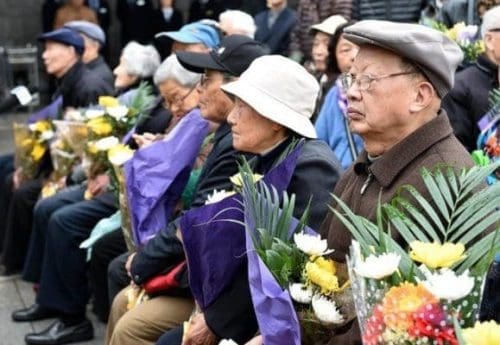
Atom bomb survivors, Japanese officials and international diplomats Thursday marked the 70th anniversary of the world’s first nuclear bomb attack on the western city of Hiroshima in the final days of World War II.

By the end of the year, some 140,000, including tens of thousands of Koreans and other non-Japanese, had died due to the bombing and its after-effects.
About 50,000 people attended the ceremony in Hiroshima’s Peace Memorial Park, including US Ambassador to Japan Caroline Kennedy, US Under Secretary of State for Arms Control and International Security Rose Gottemoeller and representatives of about 100 other countries.
Sunao Tsuboi, an engineering student at Hiroshima University, was on his way to class less than a kilometre away from ground zero when the bomb exploded.
Suddenly he was blown 10 metres sideways.
“Before I hid my face in my hands, I saw a brilliant rose-silver flash of light,” Tsuboi recalled.
He was briefly unconscious and came to lying on the sidewalk, burned from head to toe.
“I don’t know why I’m still alive today,” said Tsuboi, who now serves as chairman of the Japan Confederation of Atomic and Hydrogen Bomb Sufferers Organizations.
He was picked up by a group of soldiers and sent to a hospital.
His experience as a survivor of the world’s first nuclear attack led him to spend much of the past 70 years to “reflect on how humans could make peace,” said Tsunoi, who just celebrated his 90th birthday.
After the ceremony on Thursday, Tsuboi and other leaders of survivors’ groups met Prime Minister Shinzo Abe. They urged him to withdraw new legislation allowing the Japanese military to fight wars abroad for the first time since the end of World War II.
Thursday’s anniversary comes at the height of a debate in Japan over its role in conflicts overseas.
Surveys have indicated that a majority of the Japanese public is against the move, which involves a reinterpretation of Japan’s war-renouncing constitution, drafted during US occupation after the war.
The bombing – the first of its kind – remains one of the most highly debated actions of World War II.
Some maintain it was necessary to bring a swift end to the war in the Pacific and therefore saved hundreds of thousands of lives, while others have argued that Japan would have surrendered without the destruction of Hiroshima and then Nagasaki three days later.
Thousands of survivors are still being treated at Japanese Red Cross Society hospitals for long-term health effects, with nearly two-thirds of deaths among them due to cancer, the International Committee of the Red Cross (ICRC) said.
“Even after so many decades, we continue to see the catastrophic health impact from the use of nuclear weapons on these two cities,” said ICRC president Peter Maurer.
“What more compelling argument could there be for the complete elimination of nuclear weapons, especially as most of the bombs in the arsenals of nuclear armed states today are more powerful and destructive?”

