

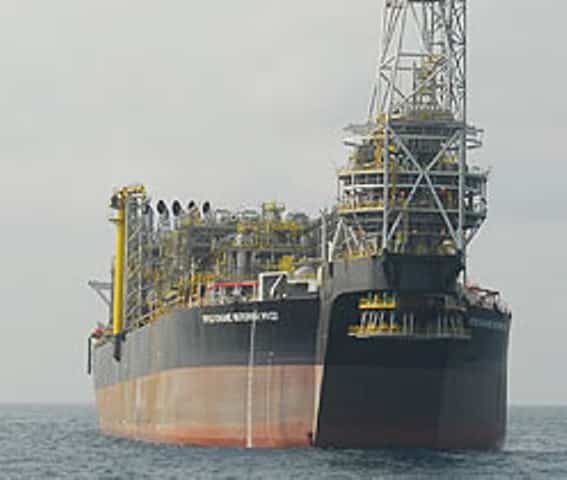
Last week, word went out that the Jubilee FPSO christened after Ghana’s first president Osagyefo Dr Kwame Nkrumah, was going to shut down for 14 days of routine maintenance.
 A statement issued by Tullow Ghana, operator of the Jubilee project said “the shutdown is to allow for routine maintenance works on the vessel, particularly on a key equipment of the FPSO”.
Public Agenda has subsequently learned that the shut down has been occasioned by a deteriorating part, known as ‘turret bearing’, which Tullow detected in mid-February.
Our information is that, the bearing is attached to the turret unit and so if engineers are unable to fix the malfunctioning bearing, the whole unit will have to be replaced, an operation that can only be carried out in a dry dock facility, and for which reason the FPSO may have to be decoupled from its production wells and sent back to Singapore for the replacement to be done. If that becomes the only viable option, then the FPSO shutdown will turn out to be longer than currently envisaged.
Tullow says its engineers are continuing to study the condition of the turret bearing and it is only when they are done, that it will know what it will take to fix the problem.
This is however, not the first time the FPSO Kwame Nkrumah has had to shut down for maintenance of some sort. In September 2013 it shutdown for what Tullow described as a scheduled routine maintenance. But in-between then and now, Tullow has had to shut down a few times to fix faulty compressors, which have largely affected its ability to rump up to its optimum production capacity of 120 barrels of oil per day (bopd), and has also constrained the volumes of gas evacuated to the Atuabo Gas Processing Plant. The evacuation of associated gas from Jubilee to the processing plant was for instance temporarily halted on February 8, 2016 to fix a leak in the gas export compressor.
From the information available to the Public Agenda both from within and outside Tullow, this particular shut down was unforeseen and so not communicated to government at the time of projecting petroleum revenues for 2016.
Projected petroleum revenues are a function of total production estimated for the year and the average projected price calculated on the basis of 7-year moving average, comprising four historical years immediately preceding the current financial year, the current financial year and the two years immediately following the current year.
The estimation of the crude oil output for the year on the other hand was based on a 3-year average, being, 2014, 2015 and 2016. The 2016 benchmark output was therefore estimated at 38.73 million barrels, translating into an average of (106,115 barrels of oil per day), up from the 2015 benchmark output of 37.24 million barrels i.e. 102,033 barrels of oil per day. This may not be met, as the 14 days shut down will mean a 1,485,610 shortfall in production, based on these same estimates.
Again, it appears the problem that has warranted the scheduling of this particular shut down is more serious than we have been made to believe; and even though Tullow Ghana has given the assurance that it will not impact on the projected average production for the year, it has failed to show how it is going to make up for the estimated production shortfall of about 1.5 million bopd on account of the 14 days shutdown, and based on its projected average daily production of 106,000 bopd.
Some industry experts have suggested that, in some jurisdictions, Tullow would have been compelled by law to compensate the Government of Ghana for its technical failings, leading to loss of potential revenue to the state. But it does not appear that our statutes currently provide for these kinds of situations.
Based on an estimated 20 percent share of production that would have accrued to the Government of Ghana, the country stands to lose about 296,800 barrels of oil over the period. This translates into a revenue loss of US$8.9 million, based on an estimated US$30 price per barrel. If you add this to the shortfall in projected revenue as a result of the price hovering way below the budgetary bench mark price of US$53.05, then the gap in the projected revenue for the period becomes substantial enough to trigger a review of the budget estimates.
Certainly, the situation could be worse if it becomes necessary to move the FPSO back to Singapore, as that will invariably extend the period of shutdown.
During the period of the shutdown, there will be no production of gas from Jubilee and therefore no supply of lean gas to fuel the country’s gas-powered plants. This does not only mean a loss of revenue to the Ghana Gas Company Ltd. for the period, but also will require that government found money to import crude to keep the LCO-powered plants running.
Government has so far given the assurances that it has procured enough crude oil for the period of the maintenance and that it is doing its best to minimise the impact of the FPSO shutdown on the country’s power generation.
But it appears the stop gap arrangement is for the foreseeable period. In the event of the shutdown lasting more than a month there is no doubt that Ghana will return to the dreadful days of intense power rationing.
Source: Public Agenda
By Steve Manteaw

