

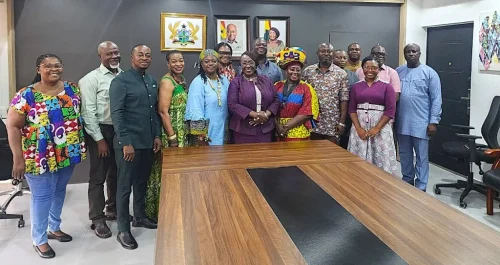
The Minister for Tourism, Culture and Creative Arts, Abla Dzifa Gomashie, has inaugurated a Committee on Reviving Theatre Arts to restore Ghana’s iconic Concert Party tradition to theatres and screens. The initiative aims to reposition Concert Party as a powerful tool for education, entertainment and economic development.
Speaking at the inauguration, Gomashie described the move as a cultural renewal. She stressed that theatre arts, particularly Concert Party, have historically entertained, educated and unified Ghanaians. The Minister noted that Concert Party remains a living archive of society, reflecting national joys, struggles and aspirations through humour, music and storytelling.
The Committee is mandated to provide strategic direction for the revival, production and regular screening of Concert Party as both a cultural and television programme. Its responsibilities include assessing the current state of theatre arts in Ghana, developing a clear revival roadmap across television and digital platforms, and recommending policy, institutional and funding frameworks.
Additional mandates include preserving Concert Party as part of Ghana’s intangible cultural heritage, encouraging youth participation and innovation, and promoting job creation within the creative arts sector. The Minister reaffirmed the Ministry’s commitment to preserving the art form for future generations.
Gomashie urged members to work with unity, creativity and integrity. She emphasized that their task extends beyond organizing performances to building a sustainable ecosystem that keeps theatre arts active in communities, schools and on national stages. The Minister underscored that culture remains the soul of a nation and that nurturing it strengthens national identity, unity and pride.
Responding on behalf of the Committee, Chairperson Dr Akosua Abdallah thanked the Minister for the confidence reposed in the members. She described Concert Party as more than entertainment, calling it the voice and memory of ordinary people. Dr Abdallah, who heads the Ghana Chapter of the International Theatre Institute (ITI), recalled Concert Party’s strong community roots and pledged to reconnect the art form to its origins.
Dr Abdallah stressed that the Committee’s goal is to revive Concert Party as a living, evolving theatrical form rather than a museum piece. She pledged to integrate music, dance and drama while investing in the next generation of performers. The Committee’s approach will focus on making Concert Party relevant to contemporary audiences while preserving its historical significance.
The Committee comprises members from academia, theatre practice, media and the creative arts industry. They include Akorfa Adjeani, Robert Nana Kodua, Ebenezer Osae Ayeh Jnr, Agness Panfred, Dr Joyce Akumaa Dongotey Padi, Gilbert Abeiku Aggrey, Henry Herbert Malm, Naa Dede Awula Tetteh and Wakefield Akuako.
Dr Abdallah is a venerated Ghanaian actress and theatre expert who has worked at the National Theatre for 27 years. She holds a doctorate from the University of Education, Winneba, and currently works at the National Commission on Culture under the Ministry of Tourism. She is widely known for her role in the popular television series Inspector Bediako, which captivated Ghanaian audiences in the 1990s.
Concert Party emerged as a distinctive theatrical form in Ghana, blending indigenous performance traditions with colonial era influences. The genre combines music, dance, drama and comedy to address social issues while entertaining audiences. It traditionally featured stock characters, satirical commentary and improvisation, making it accessible to both urban and rural communities.
The art form reached its peak popularity between the 1950s and 1980s, with troupes traveling across Ghana and neighboring West African countries. Concert Party performances typically incorporated local languages, cultural references and contemporary social commentary, making them powerful vehicles for education and community engagement.
However, Concert Party has experienced significant decline in recent decades. Factors contributing to this decline include the rise of television and digital entertainment, lack of institutional support, aging performers, insufficient youth engagement and limited funding for theatrical productions. Many veteran Concert Party practitioners have passed away without adequately training successors.
The inauguration underscores the Ministry’s renewed commitment to revitalizing theatre arts. It follows other recent initiatives by Gomashie, including the launch of the Abibigromma Theatre Festival at the University of Ghana and securing 20 million Ghana cedis allocation in the 2026 budget as seed funding for the Creative Arts Fund.
Gomashie has been a prominent advocate for the creative sector throughout her career. She served as Deputy Minister for Tourism, Arts and Culture from 2013 to 2017 under President John Dramani Mahama. Following her reelection as Member of Parliament for Ketu South constituency in December 2024 with 92.9 percent of votes, she was appointed Minister for Tourism, Culture and Creative Arts in January 2025.
The Minister is also a veteran actress, producer and screenwriter with over three decades of experience in the creative arts industry. In her native Avoeme Aflao in the Volta Region, she serves as queen mother in charge of protocol for the Aflao Traditional area with the stool name Mama Dzramedo.
The Committee’s work will involve collaboration with television stations, digital platforms and cultural institutions to ensure Concert Party reaches contemporary audiences. Members will need to balance preserving the traditional elements that made Concert Party culturally significant while adapting the format to engage younger generations who consume entertainment through different channels.
The revival effort comes at a time when Ghana’s creative and tourism sector contributed over 4.8 billion United States dollars to gross domestic product (GDP) in 2024, making it the fourth highest contributor to the economy. The Ministry views theatre arts as both cultural preservation and economic opportunity.
Success will require addressing practical challenges including training new performers, developing sustainable funding models, securing performance venues and creating distribution channels for Concert Party content. The Committee will need to demonstrate how Concert Party can remain commercially viable while maintaining its cultural authenticity and social relevance.
The inauguration signals Ghana’s recognition that cultural heritage requires active preservation and adaptation to remain vibrant. By establishing a formal committee with clear mandates and diverse expertise, the Ministry has created a framework for systematic revival rather than ad hoc interventions.
Whether Concert Party can successfully transition from its historical prominence to contemporary relevance will depend on the Committee’s ability to honor tradition while embracing innovation. The initiative represents a significant commitment to ensuring that this distinctive Ghanaian theatrical form thrives once again as a proud symbol of national creativity and cultural heritage.

