

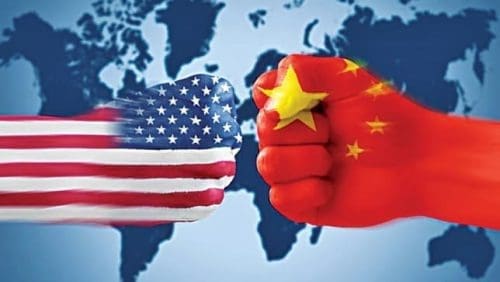
A new chapter in the economic rivalry between the world’s two largest economies unfolded this week as President Donald Trump increased tariffs on Chinese imports to 125 percent, prompting a swift and forceful retaliation from Beijing.
The escalation, confirmed by Nigel Green, CEO of deVere Group, marks a significant departure from previous trade skirmishes, as China imposed an additional 50 percent tariff on US goods on top of earlier duties.
The move, coming mere hours after China’s announcement, transformed a series of warnings into a full-scale confrontation that is expected to ripple through global markets and affect a wide range of asset classes.
In an indication that political calculations are being reshaped by economic realities, Trump also announced a 90-day pause on the enforcement of tariffs for countries that have not retaliated. This partial step-back was widely interpreted as an acknowledgement of the mounting risks of economic blowback amid a climate of uncertainty.
“The gloves are off,” Green declared, emphasizing that the traditional belief in easy victories in trade wars has been shattered. His comments highlighted that the aggressive tariff measures, once seen as a demonstration of resolve, now seem poised to create profound volatility, challenging investors to reassess portfolios built on decades of relative trade stability.
The tariff escalation has already set the stage for significant market movements, with equity markets and bonds reacting to the stark reminder that no winner exists when economic fundamentals are compromised by political maneuvering.
Amid the rapid changes, strategies that once depended on continuous global growth must be rigorously stress-tested, as the specter of disrupted supply chains and heightened inflationary pressures looms large. Investors and market observers alike are bracing for a period defined by alternating rallies and sell-offs as sentiments swing between hope and caution.
The unfolding trade conflict underscores a deeper structural shift. With the US-China relationship now characterized by overt hostility rather than diplomatic posturing, the trust that underpinned previous economic cooperation has been severely undermined.
It is becoming increasingly clear that, while a temporary pause in tariff enforcement offers immediate relief, the longer-term strategic reset required to stabilize global trade may be both painful and protracted.
As markets react to these dramatic policy shifts, the emphasis on diversification, clarity, and steadfast leadership has never been more urgent. This moment not only signals the end of easy assumptions but also serves as a stark reminder that in an interconnected world, economic policies come with consequences that extend far beyond national borders.

