

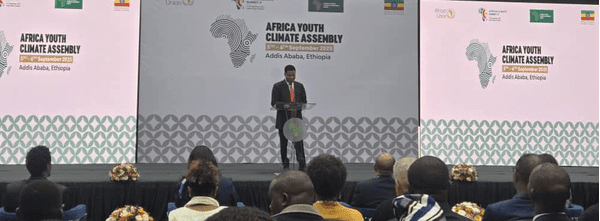
Africa’s young people must unite to demand climate justice and shape their continent’s future, a prominent climate activist told delegates at the opening of the Africa Youth Climate Assembly on Thursday.
Dr. Mithika Mwenda, executive director of the Pan African Climate Justice Alliance and recognized among the world’s most influential climate figures, delivered a powerful address to hundreds of young African leaders gathered in Ethiopia’s capital ahead of the Second Africa Climate Summit.
Speaking at the Addis International Convention Center, Mwenda painted a stark picture of climate injustice facing the continent. Africa contributes less than 4 percent of global greenhouse gas emissions yet bears disproportionate consequences, with more than 110 million Africans affected by extreme weather events in 2024 alone.
“Climate injustice is not just about rising temperatures,” Mwenda told the assembly. “It is about shrinking opportunities, farmers who can no longer rely on the rains, and young people forced to migrate because the land can no longer sustain them.”
The three-day Youth Climate Assembly runs from September 5-7 as a precursor to the main Africa Climate Summit, scheduled for September 8-10 at the same venue. The pre-summit events are designed to ensure youth voices directly influence the continental climate agenda.
Mwenda challenged delegates to use their gathering for three key purposes: organizing a united youth movement, innovating grassroots climate solutions, and demanding decision-making roles rather than observer status in climate negotiations.
The assembly comes at a critical time for African climate advocacy. The upcoming summit is viewed as an opportunity to send a clear global message that Africa is ready to supercharge climate action, with expectations that outcomes will influence discussions at COP30 in Brazil next year.
Drawing parallels to historical liberation movements, Mwenda emphasized youth leadership in transforming societies. “History tells us something very simple: no great transformation has ever happened without the energy of the young,” he said, citing examples from anti-apartheid struggles to current renewable energy innovations across the continent.
The climate advocate outlined specific priorities for African youth engagement. These include demanding climate finance as investment rather than charity, ensuring energy access for 630 million Africans currently without electricity, and creating millions of green jobs through just transition policies.
Mwenda’s organization, PACJA, represents one of Africa’s largest networks of civil society organizations focused on climate justice. His advocacy work has been recognized for influencing climate policies across African countries, and he has received multiple international awards for environmental leadership.
The Youth Climate Assembly represents a shift in how African climate summits engage with young people. Rather than token participation, organizers have positioned youth voices as central to shaping outcomes that will affect their lifetimes.
With Africa’s population projected to double by 2050, with young people comprising the majority, their participation in climate solutions becomes increasingly critical. The continent faces competing pressures of development needs and environmental protection while dealing with impacts of climate change largely caused by wealthier nations.
Participants at the assembly represent diverse backgrounds from across the continent, including tech innovators, environmental activists, agricultural experts, and renewable energy entrepreneurs. Many are already implementing climate solutions in their communities, from solar mini-grids to reforestation projects.
The assembly’s recommendations will feed directly into the main summit discussions, where African leaders will develop positions for international climate negotiations. Key themes include climate financing, renewable energy transitions, and adaptation strategies for vulnerable communities.
As the week progresses, delegates will participate in working groups on energy access, climate finance, sustainable agriculture, and green jobs. Their final declaration is expected to influence both the main summit outcomes and Africa’s negotiating positions at future international climate talks.
The timing proves significant as global attention turns toward COP30 in Brazil, where developing nations will push for increased climate finance and technology transfer commitments from industrialized countries.
For many participants, the assembly represents their first major platform to influence continental policy. The experience reflects growing recognition that climate solutions require intergenerational leadership and that Africa’s youth must help design their own climate future.

