Comet Estates Under Siege: Landguards Assist Illegal Claimant To Encroach On Land

0

..Claim Police And Jubilee House Backing

Management of Comet Properties Limited has appealed to President John Dramani Mahama and the national security authorities to urgently intervene in what it describes as an escalating landguard operation, alleged criminal trespass, destruction of property and threats to residents and investors at the Comet Estate near Brekuso in the Akuapem South Municipality of the Eastern Region.

The company’s leaders stated that they are issuing this distress call to President Mahama and national security authorities because local police cannot protect lives and property in the area.

They noted that the gang leaders are mostly foreigners. This includes a self-styled chief identified as Mawuko, who claims to be executing these acts of mayhem for the top echelons of the Ghana Police Service.

Consequently, local police officers are reportedly afraid to arrest them for criminal investigation.”

The company says the alleged activities, which it claims have intensified over the past two weeks, have created an atmosphere of insecurity within the estate and raised serious concerns about the protection of private investments and the safety of residents.

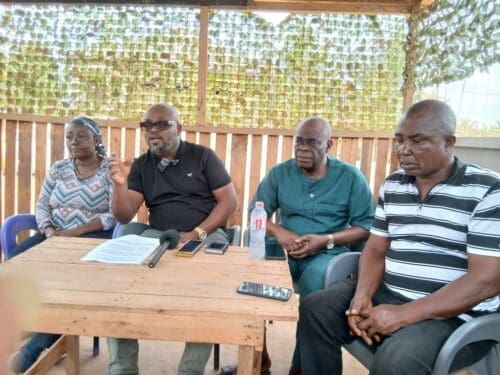
At a press conference held at CometHill at Brekusu on Friday October 9, 2026, Director of Comet Properties Limited, Nana Yaw Adom, alleged that groups of persons armed with dangerous weapons have entered portions of the company’s lands, destroyed property and attempted to sell disputed parcels to third parties.

He told journalists at a press conference that when the management of estate developing company confronted the illegal claimant to its land at Comet Estate, the developer claimed he had purchased the land from the Owoo family.
Nana Yaw Adom asserted that the company has petitioned President John Dramani Mahama to advise the illegal claimant to stop trespassing on its legally registered land.

He further claimed that whenever the company confronted the illegal developer, the individual would drop the names of top figures at the Jubilee House and within the police hierarchy.

He alleged these officials were actively supporting the developer’s encroachment on the company’s registered land, which is situated near the Brekusu Police Station.

He commended President John Dramani Mahama for his prompt response to the petition, noting that the President had directed the Crime Officer of the Accra Regional Police Command to intervene, investigate the matter, and ensure that the law was upheld.

In acting on President Mahama’s directive, a senior police officer invited both the management of Comet Estates and the illegal land developer to a meeting.

He noted that the police have instructed both parties to provide their legal indentures, certificates, and land documents so investigator can determine the true owner of the disputed property.

He pointed out that although the illegal claimant was warned to halt all development, he defied the order.

Instead, he hired masons and deployed heavily built land guards to continue constructing a house on the land, creating tension and insecurity within Comet Estate.

“As of today, Friday, October 9, 2026, while we were preparing to brief the press to expose these illegal activities, the masons and their laborers were busily constructing buildings on the disputed land, even though a special police investigator has been officially assigned to look into the matter,” Nana Yaw Adom revealed after conducting journalists around the site to give them firsthand information on exactly what is happening on the disputed land at Comet Estate.

According to him, some of the individuals allegedly involved have claimed to be acting on behalf of influential persons within the Ghana Police Service and political authorities at the Presidency.

The company, however, stressed that the allegations are claims that require independent investigation and verification.

Call for presidential investigation

Nana Yaw Adom called on President Mahama to institute an inquiry into the alleged claims of political and police connections made by persons the company identifies as landguard leaders.

He said petitions on the matter had already been submitted to the Presidency, Interior Minister and and appealed for direct intervention to restore what he described as peace and sanity to the Comet Estate.

«“Laws should work in Ghana. There should be order in Ghana,” Nana Yaw Adom said.»

The company also called on the national security authorities to assist in dealing with what it described as an organised group allegedly operating on its lands.

Allegations against persons identified as landguard leaders

Management specifically mentioned individuals it identified as Nii Sowah Shippi, also known as Mawuko, Kwabena Debrah and a Nigerian national identified as Jeremy.

According to the company, Mawuko is allegedly leading a group of landguards operating in the area, while some of the individuals are alleged to have claimed connections to powerful persons within the Police Service or political leadership.

Comet Properties alleged that such claims have made some police officers reluctant to arrest or investigate the individuals.

The company did not provide independent evidence at the press conference to establish that the named individuals are in fact acting on behalf of senior police or political officials.

The allegations therefore remain subject to investigation and the right of the accused persons to respond.

Company traces dispute to land ownership claims

Comet Properties said it was established in 2002 as a real estate development company specialising in converting undeveloped land into planned communities and providing infrastructure for residents.

Its flagship project, the company said, is the Comet Estate, located within the Akuapem South Municipality.

According to the company, the estate covers approximately 1,500 acres and currently has a population of about 15,000 residents, although its earlier description at the press conference referred to a potential population of about 20,000.

Management said the development was undertaken under the appropriate planning arrangements and that the company acquired its interests from traditional landholding families in Brekuso, Akorpman and surrounding communities.

It said the company subsequently obtained planning scheme approval from the Akuapem South Municipal Assembly.

Company disputes alleged overlap with Odai Ntow family lands

A significant part of the dispute, according to Comet Properties, concerns competing claims involving the Odai Ntow family of Ashongman and Kwabenya.

The company referred to the historical Bosompim v. Martei (1904) judgment and related judgment plan, as well as a statutory declaration said to have been registered in 1977.

According to Comet Properties, the relevant documents establish the boundaries of lands associated with the Odai Ntow family and demonstrate that those lands are distinct from the lands acquired from the Brekuso traditional landowners for development of the Comet Estate.

The company insists that its lands do not overlap with the lands claimed by the Odai Ntow family.

Management, however, alleges that some persons associated with the Odai Ntow family have repeatedly entered portions of the Brekuso lands occupied by Comet Properties and purportedly sold parcels to third parties.

The company further alleged that landguards have been used to enforce such transactions.

These claims were presented by Comet Properties and have not, in the material provided, been independently adjudicated or established by a court.

Owoo family dispute

The company also outlined a separate dispute involving the Owoo family of Accra.

According to Nana Yaw Adom, Comet Properties acquired additional lands from the Asona family of Brekuso in 2002, part of which involved approximately 67 acres released to the Owoo family pursuant to a settlement between the Owoo family and the Asona family.

He said the Owoo family subsequently sold approximately 25 acres of the released land to Comet Properties for what he described as valuable consideration of about GH¢400 million, which the company said was fully paid.

However, Comet Properties alleges that in 2013, the Owoo family subsequently entered into transactions involving the same area and began selling portions of land adjoining the 67-acre parcel.

The company claims that landguards were subsequently deployed in connection with those transactions, resulting in multiple legal disputes and confrontations.

Seven foundations allegedly destroyed

One of the most serious incidents cited by the company allegedly occurred in November 2024, when persons said to be associated with Mawuko allegedly entered disputed portions of the Comet Properties development.

The company claims that seven building foundations were destroyed, with the total value of the damage estimated at more than US$500,000.

According to Nana Yaw Adom, the incident was reported to the police, but the company was dissatisfied with the subsequent response.

He further alleged that despite legal action and an injunction obtained against Mawuko and others, the group allegedly continued to operate on the disputed lands.

Comet Properties claims that as many as 50 persons have been maintained on the land as part of the alleged landguard operation.

The company is therefore asking the authorities to enforce existing court orders and prevent further destruction or occupation of the disputed properties.

Security concerns

Management said the alleged activities have gone beyond an ordinary civil land dispute and have become a security concern because of the alleged use of armed groups, threats and destruction of property.

It argued that disputes over land ownership should be resolved through the courts and other lawful mechanisms rather than through the use of force.

The company also expressed concern that repeated changes in political administrations could be exploited by land actors who allegedly invoke the names of newly appointed political authorities to pursue claims over disputed properties.

According to the company, such conduct undermines confidence in Ghana’s land administration system and discourages private investment.

Impact on residents and investors

Comet Properties said the alleged insecurity poses a threat not only to its corporate interests but also to residents who have invested in homes and businesses within the estate.

The company described Comet Estate as a community of law-abiding residents who have invested substantial resources in the area and are entitled to protection under Ghanaian law.

It warned that continued clashes, alleged landguard activities and destruction of property could undermine the development of the community and create fear among residents.

Company seeks protection, enforcement of law

Nana Yaw Adom said Comet Properties was not asking for preferential treatment but for the enforcement of the law and protection of legitimate investments.

He urged the police, national security authorities and other relevant state institutions to investigate the allegations independently and ensure that persons found to have engaged in criminal conduct are dealt with according to law.

He also appealed to the President to investigate claims that persons involved in the alleged activities have links to senior officials within the Police Service or political authorities.

The company said it was prepared to provide relevant documents, including land acquisition records, planning documents, court processes, judgment plans and other materials relating to the disputed properties, to assist any official investigation.

Broader landguard challenge

The allegations come against the backdrop of Ghana’s longstanding struggle with landguardism, a phenomenon that has frequently been associated with violent enforcement of competing land claims, illegal sale of land, threats to developers and destruction of property.

Legal experts and civil society groups have repeatedly argued that land ownership disputes must be settled through established legal and customary processes rather than through private enforcement groups.

For Comet Properties, the immediate concern is that the alleged activities at its estate could escalate unless state institutions intervene.

The company maintained that it remains committed to the development of the Comet Estate but insisted that such investment can only continue in an environment where the rule of law is respected.

“We are a responsible corporate organisation and need a peaceful environment to carry out our business,” Nana Yaw Adom said, reiterating the company’s appeal for urgent state intervention.

Comet Properties Limited says it is seeking an independent investigation into the allegations, protection for residents and investors, and enforcement of all applicable court orders and laws governing the disputed lands


IJM Ghana Commends Ghana on Historic Upgrade to Tier 1 Status in the U.S. Trafficking in Persons Report

0

International Justice Mission (IJM) Ghana warmly congratulates the Government of Ghana and all stakeholders on Ghana’s upgrade from Tier 2 to Tier 1 in the United States Department of State’s Trafficking in Persons (TIP) Report. This prestigious recognition affirms Ghana’s sustained commitment and significant progress in preventing human trafficking, protecting survivors, and prosecuting offenders.

The Tier 1 ranking signifies that Ghana fully meets the minimum standards for the elimination of trafficking in persons. This achievement reflects years of coordinated action, strategic investments, strengthened institutional collaboration, and the unwavering commitment of government agencies, civil society organizations, development partners, the media, and citizens across the country.

IJM Ghana extends its heartfelt congratulations to:

  • The Ministry of Gender, Children and Social Protection (MoGCSP), particularly the Human Trafficking Secretariat, for its leadership in coordinating national anti-trafficking efforts and implementing Ghana’s National Action Plan.

  • The Office of the Attorney-General and Ministry of Justice for strengthening prosecutions and securing increased convictions of traffickers.

  • The Ghana Police Service, including specialized anti-trafficking and marine units working to combat child trafficking and exploitation, particularly on Lake Volta.

  • The Ghana Immigration Service and the Economic and Organised Crime Office (EOCO) for their contributions to investigations, victim identification, and efforts to tackle emerging forms of trafficking, including cyber-enabled exploitation.

  • The Ministry of Labour, Jobs and Employment Relations for efforts to strengthen labour migration safeguards and worker protections.

  • Members of Parliament, especially the Select Committees on Human Rights and Gender, for championing laws, oversight, and policies that advance the protection of vulnerable populations.

  • The National Commission for Civic Education (NCCE), media organizations, civil society actors, faith groups, traditional leaders, and development partners whose awareness creation, advocacy, and community engagement efforts have strengthened prevention and protection efforts nationwide.

  • Traditional and religious leaders whose voices and influence have helped drive the campaign.

  • Most importantly, the people of Ghana, whose vigilance, reporting of suspected trafficking, community action, and support for vulnerable children and families have been critical to this success.

A Milestone Marked by Tangible Results

The Tier 1 ranking was driven by measurable progress across prosecution, protection, and prevention efforts.

During the reporting period, Ghana significantly increased law enforcement action against traffickers, prosecuting 212 alleged traffickers and securing 28 convictions, while identifying 2,331 trafficking victims and referring all identified victims to appropriate services. The government also increased funding for victim assistance and anti-trafficking initiatives, expanded frontline training, strengthened international cooperation, and enhanced efforts to combat online scam operations linked to trafficking and forced labour.

Particularly encouraging is the increase in victim identification and referral, which demonstrates growing capacity among social welfare officers, law enforcement personnel, labour inspectors, immigration officers, and civil society organizations working together to ensure survivors receive the care and support they deserve.

Child Trafficking Remains a Critical Challenge

While this recognition is worth celebrating, it should also remind us that the fight against human trafficking is far from over.

The TIP Report notes that children in Ghana continue to face exploitation in forced labour, especially within inland and coastal fishing, domestic work, street hawking, agriculture, artisanal mining, quarrying, and herding. Child trafficking on Lake Volta remains a significant concern, and children from Ghana and neighbouring West African countries continue to be vulnerable to exploitation.

The report further highlights the increasing use of technology by traffickers to recruit and exploit victims through fraudulent job offers, cybercrime schemes, online scams, and deceptive migration opportunities.

These realities underscore the importance of sustained investments in child protection systems, survivor-centred services, community awareness, and coordinated law enforcement responses.

The Vital Role of Civil Society

Civil society organizations and NGOs have been indispensable partners in Ghana’s anti-trafficking journey. Throughout the reporting period, NGOs partnered with government agencies to provide survivor care, operate shelters, conduct public education campaigns, support investigations, build community resilience, train frontline officials, and strengthen prevention efforts in high-risk communities.

Organizations working directly with vulnerable children, families, and survivors continue to fill critical gaps in protection services and contribute invaluable expertise toward strengthening Ghana’s response to human trafficking.

Sustaining the Momentum

Despite the achievement of Tier 1 status, important challenges remain. Shelter capacity, particularly for adult survivors, remains limited. Additional investments are needed to strengthen anti-trafficking responses in rural communities, enhance specialized training on cyber-enabled trafficking crimes, improve survivor services, and address vulnerabilities that place children and adults at risk of exploitation.

This is the time to increase funding for human trafficking and child protection.

IJM Ghana encourages all stakeholders not to view Tier 1 as the termination of our efforts, but as a platform for deeper action and greater impact. Sustained progress will require continued collaboration, adequate resourcing of frontline institutions, strengthened accountability mechanisms, and a renewed commitment to protecting every person from violence, exploitation, and abuse.

Reacting to this development, IJM’s Director, West Africa Programme, Anita Budu, said:

“Ghana’s elevation to Tier 1 status is a significant national achievement that reflects the power of coordinated action and collective commitment. We commend the Government of Ghana and all stakeholders whose dedication has contributed to this milestone.

“At the same time, we recognize that thousands of children and vulnerable adults remain at risk of trafficking and exploitation. This achievement should inspire us to work even harder to ensure every child is safe, every survivor is protected, and every trafficker is held accountable.”

About IJM Ghana

International Justice Mission (IJM) is a global organization that protects the vulnerable and people living in poverty from violence and exploitation. We partner with local authorities in 33 programme offices in 19 countries to combat violence against women and children, abuse of power by public authorities, and various forms of human trafficking and forced labour.

We aim to strengthen justice systems, support survivors, and advocate for lasting change.

In Ghana, IJM partners with government institutions to address human trafficking and forced labour in the agricultural sector by strengthening the capacity of relevant authorities to identify, remediate, and prevent cases.

Citizen Kafui Appointed Media Relations Manager for EMY Africa

0

Ghanaian media professional and digital creator Citizen Kafui has been appointed Media Relations Manager for EMY Africa adding another significant responsibility to his growing career in media, communications and brand management.

With professional experience spanning GBC, Light TV, Citi FM, Channel One TV, 4Syte TV and entertainment and lifestyle portal GhanaWeekend Citizen Kafui brings a wealth of experience in media production, publicity, storytelling and audience engagement to his new role.

At EMY Africa he will lead the brand’s media engagements and publicity rollout supporting its communication efforts as the organisation continues to celebrate distinguished personalities, business leaders and individuals making meaningful contributions to society.

The appointment further strengthens Citizen Kafui’s growing portfolio in public relations and entertainment where he continues to work at the intersection of media, music and brand development.

He currently serves as Media Relations Manager for Ghanaian singer Gyakie a role that has seen him contribute to the artiste’s publicity and media engagements.

His latest appointment at EMY Africa marks another step in his professional journey reflecting his continued commitment to building strong brands, telling compelling stories and creating visibility for individuals and organisations making an impact.

Speaking on the new opportunity Citizen Kafui described the appointment as another challenge and an opportunity to grow professionally while contributing meaningfully to the industry.

“For me, this is another challenge to keep growing contributing to the industry building great brands and representing amazing people.

I look forward to this great opportunity and what we can achieve together,” he said.

As EMY Africa continues to expand its presence through its awards, events and Magazine publications Citizen Kafui’s appointment comes at a pivotal time for the brand with strategic media relations and engagement remaining central to amplifying its work and celebrating excellence.

Gyakie Unveils Artwork for New Single “Your Body” Ahead of October 16 Release

0

Ghanaian singer and songwriter Gyakie is gearing up for another exciting release as she unveils the official artwork for her upcoming single, “Your Body,” a smooth feel-good record expected to bring a fresh wave of energy to her growing catalogue.

Following a year marked by a string of releases and notable musical moments Gyakie is keeping the momentum going with the new single, scheduled for release on October 16, 2026.

The song is expected to build anticipation for Gyakie’s third EP The Dawn which is scheduled for release later this year.

The unveiling of the artwork offers fans an early glimpse into the creative direction of the upcoming release, building anticipation for what promises to be another exciting addition to the singer’s repertoire.

Known for her distinctive vocals captivating melodies and ability to connect with listeners Gyakie continues to explore her sound while maintaining the musical identity that has endeared her to audiences at home and abroad.

With “Your Body,” fans can look forward to a record designed to bring a feel-good atmosphere and get listeners moving as the countdown to its release begins.

The single also serves as another step towards the arrival of The Dawn EP Gyakie’s upcoming third EP project as she continues to build on her achievements and strengthen her position on the global music stage.

FlipTheMusic continues to play an influential role in strengthening Gyakie’s position as one of Ghana’s leading music artistes through its strategic support and efforts to expand her reach as she connects with audiences across borders.

As excitement builds around her next body of work, “Your Body” presents another opportunity for Gyakie to connect with her audience while keeping her musical journey moving forward.

Fans can mark October 16, 2026 on their calendars for the release of “Your Body” as anticipation builds for The Dawn EP and the next chapter in Gyakie’s evolving sound.

Pre-save Gyakie’s “Your Body” now and get ready for its official release.

Okada Riders Allegedly Brutalized, Shot Dead as Police Face Questions Over Handling of Case

0

Questions are being raised over the handling of a number of alleged assault, death threat and murder-related complaints in Ningo, with affected families accusing the police of failing to pursue some cases through the normal criminal justice process.

The complaints are linked to a wider dispute involving Nene Nartey Asamoah, who is described by some members of the community as the chief of Kopodor.

Information and documents made available to the family indicate that several complaints have been lodged at the Ningo and Prampram Police Stations over alleged attacks, threats and other incidents involving persons said to be associated with Nene Asamoah.

The allegations include claims that some victims were assaulted, threatened with death and, in some instances, that serious cases were not processed before the courts.

The complainants allege that police officers, instead of proceeding with investigations and prosecution where appropriate, have on some occasions advised the parties to resolve the disputes within the family.

They are questioning why allegations involving possible criminal offences would be referred for family settlement rather than being subjected to the applicable investigative and prosecutorial procedures.

Claims over attacks on Okada riders

One of the most serious allegations concerns attacks on commercial motorbike riders, commonly known as Okada riders, in the Ningo area.

According to information provided by the family and community sources, an Okada rider, Timothy teye Otubua, was allegedly killed in July after being severely beaten by persons described as land guards allegedly linked to Nene Asamoah.

His fellow Okada riders waited for him for some time, but when he did not return, they decided to follow up. They later found him at the village, lying in a pool of blood and dead.

The father of the deceased boy, Kwao teye Otubua says the family made several requests to the police to pursue the case in court, but those requests were allegedly refused.

He claims that the suspect, John Happy Asamoah, alias Nene Nartey Asamoah, continues to walk freely in the Kopodor community in Ningo and has allegedly issued threats to members of the deceased’s family.

According to the father, following the boy’s death, his fellow Okada riders went to observe the situation involving Nartey Asamoah.

He alleges that Nartey Asamoah, together with some of his alleged land guards and police officers, caused the arrest of 12 of the riders.

The father further alleges that the 12 men were beaten and subsequently detained at the Prampram Police Station cells.

The family subsequently reported the incident to the Prampram Police Station. The case was taken up by the CID, led by a female investigator identified as Madam Grace.

The account further alleges that other Okada riders subsequently travelled to the area to inquire about the circumstances surrounding the death and were also attacked.

The sources claim that as many as six Okada riders have since lost their lives in connection with the incidents.

They further allege that complaints were made to the Ningo-Prampram Police Station but that no meaningful action has followed.

Another allegation is that motorbikes belonging to some of the deceased riders were subsequently found at a property said to belong to Nene Asamoah.

These claims have not been independently established, and the circumstances surrounding the reported deaths, the identities of the perpetrators and the alleged recovery of the motorbikes require confirmation from the police and other relevant authorities.

Families question police response

The complaints also involve alleged assaults and threats against several individuals, including persons identified as Larseh Joshua, Addo and Isaac Tetteh Kwadwo.

Others, including Nii Akweh, Atteh Chenchenmah, Larseh Emmanuel, Arkuteeye, Sernor Kwao Stephen and Pastor Enoch Mensah, are alleged to have received death threats.

According to the complainants, the various matters were reported to the police at Ningo and Prampram, but the cases have allegedly not resulted in prosecutions.

The family further alleges that on occasions when Nene Asamoah was invited to the police station, he allegedly insulted or threatened complainants in the presence of police officers.

The allegations have prompted calls for the police hierarchy to review the handling of the complaints and establish whether proper procedures were followed.

According to the family, Nartey Asamoah and his associate, the Chief of Lakpleku, allegedly colluded with the police, while one Nene Simpin allegedly brought the matter to the family home, where the bereaved parents were asked to bury their son.

Dispute over Dankyira family house

The tensions have also extended to the Dankyira family house at Ningo, where members of the family allege that attempts have been made to demolish the property.

The Alipue, Chenchenma and Ashalley Botwe Gates are reportedly opposed to any demolition of the house.

In a letter dated September 30, 2026, lawyers representing the affected Gates reportedly called on Nene Asamoah to abandon any plans to demolish the property.

Documents cited by the family indicate that the house was constructed through contributions from members of the wider Dankyira clan drawn from several communities.

The family therefore maintains that the property belongs to the wider Dankyira family and that no individual should unilaterally determine its future.

Traditional authority dispute

The wider dispute has also generated questions about Nene Asamoah’s authority and his claim to the traditional position he occupies.

Some family members have challenged his authority over them and disputed his right to exercise control over family property.

The family also alleges that Nene Asamoah insulted the Gborbu Wulomo in the presence of senior police officers and later disregarded an invitation from the traditional authority.

The claims form part of a broader dispute involving land ownership, traditional authority and alleged activities of land guards in Ningo and surrounding communities.

The complainants are calling for the police administration to clarify the status of the various complaints and explain why some of the reported cases have allegedly not proceeded to court.

They insist that their concerns are not intended to interfere with traditional processes but that allegations involving assault, threats or possible loss of life should be investigated independently and dealt with according to law.

The allegations against Nene Asamoah, the alleged land guards and the police remain disputed and unproven. No finding of criminal liability has been established against the persons named in the complaints based on the information provided.

The Ghana Police Service and Nene Asamoah have not, in the material provided, given a public response to the allegations.

IEAG Boss Samson Awingobit Honoured At 2026 World Rice Conference For Sterling Contributions

0

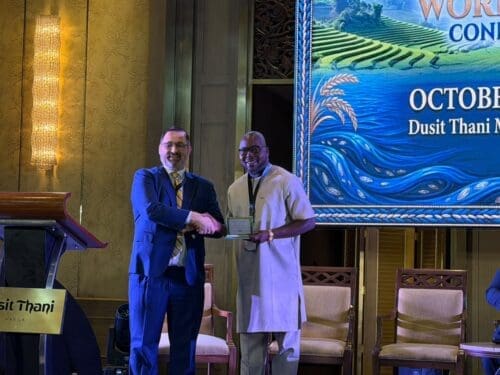
The Executive Secretary of the Importers and Exporters Association of Ghana (IEAG), Mr. Samson Asaki Awingobit, has received a Certificate of Appreciation at the 2026 International World Rice Conference in recognition of his active participation, knowledge-sharing and valuable contributions to the global rice industry.

The recognition was presented by the conference organisers, The Rice Trader and the International Commodity Institute, at the three-day event held from October 7 to 9 at the Dusit Thani Manila in the Philippines.

Mr. Awingobit also distinguished himself as a key contributor to this year’s conference, actively participating in discussions and sharing perspectives on issues affecting the global rice trade. His contributions provided an important platform for highlighting Ghana’s rice import and trade interests while strengthening engagement between Ghanaian businesses and international stakeholders across the rice value chain.

Mr. Awingobit’s recognition underscores his continued engagement with the international rice trade community and his efforts to strengthen collaboration among rice producers, farmers, importers and exporters across markets.

This year’s conference brought together key stakeholders from across the global rice value chain to exchange market intelligence, explore emerging trade opportunities and discuss developments shaping the future of rice production and commerce.

It marks the third time Mr. Awingobit has participated in the prestigious international gathering, having previously attended the 2024 edition in Manila, Philippines, and the 2025 conference in Phnom Penh, Cambodia.

Through his previous engagements, the IEAG Executive Secretary has helped connect Ghanaian rice importers with farmers, producers and trading partners in the Philippines and Cambodia, creating opportunities for Ghanaian businesses to establish commercial relationships and explore new markets.

The Association believes these engagements are important to strengthening Ghana’s rice supply chain, improving access to international suppliers and creating mutually beneficial partnerships that support the country’s wider trade interests.

The IEAG is confident that Mr. Awingobit’s continued participation in the conference will yield further benefits for Ghana by deepening international trade relationships, expanding business opportunities and improving access to market information for Ghanaian importers and exporters.

The Association has reiterated its commitment to pursuing strategic international engagements that promote trade facilitation, enhance private-sector competitiveness and advance Ghana’s position in the global trading environment.

Labadi–La Palm Beachfront: Turning a Coastal Challenge into Economic Opportunity

0

Story By: Felix Ernest Odamtten / Muhammad Faisal Mustapha….

The clearance of unauthorised structures from the beachfront adjoining the Labadi Beach Hotel and La Palm Royal Beach Hotel has opened a new chapter in the long running effort to reclaim, restore and redevelop one of Accra’s most strategically located coastal tourism enclaves.

At the heart of the exercise is a proposition that extends beyond the removal of structures: the beachfront can become a properly planned tourism and hospitality destination capable of attracting visitors, creating jobs and generating sustainable economic opportunities for communities around Labadi.

Management of the two hotels say, the objective is not simply to take away livelihoods that have developed around the beachfront over the years, but to create a better organised environment in which economic activity can flourish on a more sustainable basis.

The challenge, therefore, is how to transform a contested and increasingly congested coastal space into an attractive destination without losing sight of the people whose livelihoods have been built around it.

For years, informal businesses and other activities have emerged around the beachfront, reflecting the economic importance of the area to residents and visitors.

Indeed, the continued unauthorised occupation has created serious safety, sanitation, environmental and operational concerns for the hotels and the wider beachfront.

Management’s position is that the assets being protected are not ordinary commercial properties. They form part of investments made with the contributions of Ghanaian workers and are ultimately intended to generate sustainable returns for members.

“These assets belong to the workers and pensioners of Ghana.”

The Trust’s intervention followed what it described as persistent unlawful occupation, encroachment and unauthorised activities on the beachfront adjoining and directly in front of the two hotels. The Social Security and National Insurance Trust (SSNIT) sought the intervention of the National Security Council Secretariat to help protect the properties and restore proper control of the area.

The Trust has identified several risks associated with the encroachment, including threats to the safety and security of hotel guests, employees, service providers and visitors, as well as unauthorised access to sensitive guest and operational areas.

There were also concerns over fire, sanitation, environmental and public health hazards, alongside the deterioration of the beachfront and the potential damage to the standards expected of internationally recognised hospitality facilities.

The environmental dimension is particularly important. Construction and other activities on the beachfront can place pressure on the coastal ecosystem, while poor sanitation and uncontrolled activity can undermine the quality of the beach and the experience of residents and visitors.

Yet the future of the enclave cannot be measured solely by the number of structures removed. Its success will ultimately depend on what replaces them and whether the redevelopment produces tangible benefits for the communities that have historically depended on the area.

SSNIT says young people from Labadi and surrounding communities will be considered for employment opportunities created by the redevelopment and subsequent operations, subject to the relevant recruitment requirements. The potential areas of employment are wide ranging.

Construction alone could generate opportunities for skilled and unskilled workers, while the completed destination could support jobs in hospitality, food services, tourism, entertainment, security, cleaning, maintenance, transportation and other related businesses.


“The objective is to create a better organised tourism environment capable of generating more sustainable and wider economic opportunities.”

This approach could provide an opportunity to move from fragmented informal economic activity towards a more structured local economy in which residents participate in the value chain created by tourism rather than remaining on its margins.

For that transition to succeed, however, community participation will be critical.

Management of the hotels recognises that the people of Labadi and surrounding communities have a legitimate interest in what happens to a major public facing asset located within their traditional and residential environment.

It has therefore indicated they will continue to engage chiefs, traditional authorities, community leaders and residents throughout the various stages of the redevelopment. Such engagements can help communicate the plans, address concerns and identify practical opportunities for local participation.

Meaningful consultation will also be important in managing expectations. A redevelopment of this scale will inevitably change the character of the area, and communities need clarity about employment opportunities, access, environmental safeguards and the future use of the beachfront.

Importantly, SSNIT says the beachfront will remain a public beach. The redevelopment is expected to commence soon after engagement with stakeholders, with an emphasis on cleaning and restoring the area to a safer, more attractive and properly managed environment while retaining public access.

That commitment could become one of the defining features of the project. A successful tourism destination does not necessarily have to mean exclusion; it can combine investment, hospitality, environmental responsibility and public enjoyment when properly planned and managed.

The redevelopment also comes at a time when Ghana is seeking to strengthen tourism as a source of foreign exchange, employment and local economic development. A well-managed beachfront destination in the heart of Accra could add another dimension to the city’s tourism offering and strengthen the country’s appeal to domestic and international visitors.

The proximity of the Labadi Beach Hotel and La Palm Royal Beach Hotel gives the enclave an existing hospitality foundation on which a broader destination could be developed. With appropriate planning, the surrounding beachfront could complement the hotels rather than remain a source of operational, environmental and security challenges.

For SSNIT, the economic argument is equally significant. Protecting and enhancing the value of its investment assets is part of its fiduciary responsibility, particularly because the ultimate beneficiaries are contributors and pensioners whose financial security depends on the effective management of the Scheme’s investments.

The real measure of the redevelopment, therefore, will not simply be the physical transformation of the beachfront. It will be whether the project succeeds in creating a cleaner and safer public beach, strengthening Ghana’s tourism proposition, opening legitimate economic opportunities for local people, protecting the coastal environment and improving the long term value of an important national investment.

Labadi and La Palm beachfront now stand at a crossroads: it can remain a contested coastal space characterised by unplanned activity, or it can evolve into a properly managed tourism and economic hub that works for visitors, residents, the hospitality industry and the workers and pensioners whose contributions underpin SSNIT. The way forward, ultimately, is redevelopment that protects the asset while ensuring that the benefits of its renewal extend beyond its boundaries.

Pursuing the Promise of AI: A Guide for African Nonprofits to Advance Their Missions

0

Insights from more than 40 nonprofit, funders, and other experts highlight practical lessons for deciding whether and how to use AI responsibly and equitably.

Artificial intelligence (AI) is creating new possibilities for nonprofits across Africa to expand access to services, strengthen programme delivery, and address challenges in areas ranging from health and education to livelihoods and agriculture. A new report from The Bridgespan Group examines how African nonprofits are beginning to use artificial intelligence to advance their missions—and offers a practical roadmap for organisations considering whether, where, and how AI could help.

“The question for nonprofits isn’t ‘how do we use more AI?’ but ‘what problem are we solving, and is AI the right way to solve it?’ This involves looking beyond the technology to the organisation’s data, people, governance, as well as the communities at the centre,” said Madhuri Mukherjee, Bridgespan partner and co-author of the research. “That’s how adoption becomes responsible, helping nonprofits reach more people and deepen impact.”

Pursuing the Promise: A Guide for African Nonprofits to Advance Their Missions with AI draws on interviews and discussions with more than 40 nonprofits and social enterprises, funders, experts, and intermediaries across Africa working on issues such as education, health, and livelihoods. The research examines how organisations have approached AI—from identifying a problem and testing a use case to embedding it in programmes and, in some cases, beginning to consider scale. It also explores the strategic and organisational choices nonprofits encounter along the way.

Although nearly all interviewees recognised AI’s potential, relatively few nonprofits reported using it directly in programmes or services. Many were already using AI for day-to-day productivity, an important starting point. The report focuses instead on “mission-driven AI”: applications that directly strengthen, scale, or create programmes and services.

While adoption paths vary, the research identifies four stages in the journey towards mission-driven AI:

  • Stage 1: Explore & prepare

Organisations move from general interest in AI to considering whether and how to use it to advance their missions. Key questions surround the problem being solved, whether AI is the right tool to address it, and assessing if the necessary data, language layer, and organisational readiness are in place

  • Stage 2: Prove & learn

Organisations pilot a specific use case to understand whether it works in real-world conditions and merits further investment. This also includes decisions to build, buy, adapt, or partner—and defining what success looks like

  • Stage 3: Embed & operate

If a pilot shows promise, organisations begin integrating it into regular programme delivery. At this stage, organisations consider shifts in internal structure—governance, talent, operating models, and long-term costs—to ensure it can be effectively sustained

  • Stage 4: Sustain or scale

Organisations consider whether and how the use case should continue or expand—to more users or geographies, through public systems, or through other ecosystem actors—and what it will take to sustain it over time. The report also emphasises maintaining the status quo or reassessing a use case as appropriate outcomes

Across the interviews, nonprofits also emphasised that mission-driven AI does not happen in a vacuum. Access to digital infrastructure, local and context-specific data, policy and regulation, and existing channels for reaching communities can all shape whether AI is effective and sustainable. The report highlights a role for funders and other ecosystem actors in addressing these gaps through flexible, stage-appropriate funding; shared infrastructure; technical and strategic support; and broader capacity building.

“The aim of our research is not to advocate for mission-driven AI adoption as an end goal for African nonprofits,” said Bridgespan principal and report co-author Aditi Sharma. “It is to help organisations make informed choices about where AI can genuinely advance their missions. The next few years present an important opportunity to shape how AI is used across the continent—and to ensure it is grounded in real needs, local contexts, and meaningful impact.”

Read the full report: https://www.bridgespan.org/insights/choosing-your-ai-path-a-framework-for-nonprofit-leaders-to-make-strategic-choices

PawaPay becomes one of the first licensed PSPs in Mozambique

0

New Bank of Mozambique licence enables direct merchant onboarding across one of Africa’s fastest-growing mobile money markets

PawaPay, a leading pan-African payments aggregator, has been granted a Payment Service Provider (PSP) licence by the Bank of Mozambique through its local subsidiary, Quidexplus Mozambique.

The authorisation makes PawaPay one of the first companies to be licensed to operate as a PSP in Mozambique, giving merchants a regulated route into one of Africa’s most active mobile money markets.
The licence allows PawaPay to onboard merchants directly in Mozambique and provide regulated payment services across the country.

Mozambique’s mobile money market now exceeds 12 million active accounts across three operators: M-Pesa (Vodacom), E-Mola (Movitel) and mKesh (Tmcel).

Until now, limited licensed payment infrastructure has restricted how merchants operate at scale in the market.

“Mozambique has been one of the most active mobile money markets on the continent for years, but merchants have had no reliable way to operate here at scale,” said Ilídio Matchebe, Mozambique Country Director at PawaPay. “Becoming one of the first PSPs licensed by the Bank of Mozambique changes that. We can now onboard merchants directly and connect them to the operators their customers already use day to day.”

The Mozambique licence sits alongside PawaPay’s existing regulated presence across 23 African markets, where the company processes around 7 million transactions a day for customers operating in sectors including ride-hailing, remittance, retail and NGOs.

The licence enables PawaPay to begin commercial operations immediately, with merchant onboarding expected to begin in the coming days.

The company is also in advanced discussions with M-Pesa, E-Mola and international remittance providers around expanding inbound payment flows into Mozambique.

Thales selected by Royal Air Maroc to digitalise flight operations with AvioBook Flight

0
  • Thales is proud to support Royal Air Maroc’s ambitious growth strategy with scalable, future-ready digital solutions that enhance operational excellence and long-term sustainability.
  • Under this 5-year agreement, pilots across Royal Air Maroc aircraft will be equipped with AvioBook Flight, the cutting-edge Electronic Flight Bag (EFB) solution, developed by AvioBook, a Thales Group company.
  • With AvioBook Flight, the airline will enhance operational efficiency, support fuel optimisation, and streamline pilot and ground staff workflows.

Through this new contract, Thales will provide Royal Air Maroc with the most innovative Electronic Flight Bag technology platform in the industry. AvioBook Flight is the only fully-integrated Electronic Flight Bag solution on the market that streamlines and enhances efficiency across every phase of flight operations – before, during, and after each flight.

AvioBook Flight’s comprehensive software is designed to mitigate safety risks, enhance compliance, add technology redundancy and resiliency, and increase environmental sustainability, while enabling shorter turnaround times. Drawing on more than a decade of experience, AvioBook Flight is a proven solution that sets itself apart through seamless integration with back-office systems and functionalities tailored to meet users’ real-world needs. AvioBook has extensive experience in the development of adaptable and flexible solutions, with previous implementations on 70 airlines around the world.

This contract marks a new milestone in the long-standing partnership between Thales and Royal Air Maroc, notably in In-flight Entertainment, maintenance and cybersecurity.

The announcement comes as Thales takes part in the Marrakech Airshow 2026, held from 7 to 10 October at the Royal Moroccan Air Force Base in Marrakech. At this 8th edition of the show, Thales is presenting its latest solutions for civil aviation, defence and cyber & digital, and meeting with its Moroccan customers and partners, reaffirming its commitment to the development of the Kingdom’s aerospace ecosystem.

“We are proud to provide Royal Air Maroc with our market-leading software solutions that align with the airline’s ambitious digitalisation and expansion plans as they grow their fleet to 200 aircraft by 2037. We look forward to contributing to the airline’s evolution, positioning high technology at the heart of its development.” Frédéric Dru, CEO AvioBook, a Thales Group Company.

“This agreement reflects Thales’ long-standing commitment to Morocco and to supporting the Kingdom’s ambitions. As Royal Air Maroc pursues its fleet expansion and strengthens its role as a leading carrier, we are proud to contribute with scalable digital solutions that enhance competitiveness, operational excellence and sustainability. Through innovation and local engagement, Thales remains fully aligned with Morocco’s vision for a modern, resilient and globally connected aviation sector.” Yan Levy, CEO of Thales in Morocco