UK migrant care workers sing Asa’s ‘Jailer’ in chains

0

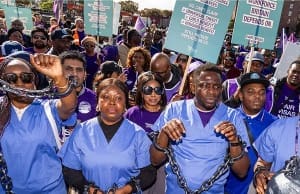
Migrant care workers in Britain wore chains and sang Nigerian star Asa’s ‘Jailer’ at a UNISON protest against plans to make some wait 15 years for permanent settlement.

UNISON, the UK’s largest trade union, said more than 400 people took part, many wearing symbolic balls and chains. It said the workers chose the 2007 song, from the debut album of the singer born Bukola Elemide, for its themes of oppression and of refusing to be treated as a prisoner. The protest is part of UNISON’s Fair Visa campaign.

The stakes reach well beyond Nigeria. In the year to mid-2024, Britain granted 71,046 work visas to foreign care workers and home carers. Indian nationals received 15,076, Nigerians 13,418, Zimbabweans 10,702 and Ghanaians 8,826, about one in eight, according to Home Office figures. Thousands of Ghanaian families with relatives in British care homes and hospitals could be affected by the final rules.

What the government proposes

Home Secretary Shabana Mahmood’s “earned settlement” plan would double the standard wait for indefinite leave to remain from five years to 10. Lower-paid workers, including those who came on health and care visas from 2022, would face a 15-year starting point. The government has proposed that the changes apply to everyone in Britain who has not yet been granted settlement. It argues that settlement should be earned, citing forecasts that 1.6 million people could qualify between 2026 and 2030.

UNISON wants the five-year route kept for workers already in Britain, along with a sector-wide sponsorship system for social care. Today, a care worker’s visa is tied to one employer. The union says that makes it risky to leave an exploitative job or speak out, because doing so can threaten a worker’s right to stay. General Secretary Andrea Egan said migrant staff keep the NHS and social care running and should not be blamed for underinvestment in public services.

Signs of a retreat

Opposition inside Labour has grown. Senior Labour figure Angela Rayner said the plans “change the goalposts” for people who arrived expecting to settle after five years. The Trades Union Congress has voted to demand that the proposals be withdrawn. Speaking at the Labour conference in Liverpool on 28 September, Mahmood acknowledged that parts of the reforms had been called unfair. She said the government would settle on a position that balanced fairness to legal migrants with fairness to British citizens.

No final decision has been announced, and the 10-year and 15-year periods remain proposals.

Mahama jokes Ayariga’s Twi is improving thanks to Bono wife

0

President John Dramani Mahama teased Local Government Minister Mahama Ayariga on 10 October, saying his Twi was improving because of his marriage to Sunyani West MP Millicent Amankwah Yeboah.

The exchange came at a public engagement during the President’s regional tour, after Ayariga was challenged to address the crowd in Twi. The Bawku Central MP said his new marriage had pushed him into learning the language. “I married a woman from Bono and I have now started Twi lessons,” he said. He described himself as a class one pupil, while the President, he said, had studied the language long enough to reach master’s level. He asked the audience to bear with his “primary school Twi”.

Speaking after him, Mahama said that if he had to grade the officials who spoke Twi that day, Ayariga had done fairly well and was learning little by little. He then turned to Roads and Highways Minister Kwame Governs Agbodza, telling him that marrying a woman from Bono would be the way to learn Twi too. The crowd laughed.

Ayariga’s marriage became public on 27 August, during his vetting before Parliament’s Appointments Committee. He pointed out that the committee chairman, Bernard Ahiafor, had introduced his father-in-law but not his wife. Ahiafor then introduced the Sunyani West MP as “Hon Mrs Ayariga”.

Amankwah Yeboah, 34, is a first-term National Democratic Congress MP. She won the Sunyani West seat in the Bono Region in December 2024, defeating the sitting New Patriotic Party MP, Ignatius Baffour-Awuah. Ayariga, a long-serving MP, was Majority Leader until a recent reshuffle moved him to the Ministry of Local Government, Chieftaincy and Religious Affairs. The couple are among the few spouses holding public office at the same time in Ghana.

Why some Ghanaian morticians knock before entering the mortuary

0

At Jabez Dominic Funeral Home, staff knock before they walk into the mortuary, even though nobody inside will answer.

Ewurabena Quartey, a manager at the funeral home, says the knock is a mark of respect, the same signal anyone would give before entering a living person’s room. “The fact that they are dead doesn’t mean that respect has to end,” she said in an interview with journalist Roselyn Feli.

Her account offers a look at the private codes some Ghanaian funeral workers follow. It comes at a time when the treatment of the dead has become a public concern, from regulators shutting substandard mortuaries to outrage over corpses mishandled at funerals.

Asking permission

The courtesy does not stop at the door. Quartey said workers often speak to the deceased and ask permission before touching, bathing or embalming the body, knowing there will be no reply. She likens it to caring for a bedridden elderly relative, where a carer would ask before touching them.

She links the habit to “last offices”, the term hospitals have long used for the care nurses give a patient’s body after death. The phrase comes from the Latin officium, meaning service or duty. Nursing guidance describes it as care that shows continued respect for the person as an individual. Many health services now prefer the term “care after death”, which also covers support for the bereaved family.

What the body reveals

Quartey said speaking to the dead also reminds workers that they are handling someone’s body and privacy. Preparing a body means undressing it completely and seeing scars, deformities and parts of the body the person would never have shown others.

So before starting, she said, a worker might quietly acknowledge that they are about to see what they are not supposed to see. The point, she said, is a pledge that whatever is seen stays in the room. She described it as a kind of bond formed with the deceased.

A wider debate on dignity

Not every facility meets that standard. In December 2025, the Mortuary and Funeral Facilities Agency (MoFFA) temporarily closed several mortuaries in the Eastern Region that failed basic environmental and safety standards or were operating without licences. The agency has also condemned videos of young people carrying corpses shoulder-high and parading them at funerals. It describes such conduct as a lack of respect and dignity towards the deceased.

The law offers some protection. Under section 285 of the Criminal Offences Act, 1960 (Act 29), it is a misdemeanour to harm a dead body without lawful authority, to dig one up or dissect it, or to hinder its burial.

For Quartey, the standard starts before any of that, with a knock on a mortuary door.

Gender Minister meets Nana Akua Addo’s husband after hospital discharge

0

Gender Minister Dr Agnes Naa Momo Lartey has met Harold Norman, husband of fashion personality Nana Akua Addo, after his discharge from hospital, as police prepare to arraign him.

The Minister for Gender, Children and Social Protection had first visited the family earlier in the week, when Norman was absent because he was receiving medical care. At the follow-up meeting, she said the immediate priority was the safety and emotional welfare of the family, above all the children. She said the children needed a safe, stable environment, shielded from conflict and from anything that could harm their development.

She said the family would receive psychosocial and social welfare support. Social welfare officers will monitor the children’s wellbeing to keep their safety and best interests at the centre of the response. The ministry said it would keep working with the Ghana Police Service while investigations continue.

The police case

Police say Nana Akua Addo, whose real name is Rosemond Akua Adobea, petitioned the Director-General of the Criminal Investigations Department (CID) on 20 August 2026. She alleged that her husband had subjected her to physical, emotional and economic abuse. The CID said the Domestic Violence and Victim Support Unit (DOVVSU) had handled an earlier case involving the couple in July.

Norman was arrested at his home on 27 August, gave a caution statement and was granted police enquiry bail with two sureties on 29 August. He was due in court on 7 October, but his lawyer told police he had been admitted to hospital. DOVVSU officers visited the hospital to verify the admission, and police said he would be arraigned as soon as he was discharged. Police have not yet confirmed a new court date.

Norman denies assaulting his wife. His lawyers have said the injury shown in images circulating online dates from 2021. They added that the couple’s dispute is the subject of both the DOVVSU investigation and a civil case in court, and that he would not discuss it at length in public for that reason.

The case drew wide attention after videos and images spread on social media from 6 October. Nana Akua Addo has asked the public to take down videos involving her children.

Mushroom picker shot dead in Volta forest; hunter arrested

0

A man picking mushrooms in Volta’s Nyagbo Kume Forest was shot dead on 7 October, allegedly by a hunter who mistook him for game.

The victim, identified only as Mr Zebio, was from Nyagbo Konda in the Afadzato South District. He died at the scene from gunshot wounds, sources told the Ghana News Agency (GNA). Theophilus Doh, the Assembly member for the area, confirmed the death and said a constituent called him about the shooting at about 4.45am.

Police have arrested the hunter, whose name has not been released, and opened an investigation into the circumstances of the shooting. The body has been deposited at a morgue for preservation and autopsy. Police urged hunters to take extreme care and follow hunting safety rules.

Residents said people from nearby communities regularly go into the forest before dawn and during the day to gather wild mushrooms, snails and other forest products, often in the same areas where hunters work. Some called for stronger safety measures in the forest.

The shooting happened during Ghana’s annual closed season, which runs from 1 August to 1 December, when hunting, capturing or killing wild animals is banned to protect breeding wildlife. The only exception is the grasscutter, which may be hunted with a licence from the Forestry Commission’s Wildlife Division. Police have not said what the hunter was hunting or what charge, if any, he will face.

Similar deaths have occurred elsewhere in Ghana. In past cases in the Western, Eastern and Bono regions, hunters told police they fired at noise or movement in the bush, only to find they had shot a person.

KNUST law graduate wins Sarbah award, faculty’s 11th since 2011

0

Akosua Achiaa Sarpong won the John Mensah Sarbah Award for Ghana’s best professional law student on 9 October, giving her university’s law faculty its 11th win since 2011.

A graduate of the Kwame Nkrumah University of Science and Technology (KNUST) Faculty of Law, Sarpong received the award for the best all-round performance in the Professional Law Examinations at the 63rd Call to the Bar ceremony. She also won the prize for Best Student in Civil Procedure. She is a former student of Notre Dame Girls Senior High School in the Bono Region.

Her win makes it four in a row for KNUST, after Ebenezer Addai Osei in 2023, Martin Waana-Ang in 2024 and Latifa Teiya Fuseini in 2025. It came in an unusually large class: 1,568 new lawyers were called to the Bar, almost double the 824 enrolled in 2025. They included Communications Minister Sam George and Lands Minister Emmanuel Armah-Kofi Buah.

Fifteen years of dominance

No other institution comes close over the period. KNUST’s record began in 2011 with Linda Mensah. Hagar Addo followed in 2013, Belinda Nada Aidoo in 2014, Grace Esi Sackey in 2015 and Emmanuel Kyei in 2016. Kezia Owusu-Ansah won in 2019 and Samuel Pinaman Adomako in 2021, before the current run of four.

The five other winners since 2011 came from four institutions. Kwesi Austin of the University of London won in 2012. The Ghana Institute of Management and Public Administration (GIMPA) produced Isaac Danso Agyiri in 2017 and Jainie Agovi in 2018. Emmanuel Yeboah Gyan of the University of Ghana won in 2020, and Sabina Sabia Bolsong of the University of Cape Coast in 2022.

That gives KNUST 11 of the 16 awards since 2011. The faculty’s first graduates were called to the Bar in October 2008.

The award is named after John Mensah Sarbah, the 19th-century Gold Coast lawyer, legislator and legal scholar.

Zanetor calls for action to keep Ghana’s nuclear scientists

0

Environment, Science and Technology Minister Dr Zanetor Agyeman-Rawlings has urged action to stop skilled scientists leaving the Ghana Atomic Energy Commission, saying the expertise is vital to nuclear power plans.

Speaking during a working visit to the Ghana Atomic Energy Commission (GAEC) in Accra on Friday, 9 October, the Minister said it takes an average of at least 15 years to train someone to the point where they can be productive in the Commission’s specialised fields. She called for talks between management and staff to identify why people are leaving and to agree solutions. Spending on nuclear infrastructure, she said, must be matched by a workforce able to run facilities safely.

The stakes are rising. Ghana chose US-based NuScale Power with Regnum Technology Group to build small modular reactors and China National Nuclear Corporation for a large reactor, and aims to add one gigawatt of nuclear power to the grid by 2034. Those plans depend on scientists and engineers that GAEC has struggled to hold on to. A former Director-General, Professor Benjamin Jabez Botwe Nyarko, has warned that trained scientists were leaving for better pay, even though the International Atomic Energy Agency (IAEA) had rated Ghana’s human capacity in the field among the best. The head of the Nuclear Regulatory Authority, Dr Nii Kwashie Allotey, has likewise blamed high attrition there on low pay.

Land, money and bills

In a presentation, GAEC listed land encroachment, high staff attrition, inadequate research funding and high utility bills as its main operational problems.

Dr Agyeman-Rawlings ordered an audit of land and other property held by agencies under her ministry. She directed them not to dispose of any land or assets without consulting her, noting that some sites could be needed for expansion and would be hard to replace.

Public safety and young scientists

The Minister called for more public education on GAEC’s work in nuclear medicine, radiation monitoring, mining, water testing and archaeology. She said people living in buffer zones around mining sites and other facilities needed clearer information on radiation risks. She welcomed the Commission’s move from cobalt-based irradiation to electron-beam technology and said protecting the public from hazards must remain central.

She also asked GAEC to make its observatory more engaging and to introduce students to careers in space science. She proposed that top performers in national mathematics and science quizzes be invited to tour GAEC facilities.

Professor Samuel Dampare, GAEC’s Director-General, thanked the Minister and said the Commission would keep working with the ministry to advance nuclear science for Ghana’s benefit.

Dr Agyeman-Rawlings was appointed in August and is touring agencies under her ministry.

Afenyo-Markin wants to stay in Parliament if NPP wins power

0

Minority Leader Alexander Afenyo-Markin says he wants to stay in Parliament if the New Patriotic Party (NPP) returns to government in 2029, promising to listen to a future opposition.

“If we come into office in 2029, I would want to remain in Parliament,” he said during a visit to the Christian Council of Ghana on 5 October 2026. The NPP lost power in the December 2024 elections. The next general election is due in December 2028, with the winning party taking office in January 2029.

The Effutu MP, who served as Majority Leader before the NPP left office, said that role had taught him the value of giving the opposition room to raise concerns. He said he often yielded to the then Minority, now the Majority National Democratic Congress (NDC), and would do the same for a future Minority.

The Supreme Court vetting row

He used the vetting of Supreme Court nominees to make his case. When the then Minority complained that 10 days’ notice was too short and asked for two weeks, he said, he agreed, sent nominees back and had the nominations re-advertised, even after they had appeared before the cameras. He said the same courtesy was not shown when the roles reversed, with nominees put up for vetting within days.

The remarks revisit a dispute from August. On 27 August, Afenyo-Markin led the Minority out of the Appointments Committee during the vetting of three Supreme Court nominees. He called the three-day timetable rushed and argued there was no vacancy on the court to justify the haste. He also accused the Majority of abandoning the position it had taken in opposition. The Minority said it was not objecting to the nominees themselves or to the President’s power to nominate them.

The committee’s chairman, Bernard Ahiafor, rejected the objections as flimsy and baseless. He said President John Dramani Mahama’s request to recall Parliament had specifically included the vetting of the Supreme Court nominees. The Majority completed the vetting without the Minority, and Parliament later approved all three nominees.

Afenyo-Markin, who first won the Effutu seat in 2012, said his time on both sides of the House would make him ready to hear the Minority when the NPP returns to power, a moment he predicted would come soon.

Bishop Gyamfi says failed election prophecies are not from God

0

The President of the Ghana Catholic Bishops’ Conference, Most Rev Matthew Kwasi Gyamfi, has said prophets whose election predictions fail are not speaking for God, in a JoyNews interview.

Bishop Gyamfi, who has led the Catholic Diocese of Sunyani since 2003, said the Church’s view of prophecy rests on close study of Scripture and of the original Hebrew, Aramaic and Greek terms. A prophet, he said, is not a seer of future events but someone who receives a message from God, usually a conditional one. He pointed to God’s covenant with Israel, where blessing depended on obedience and refusal carried consequences.

He rejected the practice of people waking from a dream and announcing it as a divine revelation. Anyone who truly knows the Scriptures would not call that prophecy, he said. Turning to predictions of election winners that later prove wrong, he asked: “Is God lying?” Such claims show the speakers are not telling the truth, he said. They might be doing something else, but they should not call it prophecy.

A wider pushback from mainline churches

His remarks add the Catholic hierarchy to a growing pushback from mainline church leaders. In January, Methodist Church Ghana Presiding Bishop Professor Kwabena Asamoah-Gyadu warned ministers not to “fake the voice” of God. He spoke after Prophet Elbernard Nelson-Eshun of Spirit Life Revival Ministries said an angel had revealed that Kennedy Agyapong would win the New Patriotic Party’s presidential primary on 31 January 2026. Former Vice-President Dr Mahamudu Bawumia won the contest and is now the party’s flagbearer.

The state has also stepped in. Elvis Ankrah, the President’s envoy for inter-faith and ecumenical relations, set up an online portal to review “sensitive prophecies”. The move followed the August 2025 helicopter crash that killed the defence and environment ministers, after which videos of pastors claiming to have foreseen an air disaster circulated online. Police have also warned that prophecies that cause fear or panic could lead to prosecution.

Some charismatic leaders reject outside control of prophecy. Perez Chapel founder Bishop Charles Agyinasare has argued that the police lack the means to legislate on what he considers a spiritual matter. Other defenders of failed prophecies have argued that a prophet is only a messenger and cannot be blamed if a message does not come to pass.

Labourer jailed three years for stealing GH¢123k at Tarkwa

0

The Tarkwa Circuit Court has jailed Nuredeen Issaka, a 26-year-old labourer, for three years with hard labour for stealing GH¢123,000 that a customer had paid his employer for tricycles.

Issaka pleaded guilty to stealing and unlawful entry. The court also ordered him to refund GH¢40,000 to the complainant, the sum still missing after police recovered part of the money.

Detective Chief Inspector Bright Nkansah, prosecuting, told the court that the complainant, Abdul Rauf Usif, is sales manager at Mumud Atiiga Enterprise, a motorcycle and tricycle dealer at Essamang Kakraba in the Tarkwa Nsuaem Municipality, where Issaka also worked. On 20 March 2026 a customer paid Usif GH¢123,000 for three tricycles, popularly called “pragya”. Because the tricycles were not yet in stock, he kept the cash in a backpack in his room on the company premises.

On 21 April he found the money gone. Suspecting someone with access to the room, he hid his mobile phone there to record what happened. The footage later that day showed Issaka going through the bag and taking GH¢120. Usif reported the matter to the police, and Issaka was arrested on 25 April and confessed.

Following the money

Police traced the cash through transfers Issaka had made after the theft. He sent GH¢61,000 to one person, GH¢22,000 to a second and GH¢17,103 to a third. The first two returned the full amounts, giving back GH¢83,000 between them. Issaka told police he had spent some of the money on food and clothes.

The GH¢40,000 refund order matches the balance still outstanding: the GH¢123,000 taken minus the GH¢83,000 recovered.

Ghana warns citizens in South Africa as asylum protests spread

0

Ghana’s High Commission in Pretoria has told Ghanaians in Johannesburg and Durban to avoid protest areas, after anti-immigration demonstrations over an asylum ruling turned violent in both cities.

In an advisory issued on 10 October, the mission said several protests had been reported in the central business districts of both cities. It said demonstrators in Johannesburg were expected to converge on the Constitutional Court, which could bring road closures, restricted movement and clashes with police. It urged Ghanaians to stay away from protest sites and large crowds, and to cut non-essential travel into the two city centres until calm returns.

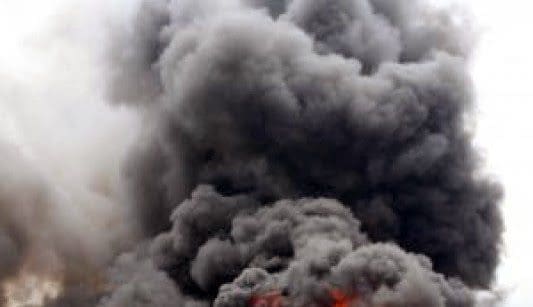
The warning follows two days of unrest. A vehicle was torched at the Constitution Hill precinct in Johannesburg on 9 October as protesters marched to the court, a day after violent protests outside Home Affairs offices in Soweto and Durban. Acting National Police Commissioner Puleng Dimpane said 10 cars were set alight in Soweto and 14 in Durban, and warned that criminality would have consequences. KwaZulu-Natal Premier Thami Ntuli said he had asked for the army to be deployed in Durban, where shops were also looted.

What sparked the protests

The anger traces to a 7 July Constitutional Court judgment, which ruled that asylum seekers cannot be shut out of the asylum system solely because of procedural failures such as irregular entry or missed deadlines. Protests followed a Home Affairs directive of 28 September on accepting asylum applications. The department withdrew that directive on 9 October, citing risks to staff and public order, and said it would draw up a new approach that still complies with the court order.

South Africa’s Inter-Ministerial Committee on Migration has tried to counter claims that the ruling amounts to an amnesty. It says the judgment does not automatically grant refugee status or residence to anyone.

A familiar alarm for Ghanaians

The advisory lands on a community that has already been through months of upheaval. Ghana has evacuated about 1,900 citizens from South Africa since May, after xenophobic attacks that intensified from April, particularly in Durban’s central business district. The final group of 1,000 returned on 4 September.

The High Commission asked Ghanaians to watch for road closures and follow updates from the South African Police Service (SAPS) and municipal authorities. It also urged them not to confront protesters and to stay in touch with family and community leaders when moving through affected areas. Anyone who faces threats, intimidation or violence should report it to the nearest police station and contact the High Commission for consular help. The mission also cautioned against sharing unverified information that could spread panic.

Tarkwa court jails mason 15 years for defiling child

0

The Tarkwa Circuit Court has sentenced Alfred Mensah, a 19-year-old mason, to 15 years’ imprisonment with hard labour for defiling a seven-year-old girl in the Western Region.

Mensah pleaded guilty to defilement, and the court, presided over by Her Honour Bernice Mensima Ackon, convicted him on his own plea.

The prosecutor, Assistant Superintendent of Police (ASP) Joseph Lartey, told the court the offence took place on 26 April 2026. Mensah, who was known to the girl’s family, lured the kindergarten pupil into a room and sexually assaulted her. An adult who walked into the room found him with the child and alerted the family.

The family reported the matter to the police, who issued a medical report form. A hospital examination confirmed the girl had been defiled, and the endorsed form was returned to the police. Officers arrested Mensah and handed him to the Western Central Regional Domestic Violence and Victim Support Unit (DOVVSU) for investigation.

Under section 101 of Ghana’s Criminal Offences Act, 1960 (Act 29), sexual intercourse with a child under 16 is defilement whether or not the child consents. It carries a prison term of seven to 25 years. Mensah’s sentence sits in the lower half of that range, a reduction that courts commonly allow for a guilty plea, which spares the victim from testifying.

The same court has handed down several similar terms in recent cases. In 2024 it jailed another mason for 15 years with hard labour for defiling a 10-year-old girl at Himan-Prestea in the Prestea-Huni Valley Municipality.

Anyone with information about the abuse of a child can report it to the nearest police station or DOVVSU office.

Kumasi Mayor leads fare checks after eight percent rise

0

Kumasi Mayor Richard Ofori-Agyemang Boadi has led spot checks on commercial vehicles across the city to stop drivers charging above the fares approved after the eight per cent national increase.

The Kumasi Metropolitan Assembly (KMA) chief executive led Transport Department officials and a security task force to Abrepo Junction, Racecourse, Ashtown, Kejetia and Adum. The team stopped loaded vehicles and asked passengers what they had paid before letting drivers go on. At some stations the Mayor supervised loading himself to make sure vehicles left at the approved fare and carried passengers to their stated destinations.

The checks come two weeks after the revised national fares took effect on 26 September. The Ghana Private Road Transport Union (GPRTU) and the Ghana Road Transport Coordinating Council agreed the eight per cent rise with the Ministry of Transport after the unions first pushed for 30 per cent. The new rates are calculated on the fares approved in May 2025, and both unions have warned that drivers who charge more face sanctions.

Targeting ‘short-short’

Boadi warned drivers against “short-short” loading, in which a long route is broken into shorter trips so passengers pay several fares to reach one destination. Commuters at Kejetia have complained about the practice in earlier KMA crackdowns. The Mayor told drivers to follow their union charters and loading rules.

He also ordered transport unions operating without the required permits to shut immediately and resume only after obtaining the proper documents. He did not say how many unions were affected.

A pattern of enforcement

The Assembly has repeatedly stepped in on fares. It impounded 22 vehicles in June 2025 when drivers ignored a 15 per cent fare cut, and a joint task force of police, soldiers and KMA guards has since impounded vehicles in the central business district for overcharging. The Assembly’s Head of Urban Transport, Randy Wilson, has also ordered routes that raised fares before the official eight per cent increase to revert. He has warned that offenders face prosecution and public naming.

Boadi urged commuters to report drivers and unions that charge above approved fares and said the Assembly would keep monitoring transport operations across the metropolis.

Ato Forson says Ghana must stop accepting graduate unemployment

0

Finance Minister Dr Cassiel Ato Forson says Ghana’s New Economy must stop treating graduate joblessness as normal, as data show nearly one in five young Ghanaians neither working nor studying.

Speaking to students and faculty at the University for Development Studies (UDS) Nyankpala Campus in the Northern Region, Dr Forson described unemployment in human terms. He pointed to the graduate who cannot find work, the young person with talent but no capital, and the family that pays for a child’s education only to see that child stay at home. “No serious nation can accept this as normal,” he said.

He also pointed to the people who could create jobs but are held back. Farmers, he said, produce without reliable markets, while small business owners who want to expand are blocked by the cost of credit. In a social media post after the visit, he said the New Economy must create decent, productive jobs at scale so that young people have a real stake in Ghana’s future.

The numbers behind the message

Official figures show the size of the task. The Ghana Statistical Service (GSS) said in July that unemployment among people aged 15 to 35 averaged 21.9 per cent over the first three quarters of 2025, nearly double the national rate of 12.8 per cent. Nearly two million young people, about 19.5 per cent of the youth population, were not in education, employment or training. Greater Accra had the highest youth unemployment at 31.9 per cent, followed by the Central and Ashanti regions.

The national rate has eased. Dr Forson’s own mid-year budget review on 23 July put average unemployment at 12.8 per cent, down from 13.7 per cent a year earlier. The youth gap has barely moved, however: the GSS put youth unemployment at 22.5 per cent at the end of 2024.

The Minister’s reported remarks at Nyankpala did not set out new measures, targets or funding to cut youth unemployment or lower the cost of credit.

The setting suited his point about farmers. UDS began academic work in 1993 with its first students in the Faculty of Agriculture at Nyankpala, and was set up to tackle deprivation in northern Ghana. Dr Forson said the New Economy engagements would continue at the University of Ghana.

Agbodza pledges prompt pay; contractors say many still unpaid

0

Roads and Highways Minister Kwame Governs Agbodza has promised Big Push contractors payment as soon as certificates are raised, though industry groups say many contractors owed arrears remain unpaid.

Agbodza gave the assurance at Antwikrom in the Sunyani Municipality after inspecting the 48-kilometre Sunyani–Atronie–Acherensua road and the 34-kilometre Sunyani Outer Ring Road. He said the years when contractors waited two to three years for money were over, and that no certificates were sitting unpaid for six months or a year. “Once contractors raise their certificates, then they are paid,” he said, adding that funds were available and that arrears under the programme were also being settled.

The pledge matters because payment delays have long stalled Ghana’s road projects and pushed contractors off sites. It also carries a condition: in July the Minister warned that contractors who fail to submit detailed work schedules or show progress risk deductions, and that only completed and certified work would be paid for. He repeated a warning against shoddy work at Antwikrom.

The arrears picture

The government says it has paid heavily. Agbodza said in August that GH¢23.1 billion had been disbursed by the end of July to Big Push contractors and for arrears, most of it arrears. Contractors describe a gap between that figure and what reaches them. Nana Opare Kwafo, Chairman of the Ghana Chamber of Construction Industry, said in August that most contractors had yet to be paid. The more than GH¢3 billion released through the Ghana Road Maintenance Trust Fund was only part of over GH¢10 billion owed to contractors and suppliers, he said. In June, road maintenance contractors in the Single Man Contractors Association threatened to protest at the Presidency over certified work for the Ghana Highway Authority unpaid since 2020.

The Sunyani projects

Work on the Sunyani–Atronie–Acherensua road began in September 2025 and is due for completion in September 2027. It was 33 per cent complete when the Minister last inspected it on 20 August. Alexiboam Company Limited, the contractor, has started asphalt overlays on sections of the road. Its Chief Executive, Alex Boampong, said building the Tano Bridge between Ntotroso and Acherensua had slowed progress, but the bridge was now about 90 per cent done. He pledged to finish the road ahead of schedule.

Kofi Job Company Limited is asphalting the Outer Ring Road, which is also scheduled for completion within two years. The project was among those abandoned in Sunyani that Agbodza ordered back to work in April 2025.

Bechem poultry factory 58 percent complete, Mahama says

0

A government poultry, meat and feed factory at Bechem in the Ahafo Region is 58 per cent complete, President John Dramani Mahama said on 9 October after inspecting the site.

The plant is meant to absorb a surplus that local farmers are already struggling to sell. Food and Agriculture Minister Eric Opoku told the President that the Nkoko Nkitinkiti programme had raised Ghana’s domestic poultry production from 4.6 per cent to 22 per cent as of May 2026, after its first year. “This has never happened in the history of our country,” he said.

He added that the programme had kept eggs in surplus on the local market for almost a year, and that the President had directed him and the Trade Minister to open talks with Burkina Faso on egg exports. The factory, its feed mill and a planned hatchery are intended to give farmers a steady outlet and keep feed and chick supplies local.

From sod-cutting to site visit

Mahama recalled cutting the sod for the facility in the Tano South Municipality on 27 November 2025, less than a year ago. He said the factory would make Bechem Ghana’s poultry capital once it opens, and urged young people to take up poultry farming to meet demand for local chicken. No completion date was given.

The stakes are large. Opoku has said Ghana spent US$400 million importing poultry and poultry products in 2024, and has projected self-sufficiency by 2029. When the programme was announced in 2025, Mahama set a more ambitious goal of producing almost all the chicken Ghanaians eat within three years.

Farmers question the gains

Not everyone in the industry reads the numbers the same way. The Poultry Farmers Association of Ghana has warned that the programme could miss its import-reduction goal if implementation problems persist. It argues that falling prices may reflect weak demand and marketing difficulties rather than real productivity gains. It also says some households that received birds under the first phase ate them instead of rearing them for sale and reinvestment.

The Nifahene of Bechem, Awuah Boadi, thanked the President for the project and said some residents were already employed on the site. He said he expected more jobs for young people once the factory runs.

The visit opened Mahama’s two-day Resetting Ghana Tour of the Ahafo Region, which also took in the Tepa–Goaso road and the Ntontroso Bridge, before a town hall meeting in Goaso on 10 October.

Ghana takes post-bailout investor pitch to IMF meetings in Bangkok

0

Ghana’s finance ministry and central bank will court investors at the IMF and World Bank annual meetings opening in Bangkok on 12 October, their first since Ghana exited its bailout.

The International Monetary Fund (IMF) and World Bank Group gathering runs from 12 to 18 October at the Queen Sirikit National Convention Center and is expected to draw about 15,000 participants. For Ghana, the pitch is about showing that its recovery can hold without IMF money behind it. In August the Fund’s Executive Board completed the sixth and final review of Ghana’s US$3 billion Extended Credit Facility (ECF) and approved a request for a 36-month Policy Coordination Instrument (PCI) in its place.

Bank of Ghana Governor Dr Johnson Asiama said at the 24 September briefing of the Monetary Policy Committee (MPC) that officials from the Ministry of Finance and the central bank would hold joint and separate sessions with investor groups. They plan to update investors on the economy, explain policy direction and pursue agreements where needed. He said an IMF staff team had visited Accra in mid-September to discuss the new arrangement, and that Bangkok would allow further talks on the benchmarks and reforms that will guide it.

A different kind of IMF deal

The PCI carries no loan. It is designed for countries that no longer need Fund resources but still value the policy credibility, technical support and signal to markets that formal IMF engagement provides. Ghana’s arrangement targets growth-friendly fiscal adjustment, debt sustainability, governance of state-owned enterprises, the monetary and exchange-rate framework, financial stability and economic diversification.

The numbers Ghana will carry

Ghana arrives with stronger external buffers than at any point since its debt crisis. Gross international reserves stood at US$12 billion, or 4.5 months of import cover, on 22 September. The trade surplus for the first eight months of 2026 rose to US$8.85 billion from US$6.69 billion a year earlier. Borrowing costs have fallen sharply: the 91-day Treasury bill rate dropped to 5.4 per cent in August from 10.3 per cent a year earlier, and average bank lending rates fell to 15.9 per cent from 24.2 per cent.

The global backdrop is harder. Crude oil has hovered above US$100 a barrel. The US Federal Reserve, the European Central Bank and the Bank of Japan have all raised rates, tightening financing for economies such as Ghana’s. At home, headline inflation rose in August as higher utility tariffs and oil prices fed through, prompting the MPC to hold its policy rate at 14 per cent for a third straight meeting.

Thailand last hosted the annual meetings in 1991. The IMF has 191 member countries and the World Bank 189.

Kojo Bamba’s rise reopens Ghana’s debate on party vigilantism

0

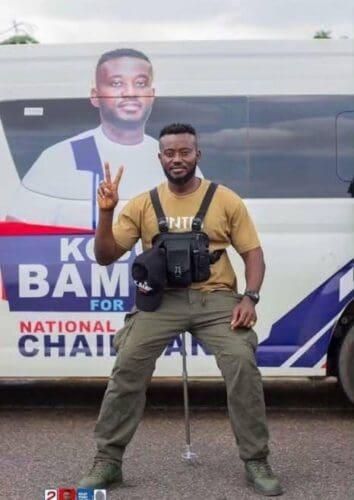
The election of former Delta Force leader Kwadwo Fosu Boadu as First National Vice Chairman of the New Patriotic Party (NPP) has turned into an early test of Ghana’s 2019 law against political vigilantism.

Boadu, widely known as Kojo Bamba, topped a field of 13 candidates with 3,116 votes at the NPP’s National Delegates Conference at the Baba Yara Sports Stadium in Kumasi on 3 October 2026. Henry Nana Boakye took second place with 3,061 votes and Nana Akomea third with 2,987. National Chairman John Boadu, who is not related to him, now leads the opposition party with him towards the 2028 general election.

The result matters beyond the NPP. Both main parties have spent years promising to keep party foot soldiers out of election security. The vigilantism debate now centres on one of the main opposition party’s most senior officers.

From Delta Force to the national executive

Boadu, an auto mechanic from Asafo in Kumasi, led Delta Force, a pro-NPP vigilante group that drew national attention in the Ashanti Region after the party’s 2016 election victory. In 2017, 13 Delta Force members escaped from lawful custody at a Kumasi Circuit Court; they later pleaded guilty and were each fined GH¢2,400. His nickname comes from the “Bamba Boys”, a group of young NPP activists reportedly mentored by a former minister of that name.

He has since moved into the party’s formal structures and in recent years presented himself as an advocate for peaceful elections. His campaign promised to strengthen the grassroots and protect the party’s votes in 2028. After being sworn in he struck a humbler note. “I do not see myself as better than anyone else,” he wrote on social media.

Why delegates backed him

His win surprised analysts. A Global InfoAnalytics poll before the vote had put his support at 17 per cent. Akomea, who finished third, said Boadu’s security message made him the one name that kept appearing in delegates’ choices, helped by a system in which delegates voted for three candidates at once rather than for each post separately.

Former Sekondi MP Andrew Egyapa Mercer said Boadu met the eligibility rules and won the votes. In his view, a past link to a group that has since been disbanded should not bar him from office.

A sharper divide over the law

The most striking defence came from former Speaker of Parliament Professor Aaron Mike Oquaye, who presided over the House when it fast-tracked the vigilantism bill in 2019. He said the NPP dissolved its security groups after the law passed and agreed that the police should handle election security. He also argued that the party could not leave supporters unprotected if state agencies failed them. At the same time he rejected the idea of a parallel security force. “The NPP has men. Therefore, let us take machoism out of this politics,” he said.

Opponents see the result differently. National Democratic Congress (NDC) Deputy General Secretary Mustapha Gbande called the election backward politics and said it raised questions about the NPP’s stance on vigilantism. He acknowledged that Boadu’s background does not disqualify him from office. He also noted that his own party has faced similar criticism over its links to the Azorka Boys.

Akomea has cautioned that the party’s leadership is collective and that the 2028 election will not be about Boadu alone.

Nigerian Disability; We sold the well, charged for and withheld the water

There is an old story about a lawyer who sold his well to a teacher, then returned demanding payment for the water inside it. The teacher smiled. If the water still belonged to the lawyer, he replied, perhaps the lawyer should remove it or pay rent for storing it in somebody else’s well. Suddenly, the lawyer remembered he had only been joking.

It is funny until we recognise ourselves as lawyers.

We tell people with disabilities that public spaces belong to everyone. Then we demand an additional price for entering them. We give them citizenship, but charge for the ramp. We promise education, but make the classroom unreachable. We proclaim equal opportunity, then construct the doorway too narrow for their wheelchair.

That contradiction came home to me when Grace shared her story with me, she titled Public Place Accessible Report for Inclusion. It contained no sentimental appeal. It simply insisted that public places should allow everyone to enter, move, communicate, receive services and participate independently, safely and with dignity.

I listened to it in her voice once as a report. Then, I read it again as an indictment.

Behind every line was somebody’s ordinary day made unnecessarily difficult. A mother arrives at a hospital, already frightened for her child, discovering that the entrance has steps but no ramp. A young man preparing carefully for an interview, only to find his opportunity waiting upstairs without a lift. An older woman confronting a pavement that has forgotten her legs cannot move as quickly as they once did.

These are imagined scenes, but the barriers Grace identified are painfully real. Poorly enforced building standards. Toilets that exclude. Transport that humiliates. Signs people cannot read. Public information people cannot hear. Facilities built without consulting those who will need to use them.

Grace’s intervention mattered because she did not reduce accessibility to a construction problem. Her story and experience understood something profound: every inaccessible entrance is also a message. Sometimes it says, “We did not think of you.” Sometimes, more cruelly, it says, “We thought of you, but you were not worth the expense.”

What does that message do to a child’s heart?

Imagine a girl with cerebral palsy watching other children rush into a school assembly while she waits outside for someone to carry her over the steps. Imagine her learning, year after year, that she must be grateful for help rather than entitled to access. Imagine how quietly a society can teach someone to apologise for existing.

On 3 October 2026, at GlowingStar Empowerment Initiative and Development’s World Cerebral Palsy Day commemoration in Bukuru, I delivered a keynote titled Beyond Therapy: Seeing the Whole Person, Not Just the Condition. Its central argument was simple: a person has cerebral palsy; cerebral palsy does not have the person.

A diagnosis is information, not identity. Therapy is necessary, valuable and sometimes life changing. But therapy is supposed to be a bridge into life, not the whole landscape of living. Beyond treatment are friendships, classrooms, jobs, ambitions, relationships, leadership, laughter, choices and dreams that deserve room to breathe.

We can celebrate a child’s progress in therapy while failing that same child at the school gate. We can praise a parent’s devotion while exhausting that parent with inaccessible transport, expensive care and the endless labour of explaining why their child deserves a chance. We can call ourselves compassionate while our architecture remains indifferent. At the commemoration, parents spoke of stigma, costly therapy and limited support. Their courage was unmistakable, but courage should not be the currency families must spend to secure ordinary human rights.

That was why I argued that admission is not inclusion. Allowing a child through the gate means little if the classroom, teaching methods, toilet, playground or attitudes inside still tell that child to remain on the margins.

And communication must never be confused with intelligence. When someone speaks differently or needs more time, our responsibility is neither impatience nor pity. Ask. Then wait. Listen without finishing their sentences. A human voice does not lose its authority because it travels by an unfamiliar route.

I returned to Grace’s story and noticed how practical her demands were: sensible ramps and handrails, usable toilets, safe pathways, accessible transport, clear signage, Braille, captions, audio information and regular audits. It called for architects, officials and contractors to understand universal design, and for people with disabilities themselves to help plan and evaluate the spaces they use.

Nothing about us without us. That principle is not a decorative language for conferences. It is what stops a well-meaning official from installing a ramp that is too steep, or declaring a school inclusive without asking the students to navigate its corridors.

Nigeria has legal commitments against disability discrimination. Yet a law that cannot travel from the statute book to a bus stop, hospital, workplace or classroom remains a promise stranded on paper. Rights should not require influential relatives, public sympathy or a viral photograph before anyone honours them.

Sometimes, as I said in that keynote, society needs therapy. Our buildings need rehabilitation. Our policies need rehabilitation. Our assumptions, professional habits and careless language need rehabilitation. We must stop asking only how a person can adapt to a hostile environment and begin asking why we made that environment hostile.

I keep thinking about Grace, my newfound friend. As she shared recommendations, their moral weight was larger than the suggestions itself. She reminded me that inclusion often begins when someone refuses to look away from what everyone else has learned to step over. It begins with the uncomfortable decision to measure progress not by the elegance of our speeches, but by who can actually enter the room.

The lawyer in the story wanted to sell the well while keeping its water hostage. Too often, our society offers people with disabilities belonging without access, opportunity without accommodation, dignity without choice. Then it calls every concession generosity.

But the water was never ours to withhold.

Every child deserves more than survival. Every caregiver deserves more than exhaustion. Every adult with a disability deserves the freedom to work, love, contribute and belong without performing gratitude for rights already theirs. The purpose of inclusion is not to make people feel fortunate to be tolerated. It is to build a country where nobody must beg to be considered human.

So, Grace, thank you for disturbing our comfort with something as unromantic, and as revolutionary, as sharing your story with me. May we answer it with budgets, redesigned spaces, enforced standards and genuine listening. May the next child approaching a public doorway find no argument waiting there, only an opening.

Beyond politics and all the drama of nationhood l, let us remember we sold them a well. It is time we stopped charging for the water—May Nigeria win

Sports Fund pledges backing for Black Bombers’ top performers

0

Ghana Sports Fund Administrator Dr David Kofi Mawuvi Wuaku has promised support for the Black Bombers’ best performers at a pre-fight meeting, saying funds will go through federations, not boxers.

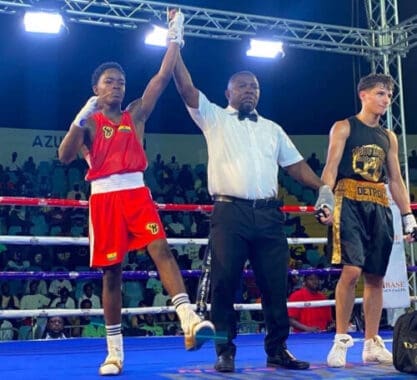
He made the pledge when a Ghana Boxing Federation (GBF) delegation, including coaches and eight boxers, visited the Fund in Accra ahead of the 10 October international friendly against the Metro Detroit Golden Gloves. Five of the eight boxers at the meeting went on to win their bouts on Saturday as Ghana beat the Americans 6-4 at the Bukom Boxing Arena: Mathias Ashitey, Amadu Mohammed, Ebenezer Ankrah, Abdul Wahid Omar and Solomon Sackey.

Dr Wuaku told the boxers they were better placed than the generations before them, who had no dedicated sports fund to call on. “You are fortunate now that the fund has been established,” he said. He added that national team athletes who perform well would benefit and urged the Bombers to train hard and win more for Ghana.

He also said he was unhappy with the recent results of some national teams, while others were doing their best.

The Fund was set up under the Ghana Sports Fund Act, 2025 (Act 1159), which Parliament passed in December 2025, to replace years of ad hoc government subventions and occasional private donations with structured financing for sport. Dr Wuaku, a banker with more than 30 years of experience, was appointed Administrator by President John Dramani Mahama.

The pledge comes with a caveat the Administrator has raised before. In September he said the Fund would deliver its programmes once it became fully operational and received the necessary resources. He did not say at the boxing meeting how much support the Bombers could expect or when it would arrive.

Boxing has a direct voice inside the Fund. Dr Wuaku noted that former world champion Azumah Nelson sits on its governing board, where he represents retired athletes. He described boxing as central to Ghana’s sporting record, having delivered medals at the African Games, Commonwealth Games and Olympics.

The GBF team was led by veteran boxing consultant Yoofi Boham, former GBF President George Lamptey, First Vice-President Nii Adama Addy and Treasurer Mustapha Nettey. Coaches Vincent Akai Nettey, Elvis Robertson and Benjamin Tetteh attended, along with boxers Henry Malm, Emmanuel Amui and Ben Bulley.

The Bombers next travel to Kinshasa for the IBA African Elite Boxing Championships, which run from 19 October to 1 November.

Black Bombers beat Detroit Golden Gloves 6-4 in Accra

0

Ghana’s Black Bombers beat the Metro Detroit Golden Gloves 6-4 at the Bukom Boxing Arena in Accra on 10 October, their final test before the African championships in Kinshasa.

The result gives the revamped national team its first win in a major international outing ahead of the 2026 IBA Africa Elite Men’s and Women’s Boxing Championships in the Democratic Republic of Congo. Ghana Boxing Federation (GBF) President Dauda Fuseni had described the Detroit friendly as the team’s final competitive warm-up before departure, a chance for coaches to judge their boxers under pressure. The championships run from 19 October to 1 November.

Ghana built a 5-0 lead before the Americans responded. Mathias Ashitey opened with a unanimous win over Cayden Youser, and Amadu Mohammed followed with a unanimous decision over Tyler Luce. Ebenezer Ankrah dominated Christian Curry for another 3-0 verdict before Francis Quartey edged Payden Jones on a split decision. Abdul Wahid Omar then beat Glanni Figueroa 3-0.

Detroit took four of the last five bouts. Christian Geck got the visitors off the mark with a unanimous win over Philip Quansah. Solomon Sackey stopped the run with a 3-0 win over Mustapha Alfartousi, which sealed victory for Ghana. Desmond Harris beat Abdul Khalid on a split decision, and Lamar Stewart III beat Joseph Frimpong by the same margin.

In the closing bout, Darius Parlor beat Jibril Muntari 3-0 and was named best boxer of the night. Junior boxers Prince “The Buzz” Larbie and Ransford Lamptey fought an exhibition on the undercard.

The visitors came with pedigree. Founded in 1934, Metro Detroit Golden Gloves counts 44 national Golden Gloves champions among its alumni, including heavyweight great Joe Louis, trainer Emanuel Steward and Thomas Hearns. The 22-member delegation of 10 boxers and 12 officials was led by the organisation’s president, Katealia Chambers, who thanked the hosts and said her team had learnt a great deal from the trip.

GBF First Vice-President Nii Adama Addy said the event had been worthwhile and the federation was looking forward to a return fixture. The GBF has set a target of qualifying at least four boxers for the Los Angeles 2028 Olympic Games.

Officials at the arena included Dr Kofi Mawuli Wuako, Administrator of the Ghana Sports Fund, and Ghana Olympic Committee President Richard Akpokavie.

The team is now coached by a new technical group led by Vincent Akai Nettey and Charles Quartey, with the 2027 African Games in Cairo also on the schedule. Ghana has won 48 medals at the African championships over the years: 16 gold, 17 silver and 15 bronze.

Africa would bear brunt of health aid collapse, Lancet warns

0

Sub-Saharan Africa could bear about 70 per cent of the avoidable health loss if health aid collapses, a Lancet Commission said on 11 October, naming 17 catastrophic threats.

The Lancet Commission on 21st Century Global Threats to Health, launched at the World Health Summit in Berlin, ranks shrinking aid alongside nuclear war, malicious artificial intelligence (AI), climate change and pandemics as dangers to human health between now and 2100. The finding lands on a continent already absorbing the shock. Global development assistance for health fell to US$39.1 billion in 2025, its lowest level in more than 15 years, according to the Institute for Health Metrics and Evaluation (IHME), and is forecast to slip to US$36.2 billion by 2030. That is roughly half the all-time high of US$80 billion reached in 2021.

The commission’s 35 members drew on IHME risk modelling across 204 countries and territories. They measured each threat in disability-adjusted life years (DALYs), the years of healthy life lost to illness, disability or early death. For each threat they compared a plausible best-case and worst-case future, and treated the gap as the harm that policy could still prevent.

To qualify as catastrophic, a threat had to account for at least one billion such years by 2100, have enough data to model, and leave room for policy action. Commissioners screened more than 500 risks before settling on the final list.

Two threats with extinction potential

Only two threats were judged capable of wiping out humanity: nuclear conflict and the malicious use of AI. The commission rates both as unlikely but too consequential to ignore. Preventing nuclear war could avert an estimated 133 million deaths and 9.35 billion DALYs by 2100, while reducing the risk of malicious AI could avert 10.4 billion DALYs.

The other 15 threats are less dramatic but already exacting a toll. They include air pollution, antimicrobial resistance, childhood malnutrition, climate change, conventional conflict, declining health aid, heavy drinking, high blood pressure, income inequality, poor schooling, natural pandemics, obesity, poor mental health, smoking and unhealthy ageing.

Obesity carries the largest avoidable burden of the threats quantified in the summary, at 23.1 billion DALYs. Low educational attainment follows at 16.1 billion, with women and children in sub-Saharan Africa most exposed. The commission links better schooling to lower death rates among the children of educated mothers.

Income inequality accounts for 13.8 billion DALYs, which the authors equate to 25 COVID-19 pandemics. On climate, holding warming to about 1.8°C rather than 4.4°C would save 1.89 billion years of healthy life. The authors call that an undercount, since it leaves out displacement, drought and mental health effects.

A three-part plan

Co-chair Professor Christopher Murray, IHME’s director, said the scale of the findings mattered less than the room left to act. “Humanity still has the agency to act,” he said, adding that delay would only push costs into the future.

The commission urges governments to build health systems with standing teams for foresight, prevention and preparedness, financed steadily rather than in emergencies. It also calls for more investment in new vaccines, antibiotics, obesity treatments and climate technology, and for a Lancet Monitor to track threats independently over time.

Co-chair Dr Natalia Kanem, former Executive Director of the United Nations Population Fund, said the poorest and most marginalised communities would carry the heaviest load. In an accompanying editorial, The Lancet said the report does not set a fixed ranking and its findings will probably change as new data arrive.

The commission was established in December 2022, with final findings first expected at the end of 2024.

Buffaloes and camels offer Kenya no quick milk fix

President William Ruto’s idea of bringing in buffaloes to ease Kenya’s milk shortage could take years to deliver any milk. Shoppers need relief now. The fastest fixes available are rain, imports from Uganda and getting more milk from the cows Kenya already has.

Speaking at the Agriculture and Food Security Summit at Jamhuri Park in Nairobi on 9 October, Ruto said the government should look at importing better camel breeds and introducing buffaloes for milk. He suggested starting buffalo farming on a small scale to test whether the animals could be milked successfully in Kenya. “Buffaloes produce a lot of milk,” he said.

The proposal comes in the third month of a supply squeeze that has thinned supermarket shelves and raised prices. In Nyeri, one milk bar raised its price per litre from Sh65 to Sh70, roughly eight per cent, and major packaged brands at one supermarket rose by about 10 shillings. Elsewhere, consumers have paid three to five shillings more for a 500ml packet.

How big is the gap?

Official data show a sharp but modest dip rather than a collapse. Formal deliveries to processors fell 3.7 per cent, from 84.4 million litres in June to 81.3 million litres in July. Pasteurised milk has been hit hardest, while long-life milk has stayed easier to find.

The deeper problem is structural. The Kenya Dairy Board (KDB) puts annual demand at eight billion litres against production of 5.76 billion. Other official estimates put output closer to 5.5 billion litres, but either way the country falls short of its own consumption by more than two billion litres a year.

Agriculture Cabinet Secretary Mutahi Kagwe has blamed dry weather that cut pasture and raised feed costs, and ruled out foot-and-mouth disease. He has also pointed to brokers who outbid cooperatives and divert milk away from processing plants, and the government has allowed duty-free imports of yellow maize to cut feed costs. The Consumers Federation of Kenya (COFEK) has said the shortage was foreseeable and could have been better managed.

The buffalo question

The animal Ruto has in mind is not the wild African buffalo but the domestic water buffalo, a separate species. India and Pakistan lead the world in buffalo milk output, and in both countries buffaloes produce more milk than cattle.

Yields are respectable rather than dramatic. According to the Food and Agriculture Organization (FAO), dairy river buffaloes produce 1,500 to 4,500 litres per lactation depending on breed and conditions. Their milk carries about twice the fat of cow’s milk, which suits butter and cheese making. Before any herd arrives, Kenya would need to choose breeds, cost the imports, estimate yields and test whether farmers and processors can build a market for the milk.

None of that eases this season’s shortage. Importing animals, building herds and creating a buyer base is a multi-year project, and Ruto himself framed it as a pilot.

Camels: a strength already in hand

Camels are a different case. Kenya already ranks among the top camel milk producers in the world; a peer-reviewed review lists it first, ahead of Somalia, though other estimates place Somalia first. Kenyan camel breeds yield between 1,000 and 3,500 litres over a lactation of up to 18 months.

The weak link is not the animals. The same review found that processing and marketing of camel milk products in Kenya remain very limited. Most camel milk stays in the arid north, far from the Nairobi shelves where the shortage is most visible. Ruto backed a call by camel farmer Mohamed Hassan for a structured plan for the industry. Better breeds would help, but cooling, collection and processing would likely matter more.

The faster fixes

Uganda is already filling part of the gap. Trade Cabinet Secretary Lee Kinyanjui confirmed on 5 September that Kenya was importing milk from its neighbour because it could not meet domestic demand. Uganda now produces about 5.4 billion litres a year, roughly level with Kenya, after years in which Ugandan exporters complained of permit delays and levies at the Kenyan border.

Within Kenya, the head of the Kenya Dairy Processors Association has argued that the country already has enough cows. Average output stays low, he said, because farms do not track feed costs, growth, conception and daily yield. KDB has said it is distributing milk coolers and subsidised sexed semen to raise herd quality.

The weather may do the most in the short term. The official October to December outlook projects above-average rain across most of the main dairy counties, including Kiambu, Nakuru, Nyeri, Uasin Gishu and Nandi.

Riyadh airport attack kills 12 as Saudis vow response

0

An attack on Riyadh’s main airport killed 12 people and injured 309 on 10 October, Saudi authorities said, tripling the week’s death toll from strikes on Saudi airports.

Saudi Arabia’s General Authority of Civil Aviation (GACA) said the attack hit a passenger terminal at King Khalid International Airport on Saturday afternoon, according to a statement carried by China’s Xinhua news agency. The dead were four Saudi citizens and eight foreign residents: two Bangladeshis and one person each from the United States, Egypt, Jordan, Syria, Palestine and Sudan. Some of the injured were in serious condition, and operations at the airport were suspended for damage checks.

The scale matters for anyone flying through the Gulf. Before Saturday, Houthi-claimed attacks on Saudi airports had killed six people in four days. A Sudanese national was killed and eight people wounded at King Khalid airport, while two women from Morocco and Algeria were killed and 28 wounded at Abha airport in the south-west, in attacks on 6 and 7 October. On 8 October three Saudi citizens were killed in two attacks on the Riyadh airport, one of which struck a Saudia aircraft. Among the dead was Saudia pilot Captain Hamoud Ali Alkalthami.

Major General Turki al-Malki, spokesperson for the Saudi-led coalition fighting the Houthis, said on X early on Sunday that the coalition would respond firmly to what he called a terrorist attack, within the bounds of international humanitarian law. He later said coalition forces had shot down a ballistic missile and a drone fired from Yemen towards the kingdom.

Houthis warn airlines again

Houthi military spokesperson Yahya Saree on Sunday repeated the group’s warning to airlines, aviation staff and travellers. He said all Saudi airports and airspace, apart from those serving Mecca and Medina, remained open to attack. The group would keep up its policy of “airport for airport, blockade for blockade and escalation for escalation” until it met its aims, he said.

After Saturday’s attack, the Houthis also said they were ready to agree reciprocal steps with Riyadh to keep airports, seaports and other humanitarian facilities out of the fighting, Xinhua reported.

Airlines have already pulled back. The European Union Aviation Safety Agency advised carriers on 9 October to avoid more sections of Saudi airspace. Etihad Airways cancelled eight Abu Dhabi to Riyadh flights on 9 and 10 October, and Cirium data showed 169 of 378 scheduled departures from the Riyadh airport were cancelled or listed as not flying on one day of disruption.

Washington weighs its role

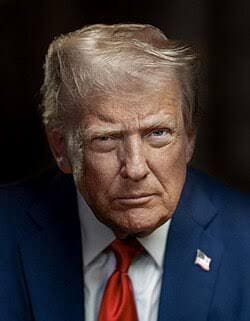
US President Donald Trump told reporters at the White House on Saturday that the United States might join Saudi strikes on the Houthis and would decide quickly, according to Xinhua. That would mark a shift. Trump has so far held back from expanding US military involvement and has not ordered American forces to resume strikes on the group. Reuters reported in September that he had turned down Saudi requests for direct US military intervention.

UN Secretary-General António Guterres on Sunday condemned the Riyadh attack, saying strikes on civilians and civilian infrastructure breach international law and must stop.

Fighting inside Yemen

The airport strikes run alongside a ground and air war in Yemen. Houthi-run al-Masirah TV said Saudi Arabia launched a fresh wave of strikes on Saturday on Sanaa International Airport, areas near the Bab al-Mandab Strait and several northern provinces. Yemeni government forces, backed by Saudi air power, began a large offensive on 5 October to retake Houthi-held territory.

The current round began in July. On 13 July Saudi Arabia struck Sanaa airport to stop an Iranian plane carrying a Houthi delegation home from Ali Khamenei’s funeral from landing there. The Houthis answered with missiles and drones on Abha airport, their first claimed attacks on Saudi Arabia since an unofficial truce took hold in March 2022.

The Houthis seized Sanaa in late 2014. A Saudi-led coalition entered the war in 2015 to back Yemen’s internationally recognised government, which now operates from Aden.

Trump says he is still weighing Hasan execution livestream

0

US President Donald Trump said on 10 October he had not decided whether to livestream Fort Hood gunman Nidal Hasan’s execution, though he suggested showing it might deter copycats.

His remarks to reporters, carried by Fox News, open a gap between the White House and Defense Secretary Pete Hegseth, who announced Thursday that Hasan’s death by firing squad would be public. Trump said there were arguments on both sides and that the final decision rested with him. “I know what the military would like to do,” he said.

The outcome matters because a livestream would have no modern precedent. The planned execution would be the first U.S. military execution since 1961, and the first public execution in the country since 1936. Hasan is set to become the first person to be executed by firing squad by the U.S. military since 1945.

Trump’s position has moved over two days. On 9 October he appeared to leave open the possibility that the federal government won’t livestream the execution, but also told reporters at the White House that he had approved it. A senior White House official, speaking on condition of anonymity, said Trump does not oppose the idea of livestreaming the execution but could change his mind.

Hasan, a former Army psychiatrist, was convicted in July 2013 of 13 counts of premeditated murder and 32 counts of attempted murder. He started shooting at the medical processing centre at Fort Hood, firing at troops who were collecting medical checks before they deployed. In his remarks on Saturday, Trump put the number of wounded at more than 20; the court record lists 32.

Pentagon spokesperson Sean Parnell said Hegseth recommended the firing squad and Trump approved it, with the order signed on 2 October. Acting Secretary of the Army Adam Telle set the execution for 3 December at 1pm local time at Fort Hood. Hegseth said the choice of a Thursday at 1pm, the approximate time, day of the week and location of the 2009 shooting, was obvious.

Opposition has crossed party lines. Republican Senator Thom Tillis of North Carolina said Hasan deserved to die but condemned the plan to stream the execution. Vice President JD Vance cast doubt on whether the Pentagon will livestream the execution and said he would not watch if it did. A senior US Catholic bishop and a US evangelical Christian leader voiced opposition to the plan, as did the UN human rights office, which said it would breach international law.

Federal Communications Commission chairman Brendan Carr said on CNBC that the potential livestream falls outside the commission’s regulatory power and that he would defer to Hegseth. Andrew Jay Schwartzman, an FCC specialist at the Benton Institute for Broadband & Society, said there is no legal basis for the commission to intervene in a broadcaster’s decision on whether to air a live execution.

Hasan’s side has also objected. His lawyer argued, according to ABC News, that televising the execution would subject Hasan to deliberate psychological degradation.

The date may still slip. Hasan could put the procedural steps on hold, potentially for years, with a habeas corpus appeal in the civilian federal court system. Army regulations require at least two media outlets to be selected as witnesses to a military execution. The Pentagon on Friday declined to say whether families of those killed would be invited to attend, as is common practice in US civilian executions.

SMEGA 2026 winners get insurance, training and Asia trade mission

0

Winners of the SME Ghana Awards (SMEGA) 2026 in Accra will receive insurance cover, mini-MBA training, introductions to international investors and a place on an Asia trade mission, organisers and MTN Ghana said.

The package moves the awards beyond a single night of trophies. It offers follow-on support to a group of businesses that make up about nine in 10 firms in Ghana and still struggle to raise finance and reach markets abroad.

Queen Gaf Enterprise, an agro-processing and cosmetics company led by Fuseini Gafaratu, was named SME of the Year. It also took the Agri-Business Value Addition & Market Award and the Women Entrepreneur Award. Gafaratu said she believes the business will one day grow into a conglomerate.

Other winners included Ahodwo Farms Limited (Agri-Business Production), Artivity Limited (Creative Arts, Crafts & Design), DemiPearl Company Limited (Food, Beverage & Agro-Processing), Binas Prime Enterprise (Retail & Consumer Products Trade), Bubune Africa Limited (Product Innovation) and Excelsa Forestry Renewables Ghana Ltd (Sustainable Enterprise & ESG Excellence).

Star Assurance Group will provide comprehensive business insurance to the winners. The organisers did not name the investors, the mini-MBA provider or the trade mission’s destination country.

SME GrowAfrica organises the awards. They close MTN Ghana’s year-long SME Accelerate Programme, which ran business clinics, pitching sessions and management training. At the launch of this year’s edition, MTN said the programme had reached more than 400 entrepreneurs and that the awards would cover 18 categories. SMEGA returned in 2025 after a five-year break.

Margaret Ansei, Chief Executive Officer of the Ghana Enterprises Agency (GEA), said small and medium-sized enterprises (SMEs) account for about 90 per cent of businesses in Ghana. She asked the winners to treat their awards as an obligation as well as a reward. “Trophies need to be celebrated, but they come with their responsibilities as well,” she said.

At the launch, Ansei listed limited access to finance, digital skills gaps, restricted market access and regulatory bottlenecks as the obstacles small firms still face. In June 2025, the GEA said such businesses made up 92 per cent of registered firms in Ghana and contributed about 70 per cent of gross domestic product.

Angela Mensah-Poku, Chief Enterprise Officer at MTN Ghana, said support for small businesses was central to the company’s plans as it marks 30 years in Ghana. She said MTN would keep providing digital infrastructure, fintech services and enterprise support to help them work more efficiently. MTN Ghana’s operating company, Scancom PLC, is listed on the Ghana Stock Exchange.

Mohammed Abubakari Siddiq, Senior Manager for SME Sales, Partnerships and Business Broadband at MTN Ghana, said a jury assessed the winners. He described the ceremony as the end of a year of training designed to sharpen their pitches and raise their profile with potential partners.

Kwesi Ofori Jr., Executive Director of SME GrowAfrica, said the package was designed to make the winners ready for investment. He urged them to build environmental, social and governance standards into their operations so their businesses can outlast their founders.

Noah Tumfo, Chief Director of the Ministry of Trade, Agribusiness and Industry, said the ministry was working to help small firms sell beyond the Ghanaian market. He said digitalisation was becoming central to business growth.

Some winners used the platform to press for more. Shadrach Ansah, Managing Director of Ahodwo Farms, a cassava grower and processor, said recognition mattered to workers in rural areas. He called on government agencies to adopt policies that support the sector and urged financial institutions, particularly the Bank of Ghana, to prioritise funding for industrialisation.

Africa’s Growth Will Shape Global Health to 2100, Lancet Finds

0

Economic growth in sub-Saharan Africa, especially the Sahel, will profoundly shape the world’s health for the rest of the century, according to a Lancet Commission published on 11 October 2026.

The Lancet Commission on 21st Century Global Threats to Health examines 17 interlinked threats across 204 countries and territories and estimates how many years of healthy life each could cost humanity by 2100. The list runs from pandemics, obesity and antimicrobial resistance to conflict, mental health and artificial intelligence (AI).

For African governments facing heavy disease burdens and tight budgets, the Commission’s advice is to stop fighting each danger on its own. Dr Christopher Murray, Director of the Institute for Health Metrics and Evaluation and Co-Chair of the Commission, told NewsGhana in written responses that countries should invest in surveillance, routine data and “preparedness capabilities that can address multiple risks rather than treating each threat in isolation.”

Why Africa sits at the centre

Murray said the Commission estimates that “global health will be profoundly affected by what happens to economic growth in sub-Saharan Africa, particularly in the Sahel.” He added that every country faces significant risks, but their scale and distribution will vary, and that people in resource-limited settings and marginalised communities are likely to bear the greatest burden of future harm.

The Sahel already sits at the sharp end of several threats on the list. Mali, Niger and Chad rank among Africa’s least peaceful countries in the 2026 Global Peace Index, published by the Institute for Economics and Peace.

Murray said poverty, inequality and low educational attainment shape how vulnerable people are to other threats. He pointed to income inequality and low education, alongside obesity, as areas with particularly large scope to prevent health loss.

Longer lives, more years in poor health

The Commission projects that global life expectancy will keep rising, but healthy life expectancy will improve more slowly. In practice, Murray said, “people may live more years with chronic disability as populations age and non-communicable diseases increasingly dominate the burden of disease.”

That shift will put pressure on health budgets designed mainly around infectious disease and acute care. Murray said health systems must prepare for the burden of chronic illness and disability, not just for longer lives.

Obesity tops the avoidable burden

Obesity is projected to become one of the largest health burdens of the century. The Commission estimates that 23.1 billion years of healthy life lost by 2100 could be avoided through policies and interventions that reduce obesity risk.

“Obesity stands out as an area where there is particularly large scope for action,” Murray said. He said proven medicines, health technologies and public policies already exist and can be scaled up, and that countries should keep funding innovation where existing tools fall short.

Pandemics have not gone away

Moderate pandemics have become less frequent, but the Commission finds no comparable decline in catastrophic ones. Murray said countries need stronger preparedness before the next major outbreak, including better surveillance and the ability to stop risks before they become crises. That, he said, requires “sustained political commitment and predictable financing,” along with investment in technologies that can speed up vaccine development.

Nuclear war and AI carry extinction risk

The Commission names nuclear conflict and malicious use of AI as the two threats with the potential to wipe out humanity. It estimates that preventing nuclear conflict could avert around 133 million deaths, while reducing malicious AI risk could avert 10.4 billion years of healthy life lost by 2100.

Murray cautioned that because no historical precedent exists for events on this scale, “these estimates carry much greater uncertainty than those for other threats.” The nuclear figures rest on structured expert judgement rather than statistical modelling. For AI, the Commission examined three pathways: the use of AI to help create biological weapons, system failures including errors in clinical decision-making and autonomous weapons, and the possible loss of human control over advanced AI systems.

The rest of the list

The other threats include antimicrobial resistance, poor mental health, high blood pressure, childhood malnutrition, smoking, unhealthy ageing, inequality and low educational attainment. Murray said all 17 met the threshold to be classed as catastrophic, and that governments should not narrow their focus to a short list because several threats amplify one another.

What governments should do first

The Commission sets out three priorities: build readiness, back breakthroughs and keep tracking threats as they change. Murray said the first step is to “create and fund threat-ready health systems with dedicated capacity for foresight, prevention, preparedness and protection.” Next, governments should invest in innovation such as antibiotic discovery, climate technologies and AI-enabled tools, with rules to ensure they are used safely and fairly. Finally, they should monitor threats continuously so emerging risks are caught early.

“The key message is that the future is not predetermined,” Murray said.

The Commission will present its findings at the World Health Summit, and Murray will lead a virtual media workshop on the findings and methodology on 12 October from 09:00 to 10:30 GMT.

Shatta Wale says TikTok live gifts earned him US$45k

0

Dancehall star Shatta Wale has said he has earned about $45,000 (about GH¢527,000) from fans’ gifts on TikTok live streams, a platform he first dismissed as one for Gen Z.

The musician, whose real name is Charles Nii Armah Mensah Jr, gave the figure on rapper YPee’s podcast, The Real Ones, in a clip published by GhanaWeb. He did not say over what period he earned the money.

He told YPee he used to stream on Facebook Live. Content creator Jackline Mensah and others then pushed him to try TikTok. He said he was doubtful at first and asked himself, “what am I doing with TikTok? I’m not a Gen Z.”

Gifts from viewers during his streams soon became a regular source of income, he said. That money now sits alongside his fees for live performances and his other earnings from social media.

On TikTok, viewers buy virtual gifts with in-app coins and send them to creators during live streams. TikTok converts the gifts into Diamonds, which creators can cash out after the platform takes its share. Shatta Wale did not say whether $45,000 is the value of the gifts sent to him or the amount he received after TikTok’s cut.

The figure also sits awkwardly beside an earlier claim. In a previous Facebook post, Shatta Wale said he had made $35,856 in gifts from a single TikTok live session in which he discussed an online row between fellow musicians Stonebwoy and Sarkodie. On that account, one stream brought in about four-fifths of the total he has now given for all his TikTok activity. He did not explain the difference on the podcast.

He also advised young musicians that steady self-promotion is essential if they want to make money from their work. Anyone who wants to succeed in music, he said, has to keep promoting their own products.

This is not the first time he has made his online income public. In 2020 he told Peace FM that YouTube paid him between GH¢70,000 and GH¢85,000 every three months, an amount he said fell short of what he spent on music videos.

Nollywood’s Harry B hails Mahama during LilWin film shoot

0

Nigerian actor Harry B Anyanwu has called President John Dramani Mahama the best leader in Africa while on set for A Journey to Africa, a Ghana-Nigeria film produced by Kumawood star LilWin.

The veteran actor and musician made the remarks in a video recorded on set as cast and crew marked his 67th birthday. In the clip, Anyanwu urges other African leaders to follow Mahama’s example. “He’s doing what other presidents are supposed to do,” he said. He also praised Ghana’s hospitality.

In the same video, LilWin, whose real name is Kwadwo Nkansah, surprises Anyanwu with a gift of US dollar notes as cast and crew cheer.

Mahama, the leader of the National Democratic Congress, took office in January 2025 after winning the December 2024 election. He had previously served as president from 2012 to 2017.

Anyanwu is one of several Nollywood names working on the film. Patience Ozokwor, Kanayo O. Kanayo, Mike Ezuruonye, Zubby Michael and Destiny Etiko arrived at Kotoka International Airport in Accra on 30 September. Anyanwu joined them later. The Ghana News Agency also listed Charles Awurum among the arrivals.

The film is produced under LilWin’s Wezzy Empire banner and is set in Nzulezu, the stilt village in Ghana’s Western Region. It is his second cross-border project after A Country Called Ghana, which also featured Nigerian actors and premiered at the National Theatre in Accra in April 2024.

The casting has drawn debate at home. LilWin told bloggers he chose mainly Nigerian actors because they usually respond to his scripts within hours, while some Ghanaian actors take a week or more. He also said Nollywood stars bring a larger fan base for international releases.

LilWin has said he plans to premiere A Journey to Africa in Accra before screening it across Ghana and abroad. No release date has been announced.

Rapper Guru says Ayawaso, Nkoranza MPs cannot beat him

0

Rapper and former University of Ghana student leader Guru has said that Members of Parliament (MPs) in Ayawaso, Nkoranza South and Nkoranza North would lose if he contested their seats.

The musician, whose real name is Maradona Yeboah Adjei, made the remarks in a radio interview published by GhanaWeb. He has not declared a bid for any seat. Ghana’s next general election is due in December 2028.

He said that if he ran in any of the three areas, “the MPs there should resign because they will not win.” He said his social and development work in those communities had built him enough support for voters to back him over anyone else.

He did not say which Ayawaso constituency he meant. Greater Accra has four. One of them, Ayawaso West Wuogon, is held by actor John Dumelo, who won it in the 2024 election. Nkoranza South and Nkoranza North are in the Bono East Region.

Guru rested his case on his one-year term as president of the University of Ghana Students’ Representative Council (SRC). He said that during that term he provided food for students, drilled boreholes to ease water shortages on campus, and took the university to court to push for a 25 per cent cut in fees. He also said many of his policies were still in progress when his term ended. If he could do that much for students in one year, he argued, a four-year term in Parliament would bring constituents far more.

GhanaWeb’s report did not include any independent check of those claims. Reports from his time in office show he publicly opposed a 20 per cent rise in Residential Facility User Fees on campus.

His route to the SRC presidency was contested. The SRC’s vetting committee disqualified him in 2024 because he did not live in a university hall, which the council’s constitution required of candidates. The university’s Appeals Board later reinstated him, and a student filed a suit at the Adentan Circuit Court challenging that decision. Guru and his running mate, Jeffery Adu-Yeboah, went on to win with 50.7 per cent of the vote, or 9,455 of 18,659 ballots cast.

During that campaign, Guru said he was a member of the New Patriotic Party (NPP). He rose to fame in 2011 with the hit Lapaz Toyota.

He would not be the first entertainer to move into national politics. Actress Dzifa Gomashie represents Ketu South and serves as Minister for Tourism, Culture and Creative Arts. Dumelo is Deputy Minister for Food and Agriculture.