

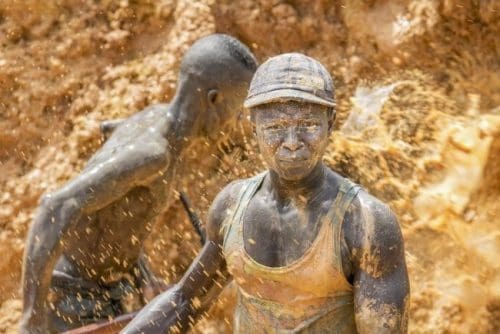
The contentious debate over illegal small-scale mining, known locally as galamsey, has reignited in Ghana as lawmakers and officials clash over its dual role as an economic lifeline for youth and a catalyst for environmental devastation.
Bongo MP Charles Bawaduah sparked fresh dialogue this week after conceding the practice’s complex trade-offs during an interview on GHOne TV. “Galamsey has undeniably created jobs for young people,” he told host Serwaa Amihere, “but the destruction of our land and pollution of water bodies cannot be ignored. We need solutions that safeguard both livelihoods and our natural heritage.”
Bawaduah’s remarks reflect a growing tension within Ghana’s political landscape, where successive governments have struggled to balance crackdowns on illegal mining with the reality of its economic pull. An estimated 1 million Ghanaians are believed to rely on galamsey for income, often operating in remote areas with limited alternatives. Yet the environmental toll is staggering: forests stripped bare, fertile soils poisoned, and critical rivers like the Pra and Ankobra choked with toxic chemicals.
The urgency of the crisis was underscored by Lands and Natural Resources Minister Emmanuel Armah-Kofi Buah during a parliamentary address. He revealed that 44 of Ghana’s 288 forest reserves are now under direct assault by heavily armed galamsey operators, who employ sophisticated machinery and violence to evade authorities. “This is no longer just an environmental issue—it’s a national security emergency,” Buah declared, warning that deforestation and water pollution have reached “catastrophic levels” with dire public health consequences.
Critics argue that years of half-measures and politicized “anti-galamsey campaigns” have failed to address root causes. While the government periodically deploys military task forces to destroy equipment and arrest miners, operations often resume within weeks. Many communities, trapped in cycles of poverty, view mining as their only viable income source—a reality Bawaduah acknowledged. “We cannot criminalize survival,” he argued, urging policies that provide sustainable alternatives.
Yet environmental advocates counter that the short-term economic gains are dwarfed by long-term costs. Ghana has lost over 60% of its forest cover since 2000, with galamsey accounting for a significant share. River pollution has forced the Ghana Water Company to spend millions treating contaminated supplies, while farmlands rendered barren by mining threaten food security. “What good are jobs today if there’s no clean water or fertile soil tomorrow?” asked Ama Serwah, a Kumasi-based environmental scientist. “The math doesn’t add up.”
The government’s latest strategy includes plans to audit mining licenses and promote community mining schemes, but skepticism runs high. Past initiatives, like the high-profile 2017 Inter-Ministerial Committee Against Illegal Mining, achieved limited success amid allegations of corruption and poor enforcement.
As the debate intensifies, one consensus emerges: Ghana’s galamsey crisis is a microcosm of a global dilemma—how to uplift marginalized communities without sacrificing ecological stability. For now, thousands of miners continue to dig, rivers run murky with mercury, and lawmakers grapple with a problem that defies easy answers. The clock ticks louder each day, as forests fall and tensions rise. The nation’s future may hinge on whether its leaders can forge a path where both people and the planet survive.

