

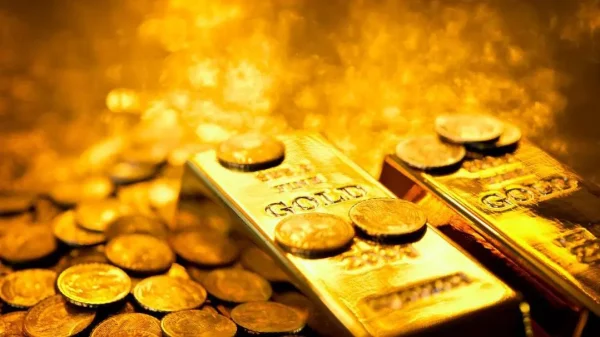
Gold declined 0.2% to $3,741.21 per ounce as of early Friday trading, retreating from recent record highs as stronger-than-expected US economic data tempered investor expectations for aggressive Federal Reserve interest rate cuts.
The precious metal’s modest pullback came despite gaining 1.6% for the week, reflecting ongoing uncertainty about the central bank’s monetary policy trajectory following its recent decision to reduce rates by 25 basis points.
The US dollar index hovered near a three-week high, making greenback-priced bullion more expensive for overseas buyers, adding pressure to gold prices alongside improved economic indicators that suggest the American economy remains resilient.
Market participants are closely monitoring today’s release of the Personal Consumption Expenditures (PCE) price index, the Federal Reserve’s preferred inflation gauge. The latest PCE data showed core inflation running at a 2.9% seasonally adjusted annual rate in July, up from June levels, raising questions about the pace of future rate reductions.
Following the central bank’s decision to cut rates for the first time since December 2024, the federal funds rate now sits at a range of 4% to 4.25%. However, recent economic data including robust second-quarter GDP growth and declining unemployment claims have led investors to reassess expectations for additional cuts.
Gold’s recent performance reflects its complex relationship with monetary policy. Gold futures have gained more than 40% in 2025 alone, reaching levels around $3,729 per ounce, driven by expectations of lower interest rates and ongoing geopolitical tensions.
Bank of America forecasts gold will hit $4,000 an ounce in 2026, citing continued monetary accommodation and sustained central bank demand. The precious metal has benefited from robust institutional buying, with central banks now holding more gold reserves than US Treasuries in many cases.
The Federal Reserve’s careful calibration of policy reflects competing economic pressures. Policymakers indicated one additional cut in 2026, significantly slower than current market pricing of three cuts, suggesting a more measured approach to monetary easing than initially anticipated.
Trade tensions and geopolitical uncertainty continue supporting gold’s safe-haven appeal, even as economic data suggests underlying strength in the US economy. The combination of modest rate cuts, persistent inflation concerns, and global instability has created a favorable environment for precious metals.
Technical analysts note that while today’s decline represents a short-term pause in gold’s upward trajectory, underlying demand fundamentals remain robust. The metal’s ability to maintain levels above $3,700 per ounce demonstrates continued investor confidence in its role as a portfolio hedge.
Looking ahead, gold’s direction will largely depend on the Federal Reserve’s policy decisions and incoming economic data. Any significant upward surprise in inflation or labor market strength could further reduce expectations for aggressive rate cuts, potentially pressuring gold prices.
However, persistent geopolitical risks, central bank purchasing programs, and concerns about long-term monetary stability continue to underpin demand for the precious metal. The balance between these competing factors will likely determine gold’s performance in the coming months.

