

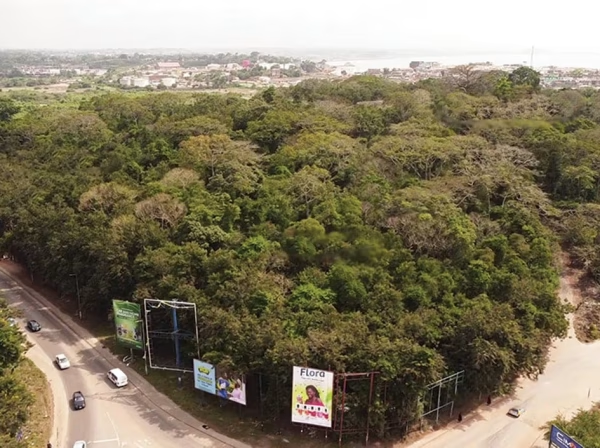
A major infrastructure project in Ghana’s Western Region has stalled due to environmental concerns over protecting a rare urban monkey habitat that city officials hope to develop into an ecotourism destination.
Construction of the Paa Grant Interchange and Sekondi Takoradi Township Road has been suspended near Monkey Hill, where environmental assessments warn that road expansion could destroy critical primate habitat in the heart of Takoradi.
The project, which began in 2022, has completed sections from Takoradi Technical University junction to Sekondi Prisons, but work remains halted at the environmentally sensitive zone where monkeys depend on tree canopies to cross roads safely.
Frederick Faidoo, Mayor of Sekondi Takoradi, explained that project consultants identified significant ecological risks in converting the area to a dual carriageway. The natural tree cover provides essential corridors for monkeys moving between feeding areas, creating a conservation challenge for urban planners.
“It is rare to have a sanctuary for monkeys right in the middle of a city like Takoradi. Developing it as a tourist attraction could generate significant revenue,” Faidoo stated during a recent radio interview on Connect FM.
The environmental impact assessment recommended constructing an artificial canopy to compensate for natural habitat loss if road expansion proceeds. However, the technical feasibility and cost of such mitigation measures remain under evaluation.
“The trees there serve as a natural canopy for the monkeys, allowing them to move across the road to access feeding areas. To convert the road into a dual carriageway, part of this natural habitat would need to be destroyed,” the mayor explained.
Monkey Hill represents an unusual case of urban wildlife conservation, where primate populations have adapted to city environments while maintaining natural behaviors. Such urban sanctuaries are increasingly rare across West Africa as development pressures intensify.
The site has attracted attention from conservationists, with Friends of the Nation, a local environmental organization, advocating for forest preservation for several years. The group’s concerns have gained relevance as infrastructure development threatens remaining green spaces in the expanding city.
Converting the habitat into an ecotourism facility could provide economic benefits while preserving wildlife, but specific development plans remain unclear. City officials have not announced timelines or funding mechanisms for the proposed tourist attraction.
The project delays highlight broader challenges facing African cities balancing infrastructure development with environmental protection. Urban growth often conflicts with conservation goals, particularly where natural habitats provide both ecological and potential economic value.
Road infrastructure represents a critical development priority for Takoradi, a major port city serving Ghana’s oil and gas industry. However, environmental considerations are increasingly influencing project design as communities recognize the economic potential of sustainable tourism.
The artificial canopy proposal reflects innovative approaches to wildlife-friendly infrastructure, though implementation costs and maintenance requirements could prove challenging for municipal budgets. Similar solutions have been tested in other countries with varying degrees of success.
Ecotourism development could provide alternative economic benefits from preserving the habitat, potentially offsetting costs of modified road design. Urban wildlife attractions generate visitor revenue while supporting conservation education and community engagement.
The standoff illustrates growing tensions between development imperatives and environmental stewardship in Ghana’s rapidly urbanizing regions. Cities increasingly face pressure to balance economic growth with sustainability objectives.
Resolution of the Monkey Hill situation may establish precedent for handling similar conflicts elsewhere in Ghana, where urban expansion frequently encounters sensitive ecological areas. The outcome could influence future infrastructure planning approaches.
Environmental groups continue monitoring the situation while advocating for solutions that protect primate populations without completely halting necessary infrastructure development. The challenge remains finding economically viable compromises.
The project’s ultimate design will likely determine whether Takoradi becomes a model for wildlife-friendly urban development or another example of development priorities overriding conservation concerns in West African cities.

