

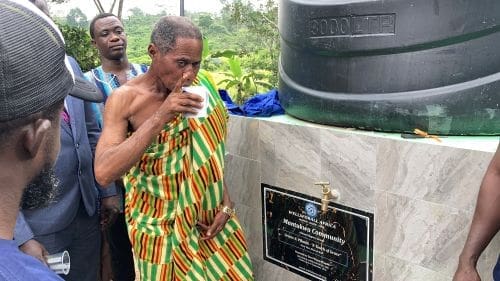
A US family’s US$8,792 stablecoin donation has paid for a borehole in Mantukwa, Ashanti Region, WellsForAll Africa’s first privately funded water project, the non-profit said on 8 October.
The project tests whether a model built inside a cryptocurrency community can draw ordinary donors who want proof their money reached the ground. WellsForAll’s first 25 boreholes were paid for through the Decentralized Hive Fund, a pool on the Hive blockchain where token holders propose, vote on and fund projects. This one came from the Pflaum family, who sent the money in USDT, a stablecoin pegged to the US dollar, in two transfers: US$500 in April and the balance in September.
The donors took no part in Hive’s governance. WellsForAll kept its existing practice of logging the project on the Hive blockchain, posting budgets, construction progress, GPS data, photographs and water test results as a public record.
Founder Samuel Owusu-Boadi said the private gift added a funding stream rather than replacing the old one. “Borehole #26 is not a move away from Hive or the DHF,” he said.
For Mantukwa, the change is practical. The farming community has relied on unprotected streams, rivers and rainwater, with residents, mostly women and children, spending about 30 minutes fetching water, according to WellsForAll. The new system puts a tap within a few minutes’ walk for an estimated 800 to 950 people.
Drillers went down 120 metres and struck the main aquifer at about 35 metres. An electric submersible pump set at 80 metres feeds a 3,000-litre overhead tank that gives the system pressure. WellsForAll said independent tests found no E. coli or coliform bacteria and that other parameters fell within World Health Organization limits. It did not name the laboratory.
Construction cost US$7,850, with US$942 going to programme coordination. The organisation describes that as a 12 per cent coordination cost, which holds against construction; it comes to about 11 per cent of the total. Spread across the people expected to use it, the borehole cost roughly US$9 to US$11 a head.
The village’s chief and elders took part in the project, and a Water Management Committee will run and maintain the system after handover. Broken rural water points are a long-running problem in Ghana, and local committees are the usual answer for keeping pumps working.
Rural Ghanaians remain the worst served. Minister for Works and Housing Kenneth Gilbert Adjei said in January that about 74 per cent of rural residents have basic water services, against 96 per cent in towns and cities, and that only 44 per cent of the national population has safely managed water. He put the number of Ghanaians still relying on unimproved, limited or surface sources at about four million.
The Pflaum family funded the borehole in honour of their daughter, who started a charitable initiative, A Touch of Grace, at the age of 11. The family said being able to follow the project from funding to construction, and check it on the blockchain, gave them confidence their money was used as intended.
WellsForAll says it raised and spent about US$191,000 on water infrastructure between 2022 and 2025, and that its 26 water points now serve more than 20,000 people. It earlier put Hive funding for its first 25 boreholes at about US$150,000.
Borehole 27 is planned for Buoyem in the Bono East Region. The organisation says more than 50 communities are on its waiting list.

