

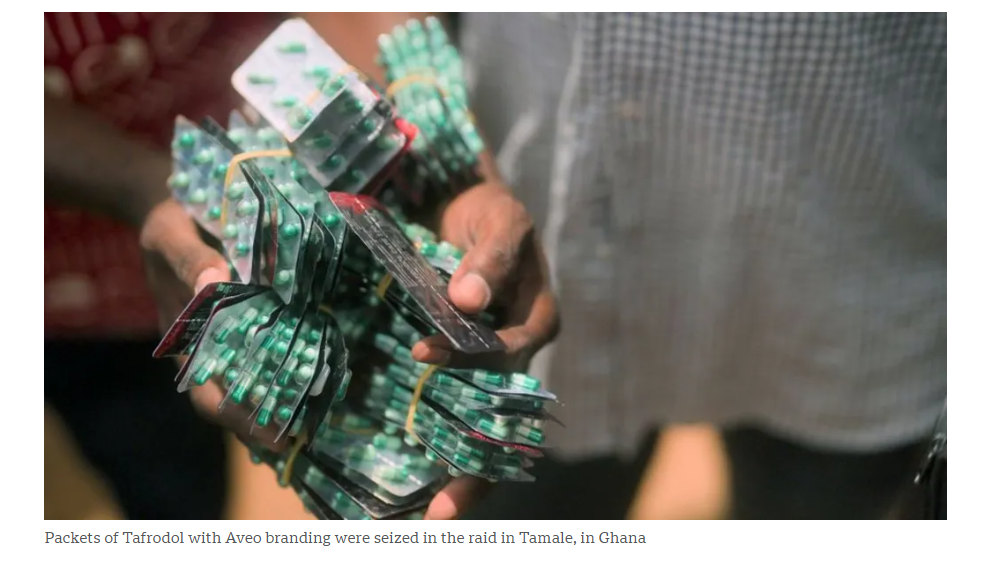
Tamale, Ghana’s northern regional capital, has become the epicenter of a devastating opioid crisis fueled by illicit, unlicensed drugs smuggled from India, a BBC investigation has uncovered.
The probe reveals how counterfeit pills labeled as “Tafrodol,” produced by Mumbai-based Aveo Pharmaceuticals, are flooding Ghanaian markets, ensnaring thousands in addiction and despair.
The BBC’s undercover team documented harrowing scenes in Tamale’s impoverished neighborhoods, where young men openly admitted the drugs had “wasted their lives.” Alhassan Maham, a local leader, has mobilized a 100-member volunteer task force to combat the crisis. “These pills burn through sanity like kerosene on fire,” Maham said, describing the grip of addiction on his community. During a raid filmed by the BBC, the task force intercepted a dealer carrying green pills stamped with Aveo’s logo—a direct link to the Indian manufacturer.
The drugs, a lethal cocktail of tapentadol (a potent opioid) and carisoprodol (a muscle relaxant banned in Europe), are unlicensed globally yet widely available in Ghana. Medical experts warn the combination heightens addiction risks and overdose potential, with dealers marketing them as cheap, quick fixes for pain and stress.
Nash Idi, a prominent Northern Region media figure, lamented the crisis as a failure of border security. “This isn’t just an election-period issue—our porous borders are a year-round threat,” he stated, urging leaders to prioritize tighter controls. “How does a sovereign nation let such poison slip through?”
The exposé underscores systemic gaps in Ghana’s drug regulation and border surveillance. Despite Tamale’s proximity to loosely monitored frontiers, authorities have yet to dismantle the networks trafficking these pills. Aveo Pharmaceuticals, meanwhile, operates with impunity, exploiting weak international oversight to target West African markets.
Local health workers report surging cases of addiction-related psychosis and organ damage, overwhelming under-resourced clinics. “We’re seeing young people with ruined kidneys, seizures, and mental breakdowns,” said a Tamale nurse who requested anonymity. “But without policy action, we’re just treating symptoms.”
The crisis also exposes a grim socioeconomic reality. In Tamale, where unemployment among youth exceeds 60%, pills selling for less than $0.50 become escapism for disillusioned young men. “I pop three a day to forget my problems,” one addict confessed. “Now I can’t stop.”
Ghana’s Food and Drugs Authority (FDA) claims it routinely seizes counterfeit drugs, but critics argue enforcement is reactive and underfunded. The BBC’s evidence of Aveo’s branding on seized pills raises questions about how such large shipments evade detection.
Maham’s task force, though commendable, highlights the vacuum left by state inaction. “We’re citizens, not cops,” he said. “But if we don’t act, who will?”
The fallout extends beyond health: addiction is fracturing families and stifling productivity in a region already lagging in development. For Ghana, the crisis is a wake-up call—a test of its commitment to protecting citizens from predatory global pharmaceutical networks.
As the BBC’s findings reverberate, pressure mounts on Ghanaian and Indian authorities to shut down Aveo’s operations and tighten cross-border collaboration. For Tamale’s youth, however, hope is fading faster than the high from a pill. Without urgent intervention, the city’s streets may remain a battlefield in a war against an invisible, yet deadly, invasion.
This story was developed with information from the BBC Eye investigation.

