

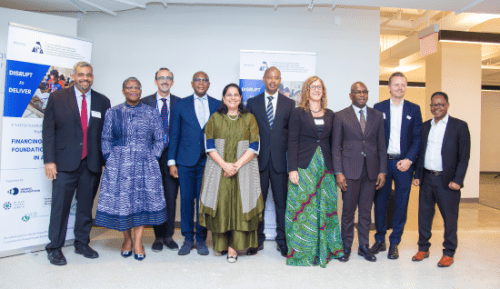
African education ministers have transformed devastating international aid cuts into a continental self-reliance revolution, launching an ambitious mission to achieve foundational learning outcomes through domestic financing and innovative partnerships during the 80th United Nations General Assembly (UNGA).
The paradigm shift emerged during Monday’s landmark “Disrupt to Deliver: Financing the Future of Foundational Learning” side event, where African leaders declared their intention to lead financing strategies for foundational learning rather than await external aid recovery. The timing coincides with the African Union’s (AU) designation of 2024 as the Year of Education, creating unprecedented momentum for continental education transformation.
The urgency driving this revolution stems from catastrophic funding disruptions across the continent. USAID’s withdrawal from sub-Saharan Africa has been particularly devastating, with the agency previously providing $6.5 billion in humanitarian assistance to the region in 2024. According to State Department data, sub-Saharan Africa accounted for $12 billion of USAID’s 2024 spending obligations, with education programmes bearing significant losses.
The cuts hit major African economies hardest, with Ethiopia facing $386.9 million in cuts representing 30% of its total aid, while the Democratic Republic of Congo (DRC) lost $386.7 million or 34% of its funding. These reductions have impacted 153 education initiatives across sub-Saharan Africa, creating an enforcement gap that African leaders now seek to fill through continental coordination.
Moustapha Mamba Guirassy, Minister of National Education of Senegal, reframed the crisis as opportunity during his UNGA address. He emphasized that the collapse of traditional aid structures presented Africa with a chance to demonstrate resilience and take responsibility for educational financing. His sentiment reflects broader continental recognition that external dependency has created vulnerabilities that homegrown solutions must address.
The African response centers on the End Learning Poverty for All in Africa (ELPAf) Campaign and the Continental Education Strategy for Africa (CESA), both designed to address the stark reality that 89% of African children cannot read simple texts or perform basic mathematics by age 10. This learning poverty represents not merely an educational challenge but a fundamental threat to continental development aspirations.
Sophia Ashipala, Head of Education Division at the AU Commission, positioned the initiative within broader continental transformation goals. She explained that the AU and United Nations Children’s Fund (UNICEF) have produced comprehensive reports on education spending that translate into actionable continental initiatives, emphasizing that literacy represents empowerment for Africa’s social and economic development rather than merely educational achievement.
The financing revolution prioritizes evidence-based efficiency over increased expenditure. Research demonstrates that modest investments of $6 per student directed toward skills-based teacher training and quality learning materials can significantly enhance learning outcomes. High-quality reading programs show impressive 30:1 return on investment, while one standard deviation increases in literacy and numeracy scores generate 2% annual growth in Gross Domestic Product (GDP) per capita.
Caroline Eliot, Country Programmes Manager at VVOB, provided concrete evidence from Zambia where only one in ten children finish primary school with literacy skills. Through Catch-up/Teaching at the Right Level (TaRL) programmes reaching one million children annually, Zambia demonstrates 20-25% improvements in literacy and numeracy for grades three to five, proving that targeted interventions deliver measurable results.
Dr. Obiageli Ezeikwesi, Chief Executive Officer of Human Capital Africa, articulated the paradigm shift away from traditional spending metrics. She emphasized that governments and donors must measure impact through learning results rather than dollars allocated or percentages budgeted, advocating for smart, efficient, and strategic spending approaches.
African governments are pioneering innovative financing models to support this transformation. Countries including Sierra Leone, Kenya, and Rwanda are modernizing financial systems by digitizing tax collection and reforming procurement to increase education spending efficiency. These domestic optimization efforts complement strategic philanthropy initiatives modeled on successful Global South examples, particularly India’s domestic philanthropy role in education system reform.
The continental approach also emphasizes catalytic international support that leverages rather than replaces domestic budgets. Dr. Pia Rebello Britto, Global Director of Education and Adolescent Development at UNICEF, outlined the new financing imperative, noting that 90% of most African government budgets consist of recurring costs, requiring innovative approaches to testing and scaling within existing financial frameworks.
Albert Nsengiyumva, Executive Secretary of the Association for the Development of Education in Africa (ADEA), declared that the time for inefficient spending has ended. Whether sourced from domestic budgets, African philanthropy, or international financing, every dollar must demonstrably improve children’s reading and calculation abilities, establishing clear accountability metrics for educational investments.
The initiative calls for establishing a G20 Foundational Learning Leaders Network and urges multilateral organizations including the Global Partnership for Education and the World Bank to align priorities with African leadership. Anders Holm, Executive Director of Hempel Foundation, acknowledged the changing philanthropic landscape, emphasizing that governments represent the only organizations with proven scaling capacity, requiring philanthropic partners to understand government needs and focus on cost efficiency.
The momentum continues through the ADEA 2025 Triennale scheduled for Accra, Ghana from October 29-31, where ministers will assess progress since the Africa Foundational Learning Exchange (FLEX 2024) commitment to end learning poverty within a decade. Building on declarations from Mauritania’s Continental Conference on Education, they will define implementation frameworks for scaling foundational learning continent-wide.
This African-led financing revolution represents more than crisis response; it signals continental determination to establish education sovereignty and set terms for future development cooperation. As one leader emphasized, Africa’s children represent the continent’s brain trust for a more prosperous future, making foundational learning investments essential for continental transformation and global competitiveness.

