

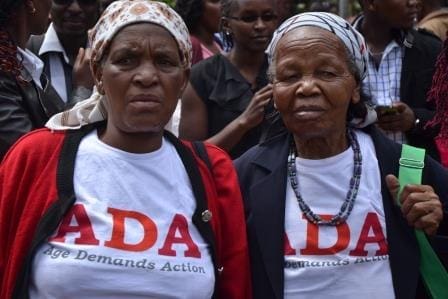
The African Union Commission and HelpAge International have urged African member states to develop and implement policies that protect the rights of older people in Africa.

At a roundtable meeting on the Role of older persons in achieving Africa?s agenda 2063 held on Thursday with the members of the Permanent Representative Committee (PRC) and other key stakeholders, the Director of Social Affairs of the African Union Commission Ambassador Olawale Maiyegun informed member states that the population of older people in Africa is increasing drastically and so there is an urgent need to ensure that specific measure are in place to address the needs of older people.
Ambassador Maiyegun said the although the African Union is making efforts to address ageing issues by setting up frameworks and legal instruments including the AU Policy Framework on Plan of Action on Ageing (AUPFAA), the African Common Position on post- 2015 sustainable development (AU, 2014) and the recently approved Protocol on the Rights of Older People; more needs to be done to implement these instruments at the national level.
The call to African governments in Addis Ababa follows the release of the Global AgeWatch Index 2015 report by HelpAge International whose main aim is to raise visibility on ageing at regional and national level as well as provide a framework for governments and institutions to respond to population ageing and the UN Secretary General?s call for a data revolution.
The Global AgeWatch Index 2015 notes that older women and men in Africa experience economic and social hardships, with the majority unable to access basic services. It reviews 13 different indicators for the four key domains of income security, health status, capability, and an enabling environment. Due to a lack of relevant data, it has only been possible to include 11 African countries in the Global Age Watch Index.
The countries are Ghana, Malawi, Mauritius, Morocco, Mozambique, Nigeria, Rwanda, South Africa, Uganda, Zambia and United Republic of Tanzania.
?The big story this year in the Index, is that millions of older people are invisible, living their lives in countries where information on the quality of older age is missing from international data sets,? said Toby Porter, Chief Executive, of HelpAge International. He adds that poverty rates in old age are missing from international data sets in at least 93 countries. ?It?s particularly shocking in Africa where there was only enough data available to include 11 out of 54 countries,? he said.
According to Dr Prafulla Mishra, Regional Director, HelpAge International, East, West and Central Africa, there is increased recognition of the ageing population and the challenge it poses for the inclusive and sustainable development in Africa.
Dr Mishra urged the African Union to make use of the Global AgeWatch Index as yet another important tool to use to generate data and plan for older persons.
Sola Mahoney, HelpAge International Trustee attending the event, said older men and women across the continent continue to live miserable lives of poverty, lacking basic human rights needs including access to a secure income, shelter and food. Without a well-established social security strategy, older people?s right to live dignified lives will be impossible to achieve. ?Older people play a critical role in many aspects of Africa?s economic and social development?, said Sola.
Sola challenged governments to put systems in place to facilitate inter-generational exchange of knowledge and skills and for the two generations to work together and realise Agenda 2063. ?We need to be careful that we shouldn?t focus all our efforts in taking care of the youth at the expense of the other generations. We should strive to ensure that we leave no one behind,? Sola said.

