

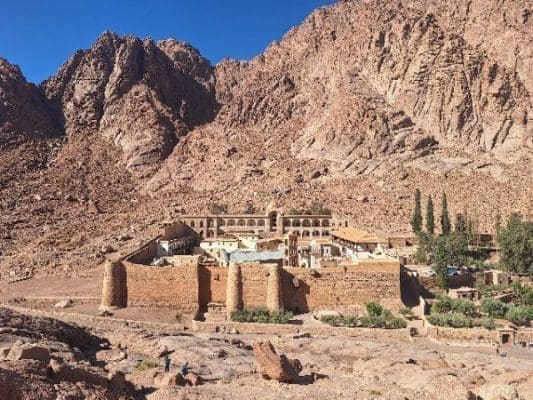
Great Transfiguration development faces UNESCO warnings over sacred site transformation
Egypt’s ambitious Great Transfiguration Project to transform Mount Sinai into a major tourism destination has triggered international concerns over the preservation of one of the world’s most sacred religious sites and its ancient monastery.
The massive state-sponsored development is set for completion by October 2026, with the government promoting it as “Egypt’s gift to the entire world and all religions” despite opposition from heritage groups and local Bedouin communities.
The project encompasses luxury hotels, shopping complexes, a cable car to Mount Sinai’s summit, and expanded airport facilities around St Catherine’s Monastery, a UNESCO World Heritage Site that has operated continuously since the sixth century.
Officials argue the development will create employment opportunities and help Egypt reach its target of attracting 30 million tourists by 2028, supporting economic recovery after regional instability and the COVID-19 pandemic’s impact on tourism revenues.
However, UNESCO has repeatedly urged Egypt to halt construction and submit conservation plans for the heritage site, which includes the monastery, surrounding town, and Mount Sinai itself. According to heritage organizations, no such plan has been submitted despite ongoing construction activities.
The controversy intensified following a May 2025 Egyptian court ruling that St Catherine’s Monastery sits on state-owned land, rather than monastery property. The decision provoked diplomatic tensions with Greece, which maintains historic ties to the Greek Orthodox monastery.
Egypt and Greece subsequently issued joint statements seeking to ease tensions, with officials reaching agreements to preserve the monastery’s unique character and allow it to continue its historical mission undisturbed.
The monastery houses one of Christianity’s oldest continuously operating communities and shelters invaluable manuscripts and artifacts accumulated over nearly 1,500 years. The site also holds significance for Jewish and Islamic traditions as the location where Moses reportedly received the Ten Commandments.
Local Bedouin communities, particularly the Jebeleya tribe who have lived in the region for centuries, report displacement from traditional lands to accommodate development projects. According to regional experts, tribal members have seen eco-camps demolished and burial sites relocated to create space for parking facilities and tourist infrastructure.
The situation mirrors earlier development patterns in Egypt’s Sinai Peninsula, where Bedouin communities were displaced from coastal areas as industrial tourism expanded along Red Sea resorts including Sharm el-Sheikh.
British travel writer Ben Hoffler, who works extensively with Sinai tribes, describes the project as imposing external development models on communities that never requested such changes. According to Hoffler, the transformation prioritizes serving outside visitors rather than addressing local community needs.
World Heritage Watch has called for the Mount Sinai site to be declared endangered, citing concerns that construction activities are severing the connection between the monastery’s spiritual mission and the surrounding desert landscape that has defined its character for centuries.
The development has also drawn attention from international religious figures, with campaigners appealing to King Charles, patron of the St Catherine Foundation, to intervene in preservation efforts for what he has described as a great spiritual treasure requiring protection for future generations.
Egyptian authorities counter that the project represents revitalization rather than destruction, emphasizing infrastructure improvements and economic benefits for the broader region. Prime Minister Mostafa Madbouli has outlined plans including residential neighborhoods, restaurants, and commercial facilities designed to establish the area as a world-class spiritual and tourism destination.
The development forms part of Egypt’s larger Great Transfiguration initiative, aimed at transforming Saint Catherine into an international destination for ecotourism, religious pilgrimage, and desert adventures.
Tourism industry analysts note that Mount Sinai has historically attracted limited visitor numbers due to its remote location and basic facilities, with most tourists to the Sinai Peninsula concentrating on coastal resort areas rather than interior religious sites.
The project’s supporters argue that improved accessibility through enhanced transportation links and accommodation options could significantly increase religious tourism while generating revenue for local communities and the national economy.
Critics maintain that mass tourism development threatens the contemplative atmosphere that has drawn pilgrims and spiritual seekers to Mount Sinai for centuries, potentially transforming a place of solitude into a commercialized destination.
Archaeological and cultural preservation groups emphasize that the Plain of el-Raha, where religious tradition holds that Israelites waited as Moses communed with God, is now crossed by construction roads and building sites that alter the historical landscape’s character.
The monastery’s monks have expressed concerns about maintaining their spiritual mission amid large-scale tourism development, though diplomatic agreements between Egypt and Greece have emphasized commitments to preserving the institution’s religious functions and Orthodox identity.
As construction continues toward the 2026 completion target, the project represents a test case for balancing economic development aspirations with heritage preservation obligations at sites holding profound religious and cultural significance for multiple faith traditions.

