

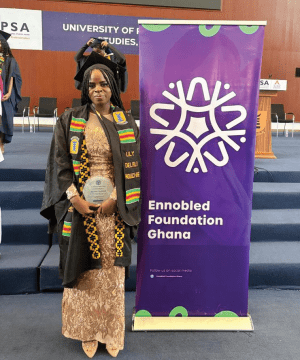
The Ennobled Foundation has presented its inaugural award to the top female graduate from the Faculty of Accounting and Finance at the University of Professional Studies, Accra (UPSA), fulfilling commitments under a memorandum of understanding signed with the institution.
Lily Delali Nouchie received a plaque and cash prize during UPSA’s 17th congregation ceremony, becoming the first beneficiary of the foundation’s gender-focused academic recognition program aimed at narrowing gaps in finance-related disciplines.
Gloria Boye-Doku, founder of the Ennobled Foundation, said the award reflects the organization’s commitment to advancing education, promoting gender equality, and empowering women leaders. She emphasized that when women excel, the benefits extend beyond individuals to families, communities, and nations.
“It is our hope that this recognition will inspire many more young women to pursue excellence with confidence and purpose,” Boye-Doku stated during the presentation.
The foundation has been expanding its footprint across Ghana’s educational sector through similar partnerships. It recently signed a memorandum with Accra Technical University (ATU) to strengthen student mentorship and career readiness, and has partnered with Kinbu Senior High Technical School to honor outstanding Home Economics students.
Nouchie, accepting the award, attributed her success to choosing supportive friends during her academic journey. She advised incoming students to prioritize study partnerships that foster advancement rather than social relationships that distract from academic goals.
“The defining moment in my academic journey has been the selection of the right friends. Level 100 students should have friends they can study with to help them advance,” she said. “As I stand here, I did not do it alone. I had people who supported me through the journey.”
She expressed surprise at receiving the recognition, saying she hadn’t anticipated the award and would cherish it greatly.
The partnership between UPSA and the Ennobled Foundation extends beyond annual awards. Both institutions expect the arrangement to create opportunities for student mentorship, empowerment, and career development as the foundation expands its educational initiatives.
UPSA, which specializes in business and professional education, has increasingly attracted partnerships with private sector organizations and foundations seeking to support students in commerce-related fields. The university’s dual qualification policy, which allows students to earn both Ghanaian and international professional certifications, has made it attractive to employers and sponsors.
Gender disparities persist across Ghana’s finance sector despite women comprising roughly half of university enrollments. Studies show that women remain underrepresented in senior accounting and finance positions within both corporate and public sectors, making targeted support programs potentially valuable for pipeline development.
The Ennobled Foundation’s focus on recognizing academic achievement rather than simply providing scholarships represents a different approach to educational support. By celebrating success publicly and attaching financial rewards to performance, the foundation aims to create aspirational targets for current students while validating the efforts of high achievers.
Whether such awards meaningfully influence career trajectories remains difficult to measure in the short term. However, recognition from external organizations can enhance graduates’ profiles when seeking employment or pursuing further education, particularly when accompanied by cash prizes that provide transition funding.
For Nouchie, the award comes as she enters a competitive job market where accounting and finance graduates face pressure to quickly demonstrate professional competence. Her academic performance positions her well, but the foundation’s recognition adds external validation that could prove useful in interviews and networking.
The foundation’s expansion across multiple educational institutions suggests Boye-Doku envisions a sustained presence in Ghana’s education sector rather than one-off interventions. Her organization’s partnerships now span secondary schools, technical universities, and professional studies institutions, creating a pipeline of supported students across educational levels.
What distinguishes the Ennobled Foundation from many educational nonprofits is its emphasis on excellence rather than need. While many organizations prioritize supporting disadvantaged students financially, this foundation targets top performers, betting that recognition and encouragement of achievement will inspire broader student populations.
That approach has merit but also limitations. Students struggling financially or academically may benefit more from direct support than from watching others receive awards. Yet foundations choose their missions based on what they believe will create maximum impact, and reasonable people can disagree about optimal strategies.
For UPSA, the partnership provides external validation of its programs while offering students additional incentives for academic excellence. Universities benefit when external organizations choose to invest in their student populations, as it signals confidence in educational quality and graduate outcomes.
The partnership is expected to continue annually, with future awards recognizing subsequent top female graduates from the accounting and finance faculty. Whether the foundation will expand recognition to other faculties or maintain its finance focus remains to be seen.
As Ghana’s economy continues developing and financial sector regulations grow more sophisticated, demand for qualified accountants and finance professionals should remain strong. Programs that encourage women to enter and excel in these fields potentially address both gender equity concerns and talent pipeline needs simultaneously.
Nouchie’s advice about choosing supportive friends resonates beyond her specific situation. Academic success in demanding fields like accounting requires sustained effort and mutual support among peers, making social choices genuinely consequential for outcomes.
For now, the Ennobled Foundation’s UPSA partnership represents one foundation’s approach to supporting educational excellence while advancing gender equity in professional fields. Its effectiveness will become clearer as more cohorts benefit and as tracking data emerges about graduate career progression.

