

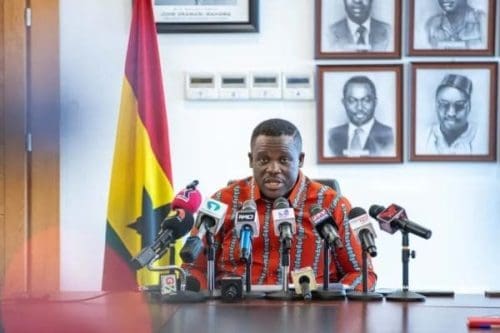
Communications Minister Samuel Nartey George has issued his strongest warning yet to Ghana’s broadcasting sector, threatening immediate license revocations for non-compliant stations as new data reveals nearly 30% of authorized broadcasters have failed to begin operations despite holding valid permits.
The National Communications Authority (NCA) reports 763 authorized FM stations as of Q2 2025, but only 539 are actually broadcasting, leaving 224 stations effectively dormant while occupying valuable spectrum space. Television figures show similar patterns, with 181 authorized stations but only 133 operational as of Q4 2024.
Speaking at a high-level media forum, George declared Ghana’s broadcasting landscape stands at a “crossroads between survival and demise” as his ministry prepares sweeping regulatory enforcement that could reshape the industry. The minister’s intervention comes amid growing concerns about money-doubling schemes, sexually explicit content, and what he termed “charlatans parading as men of God” on national airwaves.
“There must be sanity,” George stated, promising to “do a proper clean-up of the media space” through stricter license monitoring and immediate suspensions for stations broadcasting content deemed harmful to public safety.
The crackdown represents the most aggressive regulatory stance taken by Ghana’s communications ministry in recent years. George’s approach contrasts sharply with previous administrations’ tolerance for non-operational stations, which industry experts estimate cost the economy millions in lost advertising revenue and spectrum efficiency.
The ministry plans to review Ghana’s broadcasting policy framework to reflect digital convergence realities where radio, television, and internet-based platforms increasingly overlap, signaling fundamental changes ahead for the sector.
Industry insiders suggest the enforcement drive targets a specific problem: station owners who secure licenses but never invest in equipment or programming, creating artificial scarcity in Ghana’s broadcasting market. These “paper stations” often trade authorizations privately or use them as collateral for business deals while legitimate broadcasters struggle to find available frequencies.
George has already directed the NCA to provide detailed lists of all frequency authorizations issued or renewed in the past 60 days, indicating systematic auditing of recent approvals. The minister’s focus on recent authorizations suggests potential irregularities in the licensing process that warrant investigation.
The timing of George’s warnings coincides with broader media freedom debates in Ghana. The NCA previously ordered 62 FM stations to cease broadcasting over regulatory breaches, demonstrating the authority’s willingness to enforce compliance despite potential industry pushback.
George outlined five priority areas for sector transformation: enforcement of authorization conditions, embracing digital convergence, investing in local content and fact-checking capabilities, adopting artificial intelligence and 5G technologies, and benchmarking against international best practices.
The local content emphasis addresses long-standing concerns about Ghana’s broadcasting sector’s reliance on foreign programming. Many stations fill airtime with international music, movies, and talk shows rather than developing original Ghanaian content that could support local creative industries.
Fact-checking requirements represent a direct response to misinformation concerns that have plagued Ghana’s media landscape, particularly during election periods. The minister’s push for verification standards could force stations to invest in editorial infrastructure many currently lack.
Technology adoption mandates signal Ghana’s ambition to position its broadcasting sector for digital transformation. The integration of AI and 5G capabilities could enable new revenue streams through data services and interactive programming that traditional broadcasters have been slow to embrace.
Financial implications of the cleanup remain unclear, though industry estimates suggest non-operational stations collectively owe millions in unpaid licensing fees. George’s “pay your fees” ultimatum could generate significant revenue for the NCA while clearing spectrum for productive use.
The minister’s background brings unique credibility to these reforms. George holds advanced degrees from the London School of Economics and the Kofi Annan International Peacekeeping Training Centre, with professional ICT certifications that inform his technical approach to broadcasting regulation.
Opposition parties have yet to respond formally to George’s announcements, though private industry consultations suggest mixed reactions. Established broadcasters welcome enforcement against non-operational competitors, while newer station owners express concerns about potentially retrospective compliance requirements.
Regional implications extend beyond Ghana’s borders, as other West African countries monitor the enforcement approach. Ghana’s broadcasting sector has historically influenced regulatory trends across the sub-region, making George’s reforms potentially significant for regional media development.
Consumer advocacy groups have praised the cleanup initiative, arguing that spectrum hoarding by non-operational stations has artificially limited programming diversity and increased advertising costs for active broadcasters. The rationalization could ultimately benefit listeners through improved content quality and lower barrier costs for legitimate station operators.
Implementation timelines remain unspecified, though George’s urgency suggests immediate action rather than lengthy transition periods. The minister’s warning that “decisions we take now will determine whether Ghana builds a resilient, responsible media landscape or sinks into disorder and decline” indicates a compressed timeline for compliance.
The broader context reveals George’s systematic approach to communications sector reform since assuming office in January 2025. Previous interventions include directing subscription television fee reductions and auditing telecommunications infrastructure, establishing a pattern of hands-on regulatory oversight.
Success of the broadcasting cleanup will likely influence George’s credibility for future sector reforms, making the initiative a crucial test of the new administration’s regulatory effectiveness and industry relations management.

