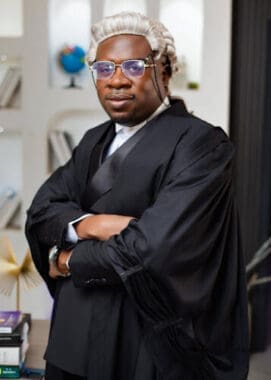
Naturopath Nyarkotey Obu now called to Bar in two countries

0

Ghanaian naturopath Raphael Nyarkotey Obu, called to the Gambian Bar in 2024, joined the Ghana Bar on 9 October 2026, according to a statement from the African Naturopath Report.

The statement said his name appeared on the published list for Ghana’s 63rd Call to the Bar, at which the General Legal Council admitted 1,568 new lawyers at a ceremony in Teshie, Accra.

Nyarkotey Obu qualified through the Gambia Law School in Banjul and was called to the Bar in The Gambia in November 2024. In a 2025 newspaper feature, he wrote that his Gambian legal education cost him about $30,000, and that he had to resit Legislative Drafting three times before passing.

Being called in both countries does not mean he can practise in both. Foreign graduates called to the Gambian Bar are barred by statute from practising law in The Gambia, a Daily Graphic feature on Ghanaian students at the Gambia Law School has noted.

Nyarkotey Obu leads a naturopathic training college in Ghana and is founding president of the African Naturopathic Federation. He has long campaigned for laws to regulate traditional and alternative medicine. In 2023 he lectured in The Gambia on legislation to regulate the country’s traditional healers.

The statement said he would use his legal training to work on practitioner regulation, training standards, professional accountability and patients’ rights in complementary and alternative medicine.

World doctors’ body asks UN to name attackers of healthcare

0

The World Medical Association has urged the United Nations to name states and armed groups that attack healthcare, under a declaration announced in Rotterdam on 10 October 2026.

The Declaration of Rotterdam on the Protection of Medical Neutrality was adopted at the global physicians’ body’s General Assembly in the Dutch port city, held from 7 to 10 October. Beyond naming attackers in UN reporting, the World Medical Association (WMA) wants the UN to appoint a Special Rapporteur on protecting health in armed conflict and other violence.

The declaration comes as accountability for attacks on medical care remains close to non-existent. In August, the World Health Organization (WHO) said it had verified more than 10,400 attacks on healthcare across 29 countries and territories since 2018. Those attacks killed about 5,700 people and injured over 8,500. Altaf Musani, a WHO emergencies director, said not one of them had yet entered an accountability process.

The pace has not slowed. WHO recorded 914 attacks in 2026 up to mid-August, with 911 deaths. Ukraine, Lebanon and the Palestinian territories accounted for most incidents. Attacks were also recorded in Sudan, Myanmar, Syria, Iran, Nigeria and the Democratic Republic of Congo.

Under the declaration, medical neutrality rests on two duties. Doctors and other health workers must treat patients impartially and keep out of military operations. States, de facto authorities and warring parties must in turn protect health workers and facilities. The text states that medical ethics in war are the same as in peace. It also says international humanitarian law protects healthcare whether or not it displays the red cross or other protective emblems.

The WMA widened its definition of an attack to include cyberattacks, the use of artificial intelligence, and the arbitrary arrest, detention, torture or ill-treatment of health workers. It said doctors keep the right, and in some cases the duty, to document and report suspected violations of international humanitarian law.

“The principles of medical ethics do not change in times of war,” WMA President Dr Jung Yul Park said.

The association called on warring parties to guarantee patients safe access to care. It also asked them to free, without conditions, all health workers held solely for treating patients. It urged governments to train their armed forces on the protections owed to medical care. It also asked them to ensure violations are independently investigated or referred to bodies such as the International Criminal Court.

The declaration also commits the WMA’s member national medical associations to speak out publicly against breaches of medical neutrality, including those committed by their own governments. They are to support colleagues who face reprisals for providing impartial care.

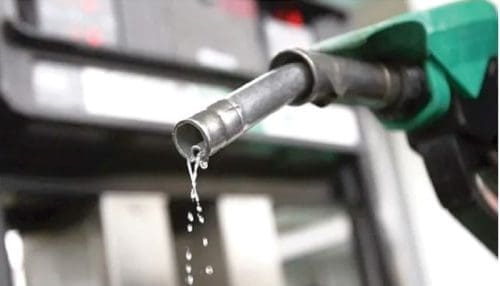
NNPC’s petrol discount is subsidy by another name

The announcement of cheaper petrol often arrives before anyone explains how it will be paid for. A commuter who hears that pump prices will fall for 30 days thinks of tomorrow’s journey and the fare home. He is not at the filling station to study fiscal arrangements. He wants to know what a litre costs today, and what it will cost when the 30 days end.

That is where the national conversation must begin. A discount does not come from thin air. Petrol must still be refined, bought, transported, stored and sold. If the retail price falls, someone absorbs the difference. The pump attendant can announce the new price, but the pump cannot tell us whose ledger is carrying the burden.

Who pays for “at cost”

On 8 October, Finance Minister Taiwo Oyedele announced that NNPC Limited would sell petrol at cost for 30 days in the first instance, with priority for public transport operators. The Presidency says NNPC Retail will give up its retail margin. The government has not said where the fuel will come from, what NNPC will pay for it, how big the discount per litre will be, or whether any supplier has agreed to sell below commercial value.

If NNPC buys petrol from the Dangote Refinery at the full market rate, Dangote receives its agreed price. The discount must then be carried by NNPC, reimbursed by the government or financed some other way. If Dangote or any other supplier is being asked to give up part of its price, that concession should be declared openly.

Selling at cost does not settle the question. If NNPC forgoes a margin it would normally earn, the consumer gains and the company loses income. In economic terms that is a subsidy, even if the Treasury writes no cheque. Because NNPC is publicly owned, the lost margin reduces its profit, retained earnings and future dividends. The cost is less visible than a budget allocation, but citizens still bear it.

How other countries handled temporary relief

Nigeria is not the first country to try short-term relief at the pump. Several Global North economies have used temporary fuel discounts or tax cuts. Their experience shows that such measures work best when they are open about cost, limited in time and properly monitored.

Germany cut its fuel tax for three months from 1 June 2022, through a measure known as the Tankrabatt, and let it lapse at the end of August. Independent studies later found the cut was almost fully passed on to petrol buyers but only partly to diesel buyers, which shows why monitoring matters.

France introduced a state-funded pump discount of 18 euro cents a litre in April 2022. It raised the discount to 30 cents from September, cut it to 10 cents from mid-November and ended it on 31 December 2022. In 2023 it was replaced by a targeted 100-euro allowance for lower-income workers who drive to work.

The United Kingdom cut fuel duty by 5p a litre in March 2022, initially for 12 months. The Treasury estimated its cost at about £2.4 billion. The cut has since been extended several times and is now due to run until the end of 2026.

In Canada, Alberta stopped collecting its 13-cent-per-litre provincial fuel tax from 1 April 2022. It linked the relief to world oil prices and reviewed it every quarter. The provincial government put the full-year cost at about 1.3 billion Canadian dollars.

These examples show that temporary fuel relief can be delivered without weakening national institutions, provided the rules are clear and the financial consequences are public.

Why the initiative can be supported

There is a defensible case for short-term relief, particularly if public transport operators receive the benefit and pass it on through lower fares. Nigeria’s economy is heavily dependent on transport, and commuters bear the brunt of rising energy costs. A targeted discount can ease inflationary pressure, support small businesses and steady household spending.

But the scheme needs clear operating rules. The government should explain how transport operators will be identified, how discounted fuel will reach them and how it will check that passengers actually benefit. Without such safeguards, the discount may reach the vehicle’s tank while the fare stays where it is.

Nigeria can borrow from practice elsewhere. That means naming the funding source, fixing the duration and publishing the cost to NNPC. It also means monitoring and evaluating the relief before any extension is considered.

The constitutional question

NNPC’s shares are held on behalf of the Federation. The Petroleum Industry Act requires the company to operate commercially and profitably. The Constitution counts dividends from the Federal Government’s shareholdings among the revenue payable into the Federation Account, the common purse of the federal, state and local governments.

If a policy predictably reduces NNPC’s earnings, all three tiers of government have legitimate grounds to ask what income has been surrendered, who authorised the concession and what it will cost. Transparent accounting is a constitutional necessity.

Timing and public trust

The presidential election is scheduled for 16 January 2027. That date does not prove an electoral motive. But the government should expect citizens to ask whether relief at the pump is also politics at the pump. Clear rules, fixed timelines and published accounts would answer that question more credibly than any verbal denial.

Beyond the politics lies an economic point that cannot be ignored: in substance, this arrangement brings subsidy back through the back door. The government may call it a discount, a margin waiver or a temporary price adjustment, but the mechanism is the same. If petrol is sold below its true commercial cost, someone absorbs the difference, whether NNPC, a supplier or the Treasury. That is what a subsidy is. It may not appear as a line in the national budget or be debated in the National Assembly, but a subsidy routed through a state-owned company is still a subsidy.

That is why citizens will question both the timing and the structure of the scheme. Relief introduced three months before a national election will attract scrutiny, especially when its financial design resembles the subsidy regime the government removed in 2023 as unsustainable. If NNPC’s margins are being squeezed to make petrol cheaper, the Federation is indirectly funding the discount through lower dividends and weaker future earnings.

Nigerians deserve to know whether this is a strategic intervention or a disguised subsidy. They deserve to know who is paying the difference, how long the arrangement will last and what will stop it from quietly becoming permanent. Without that disclosure, the scheme risks looking like a return to subsidy without parliamentary debate, budget visibility or public accountability.

What must be disclosed

The government should publish:

  • the price NNPC pays for the fuel;
  • the exact discount per litre;
  • who is absorbing the difference;
  • the projected effect on NNPC’s earnings;
  • the criteria for identifying public transport operators.

It must also say plainly what happens after 30 days.

Until then, Nigerians have been told only that petrol will be cheaper. They have not been told who is underwriting the reduction, how long it will last or what institutional sacrifice sustains it. The government may call it a discount, a margin waiver or a price adjustment. The name does not matter. The bill will still arrive, and the nation deserves to know whose name is written on it.

Professor Ojo Emmanuel Ademola is a professor of cybersecurity and information technology management, a chartered manager and General Evangelist of Christ Apostolic Church Nigeria and Overseas.

US freezes green card sponsorship at Microsoft, Indian IT firms

0

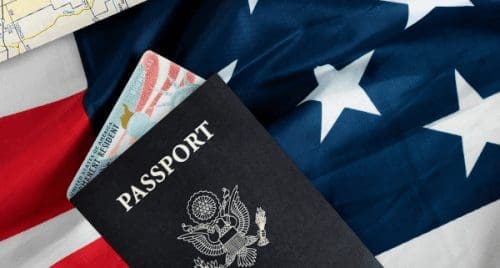
On 8 October 2026, the US Labor Department stopped processing green card sponsorships from Microsoft, Adobe and six IT outsourcers, including four Indian giants, citing alleged visa abuse.

The suspension covers the Permanent Labor Certification programme, known as PERM, which is the first step for most employer-sponsored green cards. Besides Microsoft and Adobe, it applies to Cognizant, Infosys, Tata Consultancy Services, Wipro, HCL Technologies and Capgemini. The Labor Department will not accept new applications from these companies and has stopped work on pending ones.

The move affects foreign professionals already working in the United States who were counting on these employers to sponsor them for permanent residency. Their H-1B work visas remain valid. However, their green card cases have stalled, and H-1B extensions that depend on a pending PERM case could be delayed.

Labor Secretary Keith Sonderling said the six IT services firms were suspended because of concerns about systemic abuse, while Microsoft and Adobe are subject to multiple active federal investigations. No charges have been announced against any of the companies.

Vice President JD Vance focused on Microsoft at the announcement. He said the company cut 6,000 American jobs in 2025 while receiving 6,300 H-1B visa approvals and almost 3,000 green cards. He also said Microsoft filed 3,682 PERM applications, about 1,000 of which appeared to overlap with roles held by laid-off staff. Vance said each worker Microsoft let go had been replaced by one and a half foreign workers, whom he likened to indentured servants.

Microsoft rejected the picture in a statement, saying “the vast majority of Microsoft employees in the United States are Americans.” The company said it filed petitions only for workers who met the visa category’s standards and that its H-1B wages are among the highest of all filings. It also said most of its applications were for people already on its payroll.

Asked why President Donald Trump honoured Microsoft chief executive Satya Nadella on the same day, Vance said Washington would keep its good relationship with the company. He said the government would still block its permanent residency applications until it showed it was serious about putting American workers first.

The suspension has no fixed end date. Sonderling said it would last as long as needed and that the administration wanted the companies to change their behaviour. The announcement came less than four weeks before the 3 November midterm elections, as the administration steps up action on immigration and foreign hiring.

For India’s outsourcing industry, the blow was not the first. On 8 September, Labor Department Inspector General Anthony D’Esposito suspended Cognizant’s PERM filings. The next day, Indian IT stocks lost about 550 billion rupees in market value, with Infosys falling about six per cent.

The suspensions stem from an investigation into fraud in the H-1B and PERM programmes that the inspector general opened in July. Officials said in July that dozens of subpoenas had been issued and that whistleblowers had flagged some of the largest sponsoring companies.

US consumer sentiment slides as current conditions hit record low

US consumer sentiment on current economic conditions sank to a record low in October as high prices and borrowing costs squeezed households, University of Michigan data showed on 9 October 2026.

The Current Economic Conditions index dropped to 44.7 from 50.9 in September, a fall of 12.2 per cent in one month. Bloomberg reported that the measure had reached an all-time low. The headline Index of Consumer Sentiment slipped to 46.3, its weakest reading since May and below the 47.6 median forecast in a Bloomberg survey of economists. May’s reading was a record low for the index.

The figures land 25 days before the US midterm elections, and they show rising prices hurting poorer households most while expectations of future inflation keep climbing.

Joanne Hsu, director of the university’s Surveys of Consumers, said buying conditions for durable goods fell sharply because of high prices and borrowing costs. Sentiment dropped steeply among lower-income consumers and those with smaller stock portfolios, which she described as “groups that have fewer resources to weather increases in prices.”

Gains among Democrats and Republicans were cancelled out by a decline among independents, Hsu said. She added that consumers of every political leaning agree the economic outlook has softened since the start of the year, before the Iran conflict.

Households now expect prices to rise 4.7 per cent over the next year, up from 4.6 per cent in September and well above the 3.4 per cent recorded in February, before the conflict began. Five-year expectations rose to 3.5 per cent from 3.4 per cent, against a 2024 range of 2.8 to 3.2 per cent. Both measures rose for a second straight month to their highest levels since May.

Fuel is a large part of the strain. Petrol prices have climbed by more than $1.50 a gallon on average since the war began and have stayed above $4 a gallon since midsummer, according to motoring group AAA. A US gallon is about 3.8 litres.

The survey did carry one brighter signal. The Index of Consumer Expectations rose to 47.3 from 46.3, its first increase since July, as respondents grew slightly more hopeful about their personal finances and business conditions over the coming year. Overall sentiment remains 13.6 per cent lower than a year ago.

Gloomy surveys have not yet translated into weaker spending. Retail sales rebounded sharply in August, helped by purchases of a range of goods and spending at bars and restaurants.

The university will publish final October figures on Friday, 23 October 2026, at 10am Eastern Time, which is 2pm in Accra.

The Hope Of Ghana Youth In Sports: Kwadwo Baah Agyemang

0

Story by: Bernard Nyankomago Kwasi

As politicians gather their acts together to hit the various campaign platforms to canvass for votes whether in internal or national elections, Ghanaians, especially the youth will surely be waiting for their vision in sports development.

Over the years, one fine politician who has demonstrated great and good heart for sports, especially football is Honourable Kwadwo Baah Agyemang (KBA), former MP for Asante Akim North Constituency.

Apart from the opportunities he has given to some Ghanaian youth, particularly football talents in Asante Akim North through his SportsLife Academy, he has also followed the domestic league and national teams with keen interest.

KBA, as he is well known loves football to the hilt. It was therefore a step in a right direction when President Akufo Addo appointed him as Board Chairman for the National Sports Authority (NSA). He delivered his work to perfection despite the unnecessary pressure he encountered from some Ghanaians at a point in time.

He was also the President for Teqball Federation in Ghana and Chairman for Asante Akim North, South, Central and Bosome Freho District Football Association.

In addition to his vast contribution to sports and as means of serving his people, Hon. KBA further introduced Asante Akim Marathon which brought to limelight William Amponsah, Ghana’s current record holder in Long Distance. With this scintillating achievement, many expect him to assume the office of the Sports Ministry one day.

Very soon, the NPP will go to the polls to elect their Parliamentary candidates for the 2028 general elections. For the people of Asante Akim North Constituency, there is absolutely no need for any prophet to advice delegates, before they will give power to the visionary Kwadwo Baah Agyemang to help unearth the youth who have abundant talents and huge potentials in football especially.

Admitedly, there is no way sports can be sidelined when talking about avenues to create jobs for the youth in the country. This is where some politicians have failed to utilise over the years.

Since Ghana attained Independence on 6th March, 1957 – exactly 69 years ago, sports have always propelled the nation to great heights in the international front.

Talk of the world titles that boxing heroes like D.K Poison, Azumah Nelson, Ike Quartey, Joshua Clottey, Joseph Agbeko, Isaac Gogde and the likes have won for Ghana.

The Black Stars outstanding achievements on the continent in 1963, 1965, 1978 and 1982 can also not be ingnored likewise the exploits of our junior national teams in 1991, 1993, 1995 and the famour Black Satelites victory in 2009 in Egypt.

In athletics and other sporting disciplines, Ghana has incredibly paid their dues globally. But at moment, no Ghanaian is enthused with the state of our games.

The Black Stars, which used to be the nation’s biggest hope have failed miserably in all quarters. GFA President, Kurt E S Okraku and his so called Exco and management members have mismanaged and mishandled things leaving football enthusiasts in devastating and pensive mood.

It’s time to bring on board ex footballers, administrators and politicians who are endowed with deep knowledge in the game and Hon. Kwadwo Baah Agyemang should be one of them.

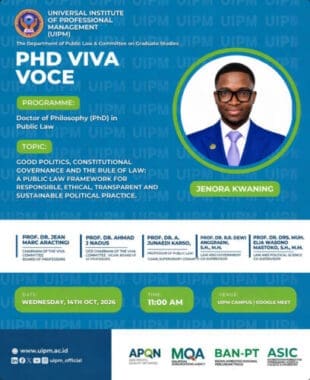
Jenora Kwaning to Defend Doctor of Philosophy in Public Law Dissertation at UIPM Indonesia

Doctoral Viva Voce scheduled for Wednesday, 14 October 2026, to examine research on good politics, constitutional governance and the rule of law.

PhD Candidate Jenora Kwaning is scheduled to undertake his doctoral Viva Voce in Public Law on Wednesday, 14 October 2026, at the Universal Institute of Professional Management (UIPM), Indonesia.

The examination forms part of his Doctor of Philosophy in Public Law programme and will focus on his dissertation titled:

“GOOD POLITICS, CONSTITUTIONAL GOVERNANCE AND THE RULE OF LAW: A PUBLIC LAW FRAMEWORK FOR RESPONSIBLE, ETHICAL, TRANSPARENT AND SUSTAINABLE POLITICAL PRACTICE.”


The Viva Voce is scheduled for 11:00 a.m. at the UIPM campus, with Google Meet also indicated as the examination venue.

The doctoral examination will provide an opportunity for Kwaning to present and defend his research before the academic committee, respond to questions and demonstrate his understanding of the legal and governance principles examined in his thesis.

The examination is associated with the Department of Public Law and the Committee on Graduate Studies.

Research Focus: Good Politics, Constitutional Governance and the Rule of Law

Kwaning’s doctoral research examines the relationship between good politics, constitutional governance and the rule of law, with a focus on developing a Public Law framework for responsible, ethical, transparent and sustainable political practice.

Public Law provides the legal and institutional foundations for understanding the exercise of public authority, constitutional responsibilities, administrative accountability and the protection of legal rights.

The thesis brings these principles into a broader discussion of political conduct, institutional integrity and the standards that can guide responsible governance.

By examining the intersection of law and political practice, the research seeks to contribute to academic discussions on how constitutional principles and legal frameworks can inform political responsibility, transparency and sustainable institutional development.

The study also raises questions about the relationship between legal accountability and ethical conduct in public institutions, as well as the role of constitutional governance in promoting responsible political practice.

Board of Professors for the Doctoral Committee

The doctoral examination is associated with a Board of Professors comprising senior academics and legal scholars with backgrounds in law, public law, government and political sciences.

The committee members and their stated roles are:

1. Prof. Dr. Jean Marc Aractingi
Chairman of the Board of Professors and Viva Committee

2. Prof. Dr. Ahmad J. Naous
Vice Chairman of the Board of Professors and Viva Committee | Professor of Strategy Execution

3. Prof. Dr. A. Junaedi Karso, SH
Chair, Supervisory | Professor of Public Law

4. Prof. Dr. R.R. Dewi Anggraeni
Co-Supervisor | Professor of Law & Government

5. Prof. Dr. Drs. Muh. Elia Wasono Mastoko
Co-Supervisor | Professor of Laws & Political Sciences


The committee’s stated composition reflects the multidisciplinary scope of the doctoral research, which connects Public Law with constitutional governance, political institutions and the principles of responsible political practice.

The Viva Voce will provide the formal academic setting for the candidate to explain the research, respond to questions and engage with the committee’s assessment of the thesis.

The Importance of the Viva Voce
A doctoral Viva Voce is an oral examination in which a candidate discusses and defends their thesis before appointed academic examiners. The process typically examines the candidate’s knowledge of the subject, the coherence of the research, the appropriateness of the methodology and the contribution the work may make to existing scholarship.

For Kwaning, the examination represents an important milestone in his Doctor of Philosophy in Public Law programme.

His thesis places the concept of good politics within a legal framework that considers constitutional principles, the rule of law, ethical responsibility, transparency and sustainability.

The examination will allow the academic committee to engage with the research arguments and assess the thesis in accordance with the institution’s applicable doctoral examination procedures.

The final academic outcome will depend on the committee’s assessment and the fulfilment of any requirements imposed by the institution.

Public Law and Responsible Political Practice

Constitutional governance and the rule of law are central subjects in contemporary legal scholarship. They inform discussions about the limits of public power, institutional accountability, administrative justice and the legal responsibilities of public authorities.

Kwaning’s research brings these themes together with the principles of ethical conduct, transparency and sustainability.

The proposed framework offers a basis for examining how Public Law can inform the standards and institutional arrangements associated with responsible political practice.

The subject is relevant to legal academics, governance researchers, policymakers, political institutions and students interested in constitutionalism, public administration and political accountability.

Through the doctoral examination, the research will undergo formal academic scrutiny concerning its arguments, methodology and potential contribution to the field.

Examination Details
– Candidate: Jenora Kwaning
– Academic Status: PhD Candidate
– Programme: Doctor of Philosophy in Public Law
– Examination: PhD Viva Voce
– Date: Wednesday, 14 October 2026
– Time: 11:00 a.m.
– Venue: UIPM Campus | Google Meet
– Institution: Universal Institute of Professional Management (UIPM), Indonesia
– Department: Department of Public Law
– Graduate Studies Body: Committee on Graduate Studies
– Institutional Website: www.uipm.ac.id

Dissertation Title: Good Politics, Constitutional Governance and the Rule of Law: A Public Law Framework for Responsible, Ethical, Transparent and Sustainable Political Practice.

As Kwaning prepares to defend his dissertation, the examination will mark a significant stage in his doctoral academic journey and provide a formal opportunity to discuss the relationship between Public Law, constitutional governance and responsible political practice.

Further information about the examination and its outcome may be communicated following the completion of the relevant academic procedures.

Lands Minister Armah-Kofi Buah joins 1,568 new lawyers at Bar

0

Lands and Natural Resources Minister Emmanuel Armah-Kofi Buah was called to the Ghana Bar on 9 October 2026, one of 1,568 new lawyers admitted by the General Legal Council.

The admission allows Buah, the Member of Parliament for Ellembelle, to practise as a barrister and solicitor of the Supreme Court of Ghana. As minister, he oversees land administration, mining and forestry, areas run largely through statute and regulation.

He was not the only cabinet member called that day. Communications, Digital Technology and Innovations Minister Samuel Nartey George was also admitted, along with Citi FM Eyewitness News host Umaru Sanda Amadu and former Eastern Regional Minister Seth Acheampong. Buah and George had attended a black-tie Call to the Bar dinner in Accra two days earlier, on 7 October.

The minister’s links to law go back to his student years. According to his ministry, Buah holds a Bachelor of Arts in Social Science with a major in law from the Kwame Nkrumah University of Science and Technology. He also holds a Graduate Diploma in Law from the University of Law in the United Kingdom and a Master of Science in Management from the University of Maryland. He was born at Atuabo in the Western Region in 1966.

Buah has represented Ellembelle since 2009. He served as Minister for Energy and Petroleum from 2013 to 2016 under John Mahama’s first administration. President Mahama named him Lands Minister in January 2025.

The ceremony was the Ghana School of Law’s 63rd Call to the Bar. It took place at the International Central Gospel Church’s Christ Temple on Teshie Bush Road in Accra. Chief Justice Paul Baffoe-Bonnie, who chairs the General Legal Council, opened the session. Attorney-General and Minister for Justice Dr Dominic Akuritinga Ayine also attended.

The cohort is large for a profession of Ghana’s size. The General Legal Council has said the number of lawyers in Ghana grew from just over 2,000 in 2010 to more than 6,500 in 2024.

The intake also comes during an overhaul of legal training. Parliament has passed the Legal Education Reform Bill, 2026, and Baffoe-Bonnie has said the new regime will widen opportunities while keeping standards. Under the changes, students can now choose to be enrolled at either an October or a March call.

Ghana’s tree crops regulator tightens rules as export push grows

0

Ghana is trying to build a second farm export engine alongside cocoa, and its tree crops regulator is using licences, floor prices and traceability rules to get there.

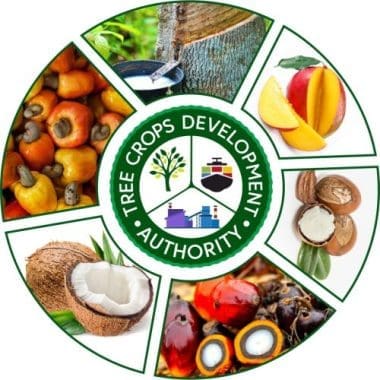
The Tree Crops Development Authority (TCDA), set up under the Tree Crops Development Authority Act, 2019 (Act 1010), regulates six crops: cashew, coconut, oil palm, rubber, mango and shea. Cocoa sits outside its remit, under the Ghana Cocoa Board. Chief Executive Officer Dr Andy Osei Okrah has set a target of about US$12 billion in annual revenue from the six crops by 2030, and has said they collectively have the strength to do far more for the economy than cocoa.

Whether that happens depends less on planting than on whether Ghana can prove where its crops come from, keep quality high and capture more of the value at home.

Enforcement first

The TCDA has moved from promotion to policing. At a stakeholder forum in Wa, Okrah warned that buying below statutory floor prices, trading without an operational licence and fronting for foreign buyers could lead to arrest and prosecution, as the authority rolls out its powers region by region under Legislative Instrument (L.I.) 2471. A digital licensing and traceability system is meant to enforce quality and moisture standards.

A mandatory conveyance certificate system now covers the movement of the six crops and ties into the Forestry Commission’s road checkpoints. Some traders have called it an extra burden. Okrah has rejected that, describing it as a tool to curb illegal trade and improve traceability. The authority has also deployed its first cohort of compliance and enforcement officers in the cashew trade.

Why proof of origin matters

Buyers in Europe and elsewhere increasingly demand evidence that commodities were not grown on deforested land and were produced without exploitation. For smallholder crops such as cashew and shea, which are often gathered across scattered plots and pass through several traders before export, that is hard to show. Okrah has named data and traceability among the authority’s top priorities, saying the sector needs reliable information on farmers, farms, production and trade.

Keeping more value at home

Ghana has long shipped most of its raw cashew nuts abroad, much of it to Asian processors. Under the government’s Feed the Industry initiative, L.I. 2471 allows the authority to reserve a share of raw materials for local processors. Okrah has also pushed commercial use of the cashew apple, usually discarded, and courted investors at the Ghana-UK Investment Summit in London in June, pointing to a global shea market projected at US$5.5 billion by 2033.

At the TCDA’s first summit and exhibition this year, President John Dramani Mahama announced a US$200 million government commitment to tree crop processing, productivity and private investment. The authority said the event drew about US$500 million in expressions of investor interest and outlined plans for 16,000 hectares of new plantations spread across all 16 regions.

Risks

Expansion brings exposure. Okrah has warned of climate change, pests and disease, citing powdery mildew in some cashew-growing areas. And floor prices only help farmers if buyers can be made to respect them in remote districts where the authority’s officers are thin on the ground.

The authority has said a farm inputs project launched at Asante Mampong in August will run from 2026 to 2032.

ACEP urges Ghana to keep Tullow ties after tax win

0

The Africa Centre for Energy Policy (ACEP) has warned Ghana not to treat Tullow as an adversary after winning a US$393 million tax arbitration against the oil producer.

The policy group’s Executive Director, Benjamin Boakye, said the state needs both the revenue from the Jubilee and Tweneboa-Enyenra-Ntomme (TEN) fields and the continued investment and production that generate it. “A commercial dispute should not turn a partner into an adversary,” he said.

The warning matters because the award lands as Ghana and the Jubilee partners are trying to extend the life of fields that have been the backbone of the country’s oil output. How the government collects the money will shape whether Tullow keeps investing in them.

An International Chamber of Commerce (ICC) tribunal delivered its award on 29 September 2026, dismissing all of Tullow Ghana Limited’s claims and upholding in full the Ghana Revenue Authority’s (GRA) assessment of US$393,091,993.70 on business interruption insurance proceeds. The tribunal found the assessment did not breach the petroleum agreements, was not time-barred, carried a properly applied penalty and was lawfully enforced. The GRA issued the assessment in December 2022, and Tullow took the dispute to ICC arbitration in London in February 2023.

Finance Minister Dr Cassiel Ato Forson said on 30 September that the ruling showed every company in Ghana, whatever its size, is subject to the country’s laws. He also called Tullow a vital partner and the country’s largest petroleum producer, said the government had been talking to the company about settling outstanding tax matters before the award, and said those talks would continue. They will also cover separate proceedings over the disallowance of loan interest. Forson said the government would implement the award under Ghanaian law with due regard for continued operations in Jubilee and TEN and Tullow’s ability to keep investing. He noted that Ghanaian law lets the GRA decide the time and manner in which assessed taxes are paid.

Tullow said it was disappointed with the ruling but willing to discuss its implications and next steps with the government.

Boakye said that response showed how commercial disputes should work: each side makes its case, submits to the agreed process and pursues whatever lawful remedies remain. He urged the state to separate commercial disagreements from criminal conduct, arguing that a company challenging the government through arbitration should not, for that reason alone, be treated as an enemy.

He linked the case to Ghana’s ambition to become a seat of international arbitration. That status, he said, depends on predictable courts, independent adjudication, respect for contractual processes and confidence that state power will not be used to get around civil procedures, not on declaring the country an arbitration hub. Civil remedies may not always produce politically satisfying outcomes, he said, but they protect rights and reduce uncertainty for investors.

Ghana was represented by the Office of the Attorney-General, the GRA and external counsel Foley Hoag LLP.