Doctoral Viva Voce scheduled for Wednesday, 14 October 2026, to examine research on good politics, constitutional governance and the rule of law.
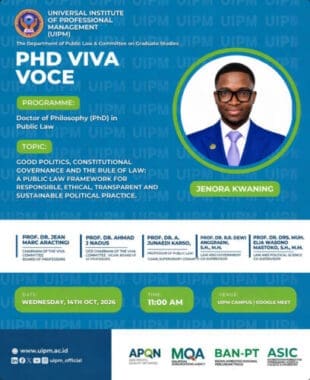
PhD Candidate Jenora Kwaning is scheduled to undertake his doctoral Viva Voce in Public Law on Wednesday, 14 October 2026, at the Universal Institute of Professional Management (UIPM), Indonesia.
The examination forms part of his Doctor of Philosophy in Public Law programme and will focus on his dissertation titled:
“GOOD POLITICS, CONSTITUTIONAL GOVERNANCE AND THE RULE OF LAW: A PUBLIC LAW FRAMEWORK FOR RESPONSIBLE, ETHICAL, TRANSPARENT AND SUSTAINABLE POLITICAL PRACTICE.”
The Viva Voce is scheduled for 11:00 a.m. at the UIPM campus, with Google Meet also indicated as the examination venue.
The doctoral examination will provide an opportunity for Kwaning to present and defend his research before the academic committee, respond to questions and demonstrate his understanding of the legal and governance principles examined in his thesis.
The examination is associated with the Department of Public Law and the Committee on Graduate Studies.
Research Focus: Good Politics, Constitutional Governance and the Rule of Law
Kwaning’s doctoral research examines the relationship between good politics, constitutional governance and the rule of law, with a focus on developing a Public Law framework for responsible, ethical, transparent and sustainable political practice.
Public Law provides the legal and institutional foundations for understanding the exercise of public authority, constitutional responsibilities, administrative accountability and the protection of legal rights.
The thesis brings these principles into a broader discussion of political conduct, institutional integrity and the standards that can guide responsible governance.
By examining the intersection of law and political practice, the research seeks to contribute to academic discussions on how constitutional principles and legal frameworks can inform political responsibility, transparency and sustainable institutional development.
The study also raises questions about the relationship between legal accountability and ethical conduct in public institutions, as well as the role of constitutional governance in promoting responsible political practice.
Board of Professors for the Doctoral Committee
The doctoral examination is associated with a Board of Professors comprising senior academics and legal scholars with backgrounds in law, public law, government and political sciences.
The committee members and their stated roles are:
1. Prof. Dr. Jean Marc Aractingi
Chairman of the Board of Professors and Viva Committee
2. Prof. Dr. Ahmad J. Naous
Vice Chairman of the Board of Professors and Viva Committee | Professor of Strategy Execution
3. Prof. Dr. A. Junaedi Karso, SH
Chair, Supervisory | Professor of Public Law
4. Prof. Dr. R.R. Dewi Anggraeni
Co-Supervisor | Professor of Law & Government
5. Prof. Dr. Drs. Muh. Elia Wasono Mastoko
Co-Supervisor | Professor of Laws & Political Sciences
The committee’s stated composition reflects the multidisciplinary scope of the doctoral research, which connects Public Law with constitutional governance, political institutions and the principles of responsible political practice.
The Viva Voce will provide the formal academic setting for the candidate to explain the research, respond to questions and engage with the committee’s assessment of the thesis.
The Importance of the Viva Voce
A doctoral Viva Voce is an oral examination in which a candidate discusses and defends their thesis before appointed academic examiners. The process typically examines the candidate’s knowledge of the subject, the coherence of the research, the appropriateness of the methodology and the contribution the work may make to existing scholarship.
For Kwaning, the examination represents an important milestone in his Doctor of Philosophy in Public Law programme.
His thesis places the concept of good politics within a legal framework that considers constitutional principles, the rule of law, ethical responsibility, transparency and sustainability.
The examination will allow the academic committee to engage with the research arguments and assess the thesis in accordance with the institution’s applicable doctoral examination procedures.
The final academic outcome will depend on the committee’s assessment and the fulfilment of any requirements imposed by the institution.
Public Law and Responsible Political Practice
Constitutional governance and the rule of law are central subjects in contemporary legal scholarship. They inform discussions about the limits of public power, institutional accountability, administrative justice and the legal responsibilities of public authorities.
Kwaning’s research brings these themes together with the principles of ethical conduct, transparency and sustainability.
The proposed framework offers a basis for examining how Public Law can inform the standards and institutional arrangements associated with responsible political practice.
The subject is relevant to legal academics, governance researchers, policymakers, political institutions and students interested in constitutionalism, public administration and political accountability.
Through the doctoral examination, the research will undergo formal academic scrutiny concerning its arguments, methodology and potential contribution to the field.
Examination Details
– Candidate: Jenora Kwaning
– Academic Status: PhD Candidate
– Programme: Doctor of Philosophy in Public Law
– Examination: PhD Viva Voce
– Date: Wednesday, 14 October 2026
– Time: 11:00 a.m.
– Venue: UIPM Campus | Google Meet
– Institution: Universal Institute of Professional Management (UIPM), Indonesia
– Department: Department of Public Law
– Graduate Studies Body: Committee on Graduate Studies
– Institutional Website: www.uipm.ac.id
Dissertation Title: Good Politics, Constitutional Governance and the Rule of Law: A Public Law Framework for Responsible, Ethical, Transparent and Sustainable Political Practice.
As Kwaning prepares to defend his dissertation, the examination will mark a significant stage in his doctoral academic journey and provide a formal opportunity to discuss the relationship between Public Law, constitutional governance and responsible political practice.
Further information about the examination and its outcome may be communicated following the completion of the relevant academic procedures.