

A new modeling study finds that raising carbon prices, not changing how free permits are allocated, does the most to push South Korea’s power plants away from coal.
The finding matters because South Korea is preparing to overhaul its Emissions Trading Scheme (K-ETS) for a fourth phase covering 2026 to 2030, and the power sector alone is expected to carry nearly half the country’s emissions-cutting burden. The reforms borrow heavily from the European Union’s carbon market, but researchers say it was unclear whether a system built for the EU’s market structure would work the same way inside Korea’s more centralized electricity sector.
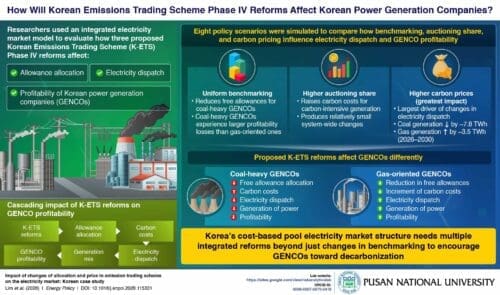
Jungmin Lim of Pukyong National University, with co-authors Seongjun Lee, Taeyoung Jin and Dowon Kim of Pusan National University, built a computational model of Korea’s electricity market and ran it through eight policy scenarios. Each combined different settings for three variables under debate: whether free permits are calculated using a single uniform benchmark or separate benchmarks for each fuel type, how large a share of permits companies must buy at auction rather than receive free, and how high the carbon price is set. The study appeared online in April and was published in the August 1 issue of Energy Policy.
Switching from fuel-specific to uniform benchmarks cut free allowances and profits across the board, but hit coal-fired generators far harder than gas-fired ones, the researchers found. Raising the share of permits sold at auction pushed up the cost of generating extra electricity, nudging companies toward gas over coal. Both effects, however, were modest.
Carbon pricing did the heavy lifting. Raising the price companies pay per tonne of emissions increased costs more sharply for coal than for gas, driving a partial shift toward gas generation, the study found. “The power sector is expected to contribute nearly 44.3% of Korea’s total emissions reduction target,” Kim said, calling the interaction between K-ETS design and electricity market operation critical to meeting that goal.
Kim and his co-authors argue reform on paper will not be enough on its own. Because Korea’s electricity market remains tightly regulated, generators have limited ability to pass rising carbon costs on to consumers, unlike in less centralized markets such as the EU’s. The researchers say the changes need to be paired with targeted investment and transition support for coal-reliant firms to avoid destabilizing the power sector while cutting emissions.
The stakes are substantial. South Korea’s government finalized its Phase 4 allocation plan in November 2025, setting a total emissions cap of roughly 2.54 billion tonnes of carbon dioxide equivalent for the five-year period and raising the share of power-sector permits sold at auction from 15% in 2026 to 50% by 2030. Under that plan, the electricity sector is targeted to cut emissions by 69% to 75% by 2035, compared with 2018 levels.

