

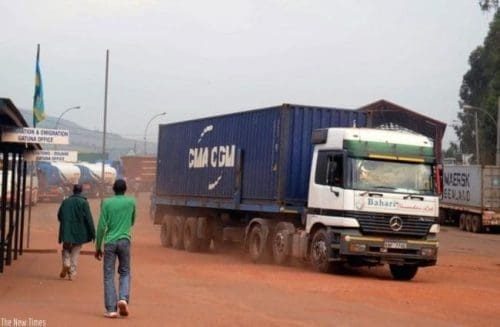

A truck enters into the country at Gatuna border post with Uganda. (File)
Alupo says she is frustrated by middlemen who offer low prices for her produce and her lack of means to transport her produce to the market. She is vulnerable because she does not have proper storage for her produce to keep it longer as she tries to access better markets.
?We are forced on selling the produce as soon as we harvest because we don?t want it to spoil. That is why we must sell to middlemen at giveaway prices,? Alupo explains.
Alupo?s situation seems to be replicated everywhere in Africa as the just concluded agricultural stakeholders? summit in South Africa revealed. Most of those engaged in agriculture on the continent are poor and mainly women. Accessing local and regional markets for them would remain a pipe dream if nothing is done.
And for that reason, the recently concluded South Africa meet called on state partners to hasten the making of economic policies that will aid such farmers to do better and benefit from both local and regional trade.
The South African meeting under the theme, ?Walking the Talk, Delivering the Malabo commitments and Agriculture for Women Empowerment? was a follow up on an earlier one by the African heads of State held in the Equatorial Guinea capital, Malabo in June 2014.
In Malabo, the heads of State resolved to boost regional trade by improving the agriculture sector. Agriculture, they resolved would be emphasised as a key tool for development and transformation of rural areas.
In his keynote address at the South Africa meet, Dr. Ibrahim Mayaki, Chief Executive Officer of the New Partnership for Africa?s Development (NEPAD) said policy reforms should address issue failing the trade of agricultural products in the regional market.
Mayaki cited the major challenges as access to markets, finances, land for women farmers and working on regional trade structures to allow easy movement of agricultural products with in the region.
?The economic policy reforms should conduct transparent and foreseeable policies that will regulate markets in order to deal with market failures and this will in the long run increase farmer?s efforts leading to increased production,? Mayaki added.
About 11 years ago in 2003 the African heads of State meeting in Maputo resolved to dedicate 10% of their budgets to the agricultural sector in what they called the Comprehensive Africa Agriculture Development Programme (CAADP).
So far only Rwanda, Nigeria and Ethiopia have managed to meet that target. Uganda has been at between 3.5% and 5%. The others have also been in similar ranges.
Mayaki said there is need to move from planning to implementation of the CAADP. He warned that unless that happens the recent commitments made in Malabo will not be achieved.
?The leap forward will come from making reforms in economic policies accompanied by a clear vision of a state? commitment. It is clear that when financial investments are not accompanied by the states? vision there are problems,? Mayaki said.
By Prossy Nandudu, The New Vision

