

The Global Media and Information Literacy (MIL) Week is commemorated annually in October and is a major occasion for stakeholders to review and celebrate the progress made towards achieving “MIL for All”.
Disinformation, coupled with information and knowledge divides, threatens the achievement of the Sustainable Development Goals (SDGs) and fundamental human rights for all. The world has come to recognize the threat of disinformation particularly as it came face-to-face with a recent wave of disinformation with the COVID-19 crisis where access to credible information has become a matter of life or death.
The theme for this year’s Global MIL Week, Resisting the Disinfodemic: Media and Information Literacy for and by everyone, highlights how we can look to addressing disinformation and divides by recognizing our shared interest in improving everyone’s capabilities to engage with the opportunities and risks in today’s media and information landscape.
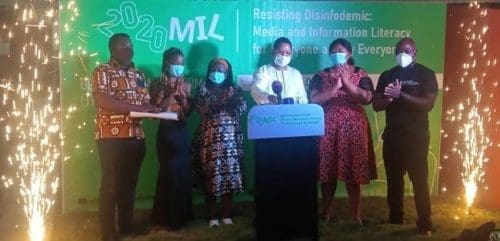
Penplusbytes under the auspices of UNESCO and with support from DW Akademie, Ghana Institute of Journalism, University of Ghana and the Ghana Commission for UNESCO, has launched the Global MIL Week. The celebration include, workshops/seminars, webinars, online discussions and a social media campaign starting from 23rd to 30th of October 2020.
The executive director of Penplusbytes, Juliet Amoah reiterates, “Target 10 of SDG 16 intends to contribute to building societies that are democratic, peaceful, inclusive, and just and this is MIL’s ultimate goal. MIL also contributes to Target 4.7 of SDG 4 by guaranteeing that all learners gain the competencies needed to promote sustainable development. All these are endangered by the volume of disinformation that has evolved from the COVID-19 pandemic: which has been dubbed “Disinfodemic”.”
Discussions during the week will seek to draw attention to how stakeholders in the MIL space in Ghana can foster the free flow of information and ideas while addressing disinformation and its attendant effects on the varied divides within our communities. Conversations will further highlight the successes and challenges of the MIL promotion movement in Ghana.
“Ahead of the elections, it has become imperative that disinformation is highlighted in our discourse around online and offline election campaigning and Penplusbytes is leading in this effort with various campaigns on different platforms”, Ms. Amoah added.
Launching the event, Mr. Abdourahamane Diallo, UNESCO’s Representative to Ghana indicated that, ” The 10th annual global celebration of MIL under the theme “Resisting Disinfodemic: Media and Information Literacy for everyone and, by everyone” highlights how we can look to addressing disinformation and divides by recognizing our shared interest in improving everyone’s competencies.”
He said, this will help to engage with the opportunities and today’s landscape of communication, technology, and information.
Mr. Diallo, also noted that, “MIL provides everybody with key competencies for life-long learning in all aspects of our lives. All 17 Sustainable Development Goals (SDGs) resonate with these objectives of MIL as an enabler of civic engagement. Citizens equipped with MIL competencies are informed, engaged and empowered. They are able to understand the dangers of disinformation, as well as the spiral of hatred and exclusion.”
COVID-19 has produced a range of disinformation types and responses, created by many different actors. The emergence of the virus has led to a parallel pandemic of disinformation that directly impacts lives and livelihoods around the world. Falsehoods and misinformation have proven deadly and sowed confusion about life-saving personal and policy choices.
To assess these misinformation during COVID 19, UNESCO published two policy briefs offering critical insights into the fast-growing COVID-19-related disinformation that is impeding access to trustworthy sources and reliable information.
That is why this research, in line with UNESCO’s role as a laboratory of ideas, coined the term ‘disinfodemic’ to describe the problem.
UNESCO Accra office shared these briefs with stakeholders to also help ‘flatten the curve’ of COVID -19 disinfodemic here in Ghana.
Indeed, MIL recognizes the primary role of information and media in our everyday lives. It lies at the core of freedom of expression and information since it empowers citizens to understand the functions of media and other information providers to critically evaluate their content, and to make informed decisions as users and producer of information and media content.
More than ever, the world needs professional journalism and reliable information to adapt its response to the spread of COVID-1 9, organize itself, learn from other countries’ experiences and counter the increase of rumors and disinformation.
In particular, UNESCO and World Health Organization (WHO) launched a new Massive Open Online Course (MOOC) themed “Journalism in a pandemic: Covering COVID-19 now and in the future”.
The MOOC, which received the support from the Knight Foundation and the United Nations Development Program (UNDP), was a four-week online training programme aimed at providing journalists with the necessary knowledge and tools to cover the COVID-19 health crisis, and the social, financial and political consequences it entails.
Again, as many Ghanaian journalists as possible signed up for this opportunity to sharpen their skills in covering news in a pandemic.
UNESCO, also promotes Open Education Resources (OERs), networks of fact-checkers, media and information literacy (MIL) resources to counter the spread of disinformation, the use of digital technologies such as artificial intelligence in response to the crisis, as well as highlighting the importance of documentary heritage in past efforts to fight pandemics.
Through capacity-building resources, such as curricula development, policy guidelines and articulation, and assessment framework, UNESCO supports the development of MIL competencies among people. Free and open online courses are available for self-paced learning about MIL.
Through media and information technology, the Organization facilitates networking and research through the global Alliance for Partnerships on MIL (GAPMIL) and University Network. The recently launched MIL CLICKS social media initiative is also part of NESCO’s strategy to enable media and information literate societies.
NESCO’s mission is to engender media and information literate societies ‘through comprehensive strategy which include preparation of model Media and information Literacy Curriculum for Teachers, the facilitation of international cooperation, development of Guidelines for preparing national MIL Policies and Strategies among other initiatives.
On her part, the Head of Communications Department at the Ghana Institute of Journalism (GIJ), Dr. Lawrencia Agyapong, said, “The Ghana Institute Journalism, recognizes that MIL must be given the much-needed attention it deserves in Ghana. As a result of this, the Institute has begun processes to integrate MIL into our curriculum at the Institute. We also have set up a research group whose focus is on MIL issues. We will be counting on support of our partners, other donor agencies and government to make this happen.”
On behalf of the Management of GIJ, She extended their sincere gratitude to Penplusbyte, DW Akademie and UNESCO for their unflinching support to the Institute in ensuring that Media and Literacy becomes available to everyone and used by everyone to combat disinfodemic.
To grace the occasion were the Dean, School of Information and Communication Studies, University of
Ghana, Prof. Audrey Gadzekpo, Mr. Jerry Sam, the Deputy Executive Director of Penplusbytes, the Country Coordinator, DW Akademie, Madam Benewaa Ofosu, the representative of Ghana National Commission for UNESCO, Appollonius Asare, CSOs and many more.

